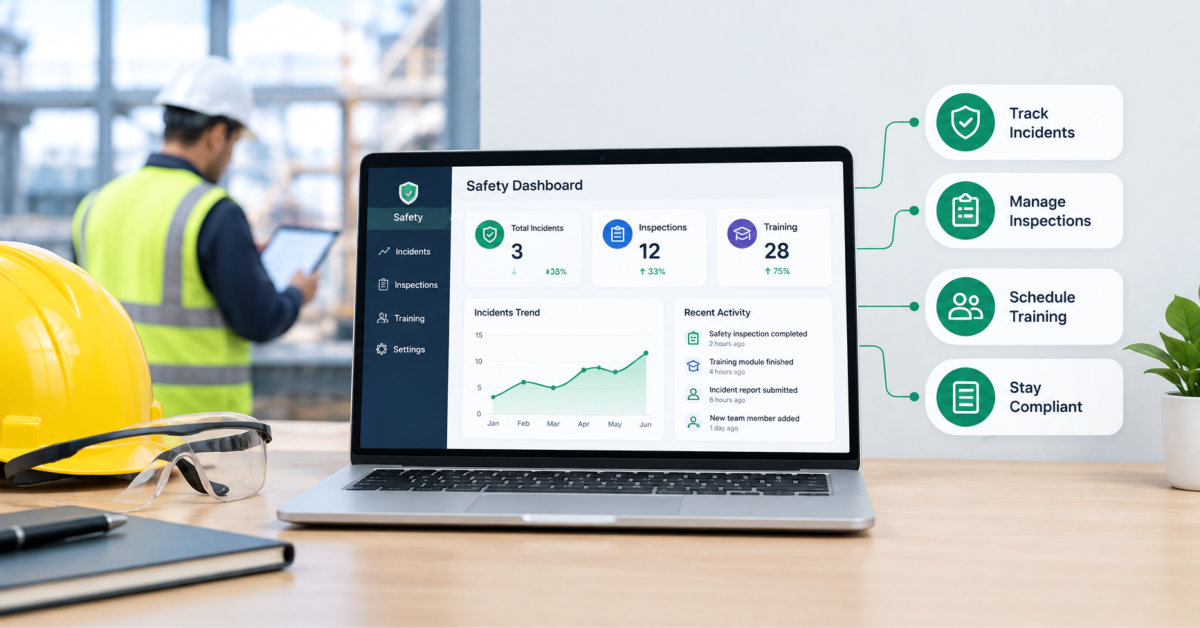
EHS software supports a more organised safety program by centralising incident records, inspections, hazards, corrective actions, training, and reporting into accountable workflows. Its value is not the dashboard alone. It is making safety responsibilities visible, assigned, documented, and easier to verify across locations.
A safety program becomes harder to manage the moment an action can disappear between a report, a spreadsheet, an email, and an unanswered follow-up task.
Workplace safety programs depend on accurate records, clear responsibilities, timely action, and consistent oversight across departments. When safety information sits across separate forms, spreadsheets, or systems, routine tasks can become harder to coordinate. A structured approach gives safety teams clearer visibility into hazards, incidents, inspections, and corrective actions.
Modern EHS software can bring these activities into one central system, which helps teams maintain accessible records and follow established processes. Features such as incident management, inspections, hazard reports, safety metrics, job safety analysis, and regulatory reports can support a connected program. This article examines how centralized safety tools can create clearer workflows, stronger oversight, and more consistent follow-through.
A well-organized program starts with reliable access to current information. A centralized platform can hold incident details, inspection results, hazard records, corrective actions, and other operational data in one location. This structure helps authorized teams find relevant records without reliance on disconnected files or separate departmental systems.
Central records also support consistency across multiple sites or business units. Safety leaders can review comparable information across departments and identify areas that require attention. Clear records also provide useful context for audits, internal reviews, and program evaluations.
Incident documentation requires more than a basic record of what occurred. A structured system can support reports for injuries and near misses, investigation details, root causes, and related corrective actions. OSHA recordkeeping forms and electronic reporting requirements can also become part of a defined workflow.
OSHA’s 2024 summary data provides useful context for the scale of workplace recordkeeping. Among 392,735 establishments that submitted Form 300A data, approximately 57% recorded at least one work-related injury or illness, with 1,478,310 total cases reported. Accurate records therefore remain an important part of structured safety administration.
Inspections have greater practical value when identified issues lead to documented responses. Digital inspection tools can support scheduled checks, customizable forms, attached photos, deficiency records, and corrective actions. Hazard reports can also classify risks according to probability and severity.
A structured process can help teams:
These steps create a clearer path from initial identification to resolution. Managers can also review unresolved items without a manual search across separate documents.
Safety data becomes more useful when teams can interpret it in a consistent format. Dashboards and reports can present measures such as total recordable incident rates, training pass rates, custom KPIs, and results for individual business groups. This visibility helps leaders assess program performance from a broader operational perspective.
Useful review areas can include:
Regular access to these indicators can support better priorities for future safety efforts. It can also help teams detect recurring concerns that individual records may not reveal.
A comprehensive safety platform can connect incident records with follow-up education and other corrective measures. Some systems can recommend targeted training from incident information, assign relevant courses, track completion, and link that activity to identified root causes. Such connections help preserve a clear record of the response after an event.
This approach gives corrective measures a defined place within the broader program. Training records, incident information, and follow-up actions remain connected for later review. That structure can also support audit preparation and internal accountability.
An organized safety program depends on clear information, defined responsibilities, and reliable follow-through. EHS software can support that structure through centralized records, scheduled inspections, hazard assessment, incident documentation, reports, and corrective-action workflows. These capabilities give safety teams a practical framework for consistent oversight across locations and departments. A well-structured system ultimately helps organizations maintain clearer records and keep important safety responsibilities visible.
EHS software is used to manage environmental, health, and safety activities in a structured digital system. Common uses include incident reporting, OSHA recordkeeping support, inspection scheduling, hazard reporting, risk assessments, corrective-action tracking, job safety analysis, training assignments, safety dashboards, and compliance reporting. The purpose is to replace disconnected files and manual handoffs with clear workflows, current records, accountable owners, and visible action status. The exact modules an organisation needs depend on its industry, workforce size, number of locations, regulatory obligations, and the complexity of its safety program.
EHS software improves incident reporting by giving teams a standard workflow to document the event, investigate causes, assign corrective actions, track responsible owners, and verify closure. Instead of storing incident details in separate forms, emails, and spreadsheets, the organisation can keep related evidence, investigation notes, root-cause findings, training assignments, and OSHA recordkeeping information connected to one record. This makes it easier for leaders to identify recurring trends, monitor overdue actions, prepare for audits, and demonstrate that reports led to a documented response. Software improves process visibility, but the quality of the investigation still depends on the people completing it.
EHS software can help covered employers organise OSHA recordkeeping information by supporting incident documentation, recordable-case workflows, Forms 300, 300A, and 301 data, and electronic-submission preparation. OSHA requirements vary by establishment size, industry, and the type of information required. Many employers with more than 10 employees must maintain injury and illness records, while certain establishments must submit specified data electronically through OSHA’s Injury Tracking Application. Software does not remove the employer’s responsibility to understand the applicable rules, maintain accurate records, and meet deadlines, but it can reduce manual consolidation and improve record traceability.
Safety leaders should review a balanced set of lagging and leading indicators in an EHS dashboard. Lagging measures can include recordable incidents, lost-time cases, severity, and days away from work. Leading measures can include inspection completion, hazard reports, near misses, action closure time, overdue corrective actions, training completion, safety observations, and repeat deficiencies by site or department. The most useful dashboard is specific to the organisation’s actual risks and operating model. It should help leaders identify where prevention work is needed, not simply present historical numbers without a clear next action.
Corrective training should not be assigned automatically after every workplace incident because training is only effective when a knowledge or competency gap contributed to the event. A proper investigation should identify the underlying cause before choosing the response. If the issue involves equipment, maintenance, staffing, supervision, work design, physical conditions, or an ineffective procedure, the corrective action may need engineering, administrative, or process controls in addition to or instead of training. When training is appropriate, link it to the incident, root cause, assigned action, completion record, and any follow-up verification so the organisation can assess whether the response addressed the actual risk.