





Is Electric Eye Right for You?
- Best fit for: Direct-to-consumer lifestyle brands in fashion, home goods, beauty, and accessories running on Shopify or looking to migrate to Shopify – typically generating between $1M and $50M annually – who need a specialized design, development, and optimization partner rather than a generalist agency
- Not the right fit if: You are pre-revenue, need a full-service marketing agency, or are looking for the lowest-cost option. Electric Eye works with brands that are serious about their store experience and ready to invest in getting it right
- What they’re known for: Front-end Shopify design, development, and conversion rate optimization – exclusively. Over 100 Shopify stores built since 2016, a top 5% podcast in Honest Ecommerce, and a reputation for treating every client like their only client
- What you’ll need to bring: A clear brief on your business goals, access to your analytics and existing store data, and internal alignment on what success looks like. The more context you give them upfront, the faster they move
- Typical engagement: Project-based for migrations, redesigns, and new builds; ongoing optimization and maintenance retainers for post-launch support. Contact directly for investment range – no public pricing
Migrating to a different platform will not solve an underlying business problem. – Chase Clymer, Founder, Electric Eye
What You’ll Learn
- Why most DTC brands underperform on Shopify not because of their product but because of decisions made during the build – and how Electric Eye approaches this differently
- How their exclusive focus on Shopify front-end design, development, and optimization produces results that generalist agencies consistently fail to match
- What the ICE method is and why Electric Eye uses it to prioritize every optimization decision for their clients
- What a real engagement with Electric Eye looks like from first conversation through post-launch iteration
- Whether your brand is at the right stage and facing the right problems to get maximum value from this partnership
There is a pattern that shows up repeatedly across mid-market DTC brands on Shopify. The store launched fine. The products are strong. The marketing is working well enough to drive traffic. But the conversion numbers don’t match the audience size, the mobile experience feels like an afterthought, and every attempt to fix it internally creates three new problems. The team is burning out managing a collection of contractors who don’t talk to each other, and the agency they tried before was good at everything in general and great at nothing specific to Shopify.
If you are running a DTC lifestyle brand on Shopify between $1M and $50M in annual revenue and you are sitting with that exact frustration, this piece is for you. If you are pre-revenue, looking for a full-service marketing agency, or need someone to run your paid media, this is not the right read right now – and Chase Clymer at Electric Eye would likely tell you the same thing directly.
What earned Electric Eye this spotlight goes beyond the 100+ Shopify stores they have built since founding in Columbus, Ohio in 2016. It is the intellectual honesty Chase brings to the craft. That honesty comes through in two conversations on the eCommerce Fastlane podcast, most recently in episode 329, and in the Honest Ecommerce podcast he has built into a top 5% ranked show with hundreds of episodes of unfiltered ecommerce insight. When someone teaches this much in public, you learn quickly whether their thinking holds up. Chase’s does.
The Problem They Were Built to Solve
Most agencies that work with Shopify brands are generalists. They do Shopify the same way they do WordPress, Magento, or whatever platform the client happens to be on. The result is a team that knows enough to get a store live but not enough to make it perform because genuine Shopify expertise is not about knowing the platform in general. It is about knowing the theme architecture, the app ecosystem, the checkout constraints, the performance levers, and the conversion patterns that are specific to how Shopify stores actually behave in the real world.
Chase Clymer founded Electric Eye in 2016 in Columbus, Ohio, after recognizing that DTC brands deserved better than the generalist agency experience. The founding insight was straightforward: if you are only going to work on one platform, you can go deeper than anyone who spreads their attention across many. Electric Eye made Shopify the only thing they do – not as a positioning statement, but as an operational commitment. Every designer, every developer, every strategist on the team works exclusively in the Shopify ecosystem. They have direct relationships with Shopify, Klaviyo, Klarna, and the other core technologies their clients rely on – not because they are affiliates, but because they have been in the ecosystem long enough to have earned those connections.
The brands that come to Electric Eye frustrated are typically dealing with one of three situations: they launched on a platform that has become a ceiling rather than a foundation, they worked with a generalist agency that delivered a store that looks fine but converts poorly, or they have been patching problems with individual contractors who each understand their own piece but nobody owns the whole picture. Electric Eye was built for exactly these scenarios, and a decade of work behind them proves it.
What They Do Differently
The most distinctive aspect of Electric Eye’s methodology is how it treats optimization as a discipline, not a deliverable. Most agencies build a store and hand it over. Electric Eye builds a store and then asks what the data says should change next.
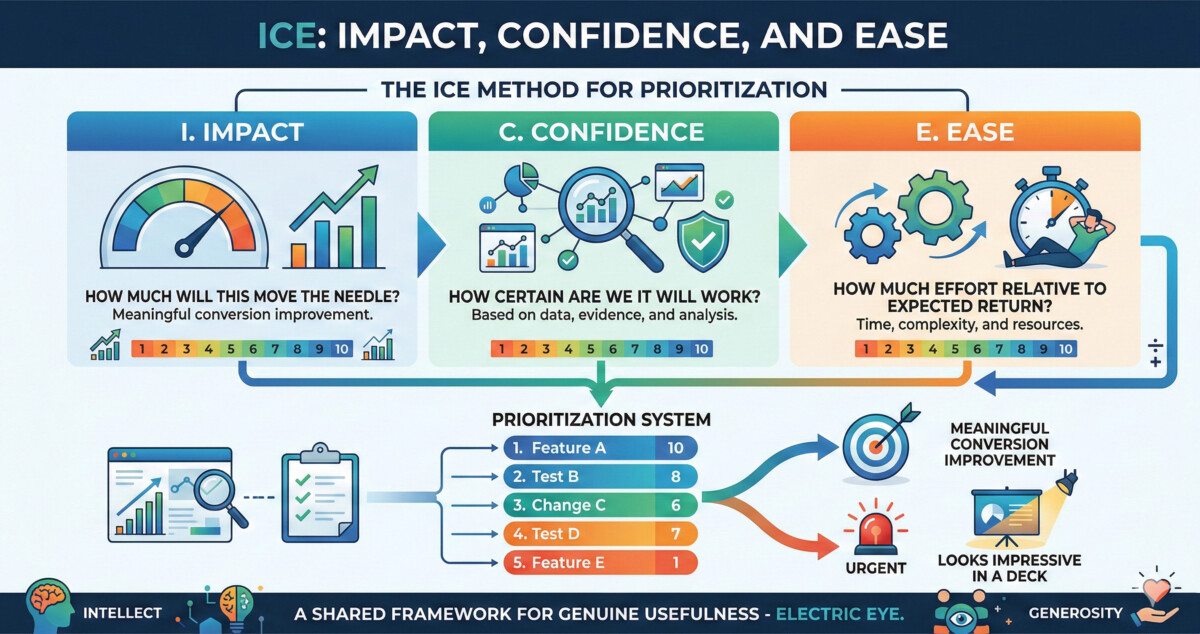
They use the ICE method to prioritize every decision. ICE stands for Impact, Confidence, and Ease. It is a scoring framework that forces every potential test or change to be ranked against three criteria before anyone touches code. Impact: how much will this move the needle? Confidence: how certain are we that it will work based on data? Ease: how much effort does it require relative to the expected return? The result is a prioritization system that consistently routes attention toward the changes most likely to produce meaningful conversion improvement rather than the changes that feel urgent or look impressive in a deck. Chase shared this framework openly because it is genuinely useful regardless of who you work with, which is exactly the kind of intellectual generosity that characterizes how Electric Eye operates in public.
They lead with data before touching design. Heat mapping tools like Hotjar and Heatmap.com, customer session recordings, and analytics form the diagnostic layer before any design or development work begins. This is not standard practice at most agencies – most start with a creative brief and a mood board. Electric Eye starts with evidence of where users are dropping off, what they are ignoring, and what is actually driving purchase decisions on the current store. The design work that follows is informed by that evidence rather than by aesthetic preference alone.
They have an exclusive focus that produces genuine depth. Electric Eye does not do paid media. They do not run your email. They do not manage your social. They do Shopify front-end design, development, and optimization – and only that. For brands accustomed to agencies that promise to do everything, this can feel like a limitation. In practice it is the opposite. The team’s exclusive focus means they have seen more Shopify-specific problems, developed more Shopify-specific solutions, and built more Shopify-specific institutional knowledge than any generalist agency can accumulate across a divided practice.
The Electric Eye Optimization Stack
- ICE scoring (Impact, Confidence, Ease) to prioritize every test and change before development begins
- Heat mapping and session recording to diagnose conversion problems with behavioral evidence, not assumptions
- Exclusive Shopify focus – every engagement benefits from a decade of platform-specific pattern recognition
- StoreTester.com for brands that want ongoing CRO without a full retainer – a structured testing service built specifically for Shopify stores under $10M
The Proof of Work: Giordano’s Pizza
The Giordano’s case study is the one that best illustrates Electric Eye’s methodology under pressure – because it combines a high-stakes brand, a failed prior attempt, and a hard deadline in a way that strips away any margin for the kind of vague agency promises that don’t hold up in practice.
Giordano’s is one of Chicago’s most iconic culinary institutions, renowned worldwide for their double-crusted stuffed deep dish pizza. Their nationwide DTC shipping operation brings the legendary taste of Chicago directly to customers across the US. The problem: they were running their shipping business on UltraCart, a platform that had become a ceiling. The architecture restricted their ability to scale, introduce upsells and cross-sells, and integrate with modern marketing and fulfillment tools.
What made this project genuinely difficult was not the migration itself. It was the context around it. A prior attempt to migrate to Shopify in 2023 had already failed – unresolved issues with reporting, product variant setup, and fulfillment workflows had created real internal skepticism about whether another attempt would succeed. And Q4 peak season was approaching. Getting it wrong again was not an option for a brand with this much riding on their DTC channel.
What the Giordano’s project demonstrates is not just technical competence – it is the specific kind of project management discipline that makes the difference between an agency that delivers under pressure and one that makes excuses. Electric Eye’s approach to the Giordano’s build – custom templates for the homepage, about page, Chi-Town Flavors collaborations page, and a bespoke pizza pack product template – reflects the same principle that runs through all of their work: the design serves the conversion goal, not the other way around. The Pocket Hose redesign tells a similar story: an internal team had built something quickly, the core metrics didn’t match the audience size, and Electric Eye came in with a data-driven redesign timed to land before spring season. On-time, on-budget delivery against a seasonal deadline is a pattern, not a coincidence.
What a Real Engagement Looks Like
The first conversation with Electric Eye is a scoping call that Chase and his team use to determine fit as much as to understand the project. They are direct about what they do and do not do – which means you will know quickly whether this is the right partnership before either side invests significant time. That directness is a feature, not a limitation. Agencies that say yes to everything are rarely great at anything.
For a typical redesign or migration engagement, the process moves through three distinct phases. Discovery comes first: understanding the existing store’s performance data, identifying where users are dropping off, and establishing what the new architecture needs to accomplish commercially – not just aesthetically. Build and optimization follows: design, development, custom features, and app integrations all executed by a team that works exclusively in Shopify, which means fewer surprises and faster problem-solving when edge cases emerge. Launch and iteration is the third phase – and for Electric Eye, this is where the ongoing relationship begins rather than ends. Their optimization and maintenance retainer model is built for brands that want a reliable partner to keep improving the store after launch, not just a team that hands over the keys and moves on.
Chase also built StoreTester.com specifically for brands that want structured CRO support without a full retainer commitment – a service designed around the ICE method that helps smaller Shopify stores prioritize and run tests that actually move conversion metrics. It is worth exploring if you are under $10M and not yet ready for a full engagement.
What you will need to bring: your analytics access, honest data about where your current store is underperforming, and a clear sense of your seasonal deadlines. Electric Eye is organized to hit timelines – the Giordano’s and Pocket Hose projects both demonstrate that – but they need the client side to be equally organized. If you are still debating your product catalog structure or your brand direction, resolve those questions before the first call. You will get significantly more from the engagement if the brief is clear before the work begins.
The Questions to Ask Before You Sign
These questions apply to any Shopify design and development agency you are evaluating. A credible agency should answer all of them without hesitation – and the quality of the answers will tell you more than any portfolio.
Electric Eye’s public track record makes pre-engagement due diligence unusually straightforward. Between the Honest Ecommerce podcast – now well past 350 episodes – and Chase’s two appearances on eCommerce Fastlane, including Episode 329, there is more unfiltered thinking from this agency’s founder available publicly than from almost any comparable Shopify partner. Listen to how Chase talks about the work. The intellectual honesty in those conversations is a reliable signal of how the agency operates when the cameras are off.
If you are a DTC brand on Shopify with a store that is not performing the way your audience size suggests it should, Electric Eye has built a decade of proof that this is exactly the problem they know how to solve. The combination of exclusive Shopify focus, a data-first optimization methodology, and the kind of post-launch partnership model that keeps improving the store over time makes them one of the most credible design and development partners in the ecosystem. The question is not whether they are good at what they do. The question is whether what they do is what your store needs right now. If the answer is yes, the conversation is worth having.
Start at ElectricEye.io
Frequently Asked Questions
What does Electric Eye specialize in and who do they work with?
ElectricEye is a Shopify-exclusive design, development, and optimization agency founded in 2016 and based in Columbus, Ohio. They work exclusively with direct-to-consumer lifestyle brands in the fashion, home goods, beauty, and accessories space – typically brands generating between $1M and $50M annually that are serious about improving their Shopify store’s performance. Their services cover custom Shopify theme design, store migrations, store redesigns, conversion rate optimization, and ongoing optimization and maintenance retainers. They do not offer paid media, email marketing management, or full-service marketing – their entire focus is the Shopify store experience itself.
How is Electric Eye different from a generalist digital agency?
The core difference is depth versus breadth. A generalist agency works across multiple platforms and disciplines – which means their Shopify knowledge is one of many competencies rather than the only one. Electric Eye has worked exclusively in the Shopify ecosystem since 2016, which means every designer, developer, and strategist on the team has accumulated platform-specific pattern recognition that generalists cannot match. They have direct relationships with Shopify, Klaviyo, Klarna, and other core ecosystem technologies. They have been invited to write courses for Shopify Plus and Klaviyo. That level of ecosystem depth is only possible when Shopify is the only thing you do.
What is the ICE method and why does Electric Eye use it?
ICE stands for Impact, Confidence, and Ease – a prioritization framework that scores every potential test or store change against three criteria before any development work begins. Impact measures how much the change is likely to move a key metric. Confidence measures how certain the team is that it will work based on existing data and behavioral evidence. Ease measures the effort required relative to the expected return. The result is a structured system that consistently routes attention toward the highest-leverage opportunities rather than the changes that feel urgent or look impressive. Chase Clymer shared this framework in detail on Episode 329 of eCommerce Fastlane – it is worth listening to if you are evaluating any optimization partner, not just Electric Eye.
What does a typical engagement with Electric Eye look like from start to finish?
Engagements typically move through three phases. Discovery comes first: reviewing existing analytics, heat mapping data, and session recordings to understand where the current store is underperforming and what the new build needs to accomplish commercially. Build and optimization follows: design, development, custom features, and app integrations executed by a team that works exclusively in Shopify. Launch and iteration is the third phase – Electric Eye offers ongoing optimization and maintenance retainers for brands that want a reliable post-launch partner rather than a handoff. For brands under $10M that want structured CRO support without a full retainer, Chase also built StoreTester.com as a more accessible entry point into their optimization methodology.
How do I know if my Shopify store is ready for an agency like Electric Eye?
The clearest signal is a gap between your traffic and your conversion rate – an audience that is engaged enough to visit but not converting at the rate your product quality and marketing investment should produce. If you are patching that problem with individual contractors who each own a piece but nobody owns the whole store experience, that is another strong signal. Electric Eye works best with brands that have enough traffic to generate meaningful behavioral data, a clear sense of their brand direction, and internal alignment on what success looks like. If you are still pre-revenue or figuring out your product-market fit, the timing is likely not right yet. If you are past $1M and your store feels like it is holding your growth back rather than accelerating it, that is the conversation Electric Eye was built for.
