


How do great eCommerce brands keep customers coming back? Stellar products are a must, but what separates the great brands from the rest are those who build strong (and sometimes, truly passionate) brand loyalty.
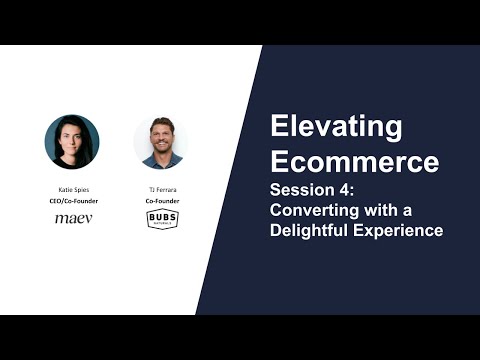
If you’re an eCommerce brand looking to separate yourself, provide next-level experiences for your customers, and build deep, long-term relationships with them via A+ brand loyalty, keep on reading. This is the fourth installment of our Elevating eCommerce series, and we talked to a couple great eCommerce brands (Maev, who sells all-natural raw dog food and BUBS Naturals, who sells grass-fed collagen and other health supplements) who have devoted customer bases due to super-high-and-getting-even-higher brand loyalty.
If you want to catch the full webinar on-demand, you can watch it here:
A quick note before we proceed: part of the subject backdrop for this webinar is headless commerce, which is a type of site architecture where the front end is “decoupled” (i.e., separated) from the backend. This allows for total customization of what customers see, and for significant website speed and performance improvements on web and mobile.
On whether you should switch to headless commerce:
Going headless may not be for everyone, and, as our panelists caution, it can be expensive to switch to headless commerce depending some variables, such as if you’re a larger brand and whether or not you have in-house tech resources. If you do have in-house tech resources, it can cost less than six figures. However, if you have to bring people in, or you’re using a firm, it can (at the high end) run you $250k.
If you are interested in planning to go headless, it’s vital to completely scope out the project and build the blueprint. That said, you need to also ask yourself whether you need to go headless and need to make the investment:
Are you facing insurmountable issues with site speed, particularly on mobile? Is your mobile conversion significantly worse than web? Does the nature of your business benefit from having heavily customized UI? Do you test constantly and need to be able to rapidly iterate? Do you use a lot of third-party integrations? Can you model and forecast how going headless will pay off for your “North Star Metrics”?
But if you do go headless, you may see serious benefits, particularly due to site speed:
As an eCommerce brand, it can be immediately beneficial to reduce the friction and number of steps required in the purchasing experience. For example, it may seem ideal to simply have a potential customer land on your site after seeing an exciting ad, search your product catalog, easily find the product they want, purchase, and have zero loading problems or encounter unnecessary pages or details along the way.
However, a (counterintuitive) potential issue with a seamless customer journey is that it actually might sometimes be too seamless. How?
Your products may require a certain amount of training, background, or experience to use. Or, they may require more than one purchase to show its true value. For customers who purchased without sufficient background reading and education to understand the true benefits of your products, they might be frustrated or turned off and won’t repurchase. In short, this means they’ll never have the chance to become valuable, loyal customers.
Here’s a couple ideas on how to combat this:
The power of the in-box experience:
Maev sees a higher level of first purchase churn among customers who purchased out of excitement (without fully realizing what Maev’s products entail). To reduce churn, Maev did a boat load of post-purchase A/B testing to figure out what mitigates it best. It turned out that the right balance of box inserts with educational materials led to repeat purchases, long-term customer (and dog) relationships, and strong loyalty.

Educational post-purchase nurture sequences:
By creating an educational post-purchase email campaign, you can layer in more and more information about the product your customer purchased, your brand, and try to add as much value as possible to customers.
BUBS, for example, runs an entire educational campaign for about 45 days (as that is their typical Time Between Orders) after a customer’s first purchase, and it’s all about education: other products they sell, people and their stories about using the products, eBooks, recipes, and more. This is a powerful strategy for creating a strong relationship and building brand loyalty.
“Surprise and delight” may be something that you’ve heard a thousand times, but the repetition doesn’t indicate a lack of importance. And to answer the questions posed in the name of this section, “Yes. All of the above.”
How to surprise? How to delight? Delight surprisingly? Surprisingly delight? Here’s some inspiration:
Surprise (and random) free gifts:
If your site has the functionality, you can create rules around certain price thresholds and cart contents leading to another (free) item popping in. For example, a kitchenware/home goods brand site might automatically add a free cutting board for someone who has bought a particular knife set.
Or, you can take a different approach by offering a gift after being a customer for X months. For example, a coffee brand might add in a free mug and/or product sample after a customer has been subscribed for three months.
Making time for personal touches:
You’re busy as heck and far past that, but taking 10 minutes every week to record a quick video for a few customers while you package their order will absolutely make them remember you forever. Pro-Tip: sort your orders by first name—let’s say, Jessica—and record a video talking to Jessica, thanking them for their purchase, and say that they can always reach out with any questions or comments. If 11 Jessicas ordered from you that week, you have 11 customers that you can make feel special (because they are!).
Another human element:
Never underestimate the importance of human interaction. Co-founders Katie Spies (Maev Co-Founder) and TJ Ferrara (BUBS Naturals Co-Founder) spend time every week talking to customers, asking them questions, asking them for feedback, and generally making them feel heard and special.
Content/Content Management
Customer Service/Customer Experience
Email Marketing
Headless Commerce
Loyalty, UGC
SMS Marketing
Subscription tools





