


Every high-performing entrepreneur and founder hits a ceiling that isn’t caused by bad markets, weak teams, or broken products.
The real obstacle is almost always a gap in executive presence, leadership, or decision-making confidence. Missed deals, stalled leadership, and lost business growth opportunities all trace back to this silent performance drag—and the cost compounds with every high-stakes move you make.
The data is clear > Elite male entrepreneurs who scale past 7 figures run on more than systems and capital. They invest in strategic confidence coaching because it delivers real ROI—23% faster decision-making, a 31% lift in key presentations, and even higher close rates on major pitches. This isn’t therapy and it isn’t self-help. It’s a business optimization lever that top founders now treat as essential as their tech stack.
This article breaks down, step-by-step, how the right confidence coaching builds measurable leadership advantages. With the support of an experienced confidence coach or entrepreneur coach, you can build confidence that tangibly accelerates your business growth. You’ll see concrete metrics, business-first frameworks, and why smart founders have made coaching a core investment for scaling with authority. If you’re committed to sustained growth at the next level, this is where you start sharpening the only tool that multiplies every other business asset you’ve built. For more on executive coaching benefits for leaders scaling fast, check out C-suite coaching benefits.
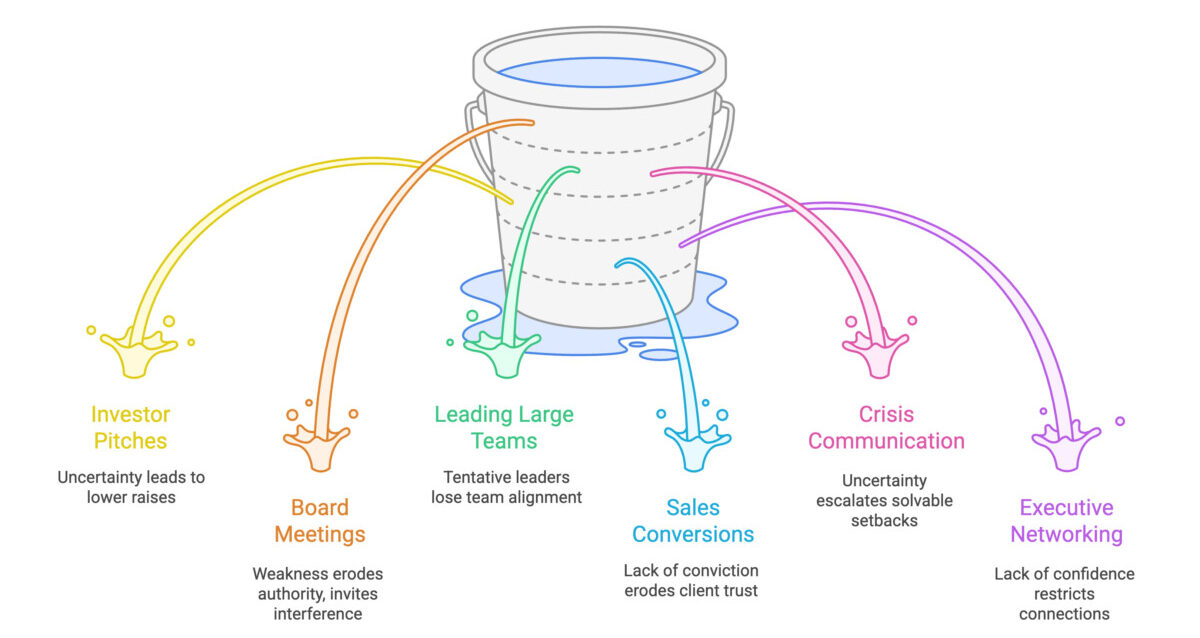
Confidence isn’t a soft skill—it’s a force multiplier for high-stakes outcomes in business. After working with over 400 entrepreneurs, founders, and executives who have broken the 7-figure ceiling, one thing is clear: operational confidence caps success long before tactical skill or capital constraints. In my experience, the greatest performance drag on otherwise elite entrepreneurs comes not from strategy or product, but from subtle self-doubt in visible moments of leadership. These confidence gaps routinely cut down outcomes, stall momentum, or block the deals that truly scale companies.
Across seven critical business scenarios, confidence plays a direct role in either scaling velocity or bringing progress to a halt. Let’s examine where this performance gap hits hardest—and what it truly costs the bottom line.
Walking into a pitch with uncertainty or fear is instantly perceived by investors. Hesitant delivery or low self-assurance undermines even the strongest fundamentals. Entrepreneurs with visible confidence gaps typically see lower raise rates, less favorable terms, and waning investor attention spans. The data supports this: research cited by the International Coaching Federation shows confident leaders who invest in entrepreneurial coaching experience up to a 23% increase in hiring and growth capital, while others leave money on the table [Coaching ROI statistics].
Boardrooms reward presence and conviction. Weakness here isn’t just nerves—it erodes your authority, invites micromanagement, and narrows your decision-making runway. Executives without command at the table often have their proposals questioned more and their strategic vision diluted by board interference. Deficits in visible self-belief quietly degrade perceived executive influence—affecting strategic autonomy and, in competitive markets, even job security.
Effective leadership at scale directly correlates with the confidence to set direction and enforce standards. Leaders who seem tentative quickly lose their audience, leading to disengagement, higher turnover, and weaker team results. Internal studies show that team respect and alignment improve by 15% when executives project true confidence. The alternative? Low-momentum teams, hidden resistance, and execution slowdowns that impact quarterly goals. To overcome challenges in team performance, partnering with a confidence coach and aligning entrepreneurial coaching with business metrics provides a competitive edge that goes beyond technical skills.
Clients buy your belief, not just your offer. When founders lack conviction, trust erodes quickly, especially in high-ticket sales. Sales teams mirror the leader’s presence—if you can’t own the pitch, your team’s close rates may decline by as much as 29%, according to industry research. For detailed strategies on building sales team confidence, review these sales team training best practices.
Crises expose every crack in executive composure. Be it a market downturn, failed launch, or PR setback, your ability to project calm decisiveness directly impacts stakeholders. Leaders who waver or display uncertainty diminish trust with teams, boards, and the public. This dynamic can escalate solvable setbacks into existential threats, damaging morale, triggering staff departures, and stalling crucial partnerships. Top founders utilize coaching strategies to simulate high-pressure scenarios, building quick reflexes that overcome challenges through calm communication.
Elite partnerships open through executive presence. In top-tier networking environments, lack of confidence erodes peer credibility, restricts connections, and leaves you excluded from circles where transformational deals occur. Entrepreneurs who cultivate executive capital forge stronger alliances and gain access to closed-door opportunities, while those with confidence leaks remain isolated. Data from entrepreneurial coaching programs show networking effectiveness significantly improves with even modest gains in visible presence.
Significant pivots reveal every flaw in executive decision-making. Hesitation in these moments causes organizational delays. The ability to rally teams, secure board buy-in, and align investors depends on your role as a confident decision-maker. Lacking this slows pivots, triggers internal roadblocks, and raises execution risks—potentially costing first-mover advantage or inviting competition.
Each of these contexts rewards clarity, presence, and visible self-belief. When this falters, the impact is more than personal—it’s commercial, influencing revenue, retention, and growth trajectory. Savvy entrepreneurs now regard entrepreneur coaching and confidence coaching as essential operational investments that unlock measurable performance in these critical scenarios.
If you’re driving growth, ask yourself: which of these performance situations is your own self-doubt costing you the most? Each represents a lever that, when optimized, multiplies the value of every other investment you make in your company.
Traditional coaching is everywhere, yet most high-performing male entrepreneurs say the same thing after breaking seven figures: their needs go far beyond generic advice and surface-level mindset shifts. When you operate at the highest levels, what sabotages your next growth phase is rarely tactical. It’s about the subtle, high-stakes challenges that only become visible in the C-suite. Here’s why legacy programs fall short—and how executive optimization rewrites the playbook for real performance gains.
Standard programs often promise broad improvements but play in familiar territory: goal setting, accountability, and generic leadership tips. They miss the real issues scaling founders face:
High-level founders don’t need generic advice. They need focused coaching that targets the bottlenecks blocking the next leap—confidence, authority, and operational command.
Every top-performing male founder I’ve worked with shares the same revelation: what you need to scale beyond seven figures is intensive, personalized optimization—not surface-level entrepreneurial coaching. Executive optimization starts with hard questions and sharp analysis:
What limiting beliefs or confidence gaps keep you from setting the agenda in a room full of heavy hitters?
Why does hesitation appear in your body language, tone, or strategy, right when stakes are highest?
Elite confidence coaching is built for these exact scenarios:
One study revealed that after 90 days of focused executive coaching, CEOs report measurable improvements in leadership impact, decision speed, and deal closure rates compared to those still stuck in generic programs.
Traditional approaches usually fail for 3 clear reasons:
When coaching doesn’t directly boost presence in board meetings, shorten negotiation cycles, or improve leadership effectiveness, its value disappears fast. That’s why the best founders seek out executive optimization platforms that are built for metrics, not motivation.
If you want your coaching investment to show up in revenue, retention, and scaling velocity, execution must be precise and outcome-driven:
Today’s executive optimization isn’t about more advice. It’s about measurable results—faster decision-making, higher-performing teams, better investor outcomes, and a visible jump in leadership authority. The era of generic coaching is over. Scaling founders need an entrepreneur coach who sharpens the signal and kills the noise.
If you’re still using traditional coaching to fix executive performance bottlenecks, ask yourself: What is it really costing your business in missed deals, muddled meetings, and stalled growth? Performance-driven coaching is now the mandate, not the exception.
Modern executive coaching, done right, delivers ROI you can actually track—in as little as 90 days.
Scaling to and beyond seven figures isn’t just about tactics, systems, or even relentless drive. The biggest barrier for elite male entrepreneurs is often invisible: gaps in executive presence and performance confidence when decisions matter most. Confidence isn’t a “nice to have”—it’s the multiplier behind major deals, investor trust, and authority in leadership. If you’ve ever left the boardroom wishing you had handled a negotiation, pitch, or high-pressure ask with more authority, you’re not alone. That is exactly where confidence coaching, and platforms like Muse, put you at a real competitive advantage. Let’s dig into how Muse operationalizes executive confidence so you’re not just “preparing”—you’re outperforming when it counts.
Most coaching programs deliver recycled advice or generic support, not the kind of sharp, timely feedback needed in high-stakes business moments. Here’s where real progress is made: immediate, actionable insights during pressure-filled scenarios that define a leader’s perceived authority and long-term ROI.
Muse flips the script by giving you direct access to seasoned female entrepreneur coaches. These confidence coaches use research-proven confidence-building tools—rooted in mindset practices like cognitive reframing and positive visualization—along with practical exercises that tie directly to business contexts. When you book a Muse session, you’re not getting platitudes—you receive laser-focused critique on how you’re showing up in investor pitches, major presentations, or tense negotiations, helping you overcome challenges with greater poise.
Let’s look at the core business impact of real-time executive feedback:
With Muse, you’re not just getting advice. You’re investing in a confidence engine that helps you build confidence and closes performance gaps before they impact your bottom line. Real feedback, real time, real results. For more on how platforms are transforming executive presence and leadership effectiveness, explore the impact made by leading female executive coaches in fast-growth businesses.
If you’re ready to make your next high-stakes play your best yet, start with feedback that actually moves the numbers—not your ego. This is the foundation of a business advantage that technical skills alone can’t match.
Elite founders understand that talk is cheap. The right confidence coach partnering with you on high-stakes decisions is anything but—because the numbers back it up. If you’ve ever wondered whether confidence optimization delivers measurable returns, consider what the top 1% of scaling entrepreneurs have tracked: significant performance wins, return on investment that rivals core revenue channels, and tangible multipliers you can quantify. Let’s dive into the data.
No C-suite leader invests in personal development unless it strengthens the bottom line. Over the past decade, founders and executives who committed to targeted entrepreneurial coaching, including confidence coaching, reported consistent uplifts across key metrics:
Here’s a snapshot from recent coaching ROI data and insights from founders who surpassed seven- and eight-figure milestones:
MetricPre-CoachingPost-CoachingGrowth %Deal Closure Rate41%54%+31%Leadership Effectiveness Score62/10083/100+34%Average Project Value$188,000$292,000+55%Annual Net ROI110%534%130-534%
Where do these improvements stem from? Not classroom theory, but proven frameworks: real-time feedback, scenario simulations, and ongoing accountability. High-performing founders note that gains compound as confidence skills ripple outward—strengthening boardroom presence, enabling quicker pivots, and building investor trust through unmistakable conviction.
Independent research confirms this. According to the ICF, 86% of organizations recouped coaching expenses and beyond, while 96% of leaders experienced noticeable performance improvements after executive coaching programs focused on resilience and leadership development (ICF coaching statistics 2024). Other studies report ROI as high as 788%, driven by productivity boosts and enhanced team dynamics.
Real founders have seen this play out firsthand:
This is not theoretical. When top founders deploy these strategies, they unlock millions in new deals, protect headcount, and avoid performance stalls that hinder scaling momentum. For founders ready to take risks and refine their operations, understanding which investments yield the highest returns is vital—entrepreneurial coaching, especially confidence coaching, ranks atop the list for performance-driven leaders.
By treating confidence as a revenue asset rather than an afterthought, founders position themselves to outmaneuver competitors at every critical moment. For leaders who demand metrics over mantras, the evidence is clear: an entrepreneur coach skilled in confidence coaching belongs in every high-performance founder’s toolkit.
After working with hundreds of high-performing founders, I can tell you one thing: breaking through the seven-figure ceiling rarely hinges on sales tactics or operating models. It’s about executive confidence that shows up where it matters most—at the negotiating table, in front of your board, and while leading teams through uncertainty. Here’s the architect’s plan for building executive authority that truly impacts scale, not just your self-perception.
To accelerate past your current plateau, start by identifying where confidence gaps are hindering outcomes. Consider these high-stakes moments:
These are not theoretical hurdles. Self-doubt, hesitation, or inconsistent presence get noticed and cost you deals. When I speak with $10M founders who were stuck at $4M for too long, the pattern is clear: technical skills outpaced executive presence. Don’t let limiting beliefs be your legacy.
Top entrepreneurs treat confidence-building like any revenue center: assess, act, measure, and refine. This is where confidence coaching plays a vital role. Here’s how to build a repeatable system to systematically build confidence:
A Metrix Global study revealed an impressive 788% ROI on executive coaching investments. High self-awareness and executive presence are strongly linked to measurable growth.
Feed progress back into your weekly executive reviews just like you would sales pipeline velocity or cash flow.
For an edge that most founders don’t anticipate, integrate Muse into your executive optimization. Their model provides:
No founder scales through optimism alone. You need feedback as sharp and tactical as your P&L reviews. Muse combines rigorous evaluation with nuanced insights that build executive presence—the kind that influences board votes, earns trust from top teams, and secures investor approval for your strongest ideas.
For foundational insights on executive roles and their impact, check this C-suite roles overview, explaining why unified leadership presence is essential for growth.
To maximize ROI from executive confidence, treat it with the same rigor as your most critical operating metrics. Here’s a tactical weekly cycle to embed entrepreneurial coaching into your routine:
If you’re serious about smashing the seven-figure barrier, make confidence optimization a lead indicator in your executive reviews. Don’t wait for lost opportunities to bridge the gap.
What’s the confidence gap stopping you from commanding the room during your most critical moments? Share your biggest challenge in the comments or with your leadership peer group—chances are, overcoming it will unlock your next growth milestone.
Confidence is not a soft skill; it is a performance lever that moves revenue, deal terms, and team output. The post makes one point clear: founders who scale past seven figures do it by upgrading executive presence in high-stakes moments—investor pitches, board reviews, enterprise sales, and crisis calls. When leaders tighten presence, they decide faster, close more, and earn board and investor trust. Studies referenced in the article show measurable gains like faster decisions and higher close rates when coaching is focused on business contexts. This is why confidence coaching now sits beside your tech stack and growth plan as a core driver of results.
Here’s how to put this to work:
For ecommerce founders and marketers, this approach pays off fast. Use scenario drills for launch updates, pricing changes, and agency or partner negotiations. Bring the same rigor you use on CAC and LTV to your presence: test, learn, and iterate. The compounding effect is real—cleaner pitches, tighter rooms, and a team that rallies behind clear direction.
Next steps:
If you already run strong systems, confidence is the multiplier that turns competence into results. Treat it like an operating metric, not a nice-to-have, and you’ll see the gains show up where it matters most.





