





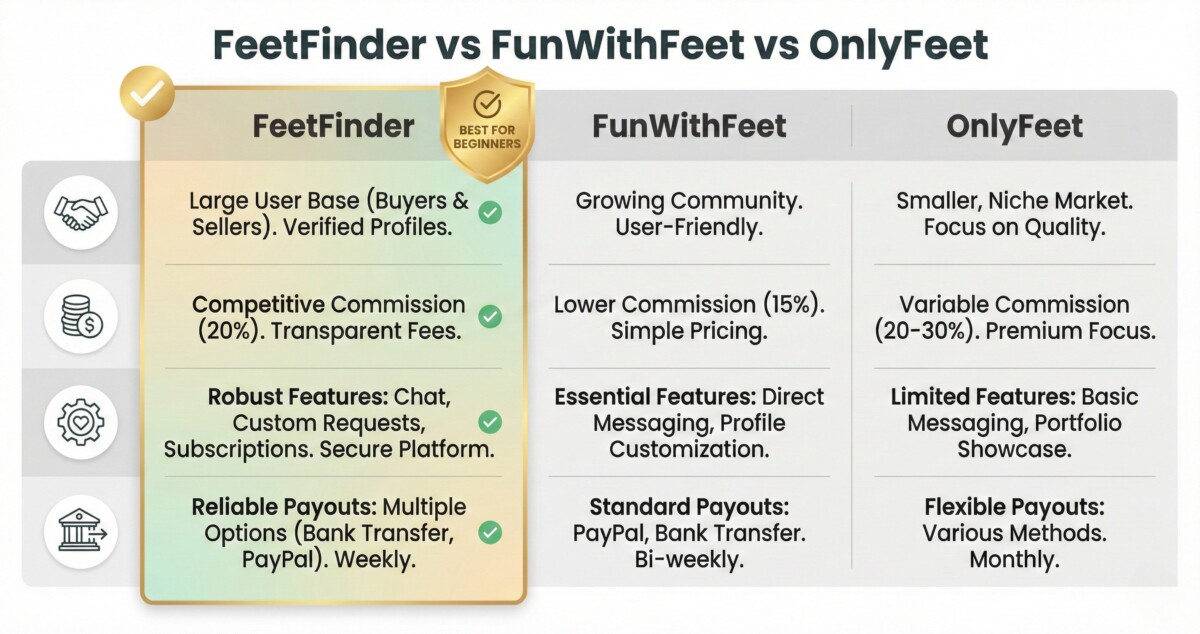
Quick Decision Framework
- Who This Is For: Content creators and side hustlers at any stage who are researching feet content platforms before committing to one, or who are currently on a platform that isn’t generating consistent sales.
- Skip If: You are already earning consistently on FeetFinder and are not evaluating alternatives. This comparison is for decision-making, not optimization of an existing setup.
- Key Benefit: Choose the right platform from day one and avoid the 60 to 90 day detour most creators take by starting on the wrong one, costing them their first $200 to $500 in potential earnings.
- What You’ll Need: A government-issued ID for identity verification on any platform you join, a smartphone or camera for content creation, and 2 to 4 hours to set up a complete profile that actually converts.
- Time to Complete: 8 to 12 minutes to read. 2 to 4 hours to set up your chosen platform and publish your first listings.
The platform you start on determines whether you make your first sale in 7 days or 70. Buyer traffic is not equal across these three platforms, and the fee structure only matters if people are actually buying.
What You’ll Learn
- Why buyer traffic volume matters more than commission percentage when choosing your first feet content platform.
- How FeetFinder, FunWithFeet, and OnlyFeet differ on fees, revenue share, and verified buyer access so you can make a data-driven decision.
- What the real earning ranges look like at each platform based on community-reported data, not platform marketing claims.
- When a multi-platform strategy makes sense and which combination of platforms produces the strongest income diversification.
- How to evaluate which platform matches your current stage, whether you are starting from zero or scaling past $1,000 per month.
Most creators spend their first 60 days on the wrong platform. Not because they made a careless decision, but because every platform comparison they found was written to rank for the keyword, not to actually help them choose. The result is a predictable pattern: a creator joins based on a low fee structure, generates almost no sales because buyer traffic is thin, and either quits or starts over on a different platform after losing two months of momentum.
This comparison is built differently. The goal is one decision, made correctly, the first time. FeetFinder, FunWithFeet, and OnlyFeet each occupy a distinct position in this market. The right choice depends on where you are right now, what resources you are bringing to the table, and what your income timeline looks like.
Whether you are exploring this as a side income or building toward a full-time creator business, the framework below gives you everything you need to choose with confidence.
The Core Difference Between These Three Platforms
FeetFinder, FunWithFeet, and OnlyFeet are all dedicated feet content marketplaces, but they are built around fundamentally different assumptions about where buyers come from. That single difference drives almost every other variable in this comparison.
FeetFinder operates as a true marketplace. Buyers create verified accounts, browse by category and keyword, and discover creators through the platform’s internal search and recommendation system. Creators get organic discovery without needing an existing audience. This is the structural advantage that makes FeetFinder the default starting point for most new creators.
FunWithFeet operates more like a hosted storefront. The platform provides the infrastructure, but the expectation is that creators drive their own traffic from social media, Reddit, or other channels. The 0% commission is genuinely attractive, but it only creates value if buyers are arriving. For creators without an existing audience, that is a significant constraint in the first 90 days.
OnlyFeet is the newest of the three and takes a hybrid approach. Free to join, 80% revenue share, built-in content watermarking, and subscription tier support. The platform is actively building its buyer base, which means early adopters are getting in before the competition density increases, but also before peak buyer volume is established.
Understanding this structural difference reframes the entire fee comparison. A 0% commission on a platform with low buyer traffic produces less income than a 20% commission on a platform where buyers are actively purchasing. Commission math only matters in the context of actual transaction volume.
FeetFinder: Built for Creators Who Are Starting Without an Audience
FeetFinder is the largest dedicated foot content marketplace operating today, and its scale creates a compounding advantage for new creators. More verified buyers mean more organic discovery. More discovery means more sales without external marketing. More sales mean more reviews. More reviews mean better placement in the platform’s internal ranking system. The flywheel starts from the moment a creator publishes a complete profile.
The fee structure has two tiers. The Basic plan runs $4.99 per month with a 20% commission on sales. The Premium plan runs $14.99 per month with a 10% commission. For any creator generating more than $100 per month in sales, the Premium plan produces higher net earnings. At $500 per month in sales, a Basic creator nets approximately $395 after fees and commission. A Premium creator at the same volume nets approximately $435. The gap widens as volume increases.
Beyond the fee structure, FeetFinder includes features that matter for building a sustainable income. Verified buyer accounts reduce the ghost account problem that plagues less moderated platforms. A ratings and review system creates social proof that compounds over time. Subscription paywall functionality lets creators build recurring monthly income alongside one-time sales. A referral program pays 10% of referred creator sales, drawn from FeetFinder’s commission cut rather than the referred creator’s earnings.
FeetFinder creators in their first year typically report $300 to $900 per month. The top 10% exceed $5,000 per month. The difference is almost always profile completeness, content volume, and consistency, not luck.
The platform covers more than 100 content categories, which means niche discovery is genuinely functional. A creator specializing in a specific style or aesthetic can surface in front of buyers who are specifically searching for that. This is not possible on platforms without robust internal search.
For creators in the Exploration Phase, the $4.99 Basic plan is the lowest-risk entry point in this comparison. For anyone past their first $200 per month, upgrading to Premium is a straightforward financial decision. The $10 per month difference in subscription cost is recovered in commission savings at approximately $100 in monthly sales.
FunWithFeet: The Right Choice for Creators With an Existing Audience
FunWithFeet’s core proposition is simple: keep everything you earn. No commission on sales, a $9.99 subscription that covers three months of access, and a platform designed with creator privacy as a foundational feature rather than an afterthought. For the right creator, this structure is genuinely compelling.
The challenge is that FunWithFeet’s buyer discovery infrastructure is limited compared to FeetFinder. Community-reported data from creators active on both platforms consistently shows lower organic discovery rates on FunWithFeet. Creators who generate strong income on FunWithFeet are almost universally driving their own traffic from Reddit, Twitter, Instagram, or TikTok. The platform converts that traffic well. It does not generate it independently at the same scale FeetFinder does.
This makes FunWithFeet a strong secondary platform rather than a primary starting point for most creators. If you have 5,000 Instagram followers in a relevant niche, a Reddit presence, or an email list, FunWithFeet’s 0% commission becomes a meaningful financial advantage. You are doing the traffic work anyway. Keeping 100% of the revenue instead of 80 to 90% compounds significantly over time.
FunWithFeet’s privacy features are worth noting for creators who prioritize anonymity. The platform’s design minimizes exposure and gives creators strong control over their visibility. For creators in markets or situations where discretion is a priority, this is a genuine differentiator. The platform also has a straightforward setup process that makes launching a profile fast, even if the buyer discovery infrastructure is limited relative to FeetFinder.
OnlyFeet: Early Mover Advantage on a Platform Still Building Momentum
OnlyFeet entered the market with a structural offer designed to attract creators who felt the established platforms were taking too large a cut. Free to join, 80% revenue share, no monthly subscription fee. The economics are straightforward and genuinely competitive. The question is whether buyer volume has reached the level where those economics translate into meaningful income for new creators.
The platform’s content protection features are a legitimate differentiator. Advanced watermarking embeds creator identity into content files, making unauthorized distribution traceable. For creators who have experienced content theft on other platforms, or who are entering this market with that concern front of mind, OnlyFeet’s approach to protection is more robust than most competitors offer at the same price point.
Subscription tier support is built into the core platform rather than added as a premium feature. Creators can offer multiple subscription levels, custom content requests, and tiered pricing without additional configuration. This is the infrastructure of a platform designed for long-term creator businesses, not just transactional sales.
The honest assessment of OnlyFeet is that it is a strong secondary platform today with genuine potential to become a primary platform as buyer volume grows. Creators who join now are building their presence before the competition density increases. That is a real advantage. It is also a real risk if buyer volume does not scale at the pace the platform needs. For creators who want zero downside risk, FeetFinder remains the safer primary choice. For creators willing to diversify, OnlyFeet as a secondary platform costs nothing to add and could become a meaningful income source over the next 12 to 24 months.
The Platform Decision by Creator Stage
The right platform is not universal. It is a function of where you are right now and what resources you are bringing to the table. The four stages below are not rigid categories. They are decision frameworks. Use whichever one reflects your current situation most accurately.
In the Exploration Phase, which covers your first 30 days, the priority is a single first sale. Not optimization. Not diversification. One sale that proves the market is real and that you can operate in it. FeetFinder Basic at $4.99 per month gives you the highest probability of that first sale without requiring an existing audience. Start here, build your profile completely, publish at least 10 to 15 listings, and let the platform’s buyer traffic do the discovery work.
In the Quick Cash Phase, which covers days 30 to 90, you have proof of concept and are optimizing for income velocity. FeetFinder Premium at $14.99 per month is the right move at this stage. The 10% commission rate versus 20% on Basic produces meaningfully higher net earnings as your volume grows. The $10 per month difference in subscription cost is recovered at approximately $100 in monthly sales. Above that threshold, Premium is strictly better math.
In the Business Builder Phase, which covers the $1,000 to $3,000 per month range, platform diversification becomes a risk management strategy rather than a distraction. FeetFinder remains your primary income source. Adding OnlyFeet as a secondary platform costs nothing in subscription fees and captures buyers who discover you through different channels. The 80% revenue share on OnlyFeet becomes financially significant at this volume level.
In the Full-Time Professional Phase, which covers $3,000 per month and above, platform concentration is the primary risk to manage. Algorithm changes, policy shifts, and platform-level decisions can materially impact income when a single platform represents 100% of revenue. At this stage, a three-platform strategy covering FeetFinder as primary, OnlyFeet for premium and protection-sensitive content, and FunWithFeet for audience-driven traffic creates meaningful income resilience. The operational overhead of managing three platforms is real, but it is proportionate to the income being protected.
The Honest Verdict: Which Platform Wins
FeetFinder wins on buyer traffic, and buyer traffic is the variable that determines whether a new creator makes $0 or $500 in their first 90 days. The verified buyer marketplace, 100-plus content categories, internal search and discovery, ratings system, and subscription paywall functionality give FeetFinder a structural advantage that no fee comparison can override. For the majority of creators reading this, FeetFinder is where you start.
FunWithFeet wins on commission structure. Zero percent is the best possible number, and for creators who already have an audience they can drive to a platform, FunWithFeet’s economics are genuinely superior. The constraint is that most creators starting out do not have that audience yet. FunWithFeet is the right secondary platform for creators who have built social presence elsewhere and want to maximize revenue per sale without paying commission on traffic they are generating themselves.
OnlyFeet wins on content protection and long-term revenue economics. The 80% revenue share with no monthly fee and built-in watermarking is a compelling combination for creators who prioritize both income percentage and content security. The platform is newer, which means buyer volume is still building. Creators who get in now are positioning for upside as that volume grows. The risk is real. So is the opportunity.
The bottom line is straightforward. Start on FeetFinder. Build your income foundation on a platform with verified buyers and proven discovery infrastructure. Add OnlyFeet as a secondary platform once you are earning consistently and want to diversify without additional subscription costs. Consider FunWithFeet when you have an external audience large enough to make the 0% commission meaningful. That sequence gives you the fastest path to income, the best risk profile, and the strongest long-term position in this market.
Ready to start? FeetFinder’s Premium plan gives you verified buyer access, full platform features, and the 10% commission rate that makes scaling straightforward. Start with Basic if you want to test before committing. Upgrading is a one-click decision once you are earning consistently.
Frequently Asked Questions
Which platform has the most buyers for feet content in 2026?
FeetFinder has the largest verified buyer base of the three platforms covered in this comparison. Its marketplace structure allows buyers to browse by category, keyword, and creator rating, which means new creators get organic discovery without needing to drive their own traffic. FunWithFeet and OnlyFeet both have buyer bases, but neither matches FeetFinder’s volume or the depth of its internal search and discovery system. For creators starting without an existing social audience, buyer volume is the single most important variable, and FeetFinder leads on that metric.
Is FeetFinder’s monthly fee worth paying compared to free platforms?
Yes, for most creators. The fee comparison only makes sense in the context of what each platform delivers in return. FeetFinder’s $4.99 Basic plan and $14.99 Premium plan give you access to a verified buyer marketplace with organic discovery built in. Free or low-cost platforms like OnlyFeet and FunWithFeet require creators to drive their own traffic. If you do not have an existing audience, the FeetFinder subscription fee is effectively a buyer acquisition cost, and it is a low one relative to what paid social traffic would cost for the same result. At $100 per month in sales, FeetFinder Premium pays for itself in commission savings alone.
Can you sell on FeetFinder and FunWithFeet at the same time?
Yes. None of the three platforms in this comparison require exclusivity. Creators can and do operate on multiple platforms simultaneously. The practical consideration is time and content management. Running two or three platforms well requires more content production and more time managing messages and listings. Most creators in the Business Builder phase ($1,000 to $3,000 per month) find that a two-platform setup covering FeetFinder as primary and OnlyFeet as secondary produces the best balance of income diversification and operational overhead. Adding FunWithFeet makes most sense when you have external traffic you can direct there.
How does OnlyFeet’s content protection work and is it effective?
OnlyFeet uses advanced watermarking technology that embeds creator identity information directly into content files. This means that if content is downloaded and shared without authorization, the watermark travels with the file and makes the source traceable. This is a meaningful protection feature for creators concerned about content theft, which is a real issue in this market. The watermarking does not prevent unauthorized sharing entirely, but it creates accountability and gives creators a stronger position if they need to pursue a DMCA takedown or report a violation. FeetFinder and FunWithFeet offer less robust built-in protection at the platform level.
What is a realistic income expectation for a new FeetFinder creator in the first 90 days?
Community-reported data from FeetFinder creators consistently shows a range of $0 to $300 in the first 30 days for creators who launch with an incomplete profile or limited content. Creators who launch with 10 to 15 complete listings, a fully built-out profile, and consistent activity in the first two weeks typically report $100 to $400 in their first month. By month three, creators who have maintained consistency and built reviews generally reach $300 to $900 per month. These are community-reported ranges, not platform guarantees. Income varies significantly based on content quality, niche specificity, pricing strategy, and engagement with the platform’s subscription and custom content features.

