What does it take to run ecommerce for one of the world’s most iconic brands, with a team of just three marketers?
At D-Congress, three people with firsthand answers took the stage together. Jim Lofgren, CEO at Nosto, brought the industry perspective, with a clear message that the era of AI experimentation is over. Keeghan McGarry, Head of Technology at Autonative (Ford’s car accessories ecommerce partner), brought the operational reality of running a global accessories business at scale. And Dan Brazier, Lead Solutions Engineer at Shopify, showed exactly how the tech stack is evolving to keep up.
Together, they gave a front-row look at how agentic AI is moving from boardroom buzzword to genuine business impact, and what it means for the teams building the next generation of commerce experiences.
Agentic AI has dominated industry conversations for the past year. But as Jim Lofgren, CEO at Nosto, made clear: the time for talking is over. Now is the time to build.
The urgency is real. Research shows that around two-thirds of consumers expect to use AI assistants in their shopping journeys, one of the fastest behavioral shifts we’ve seen in decades. That’s not a gradual evolution. It’s a step change.
For ecommerce teams, it demands a rethink of two things at once:
Ford’s accessories stack tackles both.
One of the most striking takeaways from the session? Ford’s European accessories business, serving millions of customers, runs on a marketing team of three.
That level of efficiency isn’t accidental. Autonative’s approach is built on one principle: remove friction wherever possible.
AI agents now handle merchandising decisions, campaign setup, product recommendations, and data enrichment. Tasks that once required multiple tools, teams, and handoffs now execute in a single, connected workflow.
For example, the Autonative team can, without a developer’s assistance, submit tasks that would normally require coding directly to Nosto’s AI agent, Huggin. In the example below, you can see how different prompts quickly alter the store experience, achieved in just a few minutes for tasks that would have previously taken much longer..

At the center of Ford’s car accessories store setup is a tightly integrated stack: Shopify as the commerce engine, Nosto as the intelligence layer, and Klaviyo powering customer engagement. Together, they unify customer, product, and behavioral data in real time.
But the real story isn’t the tools. It’s what happens when they start working together.
Using emerging standards like MCP (Model Context Protocol), AI agents can now communicate across platforms, share context, and execute tasks autonomously. Not just surfacing insights. Acting on them.
In practice, that means:

This is what “agentic” actually means: systems that don’t just inform decisions. They carry them out.
Shopify’s Sidekick is a clear signal of where things are heading.
Originally a conversational assistant for navigating the platform, it’s evolved into something far more capable: generating reports, building storefront components, and interacting directly with third-party tools like Nosto.
In practice, marketers and merchandisers describe what they want, and AI builds it. No tickets. No backlogs. No waiting.
Operational efficiency is a major win. But the impact on product discovery is just as significant, and for Ford, arguably more critical.
Ford’s accessories catalog runs deep. We’re talking individual nuts and bolts. Helping a customer find exactly the right part isn’t just a nice-to-have; it’s the conversion.
AI shopping assistants, combining behavioral data, product intelligence, and real-time intent signals, can guide customers in a way that mirrors an in-store experience. Understanding vague queries. Refining intent. Recommending the right product, fast.
Because in ecommerce, latency isn’t just a technical problem. It’s a conversion killer.
For all the excitement around AI, one message came through loud and clear: none of this works without the right data.
In online retail, data is often fragmented, unstructured, or buried in legacy systems. Before AI can deliver value, that foundation needs to be solid. Autonative’s first step wasn’t deploying agents. It was auditing systems, structuring data, and making sure everything could connect. Only then could agentic workflows deliver real impact.
The lesson applies far beyond Ford. AI amplifies what’s already there, for better or worse. Get the data right first.
Large Language Models (LLMs) are advanced AI systems trained on vast amounts of text data to understand, generate, and interact using human language.
One of the most charged questions of the session: with consumers increasingly turning to LLMs to search and discover products, does the website still matter?
Short answer: yes. But the role it plays is shifting.
Keeghan McGarry put it directly: “LLMs are how we get discovered. The on-site experience is crucial. I think it’s not going to get less important. Actually, it’s going to become more important.” For a brand like Ford, with decades of recognition to protect, the stakes on both fronts are significant. You need to show up in LLM-driven search. And when customers arrive on-site, the experience needs to be worth it.
That means optimizing for two things at once: LLM discoverability and a best-in-class on-site experience. Neither replaces the other.
Dan Brazier surfaced a question the industry hasn’t fully resolved yet: what happens to brand tone of voice when an LLM is doing the talking?
The appeal of AI-powered conversation is that it adapts to each individual. But merchants have spent years building a specific voice, aesthetic, and brand identity. As Dan put it, his experience buying a handbag is fundamentally different from his wife’s, and the LLM knows that. Where does merchant control over brand voice end, and hyper-personalization to the end user begin?
There’s no clean answer yet. But there’s an adjacent challenge that’s already being solved: latency.
Jim Lofgren shared how Klaviyo came to Nosto with a specific problem: their new AI customer service agent was slow. Waiting 20–30 seconds for a product recommendation isn’t just frustrating. It kills conversion. And the responses were generic: the same answer for everyone, regardless of what they’d been browsing.
The fix? Feed the LLM real behavioral context. What has this customer looked at? What intent signals are they showing? That’s exactly what Nosto’s product intelligence layer does, and plugging it into the LLM response makes the experience both faster and more relevant.

The broader lesson: LLMs are powerful, but they’re only as good as the context you give them. Which brings it back, once again, to data.
We’re still early.
Right now, we’re seeing two or three systems working in concert, early-stage automation, and rapid experimentation. Tomorrow looks like entire tech stacks operating as coordinated, intelligent systems. Multiple agents. Multiple tools. One continuous flow of data and action.
Keeghan captured it well: “This is showing two tools working together. Imagine this with 4, 5, 6, 7—the entire stack. That is where we really see this going.”
For ecommerce teams, that translates to faster execution, leaner operations, and more relevant customer experiences, at scale.
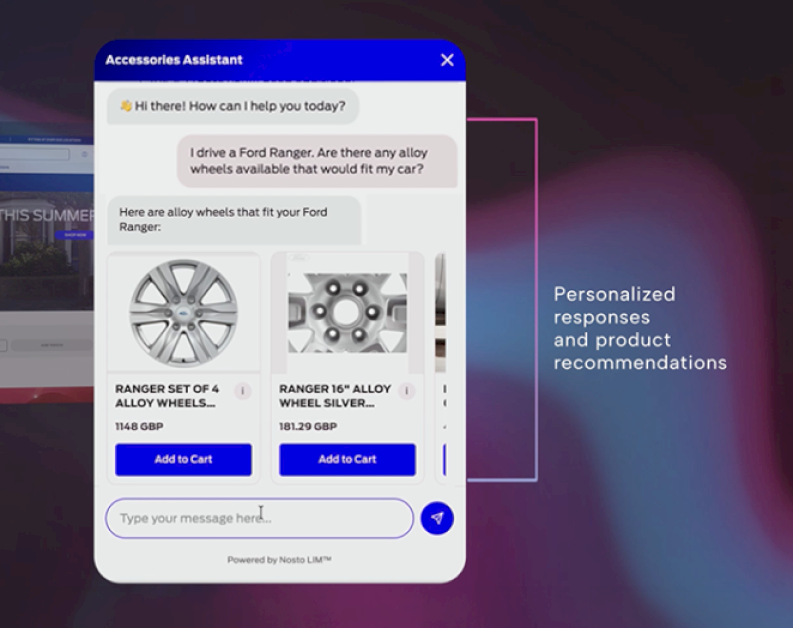
Most AI shopping assistants today have a fundamental problem: they give everyone the same answer. Same question, same response, regardless of what you’ve been browsing, what you’ve bought before, or what you actually care about. That’s not personalization. That’s a search bar with a friendlier interface.
The data makes this matter a lot: today, around two-thirds of chatbot interactions are standard customer service queries. But a third are product requests. Those customers are waiting 20 or 30 seconds for a generic recommendation. That’s a conversion problem dressed up as a technology problem.
The fix is context. Nosto’s approach feeds real-time behavioral signals directly into the LLM response. So if a customer has been browsing Ford Ranger accessories, the assistant already knows. It’s not starting from zero. It’s starting from intent. The result is faster, more relevant, and much closer to what a great in-store sales assistant would actually say.
Keeghan described the ideal: “If you walk into a shop, a good sales assistant understands your vibe. You might not be able to explain exactly what you want, but they tease that intent out of you.” That’s the experience AI needs to replicate online. And it’s getting closer, fast.
Agentic commerce isn’t coming. It’s already here.
The brands that win won’t just adopt AI. They’ll connect it, operationalize it, and let it act. And as Ford’s accessories stack shows, you don’t need a massive team to make it happen.
You just need the right foundation, and a tech stack that works as one. Learn more about nosto’s agentic capabilities.
Watch the panel discussion: