

Children learn entrepreneurship by creating something useful for another person, testing their assumptions, and keeping the promises their offer creates. A lemonade stand or adult-supervised online project can make value, costs, customer trust, and responsibility visible in ways that worksheets alone cannot.
The lesson is not that every child should become an entrepreneur. It is that every child benefits from seeing how useful work, careful choices, and trust create value for other people.
A child’s lemonade stand looks simple: a table, a sign, a pitcher, and a few cups. Yet it reflects many challenges that e-commerce operators face. The child must decide what to sell, whom to serve, what to charge, and how much inventory to prepare.
Small business projects teach more than arithmetic. They show that income follows when someone solves a problem or offers something another person values. E-commerce uses more advanced tools, but the principle is the same.
The European Commission’s Entrepreneurship Competence Framework describes entrepreneurship as identifying problems and taking action to “create value for others.” That value can be financial, social, or cultural, so entrepreneurship is broader than launching a company. It is a way of noticing needs and responding with initiative.
A lemonade stand should not begin with “How much money can you make?” A stronger question is, “What would make someone stop and buy?” On a hot day, a cold drink meets an obvious need. At a school event, clear pricing may matter as much as the recipe.
Stories can introduce these ideas before children test them in real life. Parents looking for age-appropriate prompts about economics, responsibility, and entrepreneurship can shop The Tuttle Twins and use the stories to start conversations, followed by practical activities where children make their own decisions. Tuttle Twins presents its books as story-based resources on entrepreneurship, economics, civic principles, and critical thinking.
Children often start with the product they want to make. Founders do this too. Both learn faster when they begin with the customer.
Ask a child to observe the location before setting up. Who passes by? When is foot traffic highest? What alternatives already exist? Then let the child form a hypothesis: “People leaving the soccer field will want a cold drink at a lower price than the concession stand.”
If sales are weak, the child can examine the timing, price, sign, or location instead of deciding the whole idea failed. A tally sheet showing passersby, conversations, and purchases introduces the difference between traffic, interest, and conversion.
This mirrors a useful ecommerce habit: form a view about customer needs, run a small test, study the response, and revise.
Revenue is easy to see. Profit takes more thought.
List the inputs: lemons, sugar, cups, ice, signs, transportation, and payment fees if digital payments are accepted. If supplies cost $18 and produce 30 sellable cups, the direct cost is 60 cents per cup before waste.
Selling at $1 may feel profitable, but spills, melting ice, or unsold stock can narrow the margin. A bigger cup may attract buyers but cost more. A lower price may raise volume but reduce profit per sale. Preparing too much creates waste; preparing too little creates stockouts.
The lesson is to connect each decision with a consequence, just as e-commerce operators do across inventory, shipping, discounts, and returns.
Children may think marketing means making the loudest sign. A better definition is helping the right customer understand the offer quickly.
A useful sign answers three questions: What is it? What does it cost? Why should I choose it? “Ice-Cold Lemonade – $1” may work better than a decorative sign that hides the price. A child can test two versions and record which one leads to more sales.
The e-commerce equivalent is a product page that clearly states the item’s purpose, price, delivery expectations, and returns policy. Good marketing reduces uncertainty without weakening trust.
Operations matter too. Customers experience the drink, waiting time, cleanliness, payment process, and response to mistakes as one purchase. Give the child responsibility for a simple plan: who pours, who takes payment, where clean cups sit, and what happens if supplies run out.
A strong product can still disappoint when checkout is confusing, delivery updates are missing, or support is slow. Payment turns the offer into a promise.
The Consumer Financial Protection Bureau groups youth financial capability into three connected areas: executive function, financial habits and norms, and financial knowledge and decision-making skills. It describes executive function as the thinking abilities used to plan ahead, focus attention, remember information, practice self-control, and manage several tasks.
A small selling project touches all three areas. The child plans inventory, records transactions, waits before spending revenue, and reviews the result. These are decisions with visible outcomes.
OECD findings from the PISA 2022 financial literacy assessment add context. Many 15-year-olds struggled to apply financial knowledge to real-life situations. Students who discussed money with parents and made some independent spending decisions tended to achieve higher financial literacy scores.
The takeaway is not that every child needs a business. Guided conversation and age-appropriate autonomy make financial ideas more concrete.
Adults can remove the lesson by making the project too polished. A parent designs the sign, chooses the price, buys too much stock, and quietly covers every loss. The stand may look successful, but the child has had little reason to think.
Set safe boundaries, then ask questions: “How many customers do you expect?” “What will you do if it rains?” “How will you know whether the price worked?” Let the child make small, reversible decisions and experience manageable mistakes.
Afterwards, ask what customers valued, which assumption proved wrong, where materials were wasted, and what should change next time. Discuss how much money to save, reinvest, spend, or give.
A weak sales day does not mean the child is bad at business. It means the offer or execution produced information.
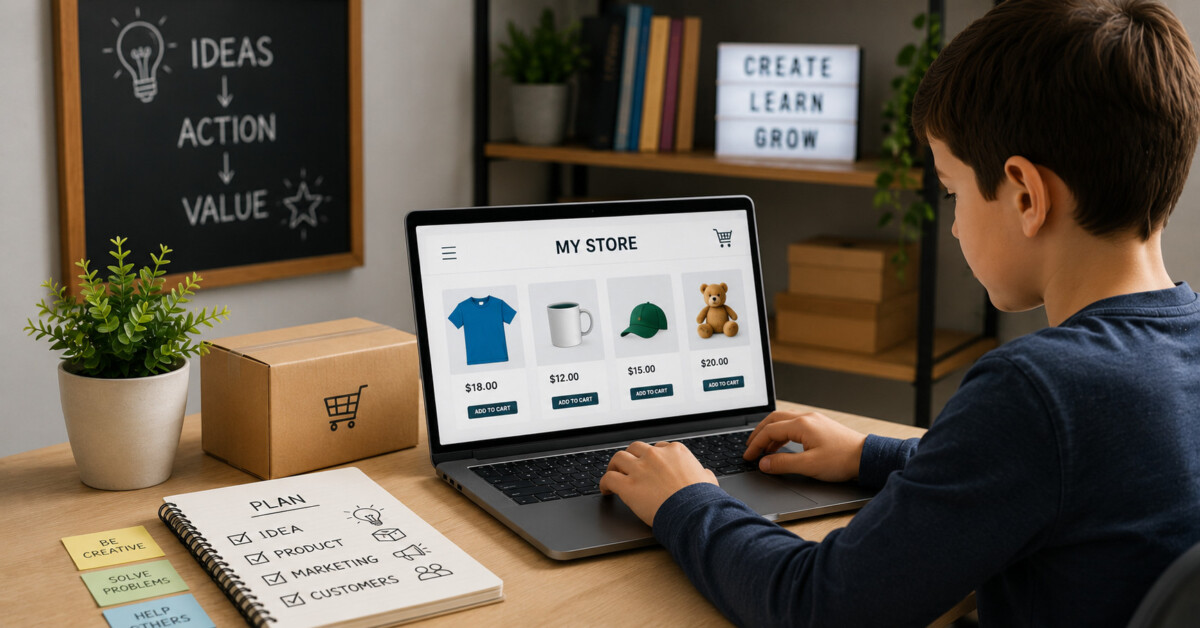
Older children can extend the same lessons online with close adult supervision. They might sell handmade bookmarks, digital artwork, tutoring slots, or another low-risk product that follows local laws and platform rules.
Keep the first version small: one product, one customer group, one clear price, and a limited number of orders. The child can write the description, photograph the item, estimate fulfilment time, and draft a customer message. Adults should control accounts, privacy, payments, and legal responsibilities, while children own suitable decisions.
The aim is not rapid growth. It is to show that an online store is a promise-making system. A listing creates expectations. An order creates work. Feedback reveals where value was delivered and where it fell short.
Lemonade stands endure because they make economic cause and effect visible. Children see that customers have choices, resources are limited, prices carry information, and profit depends on serving others well.
Moving from a sidewalk stand to a simple online store adds new tools but preserves the central lesson. Children learn to observe, test, calculate, communicate, and keep promises. Entrepreneurship is not mainly about chasing money. It is about taking responsibility for creating something another person finds worthwhile.
For e-commerce founders, that may be the most useful business lesson to pass on. Platforms and tactics will change. The habit of creating real value will remain.





