

Why on-site search and AI agent discoverability are the same infrastructure problem
A shopper types “waterproof jacket” into a search bar and gets 847 results. The same shopper asks an AI shopping agent the same question and receives three confident product recommendations, each with reasons, without the agent ever loading the website. The merchant whose product search returned 847 undifferentiated products is the same merchant that the agent passed over.
Product discovery is changing in ways that extend well beyond the AI assistants consumers use. The natural language queries shoppers now send to AI agents, full descriptions of what they need rather than keyword fragments, are the same style of query that is increasingly arriving in on-site search boxes. The infrastructure most ecommerce brands built to handle “waterproof jacket” was not designed for “waterproof jacket for hiking in the Pacific Northwest with a pack,” and that shortfall simultaneously compounds on both channels.
On-site product search and AI agent discoverability share the same foundation of rich product catalog data, semantic query understanding, and intent matching. Brands that invest in that foundation improve both at once. What follows explains how that connection works and where to start building it.
For most of the past two decades, ecommerce product search operated on a straightforward premise. Shoppers knew what they wanted well enough to name it, entered a few words into a search box, and the engine returned matching products from the catalog. “Running shoes.” “Blue sectional.” “Cast iron pan.” Short queries, reliable results.
In September 2024, Google reported that searches with more than five words were increasing, as shoppers brought the conversational habits they had learned from AI chatbots back to traditional search engines.1 On-site product search has followed the same direction. Shoppers who once typed “running shoes” now type “running shoes for flat feet that don’t cause blisters on long training runs,” a query built around a specific situation rather than a product name. Shoppers have learned to articulate what they need with precision, and they expect results that match.
Product search technology has moved to meet this. Keyword-only product search, where relevance depends on matching query words to words in a product title or description, has given way to hybrid models that combine keyword indexing with semantic vector search. Gartner’s 2025 Critical Capabilities assessment for search and product discovery found that hybrid search is now a differentiating factor across the market and that vector search is commonly used to improve query understanding. Both capabilities have moved from emerging to expected within two years.2
AI shopping agents carry this further. Rather than typing keywords, an agent sends a complete natural language description of a shopper’s need, synthesized from their preferences, history, and explicit request. On-site product search and the process an AI agent runs when evaluating your product catalog share the same core requirement. Each needs a catalog structured well enough to be understood rather than scanned for keyword matches.
Most on-site product search configurations at mid-market retailers were built for the short-query era. Baymard Institute’s 2026 ecommerce search benchmark found that 56% of sites have mediocre or worse search, and 41% fail to fully support the range of product query types shoppers use in practice.3 When a shopper’s query doesn’t map to a product title or indexed attribute, the engine returns zero results or a poorly matched results page, and most shoppers leave rather than refine the query.
Those failures carry a second cost that most ecommerce teams haven’t fully priced. In an environment where AI shopping agents evaluate product catalogs to make recommendations, the same catalog weaknesses that produce zero results on-site signal poor data quality to an agent evaluating whether your products are worth recommending. Agents use the completeness and structure of product catalog data as a proxy for merchant reliability. Thin attributes, poor synonym coverage, and unstructured product descriptions fail the human shopper querying at midnight and disqualify the product catalog from appearing in an agent’s recommendation set for the same reasons.
Gartner’s 2025 assessment found that while most vendors have released generative and conversational AI capabilities, clients remain at the pilot stage for deploying them in production.4 The market is ahead of most merchants’ implementations, which means the investment most mid-market brands need to make is clear and increasingly urgent.
When an AI shopping agent evaluates whether to recommend a product, it performs the same core operation as an on-site search engine. It queries a product catalog against a natural language input and ranks results by relevance and fit. Unlike a human shopper’s session, the agent never interacts with the search interface. It works directly from the product data.
A merchant with deep attribute coverage, clean taxonomy, and strong synonym libraries has a product catalog that both a human shopper and an AI shopping agent can read. A merchant relying on keyword matching and sparse product descriptions ends up with a catalog that struggles in both contexts, because the underlying weakness is the same.
Earlier analysis of five major AI shopping engines found a 75% overlap between the top products ChatGPT recommended and the top organic results on Google Shopping. The brands that performed well on both did so because their product catalog data was clean, complete, and well-attributed. Catalog quality determines legibility for any system querying it, whether a shopper’s on-site product search or an AI agent evaluating options in the background.
On-site product search and AI agent discoverability draw from the same enriched catalog. Investment in the center pays off on both sides.
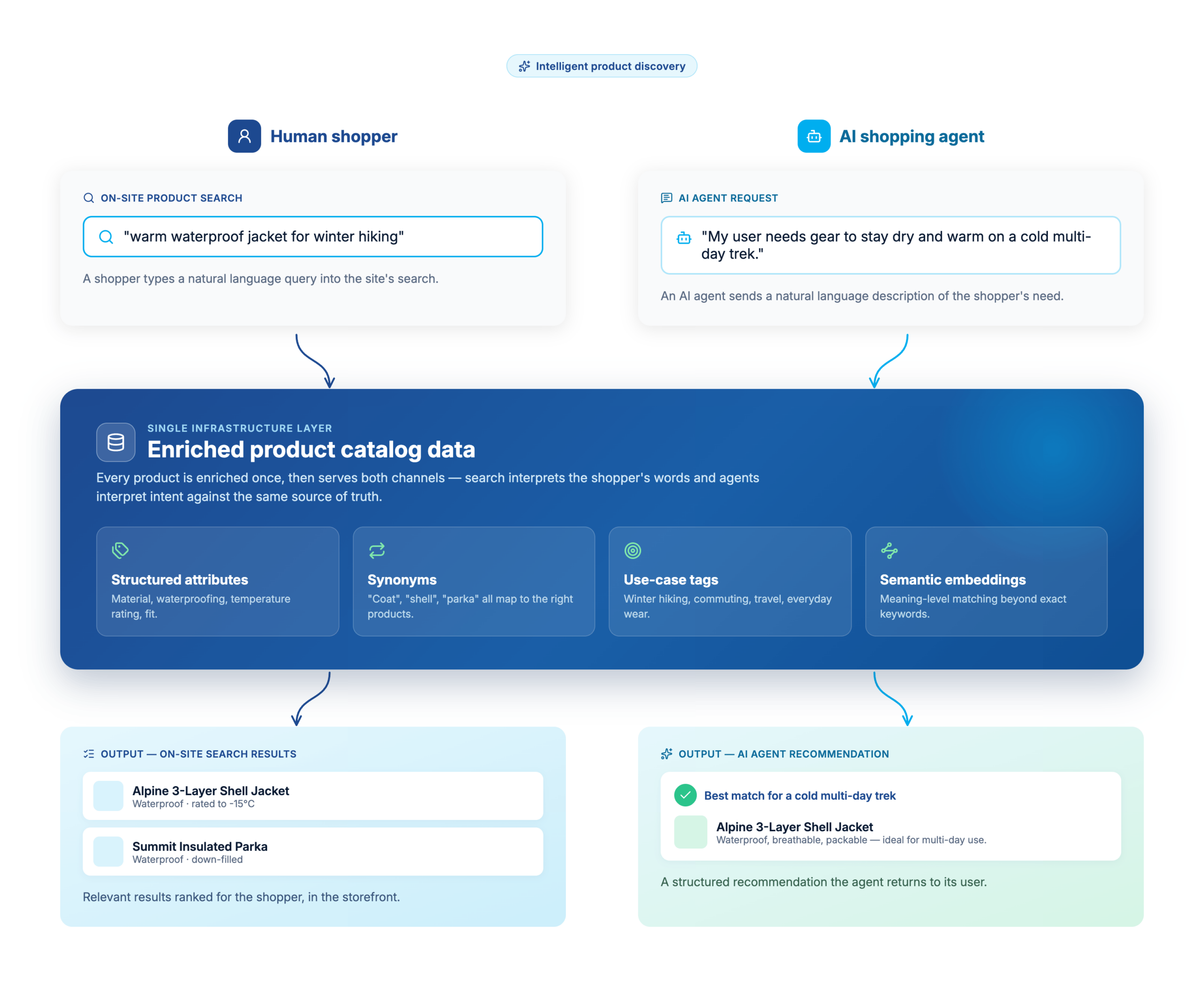
The catalog enrichment work that makes products agent-discoverable (structured attributes, synonym libraries, and use-case tags) is the same work that improves on-site search relevance. Merchants who recognize this build one project that pays off in both channels rather than two parallel efforts that each address half the problem.
Three capabilities define a product catalog ready for this environment, and each depends on the previous.
Intent understanding: A product search system that reads meaning rather than words can match “shoes for standing on concrete floors all day” to the right products even when the word “concrete” appears nowhere in a product description. This requires semantic search capability, which in turn requires a product catalog with enough attribute data, synonyms, and contextual tags to give the underlying model something substantive to work with.
Catalog-aware narrowing: Once the product search system understands what the shopper means, it needs a catalog with enough structural depth to surface the right eight products from a catalog of eight thousand. Fit data, material specifications, and compatibility details all determine whether a search returns the right result or a broadly plausible one. The query can be perfectly understood and still fail at this stage if the catalog attributes aren’t there.
Zero-result prevention: When a product search system understands intent and can query a well-structured catalog, it can return a relevant result even when no exact keyword match exists, using semantic proximity to connect what the shopper typed with the closest match in the product catalog. Gartner found that generative search and product discovery capability accounts for 50% of the weighting in its Conversational Search use case evaluation, which reflects how central it has become to where the market is heading.5 Brands building toward this capability today are addressing what buyers and agents will require at scale.
Strong attribute coverage, complete synonym libraries, and use-case tagging give semantic search engines the material they need to match intent. Without this foundation, even advanced search architectures return thin results. The catalog and the search layer need to be built in parallel to produce results worth measuring.
A practical starting sequence begins with measurement before infrastructure. Each step below builds on the previous, and each addresses a distinct part of the shared foundation that on-site product search and agent discoverability both draw from.
Measure your zero-result rate: Most ecommerce teams don’t know this number with precision, which means they’re underestimating the problem. A zero-result rate above 5% is a direct signal of keyword dependency in the search layer, and it translates directly to revenue loss. Establishing this baseline gives teams the internal justification for a semantic search investment and a clear metric to track improvement against.
Enrich the product catalog’s attribute layer: Both semantic search and agent evaluation run better when the catalog contains detailed synonyms, granular attribute data, and use-case descriptions. This work doesn’t require a platform migration to begin. Starting with the highest-traffic product categories and expanding systematically produces meaningful improvement before any infrastructure change, and it reduces the risk of a larger migration by exposing weak attribute coverage early.
Test conversational product search on your highest-intent entry points: Category pages and campaign landing pages are where shopper intent is clearest and where relevance improvements show up fastest in conversion data. A focused test on one category generates the proof of concept that makes the case for broader rollout.
The brands that move through this sequence most efficiently tend to be the ones with teams that understand catalog structure and product search behavior together rather than treating them as separate disciplines. A catalog investment without a capable search layer rarely delivers the conversion lift it should, and an advanced search architecture running on thin product records produces similarly limited gains. Both sides need an owner who sees the full picture.
Morgan Stanley projects that AI shopping agents could represent 10 to 20% of US online retail by 2030, equal to $190 billion to $385 billion in spending, up from near zero today.6 Agentic commerce is the channel where that spending will flow, and the brands positioned to capture it are the ones investing in catalog and search infrastructure now. Ecommerce leaders who build this foundation gain better product search conversion this year and agent discoverability as that channel scales. One investment, two compounding returns.
Athos Commerce is an intelligent discovery platform for ecommerce brands, combining on-site search, personalization, merchandising, and product feed management with AI-powered conversational and generative discovery tools. Learn more about Athos Search and Conversational Assistant.
On-site product search and AI agent discoverability share the same underlying infrastructure: enriched product catalog data, semantic query understanding, and intent matching. When an AI shopping agent evaluates whether to recommend a product, it queries a product catalog against a natural language input and ranks results by relevance, the same core operation performed by on-site search. Brands that invest in catalog enrichment and semantic search capability improve both channels at once.
Keyword-dependent product search was built for short queries (“running shoes,” “blue sectional”) but shoppers now send full natural language descriptions of their needs, a change driven by conversational AI habits. Baymard Institute’s 2026 benchmark found that 56% of ecommerce sites have mediocre or worse search, and 41% fail to support the range of product query types shoppers use in practice. AI shopping agents evaluating product catalogs treat the same catalog weaknesses as signals of poor data quality, reducing the likelihood of product recommendation.
Structured attribute coverage, synonym libraries, and use-case tags are the three catalog improvements with the highest combined impact on on-site search and agent discoverability. Structured attributes give search engines and AI agents the detail needed to match specific queries. Synonym libraries ensure shopper language and product catalog language align. Use-case tags connect products to the situations shoppers describe rather than just the names they use. Earlier analysis found a 75% overlap between ChatGPT product recommendations and top Google Shopping results, driven by well-attributed catalog data.8
Morgan Stanley projects that AI shopping agents could represent 10 to 20% of US online retail by 2030, equal to $190 billion to $385 billion in spending, up from near zero today.7 Brands that build the catalog and search infrastructure required for agent discoverability now position themselves to capture that channel as it scales while also improving on-site product search conversion in the near term.
A practical starting sequence begins with measurement before infrastructure. First, measure the on-site zero-result rate; a rate above 5% indicates keyword dependency and surfaces the business case for a semantic search investment. Second, enrich the product catalog’s attribute layer, beginning with the highest-traffic categories. Third, test conversational product search on one high-intent category page to generate proof-of-concept data before broader rollout. Each step addresses the shared catalog foundation that on-site product search and AI agent discoverability both draw from.
Product data decides whether creator content converts. A high-performing video still loses the sale if it points to a product that went out of stock or changed price between the seller’s systems and the TikTok Shop feed. Retailers who scale the channel keep on-site and off-site discovery in a single enriched product record, so a single correction reaches the website, the marketplace listing, and the creator’s shoppable video at once. Athos Commerce calls this connected approach intelligent discovery.




