





Quick Decision Framework
- Who This Is For: Shopify merchants actively selling in the US who want to understand the real differences between Google AI Mode and ChatGPT Shopping before deciding where to focus their time and catalog optimization effort.
- Skip If: Your catalog has fewer than 20 clean, well-attributed SKUs. Fix your product data first, then come back to this channel decision.
- Key Benefit: A clear, fee-by-fee, feature-by-feature comparison that tells you which channel to prioritize first based on your margin structure, product type, and stage.
- What You’ll Need: Access to your Shopify Admin, a rough sense of your average order value and margin, and 10 minutes to read this before your next catalog review.
- Time to Complete: 10 minutes to read. 30 minutes to act on the recommendation for your stage.
Two of the biggest technology companies in the world just turned their AI platforms into shopping channels. They made different bets. One charges you a fee. One does not. The right answer for your store depends on your margin, your product type, and how much you trust a new channel with your best customers.
What You’ll Learn
- How Google AI Mode and ChatGPT Shopping actually work for Shopify merchants, in plain language without the vendor spin.
- What the 4% ChatGPT fee really costs at different revenue levels and how it compares to Google’s current zero-fee model.
- Which channel suits which product type, merchant stage, and margin structure based on how each platform surfaces and converts products.
- What the honest risks are on both platforms, including the ones neither Google nor OpenAI will tell you about.
- How to decide which channel to turn on first and what to do in your Shopify Admin before you do it.
Two channels are live right now that did not exist twelve months ago. Google AI Mode lets shoppers buy from Shopify merchants directly inside Google Search and the Gemini app, powered by the Universal Commerce Protocol that Shopify co-developed with Google. ChatGPT Shopping lets shoppers buy from over a million Shopify merchants inside ChatGPT, powered by OpenAI’s Agentic Commerce Protocol and Stripe’s payment infrastructure. Both are real. Both are live for US merchants. Both are managed from a single place inside your Shopify Admin through Agentic Storefronts.
The question every merchant is now asking is which one to prioritize. Most of the coverage out there answers that question from a technology angle or a consumer angle. This piece answers it from a merchant angle: fees, product fit, margin math, and what you actually need to do to show up well on each platform. For the full infrastructure picture behind both channels, the complete guide to agentic commerce for Shopify gives you the foundation this piece builds on. And for the latest on how Shopify is connecting merchants to every major AI channel simultaneously, see Shopify’s March 2026 agentic commerce platform announcement.
Here is the honest comparison.
How Each Platform Actually Works
Before you can decide which channel to prioritize, you need to understand what each one is actually doing when a shopper interacts with it. They are built on different assumptions about how people shop, and those assumptions produce different outcomes for merchants.
Google AI Mode: search intent meets the Shopping Graph
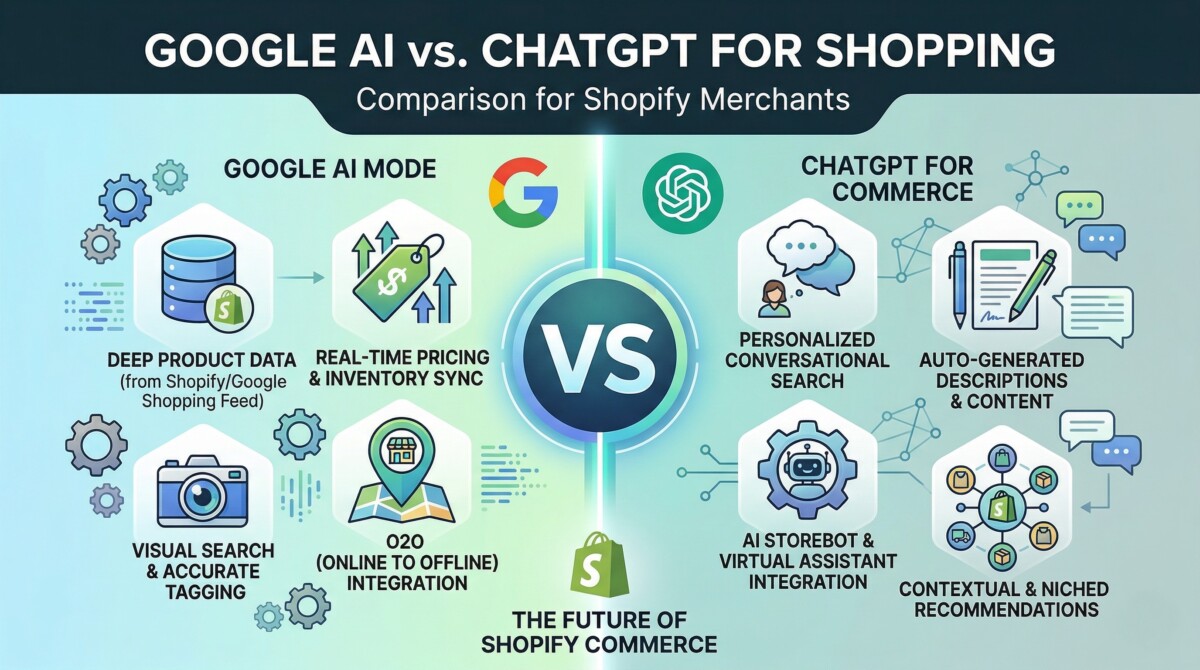
Google AI Mode is search, rebuilt. When a shopper types a complex, conversational query into Google Search or the Gemini app, AI Mode uses what Google calls “query fan-outs” to simultaneously process multiple dimensions of the request. A query like “I need a gift for my sister who runs half marathons and hates synthetic fabrics, under $120” gets decomposed into material requirements, use case, budget, and gift context, all at once, then matched against Google’s Shopping Graph, which contains over 50 billion product listings refreshed at a rate of 2 billion per hour.
The result is a highly visual, shoppable response that looks less like a search results page and more like a curated shortlist from a knowledgeable store associate. Shoppers can filter, compare, and for eligible merchants, complete checkout without leaving Google’s interface. UCP-powered checkout is live now for Etsy and Wayfair, with Shopify, Target, and Walmart rolling out in the coming months.
Google has also launched three tools that sit on top of AI Mode for merchants:
- Business Agent: a branded AI chat experience that lets shoppers ask your brand product questions directly inside Google Search, in your brand’s voice. Live now with Lowe’s, Reebok, Poshmark, and others.
- Direct Offers: a pilot that lets merchants present exclusive discounts to high-intent shoppers inside AI Mode at the moment of consideration. Already live with Petco, e.l.f. Cosmetics, Samsonite, and Shopify merchants.
- New Merchant Center attributes: dozens of new data fields designed specifically for conversational commerce, including answers to common product questions, compatible accessories, and substitutes. Rolling out to a small group first, then expanding.
The underlying data advantage Google brings is significant. Its Shopping Graph has been built over two decades of product indexing. AI Mode sits on top of that infrastructure, which means your existing Google Merchant Center feed is already part of the system. You are not starting from zero. For a deeper look at whether your store is ready to take full advantage of UCP-powered checkout on Google, see whether your store is UCP-ready.
ChatGPT Shopping: conversational discovery at massive scale
ChatGPT Shopping is different in character. Where Google AI Mode is built on top of search infrastructure and product data, ChatGPT Shopping is built on top of conversation. When a shopper asks ChatGPT a question that involves a product need, the model interprets the full context of the conversation, asks clarifying questions if needed, and returns a curated shortlist with comparisons, specs, and for participating merchants, the ability to complete checkout without leaving the chat.
ChatGPT has 800 million weekly users. That is not a search audience. It is a conversation audience, and the shopping behavior that emerges from conversations is meaningfully different from search-driven shopping. Queries in ChatGPT tend to be longer, more personal, and more context-rich than Google searches. Someone asking ChatGPT for gift ideas is sharing more about the recipient, the occasion, and the budget than they would in a search box. That context is what makes ChatGPT recommendations feel personal rather than algorithmic.
Instant Checkout, powered by OpenAI’s Agentic Commerce Protocol and Stripe’s payment infrastructure, went live for all US users across Free, Plus, and Pro tiers in February 2026. Over 1 million Shopify merchants are auto-enrolled in ChatGPT’s product index. Merchants remain the seller of record. Orders flow into Shopify with standard attribution. The 4% fee applies only to completed Instant Checkout transactions, not to product discovery or clicks that redirect to your store. According to Marketplace Pulse’s breakdown of ChatGPT’s fee economics, ChatGPT generates an estimated 3.9 billion annual product queries, which positions it as a functioning marketplace at scale even before checkout volumes are significant.
The Fee Math: What Each Channel Actually Costs
This is the number every merchant wants to see before making a channel decision. Here it is, stated plainly.
Google AI Mode currently charges no additional transaction fee beyond your standard Shopify payment processing. You pay what you already pay. ChatGPT Instant Checkout charges a 4% transaction fee on completed purchases, on top of your standard Shopify fees. That fee is opt-in: you can enable product discovery on ChatGPT without enabling Instant Checkout, which means your products appear in ChatGPT responses and link to your store without triggering the fee.
Here is what the math looks like at different revenue levels, assuming a 2.9% standard processing fee and the ChatGPT 4% fee on top:
Three things to hold in mind when you look at those numbers. First, Google’s zero-fee model almost certainly does not stay zero forever. Marketplace Pulse notes explicitly that “the zero-fee positioning from both platforms likely represents early market-share acquisition rather than sustainable long-term models.” If you build your channel strategy around Google being free, build it knowing that assumption may not hold in 18 months. Second, the 4% ChatGPT fee compares favorably to Amazon’s 8 to 15% referral fees and TikTok Shop’s 8%, and unlike those platforms, ChatGPT requires zero advertising spend to get organic product discovery. Third, the fee only applies if you opt into Instant Checkout. You can run ChatGPT as a pure discovery channel at zero additional cost and redirect shoppers to your store for checkout, which preserves your customer relationship and avoids the fee entirely.
The question is not “which channel is cheaper.” The question is “which channel delivers enough incremental revenue to justify its cost structure at my margin.” That answer depends on your product. For the broader framework on how to think about your catalog’s readiness for either channel, why your product data is now your storefront gives you the right mental model.
Which Channel Fits Which Product and Merchant Stage
The fee math matters, but product fit matters more. Each platform surfaces products differently, which means each platform rewards different kinds of products and different kinds of merchants.
Google AI Mode tends to favor these scenarios
Google AI Mode is built on search intent. The shoppers using it are already in a buying mindset. They came to Google to find something. AI Mode just makes that journey more efficient. That intent profile rewards products with clear, comparable specifications, established demand signals in Google’s Shopping Graph, and competitive pricing that can be surfaced and compared in real time.
Google AI Mode tends to perform best for:
- Products with strong existing Google Shopping presence. If you already have a clean Merchant Center feed and your products rank in standard Shopping, AI Mode amplifies that. You are not starting from zero.
- High-consideration purchases. Electronics, home goods, outdoor gear, and supplements, where shoppers want to compare specs before buying, are natural fits for AI Mode’s query fan-out approach.
- Price-competitive categories. Google’s Shopping Graph refreshes 2 billion listings per hour. If your pricing is competitive and your data is clean, AI Mode can surface you at the exact moment a shopper is comparing options.
- Merchants with existing Google Ads investment. Direct Offers gives you a way to layer exclusive discounts on top of organic AI Mode discovery. If you’re already running Shopping campaigns, this is an incremental lever, not a new channel to build from scratch.
ChatGPT Shopping tends to favor these scenarios
ChatGPT Shopping is built on conversation. The shoppers using it are often earlier in their decision process, working through a problem rather than executing a known search. That context profile rewards products that benefit from explanation, comparison, and personalization, and brands that can communicate their differentiation in plain language rather than keyword-optimized copy.
ChatGPT Shopping tends to perform best for:
- Gift purchases and occasion-driven buying. ChatGPT’s conversational interface is where people say “I need a gift for my dad who loves fishing and hates clutter.” That context is gold for the right product.
- Products with a strong “who it’s for” story. If your product solves a specific problem for a specific person, ChatGPT’s model can match it to the right buyer more precisely than a keyword search.
- Higher-margin products where the 4% fee is manageable. A 4% fee on a $200 product is $8. On a $30 product with a 40% margin, it eats meaningfully into profit. Know your numbers before opting into Instant Checkout.
- Brands with strong product descriptions and clean attributes. ChatGPT surfaces what it can understand. If your descriptions are thin or generic, you will not get recommended. If they are specific and use-case driven, you have an advantage over competitors who have not optimized for this.
The honest side-by-side
The Honest Risks on Both Platforms
Every piece of coverage on these channels leads with the opportunity. Here is what neither Google nor OpenAI will tell you directly.
Google AI Mode risks for merchants:
The zero-fee model is almost certainly a land-grab strategy. Google has a long history of offering free access to new surfaces, building merchant dependency, and then introducing monetization. Direct Offers is already a paid pilot. Business Agent will likely have a paid tier. Merchants who build their channel strategy around Google’s current zero-fee model should plan for a fee structure to emerge within 12 to 24 months.
Google’s Shopping Graph also means your pricing is visible and comparable in real time. If a competitor drops their price by $2, AI Mode may switch its recommendation mid-conversation. Traditional urgency tactics like “only 3 left in stock” carry less weight when the buyer is an algorithm monitoring inventory levels across the entire internet. Price competitiveness becomes more important, not less, as AI Mode adoption grows.
Finally, UCP-powered checkout on Google is still rolling out. Shopify merchants are in the “coming soon” category as of March 2026, not yet live. You can optimize for discovery now, but the full embedded checkout experience is not yet available to most Shopify merchants.
ChatGPT Shopping risks for merchants:
The 4% fee compounds with your existing processing costs. On low-margin products, enabling Instant Checkout may actually reduce profitability on ChatGPT-driven sales even if volume grows. Run the math on your specific product margin before opting in.
ChatGPT’s product recommendations are based on model judgment, not bid-based ranking. OpenAI has stated that enabling Instant Checkout does not bias recommendations toward merchants who pay the fee. That is good for objectivity. It also means you cannot buy your way into better placement. Your product data quality, description clarity, and attribute completeness are your only levers.
Attribution is also genuinely difficult right now. You will see ChatGPT-referred sessions in your analytics, but query-level data, what the shopper actually asked that led to your product being recommended, is not available. You are optimizing somewhat blind in the early stages.
Which Channel Should You Prioritize First?
The honest answer is that the right channel depends on your situation, and the framework for deciding is simpler than most coverage suggests. Here is how to think through it by stage.
If you are doing under $50K per month: Start with Google AI Mode. Your Merchant Center feed is likely already there, the fee is zero, and the search-driven intent profile means you are reaching buyers who already know they want something like what you sell. Enable discovery on ChatGPT as well, but hold off on Instant Checkout until you have enough volume to measure whether the 4% fee is worth it at your margin.
If you are doing $50K to $500K per month: Run both channels for discovery. Enable Instant Checkout on ChatGPT for your highest-margin SKUs only, not your full catalog. Use the 90-day baseline approach from your analytics to measure AI-attributed revenue and return rate separately on each channel. The data will tell you where to double down.
If you are doing over $500K per month: Assign a single owner to AI channel performance. Treat Google AI Mode and ChatGPT Shopping as two separate channels with separate KPIs, separate product eligibility decisions, and separate optimization cadences. The fee difference at this revenue level is meaningful enough to warrant careful SKU-level decisions about where Instant Checkout is enabled. Use the Shopify AI visibility audit to pressure-test your current discoverability on both platforms before making eligibility decisions.
Regardless of stage, the single most important thing you can do before enabling either channel is clean your product data. Both platforms surface what they can understand. Both reward specificity over marketing copy. Both penalize vague descriptions, inconsistent variants, and missing attributes. The merchants who win early on both platforms are not the ones who turned the channels on first. They are the ones whose catalogs were ready when they did.
What to Do in Your Shopify Admin Right Now
Both channels are managed from a single place: Agentic Storefronts inside your Shopify Admin. Here is the practical sequence.
- Go to Agentic Storefronts in your Admin. Review which channels are currently enabled for your store. By default, US merchants are already discoverable on ChatGPT, Microsoft Copilot, Google AI Mode, and Gemini. Confirm what is on and what is off.
- Check which products are eligible. Not every SKU needs to be on every channel. Use the eligibility controls to start with your top 20 to 50 best-selling, best-attributed products. Expand from there once you have baseline data.
- Decide on Instant Checkout for ChatGPT. This is the opt-in decision that triggers the 4% fee. If your margin on your top SKUs supports it, enable it and measure. If it does not, leave it off and let ChatGPT drive discovery traffic to your store instead.
- Clean your Merchant Center feed for Google. AI Mode pulls from the same feed as standard Shopping. If your titles, attributes, and pricing are clean there, you are already set up for AI Mode discovery. If they are not, fixing the feed improves both channels simultaneously.
- Set up your Knowledge Base. Both platforms will answer shopper questions about your brand using whatever policy information is available. If your shipping times, return windows, and warranty terms are not clearly documented, agents fill those gaps with generic answers. That kills conversion. Fix it before you drive volume to either channel.
For the full answer-first content framework that makes your product pages and policies agent-readable on both platforms, the answer-first content strategy for Shopify is the companion piece to read next.
The Bottom Line
Google AI Mode and ChatGPT Shopping are not competing for the same slot in your channel mix. They are different tools for different moments in the shopping journey. Google captures high-intent buyers who already know what they want. ChatGPT captures conversational shoppers who are working through a decision. Both are worth being on. The fee difference is real but manageable if you are strategic about where you enable Instant Checkout on ChatGPT.
The mistake most merchants will make is treating this as an either-or decision and optimizing for one platform while ignoring the other. The merchants who win over the next 12 months will be the ones who set up clean product data once, enable discovery on both platforms, and use the data from the first 90 days to decide where to invest more deeply.
Neither channel replaces your storefront. Both channels extend your reach into conversations that were not previously shoppable. Your job is to make sure that when a shopper’s conversation leads to your product, the agent can recommend it confidently and the checkout experience does not let you down.
Frequently Asked Questions
Do I have to pay the 4% ChatGPT fee to have my products show up in ChatGPT?
No. The 4% fee only applies to completed purchases through ChatGPT’s Instant Checkout feature. Your products can appear in ChatGPT responses and link back to your Shopify store at no additional cost. Shopify merchants are auto-enrolled in ChatGPT’s product index, which means your products are already discoverable inside ChatGPT conversations. The Instant Checkout fee is an opt-in decision you make inside Agentic Storefronts in your Shopify Admin. You can enable product discovery without enabling checkout, which gives you zero-fee traffic from ChatGPT that converts on your own storefront instead.
Is Google AI Mode shopping available to all Shopify merchants right now?
Discovery through Google AI Mode is available now for eligible US Shopify merchants. Your products can appear in AI Mode responses and in the Gemini app as part of Google’s Shopping Graph, which contains over 50 billion product listings. However, UCP-powered embedded checkout inside Google AI Mode is still rolling out as of March 2026, with Shopify merchants in the “coming soon” category alongside Target and Walmart. Etsy and Wayfair were the first to go live with embedded checkout. The practical implication: optimize for discovery now, and the checkout capability will become available as the rollout expands.
Which platform is better for products with low margins?
For low-margin products, Google AI Mode is the better starting point because it currently charges no additional transaction fee. The 4% ChatGPT Instant Checkout fee compounds with your standard 2.9% processing fee, bringing total costs to roughly 6.9% on ChatGPT checkout transactions. On a product with a 20 to 30% margin, that fee structure meaningfully reduces profitability. The practical approach for low-margin products is to enable discovery on ChatGPT (which is free) without enabling Instant Checkout, so you capture the traffic without the fee. Reserve Instant Checkout for your highest-margin SKUs where the fee is manageable.
How do I optimize my products to show up in both Google AI Mode and ChatGPT Shopping?
The product data requirements for both platforms are more similar than different. Both reward specific, constraint-driven product titles (size, material, compatibility, use case), unambiguous variant names, complete attributes (dimensions, ingredients, certifications, what’s included), accurate inventory signals, and crisp policy information (shipping times, return windows, warranty). For Google AI Mode, your existing Google Merchant Center feed is the primary data source, so cleaning that feed improves your AI Mode presence immediately. For ChatGPT, your Shopify product catalog is the source. The fastest path to better discovery on both platforms is the same: fix your product data so an AI agent can answer “what is it, who is it for, and what constraints does it satisfy” in two sentences.
Will Google AI Mode stay free for merchants?
Almost certainly not forever. Google’s current zero-fee model on AI Mode is widely understood to be a market-share acquisition strategy rather than a sustainable long-term position. Direct Offers, Google’s paid pilot that lets merchants present exclusive discounts inside AI Mode, is already live and represents the beginning of monetization. Business Agent will likely follow with paid tiers. Merchants building their channel strategy around Google’s zero-fee model should plan for a fee structure to emerge within 12 to 24 months and factor that into their long-term channel economics. The right move now is to build your catalog and data quality to perform well on Google while the cost of entry is low, so you have an established presence before fees arrive.
