


Picture this: It’s 9:47 PM on a Tuesday in late November.
Someone just saw your Instagram ad while scrolling before bed. They’re ready to buy—wallet out, credit card in hand—but they have one question about sizing. They see your phone number, hit dial, and… voicemail.
They hang up. Open Google. Search for your competitor. You just lost a sale.
Here’s what stops me cold: research shows that over 80% of customers who hit voicemail don’t call back. They’re gone. And suppose you’re like most Shopify brands I’ve worked with over the past six years at Shopify (and now through eCommerce Fastlane). In that case, your phone strategy is either someone’s personal cell that may or may not get answered, or it’s completely ignored while you focus on “sexier” channels like Instagram and TikTok.
We’re now 50-something days from BFCM 2025. Everyone’s talking about AI. Your inbox is probably flooded with pitches about chatbots, personalization engines, and tools that promise to “10x your conversions.” I get it—I’ve tested most of them with merchants doing anywhere from $10K to $10M annually.
But here’s what I’ve learned after working directly with over 100 Shopify merchants and recording 420 podcast episodes interviewing the best operators in this space: most AI conversations are missing critical pieces. The economic reality of 2025 makes getting this right more crucial than ever.
A July 2025 report found that 82% of consumers plan to cut back on essentials to cover holiday expenses, and 55% say discounts influence their purchasing decisions. Translation: your customers are pickier, more price-sensitive, and have higher expectations. You can’t just discount deeper—that kills your margins. You need to compete on experience.
That’s where AI actually matters. Not the hype. Not the buzzwords. The real, implementable stuff that works whether you’re doing your first $50K year or your fifth $5M year.
This isn’t 2021 anymore. The pandemic spending surge is over. Customer acquisition costs are up 11.7% in H1 2025. Revenue from new customers dropped 9.39%. Your customers are stretched thin, and competition for their dollars is fiercer than I’ve ever seen it.
However, I’ve observed a consistent pattern: last-minute shoppers are becoming a massive opportunity. In 2024, 157 million people shopped the Saturday before Christmas. That’s not a typo—the Saturday. Not Black Friday. Not Cyber Monday. The week before Christmas.
The National Retail Federation reported that 44% of shoppers now browse both online and in-store (up from 41% in 2023), and 24% shop exclusively online (up from 22%). When there are fewer days between Thanksgiving and Christmas, people go online because they don’t have time to browse stores.
Whether you’re just launching your first Shopify store or running a Shopify Plus operation, here’s what this means: the shopping window is longer, more fragmented, and more mobile than ever. And if you’re not ready with the right AI infrastructure, you’re leaving money on the table.
Here’s a stat that should wake you up: 70% of Cyber Week sales in 2024 came from mobile devices. Not desktop. Mobile.
I don’t care if you implement every AI tool I mention in this article—if your mobile experience is slow, clunky, or confusing, none of it matters. Fast loading speeds. Large touch targets. Mobile wallets like Shop Pay. These aren’t nice-to-haves. They’re table stakes.
The reason I’m mentioning this before we even talk about AI tools is simple: AI should enhance your mobile experience, not complicate it. Keep that in mind as we dig into specific solutions.
I want to clarify something upfront because too many merchants fall for overhyped promises: AI won’t magically solve all your problems. It can’t replace quality products, solid operations, or effective marketing. What AI can do—when implemented properly—is automate repetitive tasks at scale, save you time, and enhance customer experiences beyond what you could achieve manually.
Here’s an important distinction: AI automation follows rules you set (like “send this email 2 hours after cart abandonment”). AI agents, however, make decisions based on context (for example, “decide if this customer needs a human rep or if I can resolve the issue myself”).
Most Shopify stores are already using basic AI through Shopify Magic for product descriptions, often without realizing it. That’s a good start. But there’s a significant gap that almost no one is addressing—and it’s costing you more than you realize.
Imagine this scene: You’ve spent $3,000 on Facebook ads this month. You’ve optimized your product pages. Your email flows are dialed in. Your Instagram feed is perfect. But when someone calls your number at 9 PM with a sizing question—radio silence. Voicemail.
That customer is gone.
I’ve been in the Shopify ecosystem for over six years, working with everyone from bootstrapped first-time founders to brands like Dr. Squatch and Tentree. You know what I see consistently? Even sophisticated operators treat their phone number like an afterthought.
Here’s the pattern:
Every stage has the same problem: when someone calls outside your coverage window, you lose them.
And while everyone’s focused on chatbots and on-site widgets, there’s a fundamental difference: chatbots only help people already on your website. But what about the customer who’s driving, sees your ad, and wants to call? What about the international customer who speaks German? What about the person who simply prefers talking to typing?
This is where AI voice agents come in—and they’re fundamentally different from anything else in your tech stack.
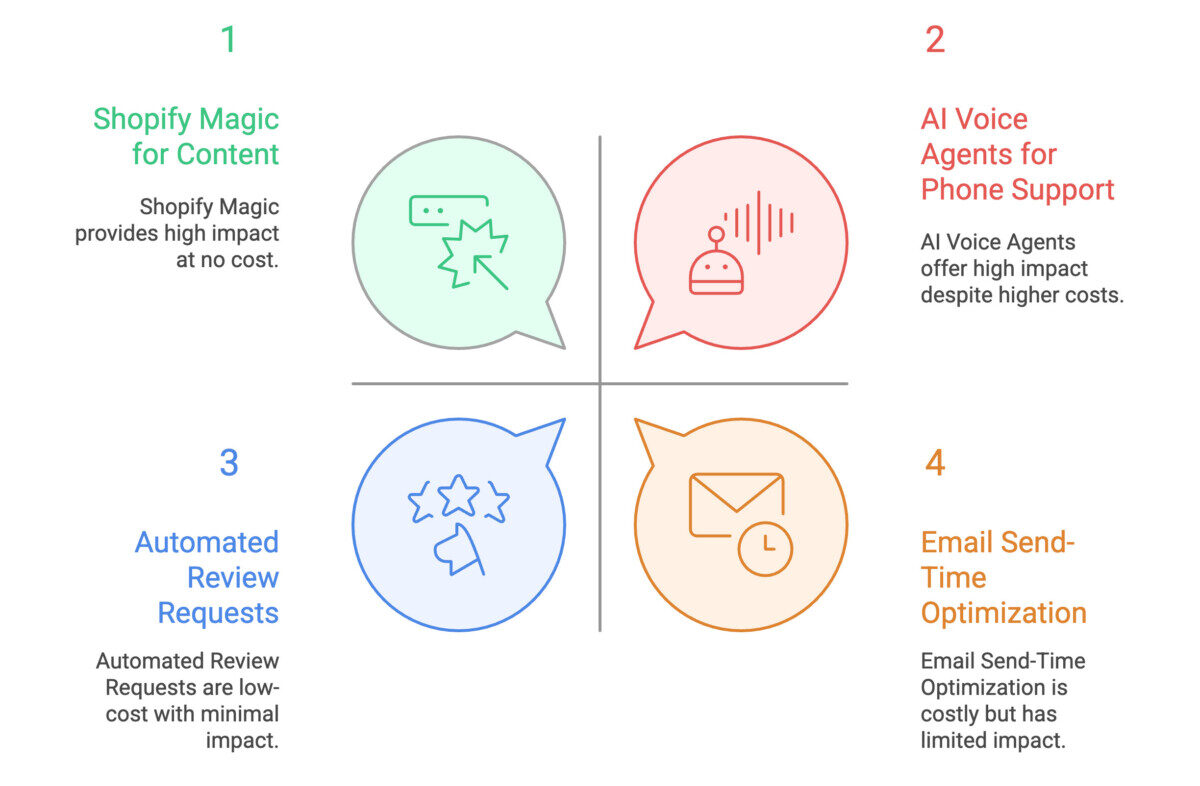
Whether you’re launching tomorrow or you’re doing $5M annually, here’s what I’ve learned works consistently. I’m breaking this into implementations you can complete in days, not months.
If you’re not using this yet, turn it on today. It’s already included in your Shopify plan. Product descriptions, email copy, instant translations—all handled in seconds instead of hours.
Timeline: 30 minutes to start seeing benefits
Cost: $0
Best for: All brands, all stages
This is the gap I want you to focus on. Here’s what stopped me in my tracks when I first learned about solutions like NLPearl: they answer actual phone calls on real phone numbers. Not browser widgets. Not on-site chat. When someone dials your number, an AI agent picks up.
Here’s what that looks like in practice:
The scenario: It’s 11 PM. A customer in Germany saw your Instagram ad. They have a question about whether your product ships internationally and what the duties might be. They call your number.
What happens: The AI agent answers immediately. In real-time, it detects they’re speaking German and switches languages automatically. It pulls up your Shopify backend data, checks your shipping policies, and answers their question. The customer places the order. You wake up to a sale you would have otherwise lost.
This isn’t theoretical. I recently spoke with Thomas Rivera from NLPearl (full disclosure: I had him on the podcast—episode goes live this week). Here’s what he told me that changed my thinking:
They have a mid-market Shopify client handling about 1,000 calls per day. Before implementing AI voice agents, their call center only operated during business hours and supported two languages. After implementation, they saw 30-40% improvement in customer experience and are now covering 18+ languages, 24/7.
What it actually does:
The costs: Starting at $49/month with a 7-day free trial. That’s roughly 10 human employees working 24/7, never taking a break, never having a bad day, speaking 18 languages.
Timeline: 10 minutes setup, live immediately
Best for: Any brand with a phone number on their website (so, everyone)
Here’s my honest take: if you’re just starting out, this might feel like overkill. But here’s what I wish someone had told me when I was launching VisionPros back in the day—every missed call is a missed sale. And unlike Facebook ads where you can throw more money at the problem, you can’t get those callers back.
If you’re scaling or established, this should be running already. If not, the question isn’t “should I test this?” It’s “why am I still losing calls to voicemail?”
Remember Cecil & Lou? Children’s apparel company. They implemented Attentive’s Send Time AI to optimize when emails hit each customer’s inbox. Not when it’s convenient for you—when each individual customer actually opens their email.
Results: 54% revenue increase, 22% higher click-through rates.
Timeline: 1-2 weeks to implement and see initial data
Cost: $200-500/month depending on list size
Best for: Brands with 5,000+ email subscribers
Simple. High impact. Set up an automated flow that requests reviews 7-14 days after delivery. Use AI to generate personalized review request messages based on the product purchased.
Timeline: 2-3 hours setup
Cost: Often included in your review platform
Best for: All brands, especially if you’re not already collecting reviews consistently
Tools like Loop Intelligence learn from network data across thousands of merchants. When fraudsters hit one store, every store gets smarter. CNBC reported that friendly fraud costs U.S. businesses over $100 billion annually, with merchants spending $4.60 for every dollar lost to fraud.
During BFCM, fraud attempts spike. Don’t let this be the surprise that ruins your holiday revenue.
Timeline: 1-2 days implementation
Cost: Varies by order volume
Best for: Any brand processing payments (so, everyone)
If you have a bit more runway—say you’re reading this in early October—here’s what requires more setup but delivers meaningful ROI:
Here’s where I save you time and money: don’t attempt these with less than 60 days to BFCM:
These might be Q1 2026 projects. They’re not BFCM 2025 solutions. And anyone telling you otherwise is setting you up for frustration.
Here’s what I want you to understand about where we’re headed: AI commerce is now genuinely multi-channel. And I don’t mean “omnichannel” in the tired marketing sense. I mean your customers expect AI assistance wherever they are.
They might discover you through social media, research you via ChatGPT (yes, Shopify now has an official ChatGPT integration as of September), browse your website with an on-site chatbot helping them, and then—here’s what everyone’s missing—call your phone number at 10 PM because they have one quick question.
The brands winning BFCM 2025 will have AI presence across all these channels, not just one. But here’s the honest truth: most Shopify competitors haven’t even considered the voice channel yet.
While everyone’s optimizing chatbots and email, voice remains a massive first-mover opportunity. Here’s why it matters:
Three reasons voice works:
Voice commerce is projected to hit $87 billion by 2035. We’re in the early days. The brands implementing AI voice agents now have a genuine competitive advantage because most of your competitors haven’t even thought about this channel.
Quick question: When’s the last time you called your own phone number after business hours? Try it. What happens? If it’s voicemail, you’re losing sales.
20% of ecommerce teams cite AI/ML as a major skills gap. But here’s the truth: implementing existing tools doesn’t require a data scientist. 77% of ecommerce professionals now use AI daily. It’s becoming table stakes, not rocket science.
My recommendation: Start with tools that have great support, clear documentation, and active user communities. Shopify apps in the ecosystem generally do this well. And if you need help, partner with agencies or Shopify experts who’ve already implemented these tools dozens of times.
Your customers are increasingly aware of how their data is used. This is especially true with voice recordings. Best practices:
Here’s the counterintuitive part: done right, AI actually builds trust. Faster responses. Better recommendations. Fraud protection that works for customers, not just you.
Not all AI tools play nice with existing tech stacks. Here’s what I recommend:
Prioritize tools built specifically for Shopify or with proven Shopify integrations. For voice agents like NLPearl, they can integrate with existing CRMs like Gorgias or Zendesk to log calls and update records. That matters—you don’t want disconnected data.
Test in staging environments first. Have a rollback plan. The brands that succeed with AI aren’t the ones that never have problems; they’re the ones that plan for problems and can recover quickly.
Let me break down actual costs:
Free tier: Shopify Magic ($0)
Entry-level: $20-50/month (basic chatbots, voice agents)
Mid-tier: $200-500/month (advanced personalization)
Enterprise: $1,000+ (usually not needed for mid-market)
Here’s the ROI framework that matters: a $50/month voice agent that prevents even 5 lost sales per month pays for itself many times over during BFCM. If your average order value is $100, that’s $500 in recovered revenue versus $50 in costs.
The question isn’t “can I afford this?” It’s “can I afford NOT to?”
Forget vanity metrics. Here’s what I track (and what I recommend you track):
Three metrics that matter most:
Also track:
The brands that succeed with AI long-term are measuring obsessively and iterating constantly.
Here’s what I’ve learned after years working directly with Shopify merchants, building my own ecommerce businesses, and interviewing 400+ operators: AI isn’t about implementing everything or being on the bleeding edge.
It’s about thoughtful adoption of tools that solve real problems for your specific business.
Whether you’re doing your first $10K month or your fifth $10M month, the forgotten channel—your phone number—might be costing you more than you realize. When over 80% of people who hit voicemail don’t call back, every missed call during BFCM is lost revenue you can’t recover.
Some of you will implement multiple AI tools—voice agents, chatbots, email optimization, fraud detection. Others might start with just Shopify Magic and a voice agent. Both approaches can work. The key is testing, measuring, and iterating.
But here’s what I know: your competitors ARE using AI. The question isn’t whether AI is worth it—it’s which AI implementations will give you a competitive advantage. And voice agents represent one of the clearest first-mover opportunities I’ve seen in the Shopify ecosystem in years.
You have 4 weeks or less. A 7-day free trial costs you nothing but could reveal a major revenue leak you didn’t know existed.
So here’s my challenge: call your own number tonight. After hours. See what happens. If it’s voicemail, you know what to do.
Want to discuss your specific tech stack and which AI tools make sense for where you are right now? Email me at [email protected] or join 28,000+ operators getting weekly insights at fastlaneinsider.com.
Now get to work. BFCM waits for nobody 😉
Curated and synthesized by Steve Hutt | Updated October 2025
📋 Found these stats useful? Share this article or cite these stats in your work – we’d really appreciate it!




