

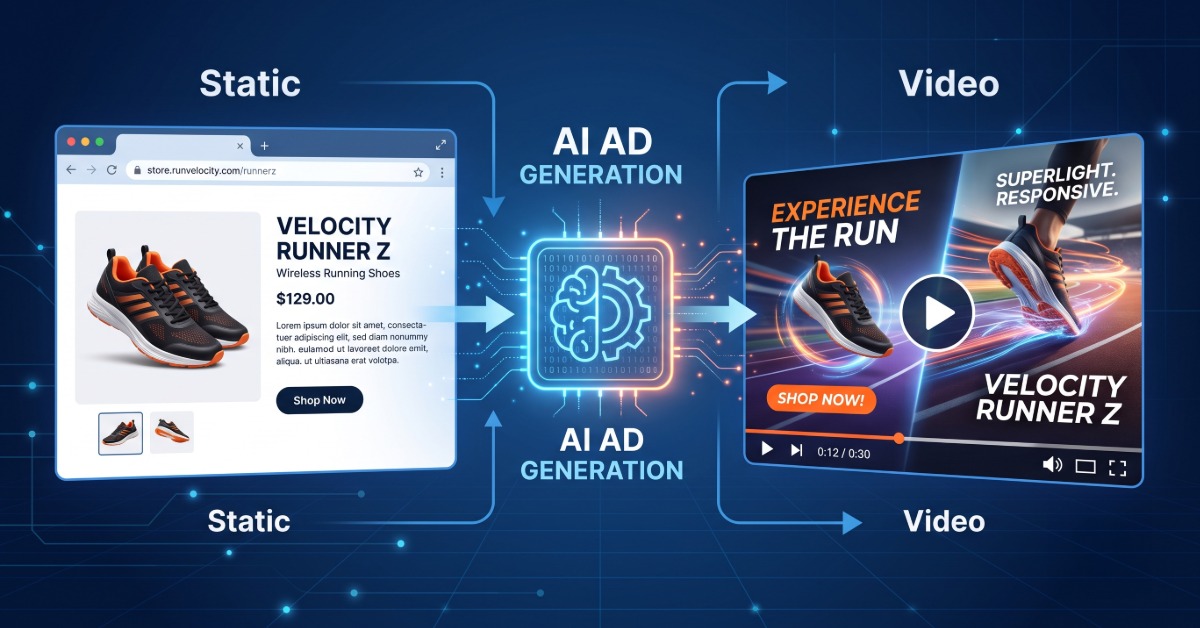
AI ad generators like Creatify turn product URLs into short video ads by scraping your page assets, auto-writing scripts and voiceovers, and exporting platform-ready clips that scale far cheaper and faster than traditional video production.
AI URL-to-video tools don’t replace good creative judgment; they remove the bottleneck between having a solid product page and shipping enough video ads to find what actually converts.
AI ad generators create product video ads simply by analyzing the product page, picking up images, price, and description, then combining them with a script, voice-over, captions, and motions to churn out a final video in a matter of minutes. You just insert the product URL; the tool fetches all the necessary info; and before you know it, you have a clip made for TikTok, Reels, or Shorts. No filming, no editor, no reconstructing the product details manually.
It is the source material that is the key to ecommerce success here. The product page offers professional photos, a written narrative, and important details on a single URL, so the tool only converts existing assets into a video format that paid social is fond of. Industry data has shown that product videos tend to garner higher engagement and conversion than static images, and this method makes video production economical not only for a single flagship product but for the entire catalog.
It all starts from the URL. You grab a product page link from Shopify Amazon your own store, or any ecommerce platform, then paste it in. The tool scans the page and detects the product images, the title, the price, the description, and sometimes the reviews, afterward it structures all these elements into a coherent video storyline including a hook, the main advantages, and a call to action.
Then the making of the video is automatic. The photographs are given animation with pans and zooms so that even if they are still images, they will be interpreted as motion, an AI avatar or voiceover speaks the text composed from your product information, captions and price overlays are put in, and background music is added. You pick the format, vertical for Reels and TikTok, square for feed ads, and the tool exports a ready-to-run clip. Creating videos for hundreds of products in a short time is what makes the whole idea not only possible but also reasonable.
Just before using it, you still get to review and make changes if necessary. You may change the text, rearrange the pictures, replace the avatar, or change the music, but the main work is already done. Instead of hiring a videographer or spending hours with editing software, now you just do a quick review and publish.
The price difference is the main point here. A good quality product video can range from a few hundred dollars for a simple freelance job to thousands of dollars if you go for an agency, plus the days or weeks of briefing, shooting, and editing. It may be worthwhile for a single hero product but scaling that to fifty or five hundred products is out of the question for most stores.
AI ad generators work based on monthly subscriptions, the prices usually ranging from low tens to a few hundred dollars given the volume, within which you produce lots of videos. Divided into a fully packed month the cost per video ends up at a few dollars or even less. A totally different group of spending compared to commissioning each clip. The saving in coordination matters as much as the money, since there is no scheduling a shoot, editor’s queue, revision rounds each costing a day. A single person self-serves the whole pipeline, which essentially eliminates the staffing cost that traditional video carries silently.
The bigger the number of products, the higher the savings. A store with only 5 products won’t change much, but a store that regularly adds new SKUs will definitely see the numbers tipping the other way, because the capability of producing videos for every product, not just the bestsellers, is what really changes the marketing.
The performance case is what justifies the effort beyond the cost. Paid social platforms push video harder than static images, and short product videos consistently outperform photo ads on engagement and click-through in platform data. A scrolling shopper stops for movement more readily than for a still, and a clip showing the product with price and features on screen gives them enough to click.
The volume angle is where it gets powerful. Because producing one more variation costs almost nothing, a store can generate fifteen versions of an ad with different hooks, run them against each other, and pour budget into the winners. Industry data has repeatedly linked creative variety to slower audience fatigue, so a store able to refresh creative constantly avoids the performance decline that hits a single static ad. A tool like Creatify.ai is built around exactly this loop, turning product URLs into batches of testable video variations so conversion data, not opinion, decides what runs.
The honest tradeoff is that automated product video suits performance ads better than brand films. The output excels at fast-scrolling feed ads where speed and volume beat polish, less so at a cinematic brand piece someone watches closely. Most stores use the savings to free budget for the occasional high-end production rather than replacing it.
The variation in fit depends on the store. A small or solo store reaps the biggest benefit, because it is a definite that such a store cannot afford any kind of video production and so, a tool turns it from an impossible job into an everyday one and allows it to go head-to-head with bigger brands on the creative front. For them the choice is automated video versus no video, which makes adoption almost automatic.
Then again, a large store or well-known brand is doing it quite differently by using such methods not for a handful of their exclusive products only but for a great number of their mid-range items, to maintain a uniform marketing of every listing, they still have committed works of arts in the form of films for flagship product launches. It also depends on the type of product. If it is an ordinary tangible product, like clothing gadgets home goods, then it is very well taken care of by an automated photo-driven video, as the assets are straightforward and a customer is most interested in seeing the product plus the price. A complicated or high-consideration product that needs a demonstration has to have a more personalized video. Yet, it may still use these tools to create quick social cuts.
A platform and a region are also determining factors. A store that sells to a younger TikTok audience is heavily dependent on those vertical, informal, and fast-cut videos, whereas the one selling to an older buyer wants a more polished, cleaner and informative style. Stores that sell to international markets are also very much into the idea of generating the same product video in several languages from one listing, which in no way equals the extent a bespoke production can be afforded and it could never cover different markets. Hypnotizing the style to the location and the audience you are selling to is even more important than which tool has produced the clip.




