
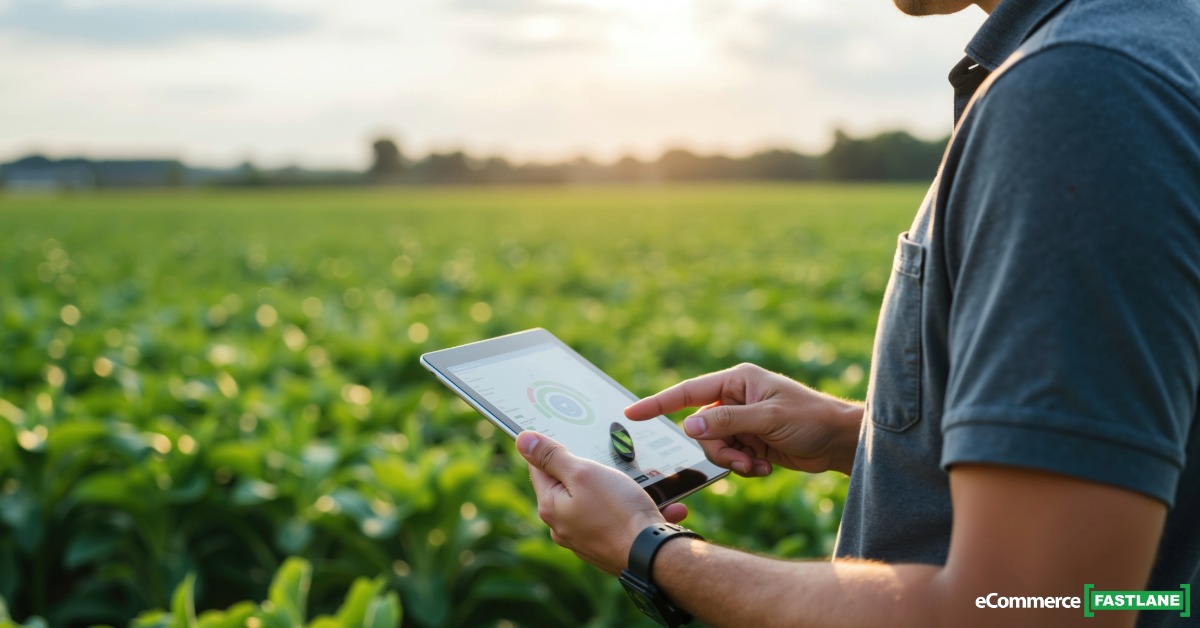
Farming today faces a big challenge: producing enough food for a growing population without wearing out the land and water we rely on.
Traditional methods often use too much water, fertilizer, and chemicals across entire fields, which is expensive for farmers and damaging to the environment. The solution is to stop treating a field as one uniform area and start managing it as thousands of smaller zones. AI makes this possible, turning guesswork into precise, data-driven decisions and helping farming become more sustainable.
AI allows farming to move past one-size-fits-all methods and into precision agriculture. It acts like a smart assistant, making sure each plant gets exactly what it needs, no more, no less. This article explores practical ways AI is already helping farmers save resources, boost crop health, and farm more sustainably.
Precision agriculture is about noticing that even a single field isn’t uniform since soil, water, and sunlight can change from one spot to another. AI takes this information and turns it into clear, practical instructions for farm machines, so farmers can act on the differences rather than treating the whole field the same.
Instead of applying a fixed amount of fertilizer or water everywhere, AI-powered technologies manage and deliver the amounts and where necessary. The process starts with collecting detailed information:
Drones, satellites, and in-ground sensors continuously measure soil moisture, nutrient levels, and the health status of the plants.
Machine learning models process these mountains of data to identify areas that are struggling versus areas that are thriving.
The models generate specific maps that are fed directly into the onboard computers of tractors and sprayers.
Such systems allow the equipment to automatically increase or decrease the flow of seeds, chemicals, or fertilizer as it crosses the field.
One of the biggest benefits of AI adoption in farming comes from managing water and nutrients accurately.
AI has changed the irrigation process from a fixed schedule into a rather dynamic system.
Smart systems use real-time data from soil sensors, combined with detailed, local weather forecasts, to predict how much water a plant will actually evaporate over the next day or two.
The system automatically schedules the pumps and irrigation lines to deliver the precise amount needed to maintain ideal soil moisture.
This prevents both underwatering, which stresses the crops, and overwatering, which wastes valuable water and energy while flushing essential nutrients out of the root zone. This approach allows for saving water and boosting productivity, among other advantages.
Overuse of synthetic fertilizer is a major environmental issue. AI helps solve this by providing highly localized nutrient control. AI algorithms analyze past harvest data alongside current soil chemistry results to create a complete picture of nutrient requirements across the farm. The models can identify specific nutrient deficiencies in small field sections. Farmers then receive recommendations for applying only the necessary nutrients, at the necessary concentration, to those specific spots. This improves the effectiveness of the fertilizer and limits the volume of excess nutrients that can enter local waterways.
One of the most valuable aspects of AgTech is moving from reacting to a crop failure to predicting and preventing it.
AI uses computer vision to continuously check crops for threats.
Drones or specialized robots take high-resolution images of the plants, capturing details invisible to the human eye.
AI models, trained on millions of images, can spot the first microscopic signs of a fungal disease or the beginning of a pest infestation, often days before a human scout could. This rapid crop health monitoring is critical.
Once a threat is confirmed, the farmer can use precision spraying, targeting the chemical treatment only onto the infected plants or the immediate vicinity, instead of treating the entire field. This process significantly reduces the overall chemical load in the environment.
AI-driven yield prediction helps make farming more sustainable by improving planning and reducing post-harvest waste. Models take into account planting density, weather conditions, biomass data, and past field performance to create detailed forecast maps. These insights allow farmers to plan labor accurately, secure the right storage and transport capacity, and schedule market deliveries efficiently. By aligning production with logistics, the food produced moves smoothly from field to market, cutting down on losses and waste.
The move to AI in farming isn’t just about using new technology; it’s about farming smarter and more responsibly. AI helps farmers apply water, fertilizer, and pesticides exactly where and when they’re needed, track plant health continuously, and run operations more efficiently. This approach supports higher yields while cutting down on environmental impact. As we’ve seen a lot, AI-driven, data-based decision-making lets farmers respond to conditions on a local level, laying the groundwork for a sustainable and resilient agricultural system.
That is an excellent way to consolidate value and authority, Steve. This FAQ section will help readers dig deeper into the topic of AI and sustainable farming right away.
AI helps solve the problem of treating an entire farm field as a uniform area. Traditional methods waste resources by applying the same amount of water and fertilizer everywhere, which is costly and damages the environment. AI turns the field into thousands of small, manageable zones for precision control.
AI-controlled systems use specific instruction maps that come from machine learning models. These models analyze data from drones and soil sensors to identify areas with nutrient needs. The maps are fed into tractors and sprayers, allowing the equipment to automatically adjust the flow of fertilizer as it moves across the field.
Precision farming collects massive amounts of data from multiple sources to make accurate decisions. This information includes real-time readings from in-ground sensors on soil moisture and nutrients. It also uses high-resolution images from satellites and drones that track the actual health status of the plants.
AI changes irrigation from a fixed schedule to a dynamic, real-time demand system. It combines local weather forecasts with soil sensor data to predict how much water a plant will really need over the next day or two. This automated scheduling prevents overwatering, which saves energy and stops essential nutrients from being washed away.
Computer vision allows for much faster and earlier detection of issues than human scouting. AI models, trained on millions of images, can spot the first microscopic signs of a new pest or fungal disease. This rapid diagnosis lets farmers use targeted chemical treatments, reducing chemical use across the entire farm.
The common myth is that precision agriculture means not using any chemicals. In reality, it means using far fewer chemicals and only applying them to the plants that actually need it. This highly targeted approach reduces the chemical load in the environment while still protecting the overall healthy yield.
AI creates a resilient system by improving forecasting and reducing waste after the harvest. Models consider density and weather to create detailed yield forecasts. This insight helps farmers plan for labor, storage, and transport, making sure everything is aligned so that food moves efficiently from the field to the market.
No, while large farms are early adopters, precision technology is becoming more accessible to smaller farms as well. The core benefit of AI is that it helps farmers of any size make smarter, more localized decisions. Tools like drone-based analysis and smart sensors are increasingly affordable.
A great first step is investing in modern soil sensing technology for your fields. These sensors provide the base level data on soil moisture and nutrients that all AI-driven recommendations are built on. Getting this data allows a farmer to start generating those useful instruction maps.
When farmers use less synthetic fertilizer, it lowers the volume of excess nutrients like nitrogen and phosphorus that typically run off fields. This action prevents the excess nutrients from entering local rivers and streams, which stops harmful algal blooms and protects the overall health of the waterways.




