

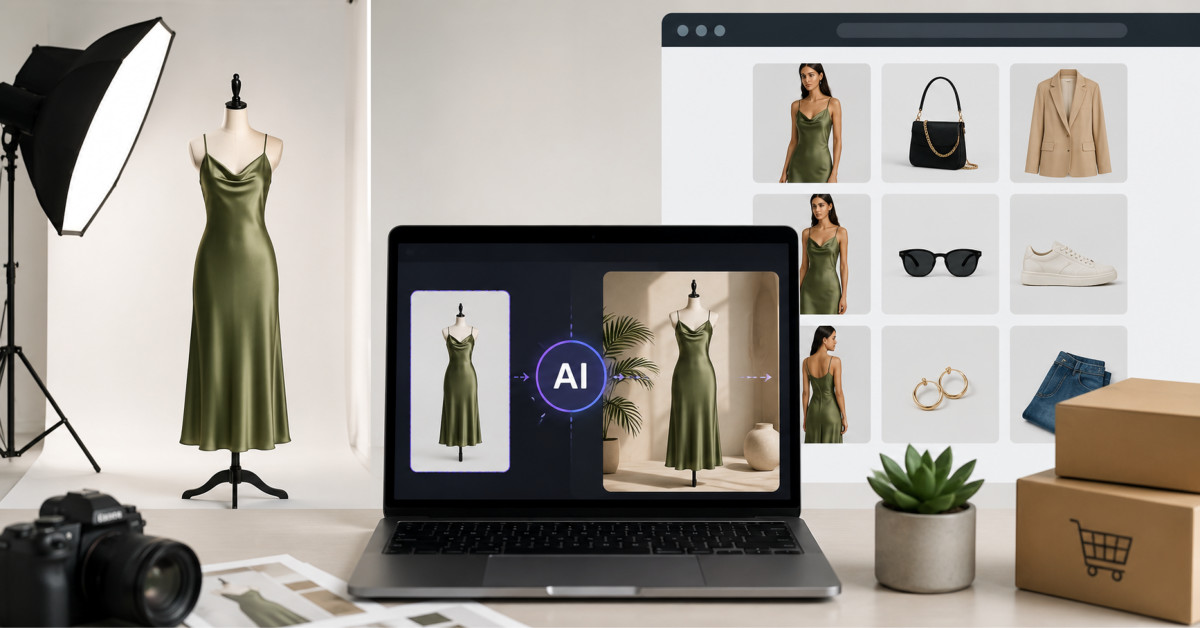
AI product photography turns image production from a slow, linear cost center into an almost instant, reusable asset pipeline, which is why it is becoming the real bottleneck remover for fashion brands trying to scale ecommerce.
Most fashion brands outgrow their photo process long before they outgrow their ad budget, and AI product photography is finally giving them a way to catch those two back up.
AI product photography is solving a key problem in fashion ecommerce: product photo production can’t keep up with the speed of brands’ growth. As a brand scales, the first bottleneck usually is not marketing budget or order volume. It’s photography. Every new style, every color, every seasonal launch needs a full set of product photos, and traditional photo shoots often can’t keep up with that pace.
When a brand is just starting out with a few products, one photo shoot is usually enough. But as the catalog grows — ten products becomes fifty, fifty becomes two hundred — every new SKU still needs its own set of photos: front, back, detail shots, and often a model shot too. With so many photos to shoot, brands often can’t keep up, and new products get delayed because there’s no open slot on the shoot calendar. That delay costs sales.
On top of that, traditional photography costs’ scale in a straight line. Studio rental, models, photographers, and retouchers usually add up to more than $100 per product. The more products a brand has, the more it spends on photography.
Marketing can scale by increasing ad spend. Fulfillment can scale by outsourcing to a third-party warehouse. But in the past, photography could only scale one way: spend more money and build in more lead time. There wasn’t another option.
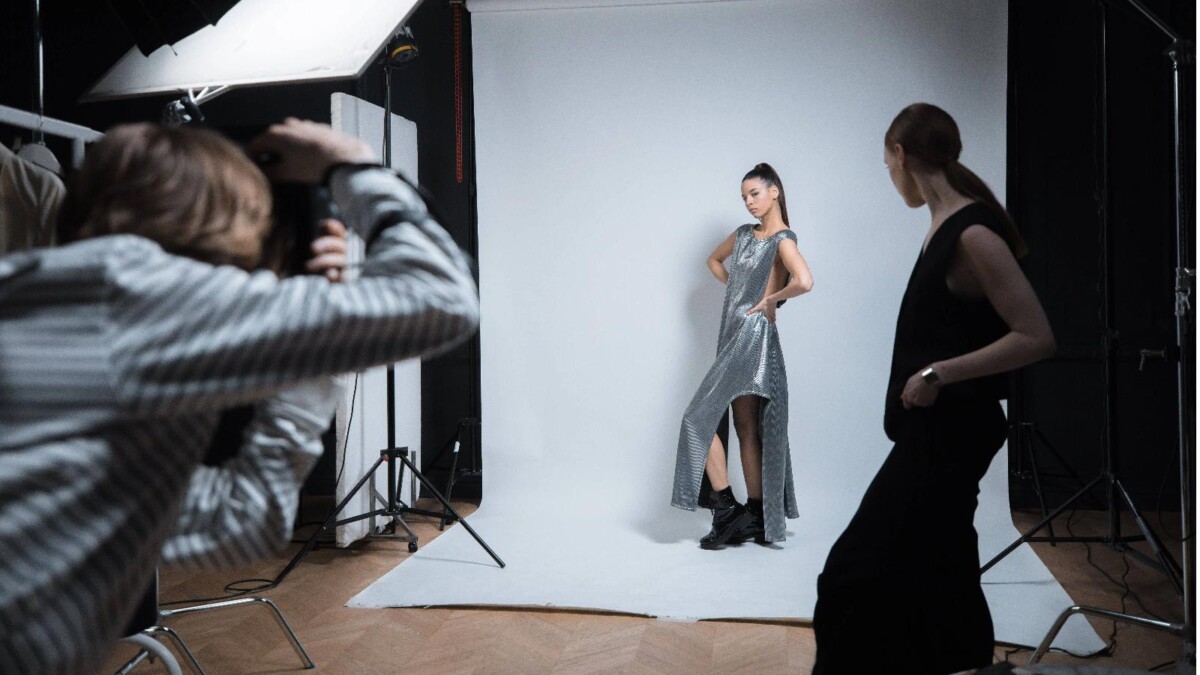
Product photos aren’t optional on a Shopify store. They’re one of the biggest factors in whether a customer buys at all.
Etsy’s own buyer research found that 90% of shoppers say photo quality is extremely or very important to their purchase decision — ranking higher than shipping cost, and even higher than price. Research from Salsify found that 60% of online shoppers want to see three to four product images before they’ll buy. If a brand can’t produce enough photos fast enough, that’s not just an operations problem. It’s lost revenue.
That’s why, when merchants plan their budget for scaling, product photos deserve the same attention as ad creative or email design. For more on this, see our guide to creating eye-catching product images for your Shopify store.
AI product photography turns a cost that used to grow with every new SKU into a process where each additional photo costs almost nothing. A few specific features are doing most of the work for fashion brands right now:
Ghost mannequin generation. There’s no need to rent a mannequin or have a retoucher manually cleaning up the collar and sleeve seams. AI can turn a flat-lay photo directly into a product photo with real shape and volume, so the garment looks like it’s naturally filled out instead of lying flat on a table. These images are usually ready in minutes, at a fraction of the cost of a traditional shoot.
On-model images. Brands no longer need to book a model and photographer for every single product. Upload a photo of the garment, AI will generate a photo of a model wearing it. This is faster and more flexible than repeated photo shoots when a brand wants to show models of different body types and skin tones.
One-click color variants. Apparel brands often need to offer the same style in multiple colors. Traditionally, that means sampling and shooting each color separately. With AI-generated color variants, a brand can start from one base product photo and generate every color version from it, without scheduling a new shoot for each one.
Product videos. Short videos usually convert better than static images on channels like TikTok and Instagram Reels, but traditional video production takes extra budget and time. AI tools can now turn a static product photo directly into a short video of a model in motion, without an extra shoot.
Shopify merchants who are thinking about scaling don’t need to replace their entire photography process all at once. Here’s a simple way to phase it in:
If you want to see what this actually looks like, this walkthrough shows how to generate realistic product photos for an apparel ecommerce brand using AI: Using AI to Create Realistic Product Photos for Apparel E-commerce Brand.
The speed and cost of producing product photos is becoming the key factors in whether a fashion brand can scale smoothly — not just an operational detail. Etsy and Salsify’s data both show that photo quality directly affects whether customers buy, which means fixing this part of the process can save far more than just the photography budget.
For brands considering this path, Snappyit offers a full workflow that turns flat-lay photos into ghost mannequin shots, on-model images, color variants, and product videos — a useful example to look at when evaluating these tools. What actually determines how fast a brand can launch new products usually isn’t the marketing budget. It’s how quickly the brand can turn a new product into photos customers can see and buy from.
—
Sophia Ma is the co-founder of Snappyit, an AI product-photography tool built for fashion and apparel sellers. Having built a company from the ground up herself, she writes about e-commerce, visual merchandising, and the small systems that help solo founders do more with less. You can connect with her at snappyit.ai or on LinkedIn
In most fashion categories, what matters most to shoppers is clarity, consistency, and coverage across angles and colors. If your AI images meet the same visual standard as your best studio work, they can perform just as well or better, simply because you can produce more of them for every product.
No. The most effective approach for many brands is a hybrid: use traditional shoots for flagship campaigns and core visuals, then use AI to fill in the gaps for new colors, additional angles, and long-tail products that would be too expensive to shoot individually.
The cleaner your base images, the better your outputs. Simple, well lit flat-lays or basic mannequin shots on neutral backgrounds usually work best, because they give AI tools clear edges and details to work from when generating ghost mannequin or on-model photos.
Run a controlled test on a subset of SKUs and track three things: cost per product image set, time from sample arrival to publish, and actual conversion rate on product pages. If AI images reduce cost and lead time while holding or improving conversion, you know they are doing their job.
Think of Snappyit as an extension of your current photo pipeline, not a replacement for everything you do today. You still plan launches and collect base images the same way, but you send those bases through Snappyit to generate the ghost mannequin, on-model, color variants, and videos that used to require multiple separate shoots.





