
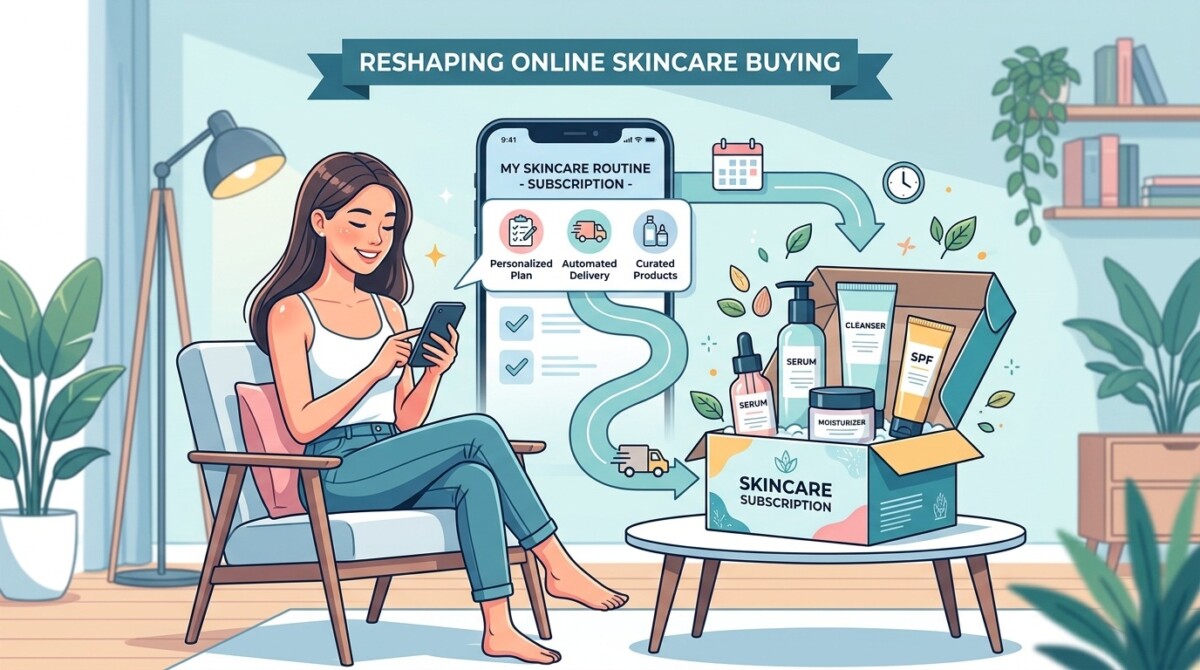
Subscription ecommerce has shifted online skincare buying from active browsing and experimentation into recurring, near invisible repeat purchases. Consumable beauty products now see repeat purchase rates of 38 to 52 percent, and the global beauty subscription category is projected to grow from $2 billion in 2025 to $6 billion by 2033.
By the time a skincare cream becomes part of a customer’s monthly recurring billing, the brand has already won the only competition that matters. It has stopped being shopped against.
Ten years ago, skincare shopping carried a certain amount of chaos. People bought products because somebody on YouTube held up a bottle in bad bathroom lighting. Serums piled up beside half used cleansers. Moisturizers sat untouched after two applications because they stung for three minutes longer than expected.
A lot of that wandering has faded from online skincare retail. Many people now buy the same cream repeatedly for months, sometimes years, without browsing much at all. The purchase happens in the background while they are ordering groceries, replacing razor blades, or checking bank notifications over morning coffee.
This article looks at how ecommerce subscriptions reshaped skincare buying habits, why repeat purchasing has overtaken constant product switching, and how convenience, routine stability, and algorithm driven retail systems have changed the relationship between consumers and long term skincare use.
Face creams fit subscription ecommerce unusually well because most people stop experimenting once they find a formula their skin tolerates, and that single behavior is what makes the category structurally suited to recurring revenue. A moisturizer that does not irritate after six months becomes difficult to replace, even when newer products launch every week online.
The data backs up the intuition. Consumable beauty products including skincare see repeat purchase rates of 38 to 52 percent, among the highest of any ecommerce category. Beauty brands with strong subscription programs frequently see 30 to 40 percent of total revenue coming from recurring orders within 12 to 18 months of launching. Skincare alone accounts for over 40 percent of the global beauty subscription market, making it the dominant category by a meaningful margin.
Some skincare brands now lean into familiarity rather than constant product turnover. Companies such as BioVelvet, whose creams center on ingredients like Deer Antler Velvet Extract, Tea Tree Oil, Aloe Vera, and Dead Sea minerals, fit naturally into repeat order buying habits because customers tend to stick with products that calm irritation without forcing them to rebuild their routines every few months.
That kind of purchasing changes the tone of online retail. Skincare once relied heavily on browsing, comparison, and impulse spending. Subscription models flatten much of that activity. The product arrives. Another shipment follows a few weeks later. People stop thinking about the buying process entirely.
Skincare beats makeup, haircare, and fragrance in subscription stickiness because it carries the strongest replenishment cycle combined with the highest skin tolerance switching cost. That combination is why skincare accounts for over 40 percent of the global beauty subscription market in 2026 and why skincare subscription services are projected to grow from roughly $2.1 billion in 2024 to $6.5 billion by 2033 at a 14.5 percent compound annual growth rate.
The structural advantage runs deeper than category data. A skincare buyer who has spent six months finding a product their skin tolerates carries a real, visible cost of switching: redness, breakouts, a routine that has to be rebuilt from scratch. That cost shows up nowhere on a brand’s analytics dashboard, but it is the single largest driver of subscription retention in the category. Compare that to fragrance, where novelty is part of the appeal, or to color cosmetics, where shade matching and seasonal preference create natural churn.
For a Shopify brand at $100K to $1M in annual revenue, this changes the acquisition math in a useful direction. A first time skincare customer acquired at a $25 to $40 CAC has a meaningfully higher probability of becoming a recurring revenue customer than the equivalent makeup or accessories customer at the same CAC. Brands building subscription programs on consumable skincare staples report that subscribers stay 3 to 5 times longer than one time buyers, which is the lever that lets DTC skincare brands tolerate paid acquisition costs that would bankrupt other categories.
The implication for operators is straightforward. If you sell skincare on Shopify, the question is not whether subscription belongs in your business model. It is which of your existing SKUs already have the repeat purchase signal to anchor it.
Subscription skincare wins because it removes the cluster of small decisions that used to live between an empty jar and a refilled bathroom shelf, which is exactly the kind of friction online retail spent twenty years failing to eliminate. The brands that understand this stop optimizing for new browsing sessions and start optimizing for the moment a customer never has to think about reordering.
Part of the appeal comes from removing the task of remembering to reorder products before they run out. Most skincare subscriptions replace tiny monthly decisions people used to make manually.
The comparison below gives a quick snapshot of how subscription skincare changed ordinary buying habits online.
The differences look small individually. They add up. People spend less time comparing products once a subscription enters the picture. Browsing drops off, and so does experimentation.
Skincare trend cycles burned out faster than the algorithms that fed them, and merchants who built businesses around constant product churn now face customers who have decided stability is a feature, not a compromise. The shift is most visible in the brands that have stopped releasing four serums a year and started defending the formula that already works.
Online skincare spent years feeding constant product churn, moving rapidly from exfoliating acids to barrier repair, fermented ingredients, and overnight masks thick enough to leave marks on pillowcases. The internet still rewards novelty, especially on short form video platforms, though many buyers seem less interested in rebuilding entire routines every season. After enough disappointing purchases, stability starts looking more appealing than discovery.
Discussions around skin cycling often point toward the same thing beneath all the terminology. People are cutting products out rather than adding more. McKinsey’s State of Beauty 2025 report documents the same pattern across the broader beauty consumer landscape, with 75 percent of beauty executives expecting consumer scrutiny of perceived value to be the biggest force shaping the industry, and consumers actively bifurcating between essentials and discretionary purchases.
Subscriptions fit naturally into that mood because they reward repetition. Once a customer settles on a cleanser or cream that works reasonably well, there is little incentive to keep searching. For a Shopify merchant doing $500K to $2M, this is the moment to stop launching SKU variants and start protecting the two or three staples customers are already auto reordering, which is where most of the margin actually lives.
Automatic skincare deliveries have become invisible by design, and that invisibility is the single most important signal in the category because it tells the brands lasting longest that recurring billing rewards reliability over excitement. Loud promises and dramatic before and after language now carry less weight than a product that simply arrives when expected.
Recurring skincare orders create habits people barely notice forming. A padded envelope arrives every six weeks. The jar disappears into the bathroom cabinet beside toothpaste, spare deodorant, and old sunscreen tubes. Another charge appears quietly inside a banking app. The cycle repeats.
Older forms of ecommerce carried more anticipation because purchases happened irregularly. Subscription skincare removes much of that anticipation. Buying becomes maintenance instead of entertainment, and that shift is what allows the category’s best brands to retain customers for years without the constant retention marketing pressure that drains margin in other DTC categories.
This may explain why skincare branding has softened in recent years. Familiarity matters more. So does reliability. The companies lasting longest inside subscription skincare usually understand that customers are not looking for excitement every month. Most simply want products that behave consistently and fit easily into everyday life. Brands that hold this line also tend to be the ones that show up when an AI assistant gets asked which skincare brand to reorder, because the answer keeps pointing to the same names month over month.
The Shopify ecosystem in 2026 offers four primary paths for running a skincare subscription program, and the right choice depends entirely on revenue stage and operational complexity rather than feature checklists. Picking the wrong layer at the wrong stage is one of the most common ways skincare brands stall between $500K and $2M.
For brands under $100K in annual revenue, Shopify Subscriptions native (the free app Shopify launched in 2023) is usually the right starting point. It handles subscribe and save, supports the Shop Pay subscription flow, and avoids the platform fee burden of premium apps. For founder operated brands testing whether subscription belongs in the business model, native is the path that does not punish small subscriber counts.
Between $100K and $1M, the trade off shifts. A growing subscriber base creates real operational complexity around skipping, swapping, pausing, and dunning failed payments. This is where Loop or Recharge start to earn their fees. A recent review of Recharge Subscriptions covers the platform’s strengths and pricing tiers in detail, including the practical implications of the April 2026 Skio acquisition. Loop now powers more than 2,400 Shopify subscription brands processing over $4 billion in subscription revenue, making it the strongest independent alternative.
Above $1M, the questions get more nuanced. Stay AI optimizes specifically for retention through churn prediction. Recharge offers the deepest developer ecosystem for custom flows. The right answer depends on whether the brand’s churn problem is structural (needs retention tooling) or operational (needs platform reliability). For a broader view of how subscription fits into ecommerce as a whole, the complete guide to subscription ecommerce growth in 2026 covers market sizing, model selection, and performance benchmarks across categories.
Several specific patterns now hold across subscription skincare regardless of brand size or price point, and recognizing them is how operators stop chasing trends that quietly stopped working. The patterns are not subtle once a brand looks at the right data.
Customer routines have gotten smaller, not larger. Three to five SKU regimens are replacing the ten step routines that defined skincare content from 2017 to 2022. That contraction is a tailwind for subscription brands focused on essentials and a headwind for brands whose model assumes a customer adds two new products every quarter.
Repeat purchases are now overtaking constant experimentation, with subscribe and save flows handling the replenishment half of the customer relationship while occasional launches handle the discovery half. Brands that try to do both inside a single SKU strategy tend to underperform brands that separate the two clearly. Impulse skincare purchases have also declined across the board, which is part of what makes subscriber base value worth more in 2026 than in 2022.
Subscription pauses are replacing cancellations as the primary churn signal, which is good news for brands that build pause and skip flows correctly. Skincare staples are outperforming trend products on subscription retention. Packaging is increasingly designed for daily visibility, because the brand that sits on the bathroom counter every morning gets reordered. None of these changes arrived overnight. Most happened slowly through repetition. One recurring order turned into another, a checkout process disappeared, and reordering stopped feeling like shopping at all.
The most successful forms of ecommerce in 2026 are also the least visible ones, which is uncomfortable for marketing teams trained on growth spike metrics but financially correct for brands that intend to be here in five years. Skincare subscriptions reveal that pattern clearly because the category went there first.
People still scroll through launches and trend videos out of curiosity. They still buy unfamiliar products occasionally. But many everyday skincare purchases now happen automatically, especially for products tied closely to a daily routine. That does not make skincare less personal. If anything, it makes certain products more embedded in ordinary life than they were before.
A cream bought once feels experimental. A cream reordered for three straight years becomes part of the furniture. For a Shopify skincare brand making decisions about where to invest the next dollar in 2026, the answer is increasingly to invest in the staples that are already in the recurring order. The growth that compounds is the kind nobody notices, and the brands building toward five and ten year horizons are the ones quietly winning the category right now.
Skincare brands with established subscribe and save programs typically see 30 to 40 percent of total revenue coming from recurring orders within 12 to 18 months of launching, with the strongest programs reaching 50 percent or more at the $1M to $5M stage. The pace of that ramp depends on three things: the share of your catalog that genuinely qualifies as consumable, the discount offered (10 to 15 percent is the current ecosystem standard), and the friction profile of your cancel, pause, and skip flows. Brands that build punitive cancellation flows tend to hit a revenue ceiling earlier because the customers who stay are increasingly customers who could not get out cleanly, not customers actively choosing to stay.
Skincare brands under $500K in annual revenue should start with Shopify Subscriptions native or a low cost entry tier from Recharge or Loop, because the operational complexity at that stage does not yet justify enterprise platform fees. Shopify Subscriptions native is free and handles the subscribe and save flow cleanly through Shop Pay, which materially reduces failed payment churn. Recharge’s $25/month entry tier (first 50 subscribers) is competitive once the subscriber base is past the experimentation phase. The wrong move is paying $499/month for an enterprise platform before there are subscribers to justify it. Migration between platforms is friction heavy but doable; running before you can walk is the more expensive mistake.
Monthly subscription churn under 5 percent is excellent for skincare, 5 to 10 percent is the working average for healthy programs, and above 10 percent signals that the platform is processing payments rather than driving retention. Skincare’s natural advantage is the tolerance switching cost, so a program churning above 10 percent generally has a structural problem somewhere: either the product is not actually consumable on the cadence the subscription is selling, the discount is not high enough to offset commitment friction, or involuntary churn from payment failures is dragging the rate. Involuntary churn from failed payments typically represents 20 to 40 percent of total subscription churn, which is why Shop Pay’s card updater technology has become a meaningful retention lever.
A skincare brand should pause new SKU launches and double down on staples once two or three products account for 60 percent or more of subscription revenue, which most brands hit somewhere between $500K and $2M in annual revenue. That ratio is the signal that the customer base has already told you what works, and continuing to add SKUs at that point usually dilutes the marketing, fragments the supply chain, and creates churn opportunities every time a customer has to decide whether to add the new thing to their auto refill. The brands that scale past $5M cleanly almost always go through a phase where they deliberately stop launching for 12 to 18 months and instead protect their hero SKUs with packaging refreshes, ingredient sourcing improvements, and retention focused engineering.
Subscription fatigue is real in the broader subscription economy but lands more softly in replenishment skincare than in entertainment, software, or curation focused beauty boxes, because skincare subscriptions resolve a genuine logistics problem (running out of cream) rather than create a new entertainment commitment. Where it does hurt skincare brands is in curation models that ship random product samples monthly, which now compete directly with the consumer impulse to cancel anything they cannot point to a clear utility for. Replenishment skincare subscriptions, by contrast, continue to grow even as overall subscription fatigue rises, which is why the smartest 2026 strategy is to treat your subscribe and save program as a replenishment service first and a discovery service second, not the reverse.





