

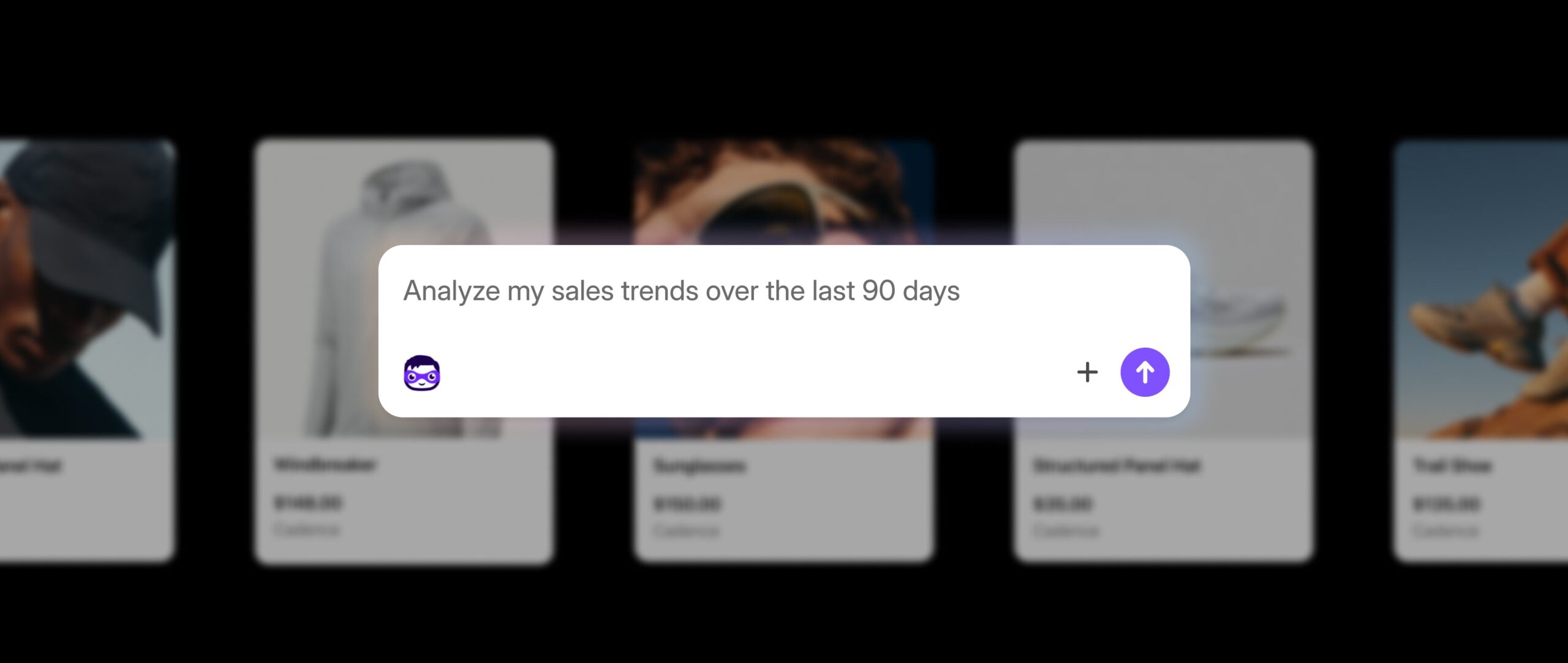
Enterprise commerce teams are under pressure to make higher-stakes decisions faster, scale output without scaling headcount, and ship campaigns in days instead of weeks. AI isn’t a strategy exercise for the teams doing this well. It’s a practical tool running inside their store, answering questions in seconds, building workflows without developer tickets, and generating content at catalog scale.
Sidekick is Shopify’s AI assistant, built directly into your admin, connected to your store’s real-time data, and capable of taking action in the platform. Because it understands how the Shopify platform works—how settings interact, what the APIs can do, and what merchants commonly run into—it doesn’t just answer questions. It executes.
It’s built for your team. Sidekick lives inside your admin, so it works the way your team already does. No exporting data, no syncing across tools, no copy-pasting into a separate interface. It automatically selects the right AI model for each task and breaks complex problems into manageable steps, so your team can focus on decisions, not execution.
You’re in control. Every team member can freely ask questions and experiment without breaking anything, leaking data, or accessing things outside their scope—Sidekick respects the same permissions as the logged-in user. It checks with you before making any changes, and nothing goes live without your explicit say-so. Store data is never used to train foundation models or shared with other merchants.
Here are just some of the ways enterprise teams are using Sidekick today:
And that’s just scratching the surface. This article breaks down how enterprise teams are putting each of these capabilities to work, with real prompts and examples.
Answering the questions that drive enterprise decisions—cross-channel performance, margin analysis, customer segmentation—typically requires analyst time, data exports, spreadsheet work, and interpretation. That creates bottlenecks at exactly the moments when speed matters most.
With Sidekick, enterprise teams can get instant multi-dimensional analysis, backed by their actual store data.
Prompt: Give me a 90-day growth snapshot vs last year with 3 executive bets to pursue.

Prompt: Pull performance data from this time last year. Show: best-selling products, top-performing campaigns, worst ROAS by channel, customer acquisition costs, and refund rates. Highlight what worked and what didn’t.
In practice: When the Princess Polly team wanted to build their 2025 BFCM strategy, they used Sidekick to analyze their 2024 Black Friday Cyber Monday performance—pulling product-level insights, identifying top performers, and generating tailored recommendations to grow sales volume and increase AOV. Instead of hours of report compilation, the analysis took minutes and surfaced specific signals like which products outperformed 3x and where the biggest growth opportunities were for the next season.
Prompt: Conduct a detailed funnel analysis identifying drop-off points across our customer journey. Specify: product pages with highest abandonment, checkout failures, mobile vs desktop performance, and which traffic sources have the worst conversion. Provide specific page URLs and quantified drop-off percentages.
In practice: A digital product team knew their return rate was dragging down net sales but couldn’t pinpoint the source. They used Sidekick to identify exactly which products were driving returns, then leveraged the recommendations to improve product detail pages—adding better fit information, sizing guidance, and material details to address the root causes.
Individual results may vary.
Prompt: Analyze inventory turnover rates and gross margins for all products with >$10k in sales this month. Identify products with high velocity but low margins, and low velocity but high margins.

Prompt: Calculate holding costs for slow-moving inventory and propose liquidation bundles or sales to recover capital. Provide expected margin and cash impact by action.
Prompt: Segment my customers from the last 90 days by purchase behavior: new vs returning, order value tiers, and purchase frequency. Show revenue contribution and average order value by segment compared to my annual average.

Prompt: Analyze multi-item purchase behavior from the last year to uncover bundling trends and missed cross-sell opportunities. Identify the most frequently bundled products, highlight top combinations by frequency and revenue, and recommend 3–5 product pairings or bundle offers to increase basket size.
In practice: A site merchandising team at a major cosmetics brand used Sidekick to identify products frequently purchased together. They created bundle products from those insights, then re-targeted existing customers with reminders to repurchase as bundles when it was time to restock.
Prompt: Act as my Shopify operator. Create a weekly business digest for last week. Summarize what changed, what drove the change, and give me the first three actions to take with links to do them now.
In practice: An SVP of Operations used Sidekick to evaluate expansion markets for their next retail store. By pulling regional sales data, customer density, and performance trends, they built a data-backed case to present to leadership.
Enterprise operations require custom workflows, specialized apps, and automation that off-the-shelf solutions don’t provide. Building these typically means dev tickets, agency contracts, or waiting in a backlog. Sidekick changes that equation. Describe what you need, and it builds it. No technical background required.
Describe an app or workflow the same way you’d describe it to a colleague. Sidekick builds it with triggers, conditions, and actions. You review the logic, test it, then activate. Nothing goes live without your review.
Prompt: Create a customer tier app that displays top customers by order count.

Prompt: Create a reorder recommendation app that calculates optimal order quantities based on sales velocity.
The more specific your description, the better the output. Sidekick works best when you describe the layout, the data you need, and the actions it should support. Think of it as writing a product brief in plain language.
Prompt: Create a workflow to email me when inventory for any variant drops below 5 for the first time.

In practice: A digital operations team used Sidekick to build an automation that checks whether an order is placed for zero dollars, helping them flag potential discount abuse in real time instead of catching it in post-hoc reporting.
Prompt: Create a returns and cancellation eligibility checker app for customer service agents.
In practice: The same digital operations team built a custom app with Sidekick that tracks how close they are to the 20 million maximum discount code limit—a real operational constraint that no off-the-shelf solution monitors, but one that could silently break promotions if missed.
Many enterprise teams already have dedicated creative resources and strict brand guidelines. Sidekick isn’t here to replace that expertise—it’s built to handle the optimization, testing, and operational content tasks that otherwise bottleneck your team.
Prompt: Optimize my top-selling product for SEO while keeping the tone of voice in line with my brand.
Sidekick helps ensure product catalogs are optimized for both traditional search and AI discovery without requiring SEO specialists to manually review every product page.
Prompt: Identify products with high return rates and common reasons. Draft product page copy updates or warnings to address those reasons and provide links to edit.
Turn CX data into content fixes. Instead of waiting for a quarterly returns review, surface the specific products driving returns and generate the copy changes to address root causes—sizing guidance, material details, expectation-setting—directly on the product page.
Prompt: Propose a ‘New Arrivals’ homepage section with space for three new products with options for badges that say ‘New’ and ‘Back in stock.’ Provide copy and settings to configure in my theme.
Prompt: Write five ad copy variants for my top selling products targeting [audience], each with one clear value prop and one proof point. Provide 30, 90, and 125-character versions and propose UTM slugs.
Generate test variants to feed your experimentation pipeline, maintaining brand voice at the volume needed for proper testing.
Prompt: Create a full-width banner section visible only to customers who are not logged in, announcing 10% off to new customers.

Conditional visibility, layout, copy, and styling—described in one sentence, built and applied without touching code. Non-technical team members ship storefront updates in minutes instead of waiting on dev cycles.
The previous sections focus on Sidekick responding to your questions. Pulse is different: it surfaces recommendations you didn’t know to look for.
Instead of waiting for the right prompt, Sidekick Pulse proactively scans your store and surfaces opportunities buried in your data.
Sidekick continuously runs deep research loops across your store—analyzing orders, traffic, returns, and seasonality, and making connections between them. It uses multiple AI models to explore signals, draft explanations, and suggest actions, then prioritizes the most valuable findings and surfaces high-value, data-cited recommendations.
When you’re ready to act, Sidekick already has the context. Click into any insight; it walks you through the specific steps to address it, turning intelligence into execution.

The teams getting the most from Sidekick don’t try to transform everything at once. They start with one use case where the same questions come up every week: a weekly performance review, a recurring inventory check, a pre-board data pull. They save the prompts that deliver value as Skills—reusable workflows that can be shared across departments—so the team doesn’t start from scratch each time.
From there, adoption grows naturally. Sidekick can turn a complex analysis into a conversation. It can take an automation stuck in a backlog and make it something anyone can describe and build. It can give any team the ability to scope and build an operational tool on their own.
Sidekick comes standard in all Shopify plans. The question isn’t whether AI can help your business. It’s where to start.





