
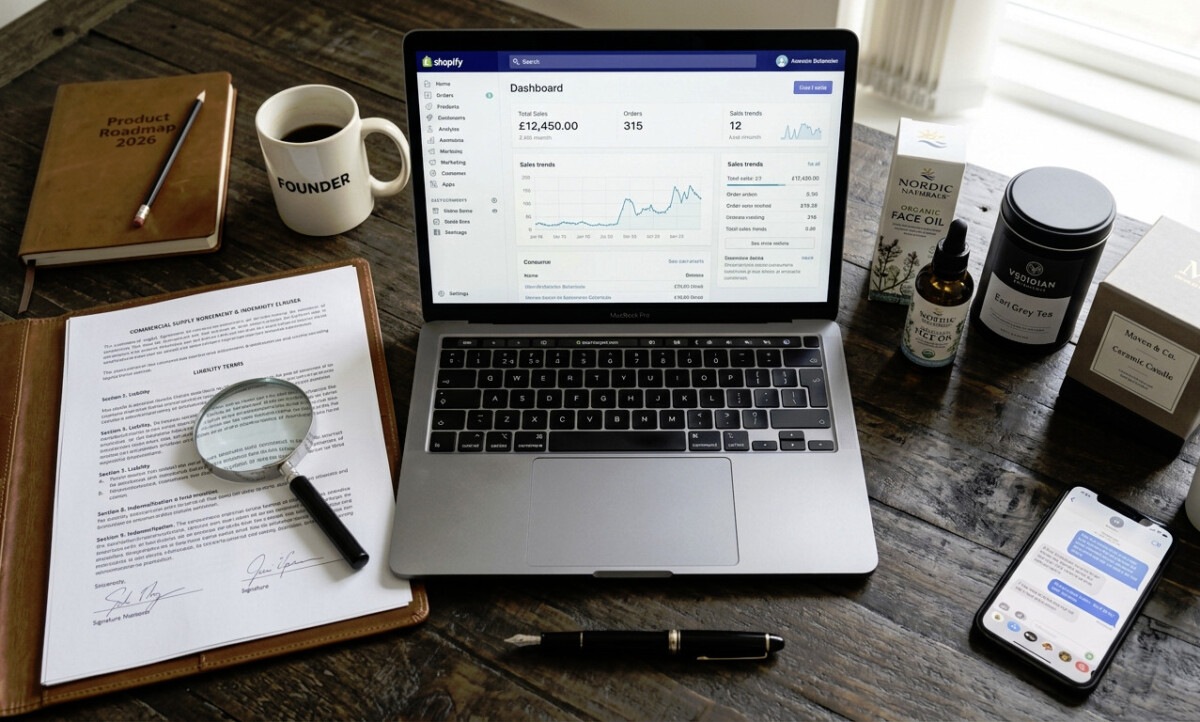
The EU’s revised Product Liability Directive must be transposed into the national law of every member state by December 9, 2026, and fulfillment service providers are named explicitly as economic operators who can be held strictly liable when the manufacturer sits outside the EU. For Shopify merchants shipping into Europe from overseas suppliers, that is not a future hypothetical. That is roughly seven months away.
For the over 28 million online retailers worldwide, the legal safety net of “just being a platform” officially dissolved in 2026. Regulatory bodies and courts are no longer differentiating between the factory that made a defective product and the Shopify store that marketed it to a consumer’s doorstep.
Image Source: Google Gemini
The most significant change in 2026 is that strict liability now extends to almost every entity in the ecommerce supply chain, including fulfillment providers and third-party marketplaces. If a product you sell causes bodily harm or property damage, you are no longer shielded by the fact that you didn’t manufacture the item or even touch the inventory.
Courts are increasingly viewing online retailers as the “apparent manufacturer” if their branding is prominent or if they exercise control over the customer journey. This means that a single claim for bodily injury from a defective product can average $500,000 in legal costs and settlements for an uninsured merchant.
The landscape is becoming more complex as specific high-risk categories are subject to intense scrutiny by the Consumer Product Safety Commission (CPSC) and equivalent bodies in other countries. Retailers are now being held to a standard of “proactive monitoring” rather than just reacting to recalls.
The onus is now on retailers to ensure recalled items are removed from their digital shelves immediately. Failing to do so can result in massive fines and criminal enforcement that targets company leadership directly.
To survive this era of heightened litigation, merchants must focus on three core areas:
The integration of artificial intelligence into the sales process has also created a new frontier for claims. If your AI-driven chatbot or personalized pricing engine provides misleading safety information, you may find yourself liable for “digital negligence” under the latest consumer protection frameworks.
Engaging a dedicated legal team like https://westcoasttriallawyers.com/ to review your automated customer interfaces can help prevent these algorithmic errors from becoming courtroom disasters. Specialists will show you the best path forward, even if the legal challenges are significant.
The European Union’s recent Product Liability Directive, which takes full effect in December 2026, is setting a global benchmark that American courts are beginning to mirror. This directive fundamentally changes the procedural mechanisms for litigation by making it easier for consumers to sue for “wrongful death” caused by software defects or hardware failures.
For Shopify users and DTC founders, this means your terms of service are no longer a suit of armor. If you are shipping to international customers or sourcing from overseas, you are subject to the strictest law in the jurisdiction where the injury occurs.
The era of “ship it and forget it” is over. Modern ecommerce requires a defensive posture that treats product safety as a core part of the brand identity rather than a back-office compliance checkbox.
Retailers who prioritize transparency, clearly stating the origin of goods and providing machine-readable safety data, will not only reduce their legal exposure but also build the trust necessary to win in a market where consumers are increasingly wary of “ghost brands” and unverified third-party sellers.
Staying ahead of these shifts requires constant vigilance and a willingness to update your operational playbooks as new case law emerges throughout the year.
Explore our latest insights on running an ecommerce store for more coverage and discussions that matter to your operations.
Product liability for online retailers in 2026 means courts and regulators increasingly treat the seller of record as part of the supply chain, even when the seller never physically handled the product. The traditional shield of “we’re just a marketplace” has been eroded by US court decisions like Bolger v. Amazon and by the EU’s revised Product Liability Directive taking effect December 9, 2026. Practical exposure depends on what you sell, where you ship, and how your supply chain is structured. A Shopify merchant selling US-made apparel to US customers faces a different risk profile than one selling electronics sourced from overseas and shipping into the EU. The right protection is stage-specific, not universal.
The EU Product Liability Directive (Directive (EU) 2024/2853) is the EU’s revised strict liability framework, and yes, it applies to non-EU Shopify merchants who place products on the EU market from December 9, 2026 forward. The directive expands the definition of “product” to include software and AI systems, holds fulfillment service providers liable when the manufacturer sits outside the EU, and introduces presumptions that lighten the burden of proof for claimants. For US-based merchants shipping into Europe, the practical effect is that EU-based fulfillment partners can be named defendants for products you sell. This is not a future concern; it is a near-term operational consideration for any Shopify merchant with material EU revenue.
“Apparent manufacturer” means a court treats you the same way it treats the actual manufacturer because you put the product out as your own. For a Shopify store, this typically applies when your branding is prominent on the product or packaging, you control the customer experience end-to-end, and the customer reasonably believed they were buying from you rather than from your supplier. The doctrine has been applied with increasing willingness in California and other states. The practical defense is documentation showing the supplier was independently identified, clear labeling distinguishing your brand from the manufacturer when warranted, and contracts that allocate manufacturing defects to the supplier with insurance backing the allocation.
A Shopify merchant in 2026 needs general liability, product liability, and (depending on stage) cyber liability coverage at minimum, with international coverage extensions if you ship outside your home country. Coverage scope should match your stage and supply chain. An early-stage brand selling US-made products to US customers can be reasonably protected by a multi-line ecommerce policy in the $1M to $2M aggregate range. A scaling brand sourcing overseas and shipping internationally typically needs higher limits, contingent liability coverage for supplier-caused defects, and confirmation that the policy covers claims brought in foreign jurisdictions where you have material sales. Generic small business policies often exclude key ecommerce-specific scenarios; pressure-test the exclusions before binding.
You should remove a recalled product from your Shopify store immediately upon notice of the recall, ideally within hours rather than days. The CPSC’s FY 2026 Operating Plan explicitly commits to using AI tools to detect recalled products re-listed after removal and to expand surveillance of e-commerce platforms. Failure to remove can result in civil penalties under the Consumer Product Safety Act, and if a customer is injured by a product you sold after the recall was issued, the legal exposure compounds significantly. Practical setup: subscribe to CPSC recall alerts for the product categories you sell, designate a specific person responsible for monitoring those alerts, and document the timestamp from notice to removal so you have a clean audit trail if questions are ever raised.




