
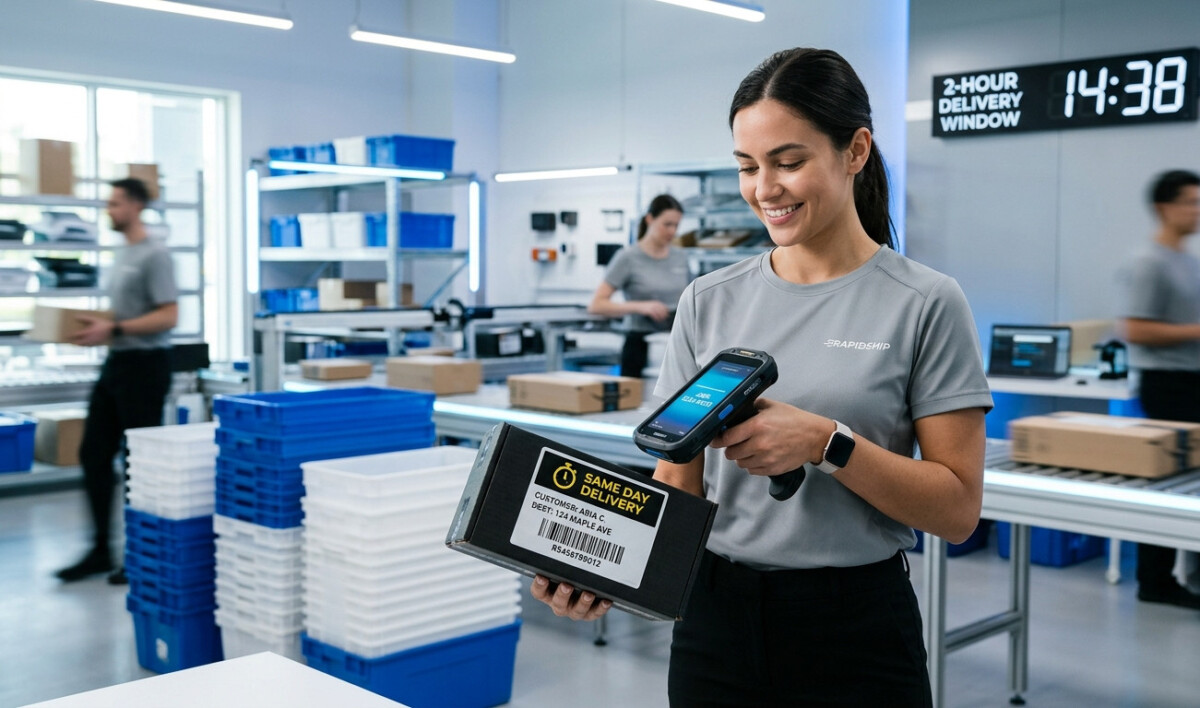
Same day delivery is not a logistics upgrade. It is a conversion tool that works at the exact moment a customer is deciding whether to buy from you or find a faster alternative.
37% of shoppers prefer quick delivery, and most will switch to a competitor simply because the checkout screen didn’t offer a fast enough delivery window. Same day delivery has shifted from a premium “nice to have” to a fundamental conversion engine that dictates whether a brand thrives or vanishes in a crowded digital marketplace. It is the bridge between digital intent and physical ownership, removing the friction of waiting that often leads to buyer’s remorse.
When a customer sees a guaranteed delivery time for later that same afternoon, the psychological barrier to purchase effectively evaporates. In 2025, same day delivery influenced 67% of e-commerce purchases while simultaneously slashing cart abandonment rates by nearly half. This isn’t just about convenience; it is about capturing the peak of consumer desire before the “impulse” phase of the journey fades into logic based hesitation.
Traditional shipping models rely on a promise of “eventual” arrival, which leaves a window open for the customer to second guess the necessity of the item. By narrowing that window to a few hours, you capitalize on the dopamine hit associated with a new purchase. High intent shoppers are looking for reasons to say yes, and rapid fulfillment is the most persuasive argument a brand can make at the point of sale.
Lifetime Value (LTV) is rarely based solely on the product. Even the best items can be overshadowed by a poor logistics experience.
Research confirms that delivery service quality is now the primary determinant for whether a customer intends to make a repeat purchase. When you deliver on a tight timeline, you aren’t just sending a package; you are demonstrating a level of operational excellence that builds deep seated trust.
A reliable same day delivery service acts as a retention moat that competitors using standard postal services cannot easily cross. Customers who experience the reliability of hyper-local fulfillment are significantly more likely to return for urgent needs, turning your store into a utility rather than just a shop. This shift in perception from “retailer” to “trusted provider” is what drives the compound growth needed to scale an e-commerce brand.
You do not need a massive warehouse network or a fleet of branded trucks to start reaping the rewards of accelerated fulfillment. Most successful rollouts begin with a focused pilot program targeting specific geographic areas with high order density. This allows for a controlled environment where you can refine your internal picking and packing speeds without overextending your resources.
To launch a successful pilot on your Shopify store, consider these operational steps:
These parameters provide the structure needed to measure the actual lift in your conversion data. By isolating these variables, you can see exactly how much more revenue a customer in a “fast zone” generates compared to someone in a standard shipping region.
A common misconception among retailers is that same day delivery must be offered for free to be effective. However, the data suggests that consumers are willing to pay a premium for the speed and certainty that comes with rapid delivery. This willingness to pay allows brands to offset the higher costs of local couriers while still delivering the value customers crave.
Price testing is essential because it helps you identify the “sweet spot” where the fee is high enough to cover costs but low enough not to discourage the purchase. You might find that a $15 same day fee actually increases the average order value (AOV) as customers add more items to their cart to justify the delivery expense. Treating shipping as a dynamic part of your pricing strategy, rather than a fixed cost, is key to maintaining healthy margins during a rollout.
Before you expand your same day operations to a national or regional level, you must validate the pilot through your CRM and analytics dashboard. Look beyond the initial sale and examine the behavior of those customers over a 90 day period to see if their purchase frequency has increased. If the data shows that local delivery customers have a 30% higher LTV than those using standard shipping, you have the financial justification to scale.
Keep a close eye on your customer support volume during the pilot phase as well. Often, the transparency of real time tracking in same day logistics leads to a sharp decline in “Where Is My Order” inquiries, and this reduction in overhead is a hidden benefit that further improves the program’s profitability. Once your internal team is comfortable with the cadence and the numbers prove the ROI, you can begin activating new zones with confidence.
The transition to high speed logistics is an investment in the future of your brand’s relationship with its audience. As the global market for same day delivery continues to climb toward a $14 billion valuation by the end of 2026, those who wait to implement these systems will find themselves playing catch up. It is no longer just about moving boxes; it is about meeting the customer exactly where they are, at the speed they now expect.
Focusing on the last mile allows you to take control of the most emotional part of the customer journey. When you eliminate the anxiety of the “delivery gap,” you create a seamless experience that feels less like a transaction and more like a service.
Start small, track the lift in your conversion rates, and use those insights to build a fulfillment strategy that drives growth for years to come. Check out the internal blog for more deep dives into optimizing your e-commerce logistics.
The two prerequisites are geographic order density and fulfillment speed. On the geography side, you need enough orders concentrated in a single metro area or ZIP code cluster to make local courier economics work, typically 10 or more orders per day within a 30 to 50 mile radius of your fulfillment location. On the fulfillment side, you need the ability to pick, pack, and hand off to a courier within two to three hours of order placement. If you can meet both conditions in at least one market, you have enough to run a pilot. You do not need to solve both conditions everywhere before you start.
Courier costs for same day delivery typically range from $8 to $20 per delivery depending on distance, package weight, and the courier partner you use. The fully loaded cost per delivery also includes the labor required for expedited pick and pack, which runs higher per unit than standard fulfillment because of the time pressure involved. Most brands offset a meaningful portion of this cost through a delivery fee charged to the customer, and some find that the higher average order value of same day customers further improves the program’s margin profile. The net cost is almost always lower than it appears before you account for the LTV improvement among customers who experience it.
Shopify’s native shipping settings allow you to create custom delivery options with specific geographic restrictions, cutoff times, and pricing. You can configure a same day option that is only available to customers whose shipping address falls within your pilot ZIP codes, set a cutoff time after which the option is no longer shown, and apply a flat fee or conditional free threshold. Some brands use Shopify apps like Local Delivery or third-party delivery management platforms to add real-time tracking and courier dispatch automation on top of the native checkout configuration. The basic setup does not require development resources, though more sophisticated routing and tracking integrations typically do.
The right price is the one that covers your courier cost without becoming the reason the customer abandons the cart. A flat fee between $12 and $18 is a reasonable starting range for most DTC categories, but the correct number for your brand depends on your average order value, your product’s price positioning, and your customer’s demonstrated price sensitivity. Run an A/B test with two price points over a four to six week period and measure both the take rate on the same day option and the overall conversion rate of customers who see it. The price that maximizes revenue per visitor, not just take rate, is the right price for your program.
Run the pilot for a minimum of 90 days before making an expansion decision. The first 30 days will give you checkout conversion data, which is useful but incomplete. The 60 to 90 day window is where the LTV signal becomes visible as same day customers either return for repeat purchases or do not. If your 90-day data shows that same day customers have a meaningfully higher purchase frequency and average order value on subsequent purchases compared to standard shipping customers acquired in the same period, you have the financial justification to expand. Making the expansion decision based on 30-day data risks scaling a program before you know whether the retention benefit is real.




