





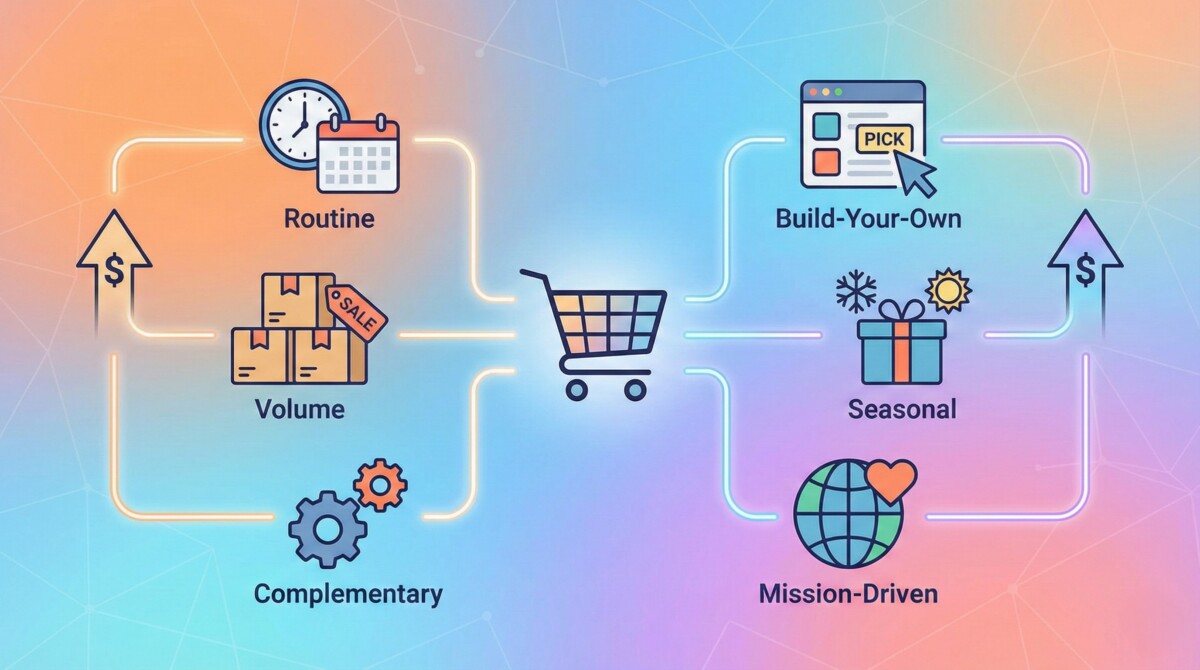
Quick Decision Framework
- Who this is for: Shopify merchants doing $250K+ annual revenue looking to increase average order value by 40-80% and reduce customer acquisition costs through strategic bundling
- Skip if: You have fewer than 10 SKUs, extremely high price points ($5,000+), or sell highly customized one-off products that don’t naturally complement each other
- Key benefit: Bundles deliver 55% average order value lift, 86% revenue per user increase, and 5-8% conversion rates (vs. 2.5-3% store average) when executed strategically
- What you’ll need: Minimum 5-10 complementary products, bundle builder app ($10-50/month), 2-4 weeks for testing and optimization, analytics tracking for bundle performance
- Time to complete: 30-60 days from strategy development to optimized bundle performance with measurable AOV increases
HiSmile transformed their business with bundles: 80% of orders now include bundles, with a 4x increase in average cart size. The strategy works when you understand what customers actually want to buy together.
What You’ll Learn
- Why bundles deliver 55% AOV increases and how top Shopify stores achieve 4x cart size growth
- The psychology behind why bundles convert better than individual product pages
- Six proven bundle strategies with real examples from successful Shopify brands
- How to choose the right bundle builder app for your business model and technical needs
- Step-by-step implementation roadmap from strategy to optimization in 30-60-90 days
- Which metrics to track and how to measure true bundle ROI beyond surface-level AOV
- Common bundle mistakes that kill conversions and how to avoid them
Most Shopify merchants leave money on the table with every transaction.
Your customer is ready to buy. They’ve added one item to their cart. They trust your brand enough to enter their credit card information. And then they check out with a single product.
Meanwhile, top-performing Shopify stores are converting those same single-item purchases into multi-product orders worth 55% more on average.
The difference? Strategic product bundling.
When HiSmile implemented their bundle strategy, 80% of their orders became bundle purchases. Average cart size increased 4x. Coconu saw a 20% AOV increase. Maev experienced a 15% AOV lift plus a 20% jump in units per transaction.
This isn’t about randomly grouping products together and hoping customers buy more. It’s about understanding purchase psychology, identifying natural product pairings, and removing friction from the buying process.
This guide breaks down exactly how successful Shopify stores use bundles to increase average order value, which strategies work best for different business models, and how to implement bundles that actually convert.
Why Product Bundles Outperform Individual Product Sales
Product bundles aren’t just a merchandising tactic. They’re a conversion optimization strategy backed by behavioral psychology and proven performance data.
The Psychology Behind Bundle Conversions
Bundles work because they solve three fundamental problems customers face when shopping online:
Decision Paralysis: When customers face too many choices, they often choose nothing. A curated bundle removes the cognitive burden of deciding which products to pair together. Instead of evaluating 20 individual products, customers evaluate 3-5 pre-configured bundles.
Perceived Value: Even without discounting, bundles increase perceived value. A “Complete Skincare Routine” bundle feels more valuable than buying cleanser, toner, and moisturizer separately, even at the same price point. The framing changes the perception.
Product Discovery: Most customers don’t know your full catalog. Bundles introduce them to products they wouldn’t have discovered on their own. A customer buying protein powder might not think to add a shaker bottle and flavor packets, but a “Post-Workout Recovery Bundle” makes the pairing obvious.
The Data Behind Bundle Performance
Research from Shopify merchants and bundle app providers shows consistent performance improvements:
- 55% average order value increase when bundles are implemented strategically
- 86% revenue per user increase from bundle purchasers vs. single-item buyers
- 5-8% conversion rates on bundle pages vs. 2.5-3% store average
- Higher customer lifetime value – bundle buyers return 2.3x more often than single-item purchasers
These aren’t marginal improvements. They’re business-transforming results that compound over time.
When Bundles Don’t Work
Bundles aren’t universal. They fail when:
- Products don’t naturally complement each other (random groupings)
- Bundle pricing offers no perceived value (same price as individual items with no framing)
- Too many bundle options create decision paralysis
- Bundle inventory isn’t synced properly, causing fulfillment issues
- Bundle pages load slowly or have poor mobile experience
The key is strategic implementation, not just turning on a bundle app and hoping for results.
Six Proven Bundle Strategies That Drive AOV Increases
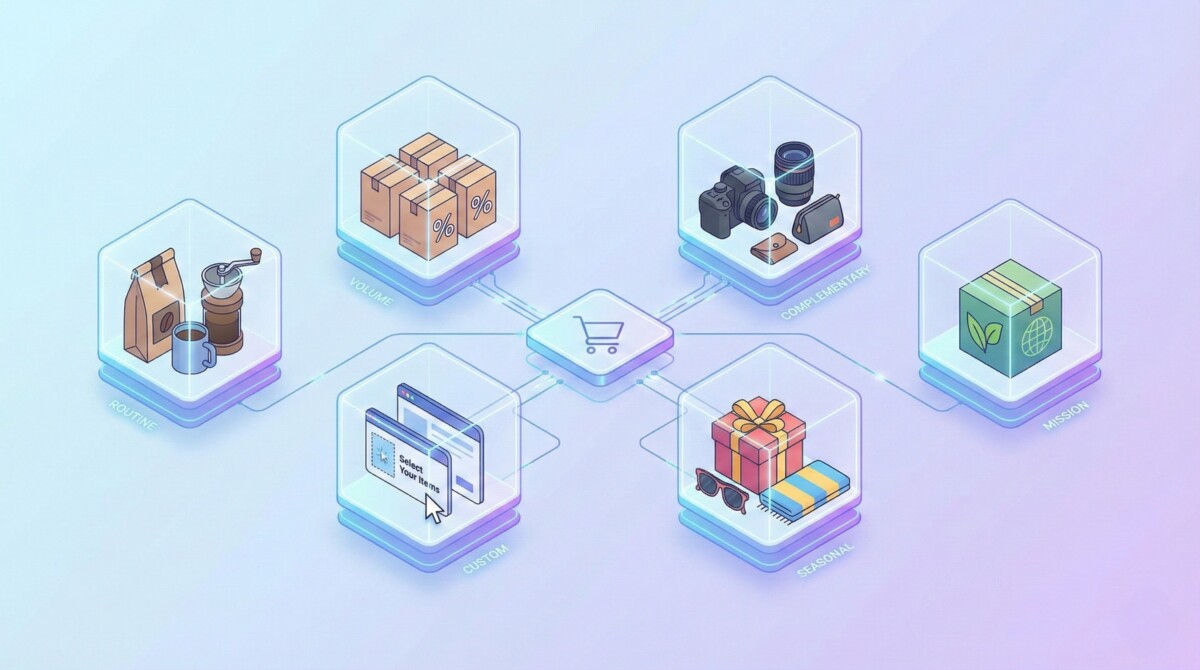
Not all bundles perform equally. The most successful Shopify stores use specific bundle frameworks based on customer behavior and product relationships.
1. Routine-Based Bundles
Routine-based bundles group products customers use together as part of a daily or regular routine.
Examples:
- “Morning Skincare Routine” (cleanser, toner, moisturizer, SPF)
- “Post-Workout Recovery Bundle” (protein powder, shaker, electrolytes)
- “Complete Coffee Setup” (beans, grinder, filters, mug)
Why it works: Customers already think in routines. You’re not convincing them to buy more; you’re organizing their existing purchase intent into a single transaction.
Best for: Beauty, wellness, fitness, food and beverage brands where products support specific use cases or daily habits.
Implementation tip: Name bundles after the routine or outcome, not the product category. “Morning Energy Ritual” converts better than “Coffee Bundle.”
2. Buy More, Save More (Volume Bundles)
Volume bundles incentivize larger purchases through tiered discounts.
Examples:
- “Buy 2, Save 10% / Buy 3, Save 15% / Buy 4, Save 20%”
- “3-Month Supply (Save 15%)”
- “Buy 3, Get 1 Free”
Why it works: Creates clear value proposition while reducing per-unit cost. Customers feel smart for buying in bulk.
Best for: Consumables, supplements, personal care products, pet supplies – anything customers reorder regularly.
Implementation tip: Show the per-unit savings clearly. “$1.50 per bar” is more compelling than “Save $6 total.”
3. Complementary Product Bundles
These pair products that naturally enhance each other’s use or value.
Examples:
- “Camera + Lens + Memory Card + Bag”
- “Yoga Mat + Blocks + Strap + Towel”
- “Dog Food + Treats + Supplements”
Why it works: Customers were going to buy these items eventually. Bundling them removes the friction of multiple purchase decisions.
Best for: Technical products, hobbies, sports equipment, pet care – categories where accessories are essential or highly recommended.
Implementation tip: Include one “hero” product (the main purchase driver) plus 2-3 complementary items. Don’t overwhelm with too many add-ons.
4. Build-Your-Own Bundles
Customizable bundles let customers choose products within a framework. When you create custom product bundles in Shopify, you give customers ownership over their selection while maintaining the convenience of curated options.
Examples:
- “Build Your 3-Product Skincare Routine” (choose cleanser, treatment, moisturizer)
- “Create Your Snack Box” (pick 6 items from 20 options)
- “Design Your Coffee Subscription” (select 3 roasts from catalog)
Why it works: Combines personalization with the convenience of bundling. Customers feel ownership over their selection while still benefiting from curated options.
Best for: Brands with diverse product lines where customer preferences vary significantly.
Implementation tip: Limit choices to prevent decision paralysis. “Pick 3 from 12 options” converts better than “Pick any 3 from our entire catalog.”
5. Seasonal and Occasion-Based Bundles
Time-sensitive bundles tied to seasons, holidays, or specific occasions.
Examples:
- “Summer Essentials Bundle” (sunscreen, hat, sunglasses, beach bag)
- “Holiday Gift Set” (curated products in gift packaging)
- “Back-to-School Bundle” (backpack, lunch box, water bottle, supplies)
Why it works: Taps into existing purchase intent around specific times or events. Customers are already shopping for these occasions.
Best for: Fashion, accessories, home goods, gifts – categories with strong seasonal purchase patterns.
Implementation tip: Launch 3-4 weeks before the occasion peaks. Too early and urgency is low; too late and customers have already purchased.
6. Mission-Driven and Limited-Edition Bundles
Bundles tied to brand values, causes, or exclusive product combinations.
Examples:
- “Earth Day Bundle” (eco-friendly products with donation to environmental cause)
- “Founder’s Favorites” (curated by brand founder, limited quantity)
- “Collaboration Bundle” (exclusive partnership with another brand or influencer)
Why it works: Creates emotional connection and urgency. Customers buy for the story and exclusivity, not just the products.
Best for: Mission-driven brands, DTC brands with strong founder presence, brands with loyal communities.
Implementation tip: Tell the story behind the bundle. “Why we created this” messaging increases conversion by 15-25%.
Choosing the Right Shopify Bundle Builder App
Your bundle strategy is only as good as the technology supporting it. The right app makes implementation seamless; the wrong one creates fulfillment nightmares.
Here’s what matters when evaluating bundle apps:
Critical Features to Look For
Real-Time Inventory Sync: If your bundle includes 3 products and one goes out of stock, the bundle should automatically become unavailable. Apps that don’t sync inventory in real-time create oversell situations and fulfillment headaches.
SKU-Level Fulfillment: The best apps break bundles down into individual SKUs at checkout, so your warehouse team fulfills the actual products, not a “bundle SKU” that doesn’t exist in inventory.
Discount Flexibility: You need the ability to discount the bundle as a whole, discount individual items within the bundle, or offer free shipping on bundles. Rigid discount structures limit your strategy.
Analytics and Reporting: Track which bundles drive the most revenue, which have the highest conversion rates, and which products perform best within bundles. You can’t optimize what you don’t measure.
Top Bundle Builder Apps for Shopify (2026)
Simple Bundles
- Best for: Merchants who need reliable, real-time inventory sync and clean fulfillment
- Pricing: $29-199/month based on order volume
- Strengths: Excellent inventory management, SKU-level fulfillment, works with most fulfillment apps
- Limitations: Less visual customization than competitors
BOGOS by Secomapp
- Best for: Merchants wanting all-in-one upsell, bundle, and promotion features
- Pricing: Free plan available, paid plans $29.99-89.99/month
- Strengths: 2,100+ reviews (4.9 stars), user-friendly interface, includes BOGO and volume discounts
- Limitations: Can be overwhelming with too many features for simple bundle needs
Fast Bundle
- Best for: Merchants wanting AI-powered bundle recommendations
- Pricing: Competitive pricing with AI features included
- Strengths: AI suggests optimal product pairings based on purchase data
- Limitations: Newer app with less proven track record
MaxBundle
- Best for: Budget-conscious merchants or those testing bundles for the first time
- Pricing: Free plan available
- Strengths: Excellent mix-and-match functionality, no cost to start
- Limitations: Limited advanced features on free plan
If you’re looking for a comprehensive solution with advanced customization, Bundle Builder offers powerful features specifically designed for Shopify merchants who want complete control over their bundle strategy and presentation.
Integration Considerations
Your bundle app needs to work with your existing tech stack:
- Fulfillment apps: ShipStation, ShipBob, Shopify Fulfillment Network
- Inventory management: Stocky, Inventory Planner, TradeGecko
- Subscription apps: Recharge, Bold Subscriptions
- Email marketing: Klaviyo, Omnisend (for bundle-specific campaigns)
Test integrations in a sandbox environment before going live. A broken integration discovered during Black Friday is too late.
Step-by-Step Bundle Implementation Roadmap
Here’s exactly how to go from no bundles to optimized bundle strategy in 30-60-90 days.
Days 1-7: Strategy and Product Selection
Analyze your product catalog:
- Which products are frequently purchased together? (Check Shopify analytics)
- Which products have the highest margins? (Prioritize these in bundles)
- Which products are slow-moving? (Use bundles to move inventory)
- Which products are gateway items? (Products that lead to repeat purchases)
Identify 3-5 bundle opportunities:
Don’t launch 20 bundles at once. Start with 3-5 high-potential bundles based on:
- Natural product relationships
- Customer purchase patterns
- Margin optimization
- Inventory movement needs
Define bundle pricing strategy:
- Will you discount bundles or maintain full price?
- If discounting, what’s the minimum margin you’ll accept?
- How will you communicate value (savings vs. convenience vs. curation)?
Days 8-14: App Selection and Setup
Evaluate 2-3 bundle apps:
- Install on development store or sandbox
- Test inventory sync behavior
- Verify fulfillment workflow
- Check mobile experience
- Review reporting capabilities
Configure your chosen app:
- Set up inventory sync rules
- Configure discount logic
- Customize bundle page templates
- Test checkout flow end-to-end
- Verify order appears correctly in Shopify admin
Create bundle landing pages:
- Write compelling bundle descriptions (focus on outcome, not just products)
- Add high-quality product images (show all items in bundle)
- Include clear value proposition (savings amount, convenience, curation)
- Add trust signals (reviews, guarantees, free returns)
Days 15-30: Launch and Initial Promotion
Soft launch to email list:
- Send dedicated email to engaged subscribers
- Offer early-bird discount (10-15% off for first 48 hours)
- Track open rates, click rates, conversion rates
- Monitor for technical issues or customer confusion
Add bundles to site navigation:
- Create “Shop Bundles” menu item
- Add bundle callouts to individual product pages
- Include bundles in homepage featured collections
- Test mobile navigation thoroughly
Monitor early performance:
- Bundle conversion rate vs. individual product pages
- Average order value for bundle purchases
- Fulfillment accuracy (any SKU issues?)
- Customer feedback and questions
Days 31-60: Optimization and Expansion
Analyze performance data:
- Which bundles have highest conversion rates?
- Which bundles drive highest AOV?
- Which individual products perform best in bundles?
- Where are customers dropping off in the bundle purchase flow?
Optimize underperforming bundles:
- Test different product combinations
- Adjust pricing and discount levels
- Rewrite bundle descriptions with clearer value props
- Improve product imagery
- Add customer reviews specific to bundles
Expand successful bundles:
- Create variations of top performers
- Add seasonal versions
- Test build-your-own options
- Launch complementary bundles
Days 61-90: Scaling and Advanced Strategies
Implement advanced bundle tactics:
- Post-purchase bundle upsells
- Subscription bundle options
- Loyalty program bundle rewards
- Influencer collaboration bundles
- Limited-edition seasonal bundles
Integrate bundles across marketing channels:
- Facebook/Instagram ads featuring bundles
- Email automation flows (abandoned bundle carts, bundle recommendations)
- SMS campaigns for flash bundle sales
- Affiliate partnerships promoting specific bundles
Optimize for long-term performance:
- Create quarterly bundle refresh calendar
- Build bundle performance dashboard
- Document best practices and learnings
- Train customer service team on bundle fulfillment
Measuring Bundle Success: Metrics That Matter
Average order value is the obvious metric, but it doesn’t tell the full story. Here’s what to track:
Primary Metrics
Bundle Conversion Rate: Percentage of bundle page visitors who add bundle to cart and complete checkout. Target: 5-8% (vs. 2.5-3% store average).
Bundle AOV Lift: Average order value of bundle purchases vs. non-bundle purchases. Target: 40-80% increase.
Bundle Revenue Percentage: What percentage of total revenue comes from bundles? Track trend over time. Top performers: 30-50% of revenue from bundles.
Units Per Transaction (UPT): Average number of items per order. Bundles should increase UPT by 50-150%.
Secondary Metrics
Bundle Attach Rate: Percentage of individual product page visitors who view or purchase a recommended bundle. Indicates bundle visibility and relevance.
Repeat Purchase Rate: Do bundle buyers return more often than single-item buyers? Track 30-day, 60-day, 90-day repeat rates.
Customer Lifetime Value (LTV): Bundle buyers should have 1.5-2.5x higher LTV than single-item buyers.
Inventory Turn Rate: Are bundles helping move slow inventory? Track inventory turn for products included in bundles vs. those not bundled.
Diagnostic Metrics
Bundle Page Bounce Rate: High bounce rate indicates poor bundle page experience or irrelevant traffic.
Add-to-Cart Rate: Visitors who add bundle to cart but don’t complete checkout. Indicates pricing or checkout friction issues.
Fulfillment Error Rate: Percentage of bundle orders with fulfillment issues. Should be under 2%.
Return Rate: Are bundle returns higher than individual product returns? May indicate poor product fit or customer expectations mismatch.
Common Bundle Mistakes and How to Avoid Them
Mistake 1: Random Product Groupings
The problem: Bundling products that don’t naturally go together just to increase AOV.
Example: “Yoga Mat + Protein Powder + Dog Treats Bundle”
The fix: Only bundle products that customers would logically purchase together. Use purchase history data to validate natural pairings.
Mistake 2: No Clear Value Proposition
The problem: Bundle is the same price as buying items individually with no additional value communicated.
Example: “3-Product Bundle: $90” (when items cost $30 each individually)
The fix: Either discount the bundle OR clearly communicate the convenience/curation value. “Complete Morning Routine – Everything You Need in One Click” justifies full price.
Mistake 3: Too Many Bundle Options
The problem: Offering 15+ bundle variations creates decision paralysis.
The fix: Start with 3-5 core bundles. Use data to identify top performers, then expand strategically.
Mistake 4: Poor Inventory Management
The problem: Bundle shows as available when one component is out of stock, leading to fulfillment issues and customer frustration.
The fix: Use bundle app with real-time inventory sync. Test out-of-stock scenarios before launch.
Mistake 5: Ignoring Mobile Experience
The problem: Bundle pages look great on desktop but are clunky on mobile (where 60-70% of traffic comes from).
The fix: Design mobile-first. Test bundle pages on multiple devices. Ensure images, descriptions, and CTAs are mobile-optimized.
Mistake 6: No Bundle-Specific Marketing
The problem: Creating bundles but not actively promoting them. Bundles buried in site navigation.
The fix: Dedicate email campaigns, ads, and homepage real estate to bundles. Treat them as hero products, not afterthoughts.
Mistake 7: Static Bundle Strategy
The problem: Launching bundles once and never updating them based on performance or seasonality.
The fix: Review bundle performance monthly. Refresh underperformers, expand winners, add seasonal variations. Bundles should evolve with your business.
Advanced Bundle Strategies for Scaling Brands
Once you’ve mastered basic bundles, these advanced tactics drive incremental gains:
Dynamic Bundle Recommendations
Use AI or rule-based logic to recommend bundles based on:
- Items currently in cart
- Customer purchase history
- Browsing behavior
- Customer segment (new vs. repeat)
Apps like Fast Bundle offer AI-powered recommendations. Alternatively, use Shopify’s product recommendation API with custom logic.
Post-Purchase Bundle Upsells
After checkout completion, offer complementary bundles on the thank-you page:
- “Complete Your Routine – Add These 3 Products for 20% Off”
- “Customers Who Bought X Also Love This Bundle”
Apps like ReConvert and Zipify OneClickUpsell enable post-purchase bundle offers.
Subscription Bundles
Combine bundles with subscriptions for recurring revenue:
- “Monthly Wellness Bundle – Save 15% with Subscription”
- “Quarterly Seasonal Bundle Subscription”
Works especially well for consumables, supplements, personal care, and pet products.
Tiered Bundle Programs
Create bundle tiers that encourage trading up:
- Starter Bundle: 3 products, $75
- Complete Bundle: 5 products, $110 (save 15%)
- Ultimate Bundle: 8 products, $150 (save 25%)
Most customers choose the middle option (decoy effect), but some trade up to ultimate.
Limited-Time Bundle Drops
Create urgency with limited-edition bundles:
- “48-Hour Flash Bundle – Only 100 Available”
- “Founder’s Picks – Limited to 250 Bundles”
- “Summer Collection Bundle – Available Until July 31”
Scarcity and urgency drive faster purchase decisions.
The Future of Shopify Bundling: What’s Next
Bundle strategies continue to evolve. Here’s what top merchants are testing in 2026:
AI-Powered Personalized Bundles
Instead of static bundles, AI creates personalized bundles for each customer based on:
- Purchase history
- Browsing behavior
- Similar customer profiles
- Inventory availability
- Margin optimization
Early tests show 20-35% higher conversion rates vs. static bundles.
Interactive Bundle Builders
Customers build bundles through guided quiz experiences:
- “Take our 60-second quiz to build your perfect skincare bundle”
- “Answer 5 questions to create your custom supplement stack”
Combines personalization with education, increasing both conversion and customer satisfaction.
Augmented Reality Bundle Previews
AR technology lets customers visualize bundles before purchase:
- See how furniture bundle looks in their space
- Preview makeup bundle on their face
- Visualize how clothing bundle items pair together
Reduces returns and increases bundle confidence.
Social Commerce Bundles
Instagram and TikTok Shop integration enables:
- Influencer-curated bundles
- Shoppable bundle posts
- Live-stream bundle reveals
- User-generated bundle content
Social-first bundles tap into existing purchase intent where customers already spend time.
Your 30-Day Bundle Quick-Start Plan
If you want to launch bundles fast, here’s the accelerated path:
Week 1: Strategy
- Analyze top 20 products by revenue
- Identify 3 natural product pairings
- Define bundle pricing (10-20% discount)
- Choose bundle app (start with BOGOS or MaxBundle free plan)
Week 2: Setup
- Install and configure bundle app
- Create 3 bundle products
- Write bundle descriptions (focus on outcomes)
- Add bundle images (show all products)
- Test checkout flow thoroughly
Week 3: Launch
- Add bundles to homepage and navigation
- Send email announcement to list
- Create social media posts
- Monitor for technical issues
Week 4: Optimize
- Review conversion rates and AOV
- Adjust pricing or product mix as needed
- Add customer reviews to bundle pages
- Plan next 2-3 bundle launches
This compressed timeline gets you live fast so you can start learning from real customer behavior.
Conclusion: Bundles as a Long-Term Growth Strategy
Product bundles aren’t a quick tactic. They’re a sustainable growth strategy that compounds over time.
When HiSmile reached 80% of orders as bundles with 4x cart size increases, they didn’t achieve that overnight. They tested, optimized, and refined their bundle strategy over months.
The brands seeing 55% AOV lifts and 86% revenue per user increases didn’t just turn on a bundle app. They understood customer psychology, identified natural product relationships, and removed friction from the buying process.
Your bundle strategy should evolve as your business grows:
- Phase 1: Launch 3-5 core bundles based on obvious product pairings
- Phase 2: Optimize based on performance data, expand winners
- Phase 3: Add advanced tactics (build-your-own, subscriptions, post-purchase upsells)
- Phase 4: Implement AI-powered personalization and dynamic recommendations
Start simple. Measure everything. Optimize relentlessly.
The merchants who master bundling don’t just increase average order value. They reduce customer acquisition costs, improve customer lifetime value, and build more profitable, sustainable businesses.
Your customers are ready to buy more. Bundles make it easy for them to do so.
Frequently Asked Questions
What is the average AOV increase from implementing product bundles?
Research shows bundles deliver an average 55% AOV increase when implemented strategically. Top-performing Shopify stores like HiSmile achieve 4x cart size increases, with 80% of their orders including bundles. The actual lift depends on your bundle strategy, product selection, and pricing approach. Volume bundles and routine-based bundles typically drive the highest AOV increases.
Which Shopify bundle app is best for my store?
The best bundle app depends on your specific needs. Simple Bundles ($29-199/month) excels at real-time inventory sync and clean fulfillment for merchants who need reliability. BOGOS by Secomapp (free-$89.99/month) offers all-in-one features with 2,100+ positive reviews, ideal for merchants wanting comprehensive promotion tools. Fast Bundle provides AI-powered recommendations for data-driven merchants. MaxBundle offers excellent free options for budget-conscious stores testing bundles. If you need advanced customization, Bundle Builder provides powerful features specifically for Shopify merchants.
How do I choose which products to bundle together?
Start by analyzing your Shopify analytics to identify products frequently purchased together. Look for natural product relationships like routine-based pairings (morning skincare, post-workout recovery), complementary items (camera + lens + bag), or volume purchases (3-month supply). Prioritize bundles that include high-margin products to maintain profitability. Avoid random groupings – customers should logically understand why products are bundled together. Test 3-5 bundles initially based on your strongest product relationships.
Should I discount my bundles or keep them at full price?
Both approaches work depending on your brand positioning and goals. Discounted bundles (10-20% off) drive higher conversion rates and are effective for moving inventory or competing on price. Full-price bundles work when you emphasize convenience, curation, or exclusivity rather than savings. Use the “rule of 100”: for items under $100, percentage discounts (15% off) feel more valuable; for items over $100, dollar amounts ($50 off) have greater perceived value. Test both approaches and measure which drives better profit margins, not just revenue.
How long does it take to see results from bundle implementation?
Most merchants see initial results within 30-60 days of launching bundles. Week 1-2 focuses on strategy and app setup. Week 3-4 involves soft launch and initial promotion. By day 30-60, you’ll have enough data to optimize underperforming bundles and expand successful ones. Full optimization and scaling typically takes 90 days. The accelerated path can get you live in 30 days if you focus on 3 core bundles and streamlined setup.
What metrics should I track to measure bundle success?
Primary metrics include bundle conversion rate (target 5-8% vs. 2.5-3% store average), bundle AOV lift (target 40-80% increase), bundle revenue percentage (top performers hit 30-50% of total revenue), and units per transaction (should increase 50-150%). Secondary metrics include repeat purchase rate for bundle buyers vs. single-item buyers, customer lifetime value (bundle buyers should have 1.5-2.5x higher LTV), and inventory turn rate for bundled products. Track these monthly to identify optimization opportunities.
Do bundles work for all types of ecommerce businesses?
Bundles work best for businesses with complementary products, consumables, or items used in routines. They’re highly effective for beauty, wellness, fitness, food and beverage, pet supplies, and hobby/sport equipment. Bundles are less effective for businesses with very few SKUs (under 10), extremely high price points ($5,000+), or highly customized one-off products. If your products don’t naturally pair together or customers rarely purchase multiple items, focus on other AOV strategies like upsells or volume discounts instead.
How do I handle inventory management for bundles?
Choose a bundle app with real-time inventory sync so bundles automatically become unavailable when any component is out of stock. The best apps break bundles down into individual SKUs at checkout for clean fulfillment – your warehouse team fulfills actual products, not phantom “bundle SKUs.” Test out-of-stock scenarios before launch to ensure bundles behave correctly. Integrate your bundle app with fulfillment tools like ShipStation or ShipBob. Monitor fulfillment error rates (should stay under 2%) and address any SKU issues immediately.
Can I use bundles with subscription products?
Yes, subscription bundles are highly effective for recurring revenue. Combine bundles with apps like Recharge or Bold Subscriptions to offer “Monthly Wellness Bundle” or “Quarterly Seasonal Bundle Subscription” options. This works especially well for consumables, supplements, personal care, and pet products. Subscription bundles typically command 15-25% discounts vs. one-time purchases and significantly increase customer lifetime value. Ensure your bundle app integrates properly with your subscription platform before launch.
What are the biggest mistakes to avoid when launching bundles?
The biggest mistakes include: creating random product groupings that don’t make logical sense, offering no clear value proposition (same price as individual items with no framing), overwhelming customers with too many bundle options (start with 3-5), poor inventory management causing fulfillment issues, ignoring mobile experience where 60-70% of traffic comes from, failing to actively promote bundles through dedicated marketing, and treating bundles as a one-time launch instead of an evolving strategy. Avoid these pitfalls by starting simple, testing thoroughly, and optimizing based on performance data.
