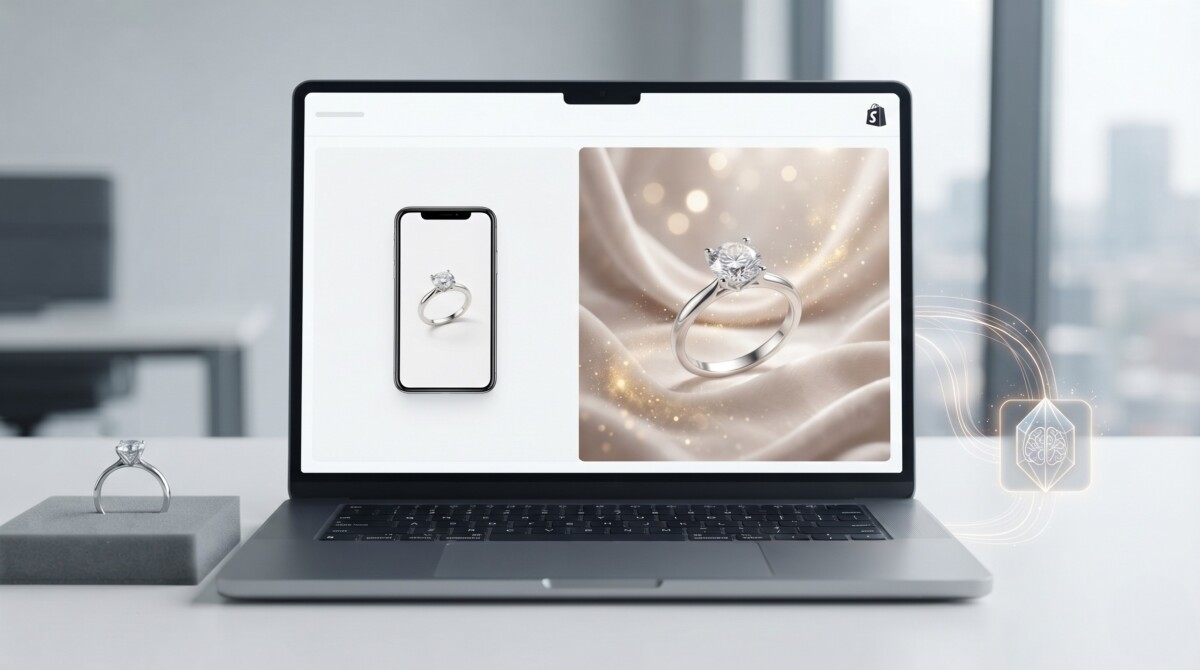
Shopify jewelry stores can use AI product photos to turn a single clear image into a complete, accurate listing set with model try-ons, close-ups, angles, and lifestyle scenes that build trust, show scale, and help customers decide faster.
Jewelry photos are not just decoration; they are how online shoppers decide whether a piece feels real, wearable, and worth the price before they ever read the description.
For Shopify jewelry stores, product photography is not just a visual detail. It is part of the buying experience.
A customer shopping online cannot hold a ring, try on a necklace, feel the weight of a bracelet, or see how an earring moves in real life. Before they read the full product description, compare materials, or check shipping details, they usually make a quick visual judgment. Does the product look clear? Does it feel trustworthy? Can they imagine wearing it?
That is why jewelry product images carry so much weight in ecommerce. Jewelry is small, reflective, personal, and detail-heavy. A clean product image is important, but it is rarely enough on its own. Buyers often need to understand scale, styling, texture, finish, and how the piece looks when worn.
For larger jewelry brands, this usually means professional shoots, models, lighting setups, stylists, editing, and a repeatable creative production process. For smaller Shopify stores, that workflow can be expensive and slow. A new product may be ready to sell, but the listing still needs enough visuals to make the page feel complete.
This is where AI product photography is becoming useful for jewelry sellers. Instead of replacing the original product image, AI can help turn one clear product photo into a stronger set of listing assets: model try-on images, close-up detail shots, second-angle visuals, and lifestyle-style scenes.
The result is a faster way to move from product idea to polished online listing.
A single product image can show what an item looks like, but it often does not answer every customer question.
A necklace might look beautiful in a close-up, but the buyer may still wonder how long it looks on the body. A ring may look premium in a studio shot, but the customer may want to see how bold or delicate it appears on a hand. Earrings can be hard to judge without seeing them on an ear. Bracelets and bangles usually need wrist context so shoppers can understand proportions.
Strong jewelry listings usually include a mix of image types. A complete product page may use:
A clean hero image that shows the item clearly.
A model try-on image that shows how the jewelry looks when worn.
A close-up detail shot that highlights stones, metalwork, engraving, clasps, or texture.
A second product angle that shows depth, side profile, back details, or chain structure.
A lifestyle or gift-style image that adds emotion and context.
Each image has a different job. The hero image catches attention. The try-on image explains scale. The close-up image supports perceived quality. The product angle builds trust. The lifestyle image helps customers imagine the product in real life.
For Shopify stores, this kind of visual completeness can make a product page feel more professional. It can also reduce uncertainty, which is especially important for newer brands that do not yet have strong name recognition.
The best use of AI product photos is not to treat AI as a magic replacement for all photography. A better approach is to use AI as a creative production layer.
Start with a clear product photo. This could be a simple image of a ring, necklace, pair of earrings, bracelet, or bangle. The product should be sharp, well-lit, and easy to identify. From there, AI can help generate supporting visuals that would normally require extra shoot time.
For example, a Shopify jewelry seller can use AI-assisted workflows to turn one clear product image into a more complete visual set for a product page. Tools like AI jewelry model photos can help create model try-on images, close-up detail shots, product angles, and lifestyle-style visuals for jewelry listings. This is especially useful for stores that launch many SKUs, test new styles often, or sell across multiple channels such as Shopify, Etsy, and social commerce.
The goal is not simply to create attractive images. The goal is to create useful listing images. A useful jewelry listing image should help the buyer understand the product faster. It should show scale, detail, style, and context without distracting from the item itself.
That difference matters. Generic AI images may look polished, but jewelry sellers need visuals that still respect the original product design. The ring should remain the same ring. The necklace length should feel believable. The earring should sit naturally on the ear. The bracelet should wrap around the wrist in a realistic way.
Accuracy is especially important for jewelry because small changes can misrepresent the product. A different stone shape, an added gem, a changed chain, or an unrealistic scale can create customer disappointment. AI should make the product easier to understand, not make it look like something else.
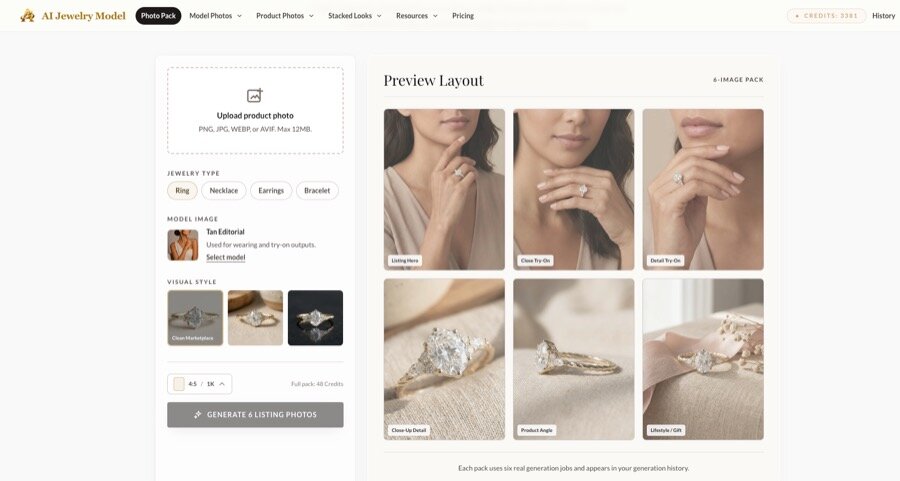
A complete jewelry listing pack can include a hero image, model try-on shots, close-up details, product angles, and lifestyle visuals.
One of the biggest challenges in jewelry ecommerce is scale.
A product photo can make a small ring look larger than it is. A necklace pendant may look dramatic in a close-up, but much smaller when worn. Earrings can be difficult to judge without seeing them on an ear. Bracelets and bangles need wrist context so shoppers can understand proportions.
Model try-on photos help solve this problem. They give shoppers a realistic frame of reference. Instead of guessing how a product might look when worn, the customer can see it in context.
For Shopify stores, this can improve the buying experience in a practical way. Try-on photos can reduce uncertainty, make the product feel more tangible, and help customers compare styles. A shopper choosing between two necklaces may not only be comparing designs. They may be deciding which one fits their neckline, outfit style, or intended occasion.
This is especially important for giftable jewelry. When someone buys jewelry as a gift, they may not know exact measurements or styling preferences. A model photo helps them imagine the item as a real wearable product rather than a small object on a plain background.
AI-generated try-on images can also help small stores create more consistent product pages. Instead of having some products with model shots and others with only flat lays, sellers can build a more repeatable visual standard across the catalog.
For example, a store could use a consistent model-photo style for all necklaces, a consistent hand style for rings, and a consistent ear close-up for earrings. This makes the store feel more organized and intentional, even if the brand is still small.
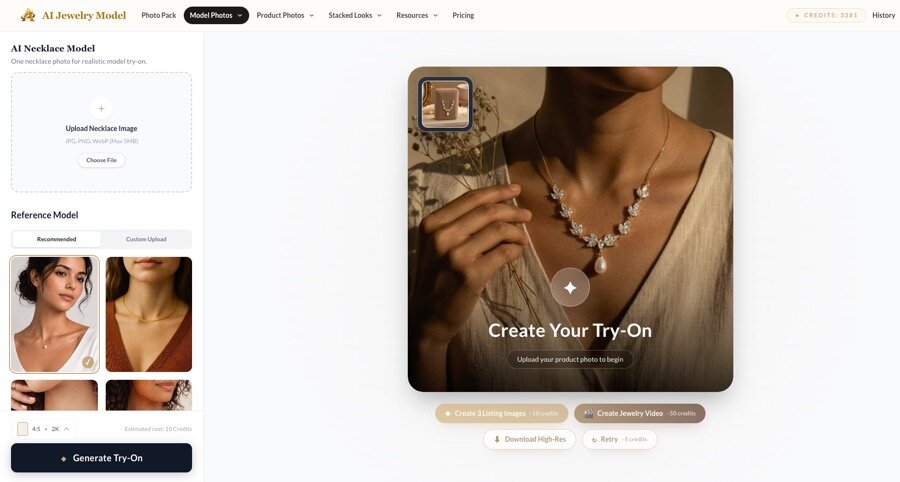
AI model photos can help jewelry sellers show how necklaces, rings, earrings, and bracelets look when worn.
Jewelry shoppers care about details. They want to see the stone setting, chain links, band thickness, clasp design, engraving, texture, and finish. These details are often what separate a basic listing from a premium one.
Close-up images are especially useful for handmade jewelry, fine jewelry, custom pieces, and products with unique craftsmanship. They help communicate quality without relying only on written descriptions.
For Shopify stores, close-up images also support brand positioning. If the brand is selling minimalist everyday jewelry, the close-up may focus on clean lines and subtle finish. If the brand sells vintage-inspired or handmade pieces, the image may highlight texture, character, and artisan details. If the product is designed as a gift, the detail shot can help the item feel more thoughtful and special.
AI can help produce these supporting visuals more quickly. A seller may not need to set up a new macro photography session for every product variation. Instead, AI-assisted workflows can generate detail-focused images that match the overall visual direction of the store.
However, close-up images need careful review. They should not invent new stones, change the metal color, alter the engraving, or make the product look more expensive than it is. The best workflow uses AI to improve presentation while keeping the product faithful to the original design.
A strong jewelry listing needs clarity, but it also needs feeling.
Lifestyle images help create that emotional layer. A ring placed on soft fabric, a necklace shown near gift packaging, or earrings styled in warm natural light can make a product feel more desirable. These images are not just decorative. They help customers understand the mood of the brand.
For Shopify jewelry stores, lifestyle visuals can support different buying intentions. A clean marketplace-style image may work well for shoppers who want to inspect the product clearly. A warm boutique-style image may appeal to customers buying handmade jewelry. A soft gift scene may work well during holidays, anniversaries, Valentine’s Day, Mother’s Day, or wedding season.
Lifestyle images can also be reused beyond the product page. They can support homepage sections, collection banners, email campaigns, social posts, ads, and seasonal promotions. That makes them valuable assets for small teams that need more content but do not have a full creative department.
AI product photography makes this easier because sellers can generate visual variations around the same product. Instead of waiting for a full campaign shoot, a store can test different visual angles and see what fits the brand.
A Shopify product page should help the customer make a decision quickly. For jewelry, that usually means reducing uncertainty.
A complete image set can answer questions such as:
What does the jewelry look like clearly?
How does it look when worn?
How large or delicate does it feel?
What are the important details?
What kind of lifestyle or occasion does it fit?
When each image has a clear purpose, the product page becomes easier to understand. The buyer does not need to rely only on imagination. They can move through the image gallery and build confidence step by step.
This is where a structured image pack can be more useful than random image generation. Shopify sellers do not just need more images. They need the right image types in the right order.
A practical structure could look like this:
Image 1: Clear listing hero.
Image 2: Primary model try-on.
Image 3: Alternative model try-on or scale reference.
Image 4: Close-up detail.
Image 5: Second product angle.
Image 6: Lifestyle or gift scene.
This type of structure gives sellers a repeatable system. Instead of deciding from scratch every time a new piece is launched, the brand can follow the same visual framework across the catalog.
For small jewelry stores, that repeatability matters. It saves time, improves consistency, and makes the store look more professional.
Speed matters in ecommerce. If a Shopify jewelry store can launch products faster, test designs earlier, and update visuals more often, it has more chances to learn what customers respond to.
Traditional photoshoots often create a bottleneck. The product may be ready, but the photos are not. The brand may want to test a new necklace collection, but booking a model and photographer delays the launch. A seller may want to refresh old listings, but the cost of reshooting everything is too high.
AI product photos can reduce that bottleneck. A store can start with existing product images and create more complete listing visuals without rebuilding the entire creative process. This is particularly useful for independent designers, Etsy-to-Shopify sellers, dropshipping jewelry boutiques, print-on-demand accessory brands, and small DTC jewelry stores.
It also gives brands more room to test. A seller can compare clean studio-style visuals with warmer boutique-style scenes. They can test model try-on images against product-only pages. They can refresh a collection page with more consistent visuals. They can create seasonal imagery without waiting for another shoot.
The advantage is not only lower cost. It is faster creative iteration.
For small brands, that can be a major advantage. Large brands may have bigger creative budgets, but smaller sellers can often move faster. AI tools can help them turn that speed into better product pages, better campaigns, and more frequent testing.
AI product photography is powerful, but sellers should use it carefully.
The most important rule is product consistency. Jewelry is detail-sensitive. If an AI image changes the stone shape, adds extra gems, alters the chain, changes the metal color, or makes the item look larger than it really is, that image can create customer disappointment.
Sellers should review every output before publishing. The product should match the original design. The scale should feel believable. The lighting should support the product without hiding details. Skin, hands, ears, necklines, and wrists should look natural in try-on images.
It is also important to keep a consistent brand look. If every product page uses a completely different visual style, the store can feel messy. Shopify jewelry brands should decide on a few core visual directions, such as clean marketplace, handmade boutique, or editorial lifestyle, then use AI to support that direction consistently.
AI should make the store look more professional, not less coherent.
Jewelry ecommerce depends on trust, clarity, and emotion. Customers want to see the product clearly, understand how it looks when worn, and feel confident that it matches their expectations.
For Shopify jewelry stores, AI product photos can make that process faster and more accessible. Instead of relying on one or two basic images, sellers can create complete listing photo sets that include model try-ons, detail shots, second angles, and lifestyle scenes.
The strongest approach is to use AI as part of a thoughtful product listing workflow. Start with a clear product photo. Generate useful supporting images. Review for accuracy. Keep the brand style consistent. Then use those visuals across product pages, collections, emails, ads, and social content.
Better jewelry photos do not just make a product look nicer. They help customers understand the product faster. And in a crowded Shopify market, that can make the difference between a quick scroll and a confident purchase.
AI product photos help small Shopify jewelry stores by turning one clear product image into multiple listing visuals—model try-ons, detail shots, angles, and lifestyle scenes—without needing a full studio shoot for every piece.
This lets small teams launch more SKUs, refresh listings faster, and test different visual approaches without the time and cost of traditional production each time.
Yes, you still need at least one original, well-lit product photo because AI works best as a layer on top of reality, not as a complete substitute for it.
That base image anchors all generated visuals to the real design, which helps prevent AI from inventing details that do not exist on the actual piece.
You keep AI-generated jewelry images accurate by reviewing every output and rejecting anything that changes stone shapes, chain styles, metal colors, or apparent size compared with the real piece.
Setting clear rules in advance—such as “no added gems or altered engravings”—and treating AI as a presentation tool, not a redesign tool, helps maintain trust.
A good structure is to start with a clear hero image, then show a primary model try-on, an extra try-on or scale reference, a close-up detail shot, a second angle, and finally a lifestyle or gift scene.
This order walks the shopper from clarity to context to emotion, answering practical questions before asking them to picture the piece in their own life.
AI-generated jewelry images are also useful for collection banners, homepage sections, email campaigns, organic social posts, and paid ads.
Reusing consistent lifestyle and try-on imagery across these touchpoints helps reinforce your brand and makes your creative library go further.