






Verified & Reviewed
Published on March 23, 2026 Written By Rachel Hand

Published on March 23, 2026 Written By Rachel Hand

Subscribe for More
To meet rising demand and overcome labor shortages, more brands are turning to warehouse automation to scale smarter and stay competitive.
From robotic systems and autonomous mobile robots (AMRs) to AI-powered software, modern automation tools help reduce human error, boost productivity, and accelerate order throughput.
But automation isn’t one-size-fits-all. Whether you’re exploring targeted tools like barcode scanners or looking to overhaul your fulfillment with end-to-end automation, the right strategy depends on your growth goals, budget, and operational complexity.
In this guide, we’ll break down the different types of warehouse automation, key benefits, real-world use cases, and tips to implement it effectively.
What is warehouse automation?
Warehouse automation refers to the use of technology and automated systems to streamline and optimize various processes within a warehouse facility.
This encompasses a wide range of solutions, from physical hardware like robotic picking arms and autonomous mobile robots (AMRs) to advanced software platforms for inventory management, order processing, and data analytics.
The evolution of warehouse automation
The concept of warehouse automation has evolved significantly over the years. Early forms of mechanization, such as conveyor belts and forklifts, laid the groundwork for modern automation by reducing manual labor and increasing efficiency. However, these tools still required significant human intervention and were limited in their ability to adapt to changing needs.
In contrast, today’s warehouse automation solutions leverage cutting-edge technologies like artificial intelligence (AI), machine learning (ML), and the Internet of Things (IoT) to create truly intelligent and flexible systems. These advanced solutions can automatically adjust to fluctuating demand, optimize routes for material handling equipment, and even predict maintenance needs before breakdowns occur.
The rise of warehouse automation is largely driven by the rapid growth of ecommerce and the increasing pressure on businesses to meet customer expectations for fast, accurate order fulfillment. With online sales surging and customers demanding shorter delivery times, manual processes simply can’t keep pace. Automation offers a way to handle higher order volumes, reduce labor costs, and improve overall efficiency.
However, it’s important to recognize that warehouse automation is not an all-or-nothing proposition. While some businesses may benefit from a fully automated, “lights-out” warehouse, others may see significant improvements by implementing automation in specific areas like picking or packaging. This partial automation approach allows businesses to gradually adopt new technologies based on their unique needs and resources.
Addressing modern fulfillment challenges
Running a warehouse today is harder than ever. Online shopping has exploded, which means more orders to fill — but not enough workers to fill them. Warehouse work is tough, so employees often quit, which drives up the cost of constantly hiring and training new people.
On top of that, customers now expect their orders to be fast and accurate. Thanks to companies like Amazon, people expect near-instant delivery, and any mistake can lead to returns and complaints.
Warehouse automation can solve many of these problems. With the right automation technology in place, brands can: Here’s what it can do:
- Reduce dependence on manual labor, helping businesses cope when workers are hard to find
- Cut costs, which means less spending on hiring, training, and turnover
- Improve order accuracy since machines make fewer mistakes than people, leading to fewer returns and complaints
- Speed up order processing with robots can work 24/7 without getting tired, and automated conveyor systems that keep products moving quickly through the warehouse
But automation isn’t something you can just switch on overnight. To do it right, businesses must:
- Review their current operations to understand where they’re struggling most
- Identify the biggest opportunities where automation would make the most difference
- Plan a gradual rollout that fits their budget and goals
- Work with experienced vendors who can guide them through the process
Done right, warehouse automation can help businesses grow and keep up with the hectic demands of today’s online shopping world.
Types of warehouse automation systems
Warehouse automation encompasses a wide range of technologies that work together to streamline operations and improve efficiency. These systems can be implemented gradually based on a business’s specific needs and budget, allowing for a tailored approach to automation.
Goods-to-person systems
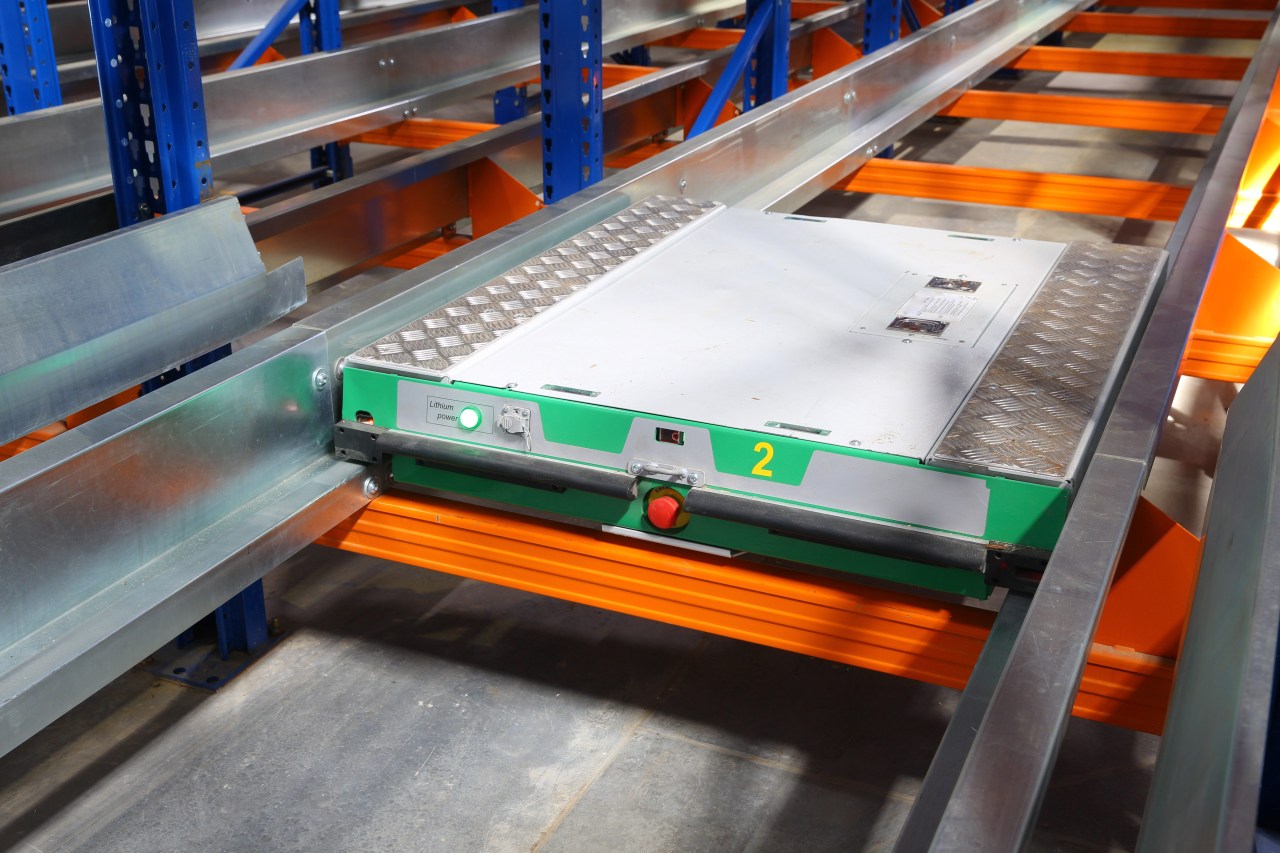
Goods-to-person systems, such as automated storage and retrieval systems (AS/RS), shuttle systems, and carousels, bring products directly to pickers, eliminating the need for them to travel through the warehouse to locate items.
This approach significantly reduces picker travel time and improves overall space efficiency. Implementation costs vary based on the scale of the operation and the specific technology used.
Robotic solutions
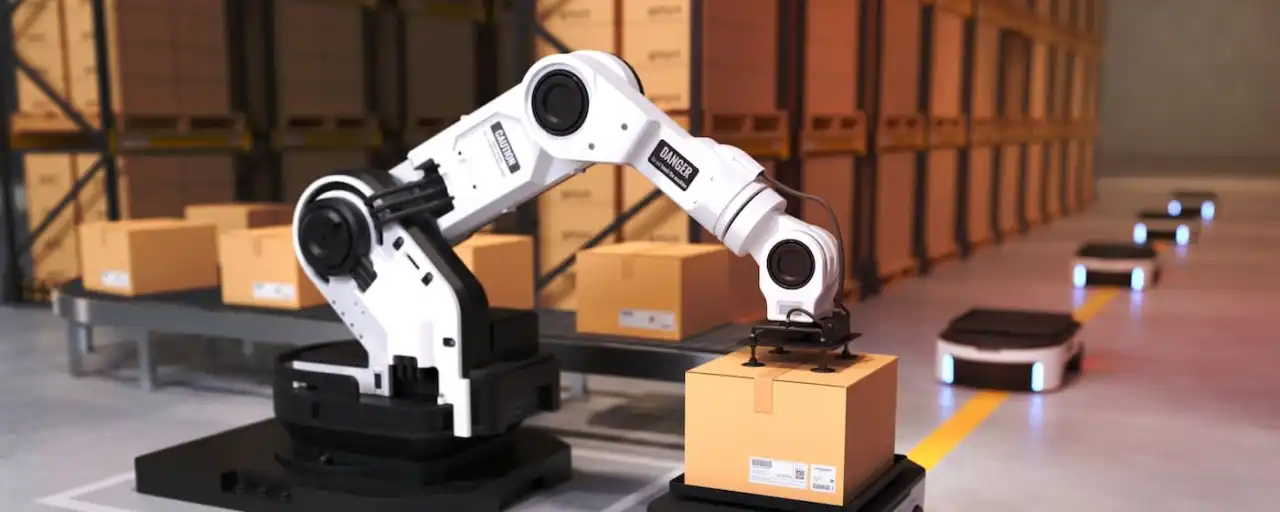
Robotic technologies, including picking robots, autonomous mobile robots (AMRs), and collaborative robots (cobots), are increasingly being deployed in warehouses to reduce labor requirements and boost throughput.
These robots can navigate the warehouse autonomously, pick and transport items, and work alongside human workers. When considering robotic solutions, it’s essential to evaluate how they will integrate with existing warehouse infrastructure and processes.
Conveyor and sortation systems
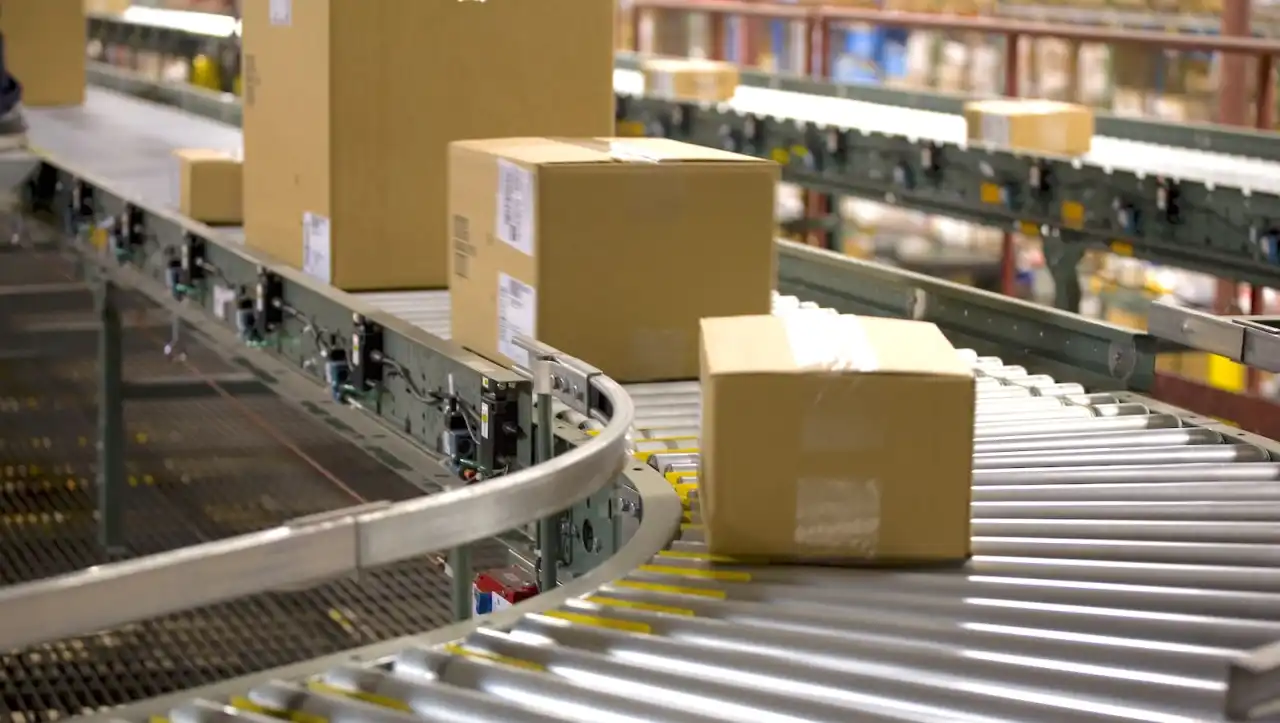
Automated conveyor systems are designed to move products efficiently through the warehouse, reducing manual handling and increasing processing speed.
Sortation technologies, such as cross-belt sorters and tilt-tray sorters, automatically direct items to the correct packing stations or shipping areas based on predefined criteria.
These systems can significantly streamline the flow of goods and minimize the risk of errors.
Software automation
While physical automation components are critical, software plays an equally important role in orchestrating warehouse operations.
A warehouse management system (WMS) serves as the central hub, providing real-time visibility and control over inventory, orders, and resources.
Order management systems automate the flow of orders from receipt to fulfillment, while integration with ecommerce platforms and marketplaces ensures seamless data exchange and inventory synchronization.

Data and analytics tools
Advanced data analytics, powered by artificial intelligence (AI) and machine learning, enable businesses to optimize their warehouse operations continuously.
- Predictive analytics can help forecast demand more accurately, ensuring that the right products are in the right place at the right time.
- Automated data collection through sensors and IoT devices provides real-time insights into system performance, allowing for proactive maintenance and troubleshooting.
- Dashboards and reporting tools give managers the visibility they need to monitor automation effectiveness and identify areas for improvement.

The benefits of warehouse automation systems
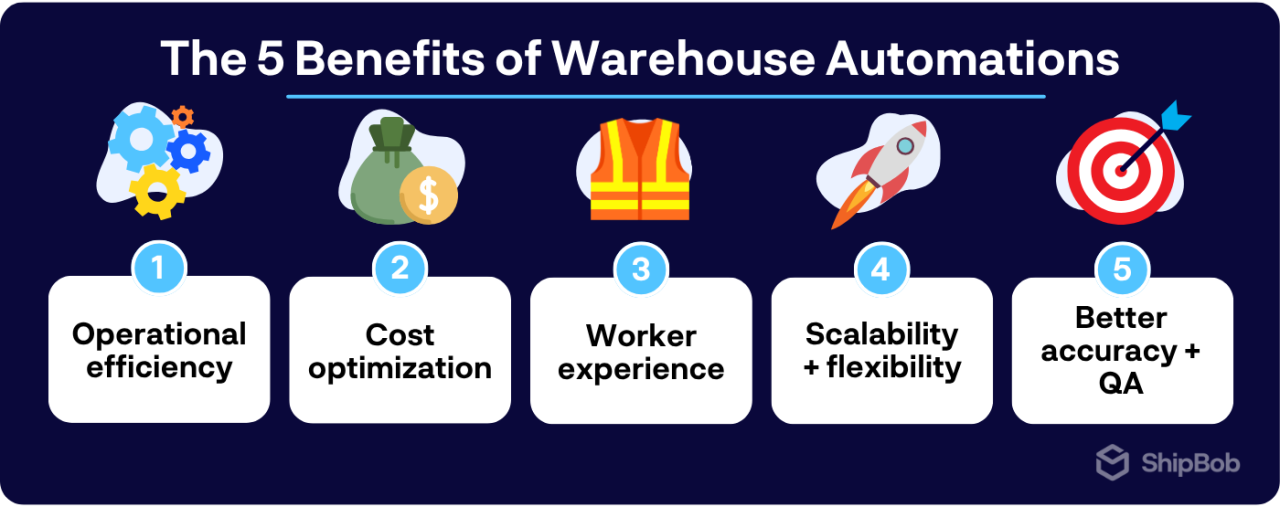
Warehouse automation offers a range of compelling benefits that can significantly improve operational efficiency, cost-effectiveness, and customer satisfaction.
By leveraging advanced technologies and streamlined processes, businesses can gain a powerful competitive advantage in today’s rapidly evolving ecommerce landscape. Here’s how:
Operational efficiency
Warehouse automation has a profound impact on operational efficiency, enabling businesses to process orders faster and more accurately than ever before.
By reducing the time required for each step of the fulfillment process, automation can dramatically increase throughput and minimize bottlenecks.
Consider the case of a company that implements an automated storage and retrieval system (AS/RS) for picking. With this technology, the average pick time can be drastically reduced, meaning that the same number of workers can process far more orders in the same amount of time without any increase in labor costs.
Similarly, automated packing systems can significantly accelerate the packing process while ensuring consistent quality. These systems use advanced algorithms to determine the optimal box size and packing configuration for each order, reducing wasted space and minimizing shipping costs. They can also automatically print and apply shipping labels, eliminating the need for manual data entry and reducing the risk of errors.
By streamlining these and other key processes, warehouse automation can help businesses achieve remarkable improvements in efficiency that are simply not possible with manual methods, making automation essential for businesses looking to scale their operations.
Cost optimization
In addition to boosting efficiency, warehouse automation can also have a significant impact on costs.
Reducing labor requirements, minimizing errors, and optimizing space utilization through automated systems can help businesses operate more cost-effectively and improve their bottom line.
Some of the biggest cost centers automation reduces include:
- Labor costs: Labor costs are often one of the biggest expenses for warehouses, particularly in regions with high minimum wages or limited availability of skilled workers. Automation can help mitigate these costs by reducing the need for manual labor in key areas like picking, packing, and sorting. While there is an upfront investment required for automation equipment, the long-term labor savings can be substantial.
- Errors and returns processing: Even if you have a very small mistake percentage, the costs can add up quickly when you consider the labor required to process returns, the potential loss of customer trust, and the impact on overall efficiency. By contrast, automated picking systems can achieve accuracy rates of 99.9% or higher, virtually eliminating the costs associated with errors.
- Space utilization: Leveraging vertical space and high-density storage systems, businesses can maximize the capacity of their existing warehouse without the need for costly expansion or relocation. This not only reduces real estate costs but also enables more efficient inventory management and faster order processing.
Improved worker experience
Beyond these operational and financial benefits, warehouse automation also has the potential to greatly enhance the worker experience.
When brands automate repetitive and physically demanding tasks, they create a safer and more ergonomic work environment.
This not only reduces the risk of workplace injuries but also allows employees to focus on higher-value activities that require human judgment and problem-solving skills.
As the role of the warehouse worker evolves, automation can also open up new opportunities for training and professional development, and help to build a more engaged and adaptable workforce.
Scalability and flexibility
Perhaps most importantly, warehouse automation provides the scalability and flexibility needed to thrive in an unpredictable business environment.
With modular and adaptable automation systems, businesses can easily adjust to changing product mixes, seasonal peaks, and shifting customer demands.
This agility is critical in an era where consumer expectations are constantly rising, and businesses need to be able to pivot quickly to stay ahead of the curve.
When all of these cost-saving factors are combined, the financial benefits of warehouse automation can be truly impressive. As the technology continues to advance and become more affordable, the ROI of warehouse automation will only continue to improve, making it an increasingly attractive option for businesses of all sizes.
Enhanced accuracy and quality control
One of the most significant advantages of warehouse automation is the dramatic improvement in accuracy and quality control.
Automation minimizes the potential for human error and implementing automated checks and balances, which boosts order accuracy and ensures quality.
In a traditional manual warehouse, the accuracy of order picking and packing is largely dependent on the skill and attentiveness of individual workers. Even with thorough training and well-designed processes, errors can slip through under pressure to meet high demand, particularly during peak periods.
Automated picking systems, on the other hand, can:
- Achieve near-perfect accuracy rates by using advanced technologies like barcode scanning, RFID tracking, and machine vision.
- Quickly and reliably identify the correct products for each order, eliminating the risk of human error.
- Automatically update inventory records in real-time, ensuring that stock levels are always accurate and up-to-date.
Similarly, automated inspection systems can enhance quality control throughout the warehouse using cameras and sensors to check products for defects, damage, or incorrect labeling before they are shipped to customers. This helps catch quality issues early in the process, reducing the risk of customer complaints and returns.
How to implement warehouse automation successfully
Implementing warehouse automation is a complex process that requires careful planning and execution. To ensure a successful transition, it’s essential to take a strategic approach that minimizes disruption and maximizes long-term benefits. Here’s a practical roadmap for implementing warehouse automation in your facility:
1. Assess your current operations
Before embarking on an automation journey, it’s crucial to understand your current warehouse processes and identify areas for improvement.
Conduct a comprehensive audit of your existing operations, analyzing factors such as throughput, accuracy rates, and labor costs.
This assessment will help you pinpoint specific processes that could benefit most from automation and establish baseline metrics for measuring progress.
2. Define clear automation objectives
Once you have a clear picture of your current operations, the next step is to define specific, measurable goals for your automation initiative.
These objectives should align with your overall business strategy and address the pain points identified in your assessment. For example, you might aim to increase order processing speed by 30% or reduce picking errors by 50%.
Be sure to avoid common pitfalls like setting unrealistic targets or failing to consider the broader impact on your organization.
3. Select the right automation partners
Choosing the right technology vendors and integrators is critical to the success of your automation project.
- Look for partners with proven expertise in your industry and a track record of successful implementations.
- Consider factors like scalability, ease of integration, and post-implementation support when evaluating potential providers.
- Don’t hesitate to negotiate contracts that protect your business interests and ensure a smooth transition.
4. Plan for integration challenges
Integrating automated systems with your existing infrastructure can be one of the most challenging aspects of implementation. Legacy systems, data migration, and synchronization issues can all create obstacles.
To minimize these risks, develop a detailed integration plan that addresses potential compatibility problems head-on. Consider using middleware solutions or APIs to bridge gaps between old and new systems, and allow ample time for testing and troubleshooting.
5. Execute a successful pilot program
Before rolling out automation across your entire operation, it’s wise to start with a limited-scope pilot program. This approach allows you to test your automation concepts in a controlled environment and gather valuable data on performance and usability. Use the insights gained from your pilot to refine your implementation plan and make any necessary adjustments before scaling up.
6. Invest in training and change management
Successful automation implementation depends heavily on the people who will be working with the new systems.
- Invest in comprehensive training programs that help your staff understand and embrace the changes.
- Communicate openly about the benefits of automation and address any concerns about job security.
- Fostering a culture of continuous learning and development, so your workforce is equipped to thrive in an automated environment.
7. Scale automation across operations
With a successful pilot under your belt and a well-trained team in place, you’re ready to scale your automation solution across your entire operation. Take a phased approach to minimize disruption, focusing on one area or process at a time. Monitor performance closely during the rollout, and be prepared to troubleshoot any issues that arise. Celebrate successes along the way, and use the momentum to drive continuous improvement.
By following this implementation roadmap and partnering with experienced automation providers, you can navigate the challenges of warehouse automation with confidence. Remember, the key to success is careful planning, clear communication, and a commitment to ongoing optimization.
When to implement warehouse automation
Knowing when to implement warehouse automation is a critical decision for any business. Implementing too early can lead to unnecessary costs and complexity, while waiting too long can result in missed opportunities and competitive disadvantages.
To determine the optimal timing for your specific situation, you’ll need to evaluate key indicators, calculate ROI, and consider partial automation strategies.
🔑 Key indicators you’re ready for automation
Several operational metrics can signal that your business is ready for warehouse automation. If you’re experiencing high error rates, rising labor costs, or throughput limitations, automation may be the solution. For example, if your picking accuracy falls below 98% or your labor costs exceed 50% of your total warehouse budget, it’s time to consider automation.
Growth trajectories can also necessitate automation. If your order volume is doubling year-over-year or you’re expanding into new product categories, manual processes may not be able to keep pace.
Similarly, if you’re facing increased competition in your industry, automation can help you maintain a competitive edge by improving efficiency and reducing costs.
💵 Calculating automation ROI
To justify the investment in warehouse automation, it’s essential to calculate the expected return on investment (ROI). Start by estimating the upfront costs of hardware, software, integration, and training. Then, project the anticipated benefits, such as labor savings, increased throughput, and reduced error rates.
To calculate the payback period, divide the total upfront costs by the annual benefits. For example, if your automation project costs $1 million and is expected to save $250,000 per year, your payback period would be four years. In addition to the financial ROI, consider intangible benefits like improved customer satisfaction and employee morale.
📈 Starting small: Partial automation strategies
Warehouse automation doesn’t have to be an all-or-nothing proposition. In fact, starting with partial automation can be a smart way to test the waters and build a foundation for future expansion. By focusing on specific processes or areas of your warehouse, you can achieve quick wins and demonstrate the value of automation to stakeholders.
For example, you might start by automating your picking process with a goods-to-person system. This can improve accuracy and efficiency without requiring a complete overhaul of your warehouse layout. As you gain experience and see the benefits, you can gradually expand your automation roadmap to include other processes like packing and shipping.
⚖️ Balancing human expertise with warehouse automation
As you consider warehouse automation, it’s natural to have concerns about job displacement. However, it’s important to recognize that automation is not about replacing humans, but rather augmenting their capabilities.
Automating repetitive and physically demanding tasks frees up your staff to focus on higher-value activities that require human judgment and problem-solving skills.
The evolving role of warehouse staff
In an automated warehouse, job responsibilities often shift from manual labor to system monitoring, maintenance, and optimization. For example, instead of walking the warehouse floor to pick orders, a worker might oversee the performance of an automated picking system and troubleshoot any issues that arise.
Automation can also create new roles, such as data analysts who use the wealth of information generated by automated systems to identify opportunities for improvement.
Building an automation-ready workforce
To prepare your workforce for the transition to automation, invest in training and development programs that focus on the skills needed in an automated environment. This might include technical training on specific systems, as well as soft skills like problem-solving and communication.
When recruiting new staff, look for candidates who have experience with automated systems or demonstrate an aptitude for learning new technologies.
Human-machine collaboration models
Effective warehouse automation often involves a collaboration between human workers and automated systems. For example, a human picker might work alongside a collaborative robot (cobot) to pick items from a shelf. The cobot can handle the heavy lifting and repetitive motions, while the human worker can use their judgment to select the right items and ensure quality.
By designing workflows that leverage the strengths of both humans and machines, you can create a more efficient and engaging work environment.
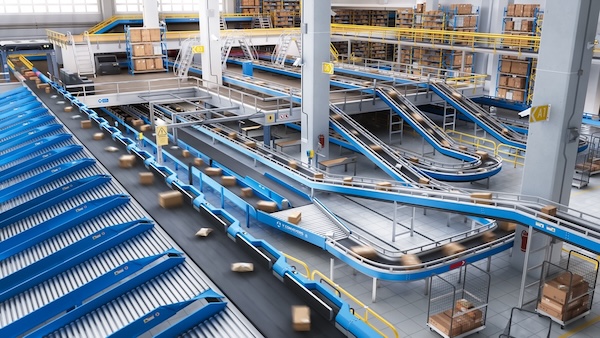
Warehouse automation solutions can be leveraged for rapid fulfillment
In today’s fast-paced ecommerce landscape, customers expect rapid fulfillment and on-time delivery. Warehouse automation solutions can help you meet and exceed these expectations by streamlining the order fulfillment process and enabling same-day and next-day delivery.
Automating the order fulfillment process
End-to-end automation can transform your order fulfillment process, reducing processing time at every step.
When an order is received, an automated system can immediately allocate inventory and generate a picking list. Robotic pickers can then retrieve the items from storage and transport them to the packing station, where automated systems can select the appropriate packaging and apply shipping labels.
By integrating your warehouse automation with transportation management systems, you can ensure that orders are quickly handed off to carriers for delivery.
“We don’t want to waste time doing everything manually, so we love that ShipBob’s solutions automate so much of the fulfillment process across all our channels.
For instance, we automate retail distribution for Target through ShipBob’s EDI connection with SPS Commerce. If we were to manage it by hand, it would require a ton of time and labor to learn each retailer’s guidelines, figure out how to send advance shipment notices (ASNs) correctly, and pack everything to perfection.
But with ShipBob’s solution, SPS Commerce handles incoming purchase orders and sends ASNs directly to ShipBob. It’s that simple, and there’s no hassle for us.”
Hayden Pembridge, Director of Operations at Nood
Enabling same-day and next-day delivery
Automated warehouses make rapid shipping economically viable by reducing the labor costs associated with order processing. With the ability to process orders around the clock and minimize picking and packing times, you can offer same-day and next-day delivery options without sacrificing profitability.
Automation also enables more sophisticated inventory positioning strategies. Analyzing sales data and customer location information lets you strategically place inventory closer to your customers, reducing shipping distances and times.
This approach, known as distributed inventory, can be managed effectively with the help of automated systems that track inventory levels across multiple locations.
“Since partnering with ShipBob, we’ve been able to cut our shipments that are damaged in transit in half, our fulfillment fees have gone down in all countries, and most of our US customers can get their parcels in 2 days or less, even with standard delivery. We’re about to bring on a fourth US fulfillment center with ShipBob, so even more of our customers can get their orders even quicker.”
Danica Quilty, Ecommerce Director of Lyres
Maintaining accuracy under pressure
In addition to speed, customers also expect high levels of accuracy in their orders. Logistics automation solutions can help maintain accuracy even during peak periods when order volumes are high.
Automated quality control checkpoints can also be built into the fulfillment process. For example, machine vision systems can inspect products for damage or defects before they are shipped, ensuring that only high-quality items reach your customers.
“ShipBob has so many automated systems in place to handle lost orders or if something goes wrong. Those are the types of things that fell through the cracks when we managed fulfillment and logistics on our own, so it’s incredible to have ShipBob bridge that gap and handle it for us.”
Annie Leal, owner of I Love Chamoy
How ShipBob helps automate warehouse operations
ShipBob is a leading provider of warehouse automation solutions, offering both in-house WMS options and outsourced fulfillment services.
By partnering with ShipBob, you can access the benefits of automation without the need for significant capital investment or operational disruption.
Here are just some of the ways ShipBob leverage automation to make fulfillment easier for brands like yours:
ShipBob’s WMS: Powering in-house automation
For businesses that prefer to manage their own warehouses, ShipBob offers a powerful warehouse management system (WMS) that can automate key processes like picking, packing, and shipping. The system:
- Integrates seamlessly with popular ecommerce platforms, providing real-time visibility into inventory levels and order status.
- Automates pick list generation to maximize pick path efficiency.
- Monitors performance with detailed analytics.
- Supports advanced features like batch picking and multi-carrier shipping, allowing you to scale your operations as your business grows.
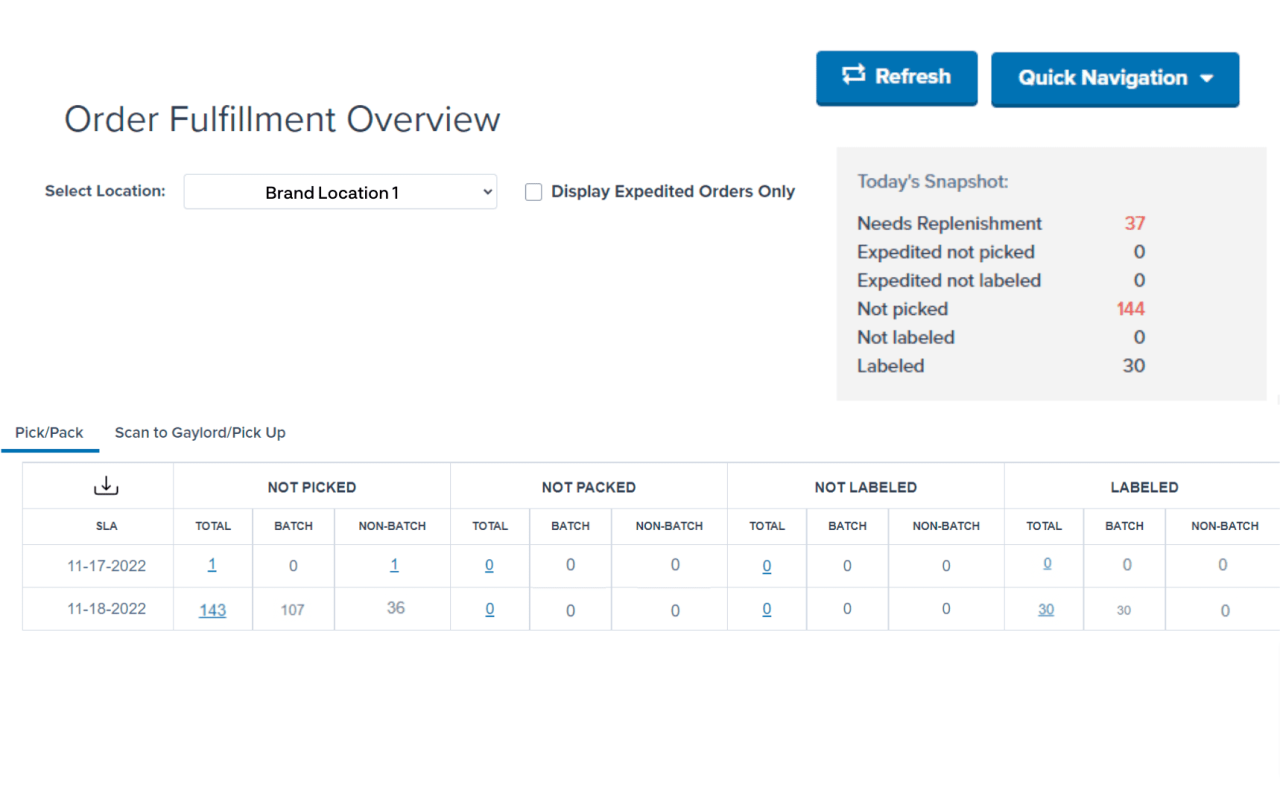
“ShipBob WMS is so useful because it gives you more trust in your operations. You feel freer with picking and packing, because ShipBob’s system handles so much more of the tracking, and it does it really well.
Picking with ShipBob WMS is really well-designed – the system leverages batch and cluster picking to group multiple of the same orders and send your pickers through your aisles once (instead of all the way through for every order), which makes the process so much more efficient and yields endless results.
Packing also has a lot of great checks and balances, and it’s designed for the packers’ experience, so that it make sense and flows really well and. Overall, it’s really cool to be able trust your WMS system and feel like you can enjoy the way it works.”
Tucker Robinson, Warehouse Director at Savannah Bananas
Outsourced fulfillment: Instant access to automation benefits
If you prefer to outsource your fulfillment operations, ShipBob’s network of automated fulfillment centers can provide instant access to the benefits of automation. By storing your inventory with ShipBob, you can leverage their state-of-the-art facilities and technology without the need for capital investment.
ShipBob’s fulfillment centers are equipped with the latest automation technologies, including robotic picking systems, automated conveyors, and advanced scanning and sorting equipment. This allows them to process orders efficiently and correctly, even during peak periods.
“Thanks to ShipBob, order fulfillment largely takes care of itself. I don’t have to sort out issues or dedicate time to figuring things out; it’s a section of the business where I don’t have to spend a lot of time. ShipBob has allowed us to focus on other aspects of the business, which has allowed us to grow considerably.”
Jay Stephens, Director of Operations, and Ania Giuffra, Supply Chain Manager, at Ancestral Supplements
Data-driven optimization with ShipBob
Whether you use ShipBob’s WMS or outsourced fulfillment services, you’ll have access to powerful analytics and reporting capabilities. ShipBob’s platform provides real-time data on key performance indicators like order accuracy, inventory turnover, and shipping times, allowing you to make data-driven decisions about your operations.

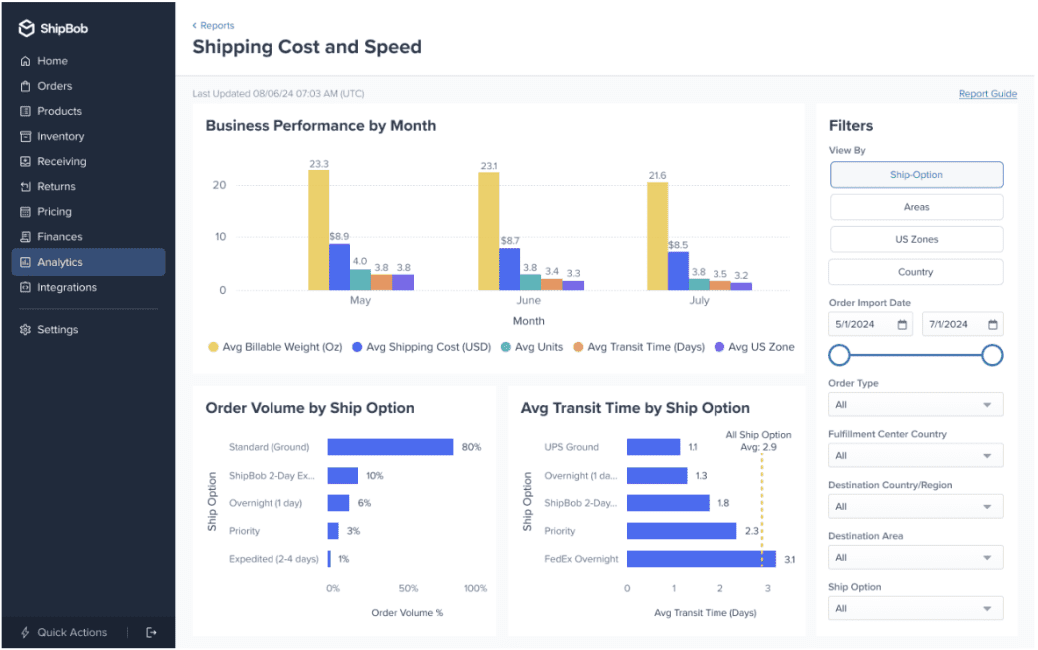
“For mid-market brands with big-scale operations like ours, it’s super important to have a fulfillment partner with top-of-the-line technology. When the numbers are big (and getting bigger), you simply cannot control, monitor, or record everything manually. You need a lot of tools to support you, and ShipBob offers those tools.
I’m very tech-savvy and a big numbers guy. Through ShipBob’s dashboard, I can access all the analytics we need across inventory, storage, orders, fulfillment, shipping – the works. I’m using them all, and they’re all great. Honestly, these analytics help me keep my team really lean. I don’t need a lot of people to work with the system, because the system is working for me. That’s a huge upside.”
Nadav Haras, VP of Supply Chain at Particle
For more information on how ShipBob can offer you the warehouse automation capabilities you need to scale, click the button below to get in touch.
Warehouse automation FAQs
Here are answers to some of the most common questions about warehouse automation.
What are the typical costs and timelines for warehouse automation?

The total investment and rollout duration for warehouse automation vary widely based on scope, technology, and facility size, but you can expect the following ranges.
Costs
- Entry-level automation (barcode scanners, basic conveyors, pick-to-light): ~ $10,000–$75,000
- Mid-range solutions (AMRs, standalone robotic pickers, advanced sortation): ~ $100,000–$500,000
- Full-scale deployments (AS/RS shuttles, integrated goods-to-person, end-to-end robotics + WMS integration): $1 million–$5 million+
Keep in mind: these figures must also account for software licensing, integration services, and staff training. Many vendors offer financing or pay-per-use models to spread capital costs over time.
Timelines
- Light implementations (e.g. mobile scanners, pick-to-light, small conveyor loops): 2–6 weeks
- Mid-level projects (deploying a fleet of AMRs or standalone robotic stations): 2–4 months
- Complex, facility-wide automation (full AS/RS, large-scale WMS integration, multiple robot types): 6–12 months
Key drivers of schedule include facility modifications, legacy system integration complexity, and pilot testing phases. Running a limited-scope pilot (e.g. one picking zone or SKU family) can help validate your approach in 4–8 weeks before scaling.
What are the biggest challenges in warehouse automation?
Some of the biggest challenges in warehouse automation include:
- Integrating new technologies with existing systems and processes: Many warehouses rely on legacy software and equipment that may not be compatible with modern automation solutions. Bridging these gaps can require significant time and resources.
- Change management: Introducing automation can disrupt established workflows and roles, leading to resistance from staff. Effective communication, training, and support are essential to ensure a successful transition.
- Validating and measuring the ROI of automation investments: While some benefits, like labor cost savings, are easily quantifiable, others, such as improved customer satisfaction, are harder to measure directly.
How do I maintain and troubleshoot automated systems?
Regular preventative maintenance, such as cleaning sensors, calibrating equipment, and updating software, can help prevent unexpected downtime. Establishing clear maintenance schedules and procedures ensures that these tasks are completed consistently.
When issues do arise, having a clear troubleshooting plan is crucial. Detailed documentation of the system architecture and components can also facilitate faster problem-solving.
Investing in comprehensive support and maintenance contracts with automation vendors is often worthwhile. These agreements can provide access to expert technical resources, priority service, and software updates that keep systems running smoothly.
Will automation replace my warehouse workers?
Automation is unlikely to replace human workers entirely. In many cases, automation augments human capabilities, taking over repetitive or physically demanding tasks and allowing workers to focus on higher-value activities.
How does ShipBob’s automation compare to building my own system?
Building an in-house automated fulfillment system requires significant upfront investment in hardware, software, and infrastructure. It also involves ongoing costs for maintenance, upgrades, and technical staff. For many businesses, these expenses can be prohibitive.
Outsourcing fulfillment to ShipBob provides access to advanced automation technologies without the need for capital investment.
ShipBob’s fulfillment centers are equipped with state-of-the-art systems, including autonomous mobile robots, automated conveyor and sorting equipment, and advanced warehouse management software.
By leveraging ShipBob’s established automation infrastructure, businesses can achieve the benefits of automation more quickly and cost-effectively.
