

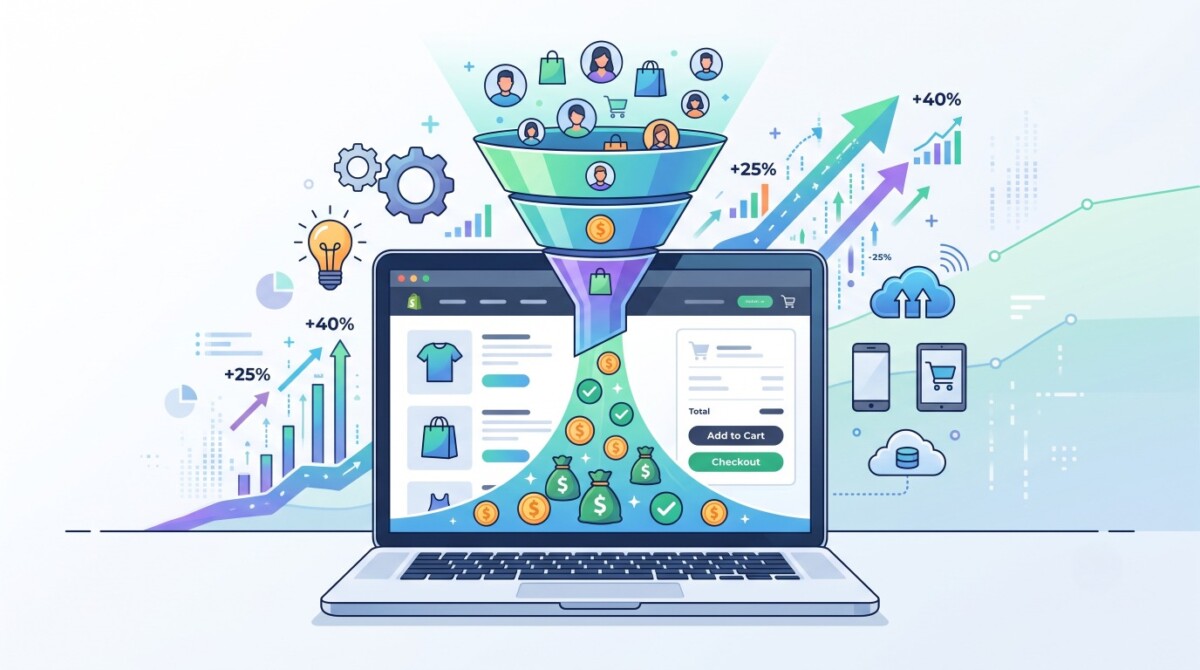
After reading the blog you will learn:
Across the Indian D2C stores we’ve worked on, most are converting somewhere between 0.8 and 1.5% of their visitors, a number that holds whether the category is skincare, apparel, or home goods.
Most founders respond to this by spending more on ads. But that is the wrong move.
More ad spend on a store that does not convert just means paying more for the same result. We have worked on Shopify store development across Indian D2C brands in skincare, furniture, food, and apparel. The product is rarely the problem. What fails is the store’s ability to make a first-time buyer feel confident enough to pay.
This guide covers what to fix, and in what order.
Most Indian D2C stores are designed on a MacBook and tested on fast WiFi. They are never tested the way the buyer experiences them, on a Redmi Note or Samsung Galaxy A-series phone on a 4G connection in a Tier 2 city.
If your homepage takes more than three seconds to load on that device, you are losing buyers before they see a single product.
#1 Images not converted to WebP
Eight product images at 600KB – each add 5MB of page weight before a single app script loads. WebP cuts this by 40 to 60% with no visible quality difference.
#2 Too many installed apps
Every app injects JavaScript that runs on every page load, whether the feature is active or not. Go through your app list and remove anything that does not have a clear, measurable impact on revenue.
#3 Fonts blocking text rendering
Without font-display: swap in your CSS, the browser waits for the font file before showing any text. On a slow connection that is two to four seconds of a blank screen.
#4 Unused theme sections
Most brands use five or six of the fifteen-plus sections that come with a Shopify theme. The rest still add to file size. Remove what you are not using.
Run your store through Google PageSpeed Insights on the mobile tab. A score below 40 means you are losing buyers at the load stage and blaming it on your ads.
RTO (return to origin) happens when a COD order ships and the buyer refuses it at the door. You pay forward shipping as well as return shipping but earn nothing.
In the stores we’ve audited, COD RTO typically sits between 20 and 30% before any intervention, and in fashion or impulse-buy categories, it often runs higher
Most brands blame the courier but the real question is what in your store generated that bad order to begin with.
#1 COD as the default with no friction
When placing an order costs nothing but a name and address, it functions like a wishlist. Buyers who were never truly committed place orders and cancel at the door.
#2 Product pages that set wrong expectations
It includes vague sizing, stock photography that doesn’t match the actual product, and inaccurate colour swatches. A buyer who receives something different from what they saw will refuse delivery.
#3 Fake urgency tactics
It has countdown timers that reset, artificial low-stock alerts, and aggressive retargeting. These push uncommitted buyers to order before they are ready.
Indian buyers arrive at unfamiliar brands with justified scepticism. The Indian internet has a long history of counterfeits, non-delivery, and brands that disappeared after taking payment.
That history shapes how new buyers evaluate your store, even if your product is excellent.
The trust gap is the distance between the credibility your brand has and the credibility a new buyer needs before paying. Your store’s job is to close that gap before the buyer closes the tab.
Photos of real people using your product in real settings are significantly harder to fake than text reviews. Prioritise collecting them over star ratings.
Even buyers who pay online find it reassuring when they see the option of COD. Its presence says you are confident enough in your product to accept cash at the door.
Most buyers will never use it. But they just need to know a real person is reachable if something goes wrong.
A buyer who types their pincode and sees “Estimated delivery by Friday, December 14” feels more confident than one staring at “5 to 7 business days.” Specificity builds trust. This can be set up through apps or through custom Shopify store development using your logistics partner’s API.
On mobile, a buyer sees roughly 600 pixels of content before they need to scroll. What sits in that space determines whether they keep reading or leave. This is not a design opinion but a behaviour pattern visible in session recordings across Indian ecommerce stores.
Everything else, descriptions, size guides, ingredients, FAQs, related products, belongs below the fold. Buyers who are close to purchasing will scroll for more. Buyers who are not will not scroll regardless of what you put there.
As a buyer scrolls down to read the product description, the CTA disappears off screen. A sticky bar that follows them as they scroll keeps the purchase option visible without interrupting their reading.
Most premium themes include this as a built-in setting. And on custom builds, it requires minimal development work.
Showing “Save INR 300” consistently outperforms “30% off” for Indian buyers, particularly at price points below INR 2,000. Update your product page template to show both.
India has structurally lower average order values than Western markets while customer acquisition costs on Meta and Google keep rising.
A skincare brand that increases AOV from INR 650 to INR 950 through complementary bundle offers recovers its acquisition cost on the first order rather than waiting for a second purchase.
Relevance is what makes bundles work. A random algorithm recommending unrelated products does not move the number.
The decisions made during Shopify store development determine whether your store scales cleanly or creates expensive problems at the worst possible moment.
Most of this work is not visible to the buyer but it shows up in your numbers.
Razorpay is the right starting point for most Indian Shopify stores. It has the widest payment method coverage including UPI, cards, net banking, and wallets, and the most complete Shopify integration.
You can also set up a secondary gateway like Cashfree or PayU as a fallback.
Gateway downtime during a high-traffic sale period loses real revenue. A working backup means a failed payment on one gateway does not mean a lost order.
A proper API connection between your Shopify store and your logistics partner makes several things possible that off-the-shelf apps cannot deliver:
Both Shiprocket and Delhivery document their APIs publicly. This work requires a Shopify development agency with direct experience in Indian logistics integrations.
Every order on an Indian Shopify store requires a GST-compliant invoice. Basic invoice apps work at low volume.
At scale, the gaps become a compliance problem including missing HSN codes, IGST applied to intra-state orders that should carry CGST and SGST, or credit notes not generated for returns.
Building GST invoicing into the store’s development from day one, connected to Tally Prime or Zoho Books, eliminates a reconciliation problem that compounds with every order.
The quality range in Indian Shopify development is wide. A developer who knows how to configure Shopify and an agency that understands Indian buyer behaviour and builds around it are not the same thing.
Test them yourself on a mid-range Android phone right now. And we are not talking about screenshots but live URLs. Also, run their PageSpeed score.
If the stores they built score below 55 on mobile, performance is not a priority for them.
An agency with experience will answer specifically. One without will give a vague yes.
A serious agency tests checkout flows across multiple Android devices and multiple payment methods before any store goes live.
Ask for a written feature list before signing anything. Every feature, integration, and page template should be explicitly listed as in scope or out of scope.
The most expensive words in any Shopify development project are “I thought that was included.”
The Navratri to Diwali window accounts for 25 to 40% of annual revenue for many Indian D2C stores. Most brands spend the first two weeks of October scrambling to add discounts and create landing pages.
By then the window for technical preparation has already closed.
Run PageSpeed Insights and fix every issue scoring below 55 on mobile. Remove unused apps. This is when technical work happens, and not a week before the sale.
Build and test all festive collection pages and landing pages. These should be live and checked before your ads go live.
Test the full checkout flow across COD, UPI, credit card, and net banking on at least three Android devices.
Brief your logistics partner on projected order volumes and agree on dispatch SLAs in writing.
Load test any custom theme code and third-party apps handling real-time events like countdown timers or live inventory displays.
Freeze the store. Include no new apps, no theme changes, or no code deployments. Every change in this window is a risk to your biggest revenue week of the year.
Most analytics dashboards show more data than is useful for conversion work. Three numbers, read in sequence, tell you exactly where the problem is.
Add-to-cart rate below 3% with qualified traffic means the product page is failing. Fix this before anything else.
Low checkout initiation despite a healthy add-to-cart rate means buyers are stalling in the cart, usually due to unexpected shipping costs, no visible COD option, or unfamiliar payment methods.
Low checkout completion means the checkout flow itself has friction. Test it in an incognito window on a mobile browser. Remove every field that is not required.
Work through these in order. Optimising checkout completion when your add-to-cart rate is 1.2% is solving the wrong problem.
In our experience running post-purchase flows for Indian D2C brands, email rarely clears 20% open rates. WhatsApp, through the official Business API, routinely delivers open rates above 80% on the same messages.
A basic sequence covering order confirmation with tracking, a delivery notification, a review request three days after delivery, and a repurchase message timed to your category’s reorder window recovers a meaningful share of the acquisition cost you paid for that first order.
Tools like Interakt and Wati handle this through the official WhatsApp Business API.
Indian ecommerce in 2026 does not forgive stores that were built quickly and never revisited.
The stores that convert consistently load fast on the phones their buyers actually use. They manage trust with specific, credible signals rather than generic claims. They treat COD as a risk management decision. Their product pages are built around the buyer’s decision process, not around what looks good in a screenshot.
None of this requires a big budget. But it requires making the right decisions in the right order.
If you need a Shopify development agency to handle the technical side, Crawlapps builds Shopify stores for Indian D2C brands with a specific focus on the problems this guide covers.
Why does my Shopify store get traffic but no sales?
The most common cause is an unresolved trust gap on the product page. Check whether your return policy is visible on the product page itself, whether you have photo reviews from real customers, whether your delivery timeline shows a specific date, and whether COD is available.
What is a good conversion rate for a Shopify store in India?
The Indian ecommerce average sits between 0.8 and 1.5%. A well-optimised Shopify store with qualified traffic and strong trust signals typically converts between 2 and 3.5%. Stores above 4% usually reflect a strong brand, a product with minimal competition, or very high-intent organic traffic.
What is RTO and how do I reduce it?
RTO, return to origin, happens when a COD order ships and the buyer refuses it at delivery. You absorb both forward and reverse shipping costs with no revenue. The fix starts at the store: an OTP confirmation step on COD checkout filters uncommitted orders before they ship. Paired with a small prepaid incentive, this typically reduces RTO by 10 to 20% points without removing COD as an option.
Which payment gateway should I use for my Indian Shopify store?
Razorpay is the recommended starting point for most Indian Shopify stores. It covers UPI, cards, net banking, and wallets, and has the most complete Shopify integration documentation. Configure a secondary gateway like Cashfree or PayU as a fallback so a gateway outage during a sale does not mean lost orders.
Do I need a Shopify development agency or can I build it myself?
A basic store using a premium theme can be built without an agency. You need a Shopify development agency when you require custom logistics API integrations, GST-compliant invoicing, COD OTP verification, regional language support, or a product page layout beyond what standard theme sections offer. The agency cost becomes justified when the alternative is months of self-learning or a store that needs rebuilding once it starts failing at volume.





