

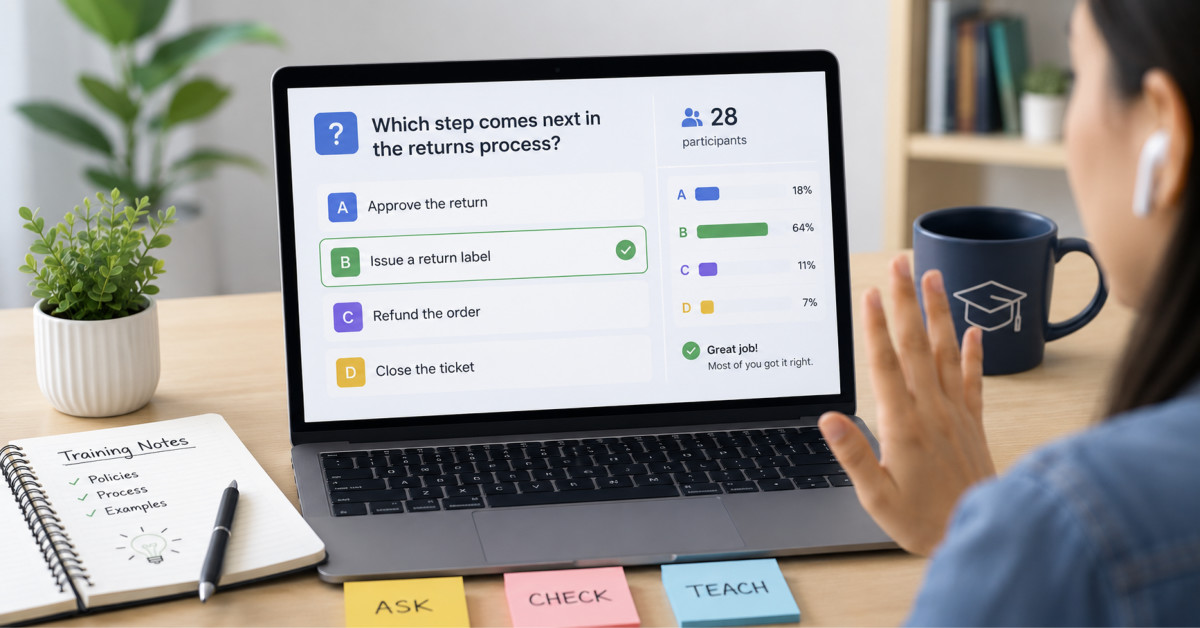
Real-time understanding checks turn training from a one-way presentation into a visible feedback loop. Shopify teams and customer educators should use short scenario questions, polls, and low-stakes quizzes to catch confusion early, correct it immediately, and confirm people can apply the process in real work.
If people can only say that a process makes sense, you have measured agreement. If they can choose the right action in a realistic scenario, you have started measuring understanding.
Teaching doesn’t only happen in classrooms anymore. Ecommerce teams teach all the time, even when they don’t call it teaching. A Shopify merchant trains staff on fulfillment. A direct-to-consumer brand explains a new product line to customer support. A marketing lead walks a team through a campaign dashboard. A founder hosts a webinar to help customers understand how to use a product properly.
In all those moments, the biggest risk is silence. People may nod, smile, stay muted or type “makes sense” in the chat, but that doesn’t always mean they understood. Real-time checks help you catch confusion before it turns into mistakes, poor customer answers, weak adoption or another “wait, what are we doing?” Slack message two days later.
Real-time understanding is easiest to check when questions are small and specific. A broad question like “Does everyone understand?” usually gets a polite yes, even when half the room is quietly panicking. A sharper question gives you better feedback.
For example, if you’re training a support team on a new returns policy, don’t ask whether the policy is clear. Ask what the team should do if a customer returns an opened item after 35 days. If you’re explaining a Shopify discount setup, ask which condition controls the minimum spend. If you’re teaching a marketing team about abandoned cart flows, ask when the first email should be triggered.
Small questions reveal whether people can apply the information, not only repeat the headline. They also make it easier for quieter team members to participate without feeling put on the spot.
Keep questions low-pressure. Multiple choice, quick polls, rating scales and short written answers all work well. The goal is to see where the group stands. Once you know that, you can slow down, give another example or move on with more confidence.
A live quiz can turn passive listening into active learning without making the session feel heavy. Instead of presenting ten slides and hoping everyone follows, you can pause after each section and ask the group to answer a question in the moment.
In e-commerce training, so much of the work is practical. A warehouse team may need to identify the correct packing rule. A customer support team may need to choose the right response to a shipping delay. A marketing team may need to spot which metric shows repeat purchase behavior. A product team may need to understand which feature solves which customer problem.
Tools that let you run a live quiz can help teams check understanding as the session happens. Wooclap’s live quiz format, for example, is built around real-time participation, so trainers can ask questions, collect answers and see whether the group is keeping up before the next section begins.
It’s all in the timing. You’re not finding out after the training that everyone missed the same detail. You’re catching it while the example is still fresh.
Wrong answers aren’t failures. They’re clues. When one person gets something wrong, it may be a simple mistake. When half the group chooses the same wrong answer, the explanation probably needs work.
If support agents are misunderstanding a warranty rule, customers usually get inconsistent answers. When the marketing team misreads campaign data, important budget decisions can drift in the wrong direction and if the fulfillment staff miss a packaging update, orders can end up wrong or not going out at all.
Real-time checks help you separate individual confusion from a broader training gap. Say you ask a team which orders qualify for free returns. If most people choose the wrong condition, the policy may be too complicated, the example may have been unclear or the slide may have hidden the key detail.
Don’t rush past those moments. Pause and explain the issue again with a fresh example. Ask the question another way. Let someone talk through their reasoning. The point isn’t to embarrass anyone. It’s to fix the misunderstanding before it becomes a repeated mistake.
Customer education is just as important as internal training. Many e-commerce brands sell products that need explanation: skincare routines, supplements, tech accessories, fitness gear, baby products, home tools, subscription boxes or anything with sizing, setup or usage instructions.
A customer may read the product page and still misunderstand how to use the item. That can lead to returns, poor reviews or support tickets that could’ve been avoided with better guidance. Real-time checks can help during webinars, product launches, live shopping sessions and community events.
For example, a skincare brand hosting a routine-building session could ask customers which product should be used first. A fitness brand could ask which resistance band suits a beginner. A food subscription brand could ask how long a chilled item can stay outside the fridge. Those quick questions show whether the audience is actually following.
Real-time checks work best when they become normalized, because when they only appear during formal training, people usually treat them as a big event. If they’re part of the everyday workflows, they feel lighter and more useful.
Add one quick check to team meetings after a process update. Use a short quiz at the end of onboarding. Ask a poll during a product launch briefing. Drop a scenario question into a customer support refresher. Keep the format simple enough that nobody needs a separate training session just to answer the question.
Ecommerce moves quickly, so learning has to keep pace. Product details change. Promotions change. Shipping rules change. Platform features change. Customer expectations change. Teams need a way to confirm that updates have landed properly, not just that they were announced.
Real-time feedback also gives managers better information. Instead of assuming a team is ready, they can see where confidence is strong and where more support is needed, making training less of a one-way presentation and more of a working conversation.
Checking understanding in real time doesn’t need to be complicated. The faster you spot confusion, the easier it is to turn training into action.
You check whether your team understood a training session by asking short scenario questions that require them to apply the new rule or process. Avoid ending with “Does everyone understand?” because agreement does not demonstrate capability. Instead, present a realistic customer, order, campaign, or fulfillment example and ask what action should happen next. Review the response pattern immediately, explain the correct answer, and repeat the concept with a second scenario if several people choose the same incorrect option. This approach shows where training needs reinforcement before errors reach customers.
The best real-time quiz format for employee training is usually a low-stakes multiple-choice scenario followed by a concise explanation of the correct answer. Multiple-choice questions are fast to answer, easy to analyze, and useful for identifying common misconceptions across a group. Add short written responses when people need to explain judgment or tone, such as drafting a customer-support reply. Keep each question tied to one operational decision, use plausible wrong answers that reflect real mistakes, and limit a 45-minute training session to about three knowledge checks.
Ecommerce teams should check understanding after every material process change and during each important onboarding module. That includes new returns policies, promotion eligibility, product launches, shipping cutoffs, packaging changes, revised support macros, and dashboard definitions. For routine team meetings, one scenario question after a process update is enough to build the habit without slowing work down. High-volume support and fulfillment operations benefit from weekly or monthly short checks on the policies that create the most customer impact, exceptions, or financial risk.
You can use live quizzes for customer education during webinars, live shopping events, product launches, community sessions, and onboarding flows for products with a learning curve. Ask questions that affect product success, such as setup order, sizing choice, care instructions, safety guidance, or the best product combination for a stated need. Keep participation optional and useful, then explain the answer immediately with a demonstration or resource link. Review repeat wrong answers after the event and update product pages, FAQ content, packaging, and post-purchase messages to prevent the same confusion.
When most people give the same wrong answer, treat it as evidence that the explanation, example, policy, or workflow needs improvement. Pause the training, show why the incorrect answer was tempting, state the correct decision rule in plain language, and use a new example to confirm the correction. Then review the source material after the session. Update the SOP, support macro, training slide, packing-station instruction, or product guidance that created the misunderstanding. Repeated group errors are valuable because they identify a problem before it becomes repeated customer-facing work.





