

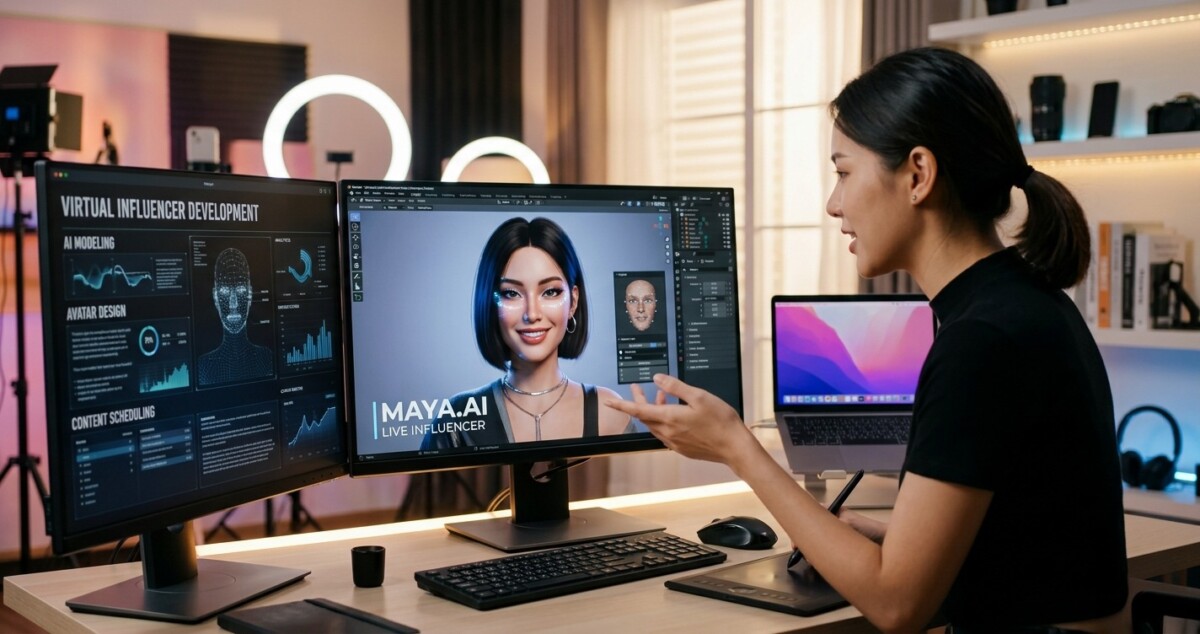
The brands winning with AI influencers are not the ones with the biggest budgets. They are the ones that treat the virtual character like an internal team member: briefed, measured, and iterated, rather than a one-off experiment.
The average mid-tier human influencer campaign takes three to five weeks from brief to published post. Studio time, talent fees, travel, wardrobe, reshoots, and usage rights negotiations all add up before a single frame hits a feed. For a DTC brand doing $500K to $2M in annual revenue, that timeline and cost structure is genuinely hard to sustain at the posting cadence Instagram and TikTok reward. The brands doing $5M and above have figured this out. Many of them are quietly testing a different model.
Virtual characters such as Lil Miquela, who still commands roughly 2.4 million Instagram followers and estimated monthly earnings between $4,610 and $6,316 according to HypeAuditor data from April 2026, proved years ago that audiences will follow and engage with an AI influencer the same way they engage with real people. What has changed in 2026 is that the tools to create your own AI influencer have left the research lab and landed inside a browser tab that costs less than a monthly gym membership.
This guide covers the full workflow: how to design and lock a character, what platform features actually matter for ecommerce production, how to monetize a virtual talent, what the disclosure rules require, and how to run a pilot without betting the content budget on a single experiment.
Traditional influencer marketing still works, but its unit economics are under pressure in a way that is hard to ignore. A mid-tier human influencer can take weeks to plan, shoot, and post a single campaign. Reshoots happen. Talent goes off-script. Booking windows close. For a brand that needs fresh product visuals every week, the operational drag of managing human talent at scale creates a ceiling on content output that no amount of budget can fully remove.
The always-on content problem is real. Ecommerce brands that depend on organic social for discovery need fresh visuals consistently, not just at campaign launch. Product teams want to showcase new SKUs, test creative variations, and swap backgrounds before committing ad spend. When the marginal cost of one more image or one more short video drops to the cost of a generate call inside a browser tool, the math changes entirely. That compression of the content creation pipeline is the core reason why marketing leaders at brands of every size are experimenting with AI-generated talent as a production asset.
The cost savings are measurable. Teams running custom AI influencer campaigns report savings of over $1,000 per photo campaign compared to traditional photography methods, and the ability to generate a full month of posts in a single session. For a brand spending $3,000 to $5,000 per traditional shoot, that reduction in marginal cost is a meaningful margin lever, not just a convenience.
Brand safety is a second driver that does not get discussed enough. A brand-owned AI character cannot post off-script content, miss a deadline, or create a PR incident. For regulated sectors including supplements, beauty, and financial products, the control premium is significant. The character does exactly what the brief says, every time.
Teams that successfully create AI influencer characters are converging on a repeatable process. It looks less like art direction and more like a product pipeline. The brands that get results are the ones that treat each stage as a deliberate decision rather than a quick prompt.
The first step is defining the look. Creators feed text prompts into an AI influencer generator to specify hair, skin tone, wardrobe style, vibe, and personality. Advanced platforms then let the user upload or select a single reference image as the identity anchor, so every future render shows the same person. This identity lock is the most important technical decision in the entire workflow. A character without a locked identity will drift across sessions, and audience trust depends on visual consistency above almost everything else.
Spend more time here than feels necessary. The brands that rush character design and move straight to content production end up rebuilding the character two months later when inconsistency erodes the feed’s coherence. Define the character’s aesthetic, the categories she or he represents, and the three to five visual cues that make the character immediately recognizable. Treat this like a brand identity exercise, because it is one.
Maintaining a consistent look across hundreds of shots is the technical hurdle that separates a toy from a production tool. Newer systems use identity-locking so the character keeps the exact face, body, and style across different outfits, scenarios, and backgrounds. When evaluating platforms, this is the feature to test first. Generate the same character in three different settings and compare. If the jawline shifts, the eye color changes, or the hair style varies between renders, the platform is not production-ready for a brand that needs to post at scale.
The best platforms also allow style sliders that treat outfit, scene, and pose as editable parameters rather than full regenerations. This matters because ecommerce teams need to swap the same character into new product contexts without rebuilding the entire prompt from scratch each time.
Once the character is locked, brands move to batch video generation and image production. Modern tools bundle motion control, lip sync, and reference video mimicry so a single creative concept can be turned into dozens of reels, ads, and product shots without a camera on set. The ability to generate realistic AI influencer videos with script-driven voiceover and natural head movement is what makes this workflow viable for short-form content on Instagram and TikTok, where motion outperforms static images by a significant margin in feed performance.
Batch generation is where the cost advantage becomes concrete. A team that previously spent a full day in a studio to produce 20 usable images can now produce 200 in the same time, with the ability to iterate on any of them in minutes rather than scheduling a reshoot.
The final step is scheduling the assets across Instagram, TikTok, YouTube, and on-site galleries. Because the AI influencer never gets tired, brands can run a consistent posting cadence that no human creator can match without a full production team behind them. The character can front seasonal campaigns, product drops, and always-on content simultaneously, across multiple markets and languages if the platform supports it. When that cadence is in place, the always-on content problem finally has a repeatable answer.
Not every AI influencer tool is built for commerce. Marketing directors evaluating platforms tend to converge on the same short list of features after the first few tests. The marketing claims on platform homepages are secondary to what the tool actually produces when you run it against a real brief.
The headline feature is face consistency across renders. If the character shifts between shots, the illusion collapses and audiences disengage quickly. Test this before committing to any platform at a paid tier. Generate the same character in at least five different contexts and compare the results side by side. Platforms that cannot hold identity across varied prompts are not ready for production use at scale.
Reels and TikTok require motion, voice, and lip sync. Modern tools generate AI influencer videos with script-driven voiceover and support realistic head movement. For ecommerce brands, this is the capability that unlocks product demo content, unboxing-style videos, and talking-head ads that look native to the feed. Platforms that only produce static images are useful but limited for the formats that currently drive the highest organic reach on short-form platforms.
Ecommerce teams need to swap the same character into new outfits, new backgrounds, and varied scenarios without re-training the model each time. The better tools treat style, scene, and pose as editable parameters. This is what makes a platform a production asset rather than a novelty. If changing the character’s outfit requires building a new identity from scratch, the workflow breaks down at the first seasonal campaign.
The audience for these tools is no longer prompt engineers. It is social media managers and brand marketers who want a browser interface, not a command line. One example is RYLA AI, a browser-based platform that lets users create AI content with what the company describes as perfect character consistency, reporting 10,000+ creators, more than 2M images generated, and reach across 120+ countries on its homepage. RYLA AI publishes pricing tiers from a $29.99 per month plan to an agency plan at $149.99 per month, which puts it within reach for brands at almost any stage.
Ease of use is not a soft requirement. It determines whether the tool actually gets used consistently or sits dormant after the initial experiment. Platforms that require technical setup, prompt engineering expertise, or developer involvement will not survive contact with a lean marketing team under deadline pressure.
The category is crowded and moving fast. A non-exhaustive scan of the platforms marketers are currently testing includes Synthesia, Creatify, HeyGen, Higgsfield, Arcads, Captions, D-ID, Virbo, Influencer Studio, Influencer Farm, and RYLA AI. Each takes a slightly different angle on the same core problem, and the right choice depends on your primary content format and team’s technical comfort level.
Video-first platforms such as Synthesia and HeyGen lead on talking-head videos with 100-plus language support, originally aimed at enterprise training content that has since expanded into marketing use cases. These platforms are strong for brands that need localized video content across multiple markets, where the same character can speak in a dozen languages without re-casting talent.
Photo-and-reel platforms such as Higgsfield, Creatify, and RYLA AI focus on photo generation plus short-form reels, which maps cleanly onto how ecommerce teams actually produce content for Instagram and TikTok. These tools are generally more accessible for smaller teams and produce output that is directly usable in feed-native formats without additional post-production.
A newer wave of platforms adds motion control, letting creators upload a reference video of a dance, walk, or gesture and transfer that motion onto the AI character. This capability is what makes realistic AI influencer videos possible without a film crew, and it is the feature category to watch most closely as the tools mature through 2026.
Pricing across these platforms is moving quickly. Treat the figures above as directional benchmarks rather than current quotes, and check each platform directly before committing to a tier. Most offer a free or limited trial that is sufficient to test character consistency before paying.
The interesting business question is not whether brands can create an AI influencer. It is how they monetize one once it exists. The monetization paths mirror what human influencer marketing has always offered, with some structural advantages that only apply to owned virtual talent.
The most direct path is the same as human influencer marketing: the virtual character fronts sponsored social media posts for the brand that owns it, or for partner brands that pay for access to the character’s audience. HypeAuditor April 2026 figures on Lil Miquela show monthly sponsored earnings in the low five figures, confirming that audiences respond to AI influencers the way they respond to real people when the character is well-established and the content is consistent. For measuring influencer marketing ROI, the same attribution frameworks that apply to human creators apply here: UTM parameters, creator-specific discount codes as a floor estimate, and post-purchase surveys to capture dark social conversions the click data misses.
A growing number of brands prefer to own the character outright rather than rent human talent for each campaign. An owned AI influencer becomes a permanent front person for campaigns, seasonal drops, and PR moments, with zero talent contracts, zero usage rights negotiations, and zero risk of the talent going off-brand between campaigns. The character is a brand asset that appreciates with audience familiarity rather than a vendor relationship that resets with every brief.
Agencies and media companies with a well-known virtual character can license that identity to non-competing brands. This is the same business model that built the human influencer marketing industry, with the booking fees replaced by software seats and licensing agreements. For a brand that has invested in building a character with genuine audience recognition, this creates a revenue stream that did not exist before the character was built.
Performance marketers use AI influencer generator tools to produce UGC-style ads where the character speaks to camera with a product reference in hand. These ads convert because they look native to the feed. The production cost per creative is a fraction of traditional UGC sourcing, and the brand controls every element of the execution. For brands running paid social at scale, the ability to produce and test dozens of creative variants without coordinating with external talent is a meaningful operational advantage. To understand how to scale AI video for ecommerce without technical bottlenecks, the infrastructure decisions matter as much as the creative workflow.
When a CFO asks why a marketing team should create a brand-owned AI influencer rather than book human talent, the answer comes back to four numbers: speed, cost, control, and scale. Each one maps to a real business outcome, not a vanity metric.
Speed is the most immediate advantage. Creators can move from a brief to a finished social media post inside a single browser session. That is the difference between a one-week turnaround and a one-hour turnaround for a reactive campaign. When a competitor drops a product or a trend breaks on TikTok, the brand with an AI character can respond the same day. The brand waiting on talent availability and studio scheduling cannot.
Cost is where the math is clearest. After the initial character design, every additional asset costs the price of a generate call. Teams report savings of over $1,000 per photo campaign compared to traditional photography. For a brand that produces content weekly, that compounds into a meaningful budget reallocation over a 12-month period. The money does not disappear. It moves from production overhead into media spend or product development.
Control is the advantage that matters most in regulated categories. A brand-owned character cannot post off-script content, miss a deadline, or create a PR incident. The character does exactly what the brief says, every time, without negotiation. For brands in beauty, supplements, or financial products where a single influencer misstep can trigger regulatory scrutiny, this is not a soft benefit. It is a risk management decision.
Scale is the long-term story. An AI influencer can run campaigns in multiple languages, across time zones, with batch exports for different markets, simultaneously. That multi-market capability at marginal cost is what makes the model attractive to brands with international ambitions that cannot staff a full production team in every geography. Exploring the full range of AI tools for ecommerce businesses reveals how AI-generated talent fits into a broader stack that also includes personalization, customer segmentation, and content automation.
The regulatory picture is the part most marketers get wrong, and the consequences of getting it wrong are no longer theoretical. The rules exist, the enforcement mechanisms are in place, and the platforms have their own requirements on top of the underlying law.
The United States Federal Trade Commission updated its Endorsement Guides in October 2023 and has since clarified through 2024 and 2025 staff guidance that AI-generated testimonials are covered by the same deception rules as human ones. A virtual character cannot claim a personal experience it never had, and paid partnerships must be disclosed. Penalties for violations can reach $53,088 per incident under the 2026 civil penalty adjustments. The disclosure requirement is not a technicality. It is a legal obligation with a specific dollar amount attached to each violation.
In Europe, Article 50 of the EU AI Act sets transparency obligations on providers and deployers of AI systems that generate synthetic content. Deepfakes and AI-generated public-interest content must be disclosed to the end user, and outputs must be machine-readable as synthetic. Brands running EU campaigns need a label strategy built into the creative from the start, not added as an afterthought after the campaign has launched. The compliance cost of retrofitting a disclosure strategy is higher than building it in from day one.
TikTok, Meta, and YouTube have all rolled out platform-level AI-generated content tags, often stricter in practice than the underlying law requires. Ecommerce teams that create AI influencer content for these channels should assume labeling is mandatory and design the campaign with the disclosure badge visible in the frame. Audiences are more forgiving than brand lawyers expect, provided the disclosure is upfront. Research tracked through 2025 by HypeAuditor and others shows that engagement on virtual characters stays healthy when the AI status is clear in bio and captions. Transparency is not a conversion risk. It is a trust-building mechanism.
For marketing leaders who want to pilot this in the next quarter, a few principles separate the teams that get results from the teams that get stuck. The failure mode is almost always the same: moving too fast from character creation to full calendar deployment before the workflow is tested and the disclosure strategy is in place.
Pick one use case first. Do not try to replace the entire content calendar on day one. Pick a single use case, a seasonal product showcase or a new SKU launch, and measure the impact against a baseline of human-produced content. The comparison will tell you more than any platform benchmark about whether the workflow fits your brand. For guidance on how to choose influencer marketing services for your brand, the same evaluation criteria that apply to human talent apply here: fit, consistency, and measurable output.
Lock the character before scaling. Invest the time upfront to get the character design right. A well-locked identity delivers consistent content across months of campaigns. A weak identity delivers inconsistent visuals that erode trust faster than any disclosure issue. The character is a brand asset. Treat the design process with the same rigor you would apply to a logo or a brand color palette.
Build a prompt and style library. Treat the prompts, reference photo set, and voice settings as brand assets. Store them in a shared library so any creator on the team can generate on-brand images, videos, and short-form content without rebuilding the rig from scratch. This is the operational step that turns a one-person experiment into a team-wide capability.
Stress-test the disclosure flow before going live. Run the full disclosure flow past a legal reviewer. Make sure the bio, captions, and any paid promotion language meet the FTC and EU AI Act standards the campaign will face in market. The platforms will enforce their own requirements regardless of what the underlying law says, so check both layers before the first post goes live.
The category is still early. Tools are launching monthly, motion control is improving, and the gap between a human creator and an AI influencer in a feed is narrowing faster than most brand teams expect. Two years ago, virtual influencers were a novelty reserved for luxury fashion brands chasing press coverage. Today, they are becoming a production asset for mainstream DTC brands that need to create content at a scale human talent cannot match.
The next wave of features to watch is real-time video generation, smarter voice cloning with brand-specific tonality, and tighter integration with ecommerce platforms so the same character that fronts an Instagram reel also appears on a product detail page. When that integration lands, AI influencers will move from social media into the rest of the ecommerce stack. The brands that have already built their character, locked the identity, and established an audience will have a compounding advantage over the brands that are still evaluating whether to start.
The brands that get the most value from this shift are not necessarily the ones with the biggest budgets. They are the ones that treat the AI influencer like an internal team member: briefed, measured, and iterated. For DTC brands already using TikTok as a primary discovery channel, the workflow maps directly onto existing content operations. Understanding TikTok influencer marketing and how the platform rewards consistent posting cadence is the context that makes AI-generated talent most valuable, because the character can sustain that cadence indefinitely without the operational overhead that burns out human-led content teams.
The entry cost for creating a brand-owned AI influencer is lower than most teams expect. Browser-based platforms start at $19 to $30 per month for individual plans, with agency-tier plans running $100 to $150 per month. The initial character design takes 2 to 4 hours. After that, the marginal cost of each additional image or video is included in the subscription. Compare that to a single mid-tier human influencer campaign, which typically runs $1,500 to $10,000 per activation before usage rights. For brands producing content weekly, the subscription model pays for itself within the first month of active use.
Yes, disclosure is legally required in the United States and the European Union, and platform-level rules on TikTok, Meta, and YouTube add additional requirements on top of the underlying law. The FTC’s updated Endorsement Guides cover AI-generated testimonials and paid partnerships involving virtual characters. The EU AI Act Article 50 requires that synthetic content be disclosed to end users and be machine-readable as AI-generated. Penalties for FTC violations can reach $53,088 per incident under 2026 adjustments. Build the disclosure into the bio, captions, and any paid promotion language from day one. Audiences are more forgiving than brands expect when the AI status is transparent.
The terms are used interchangeably but carry a useful distinction. A virtual influencer is any digital character that operates as a social media personality, regardless of the technology used to create it. An AI influencer specifically refers to a character created and animated using generative AI tools, where the face, body, voice, and video output are produced by machine learning models rather than hand-crafted by a 3D animation team. The practical difference matters for production: AI-generated characters can be created in hours using browser tools, while traditionally animated virtual influencers required significant production investment. In 2026, nearly all new virtual influencer characters being created for ecommerce use are AI-generated.
The evidence from established virtual characters and early ecommerce adopters points toward real commercial impact when the workflow is executed correctly. Lil Miquela, the best-known virtual influencer, generates estimated monthly sponsored earnings in the low five figures according to HypeAuditor April 2026 data. DTC fashion brands using AI influencer models for catalog shoots report engagement rates comparable to mid-tier human creators, with significantly lower production costs per asset. The novelty effect is real in the early stages of a character’s audience growth, but it fades quickly. What sustains performance is the same thing that sustains any influencer: consistent content, a clear aesthetic, and a character that resonates with the target audience.
For a Shopify brand starting its first AI influencer experiment, the priority is a platform with strong character consistency, a browser-based interface that does not require technical setup, and a free or low-cost tier for initial testing. Platforms like RYLA AI, Creatify, and Higgsfield all meet these criteria at entry-level price points. Start by testing character consistency across five or more varied prompts before committing to a paid plan. The platform that holds your character’s identity most reliably across different outfits, backgrounds, and scenarios is the right choice for production use, regardless of which other features the marketing page highlights.





