

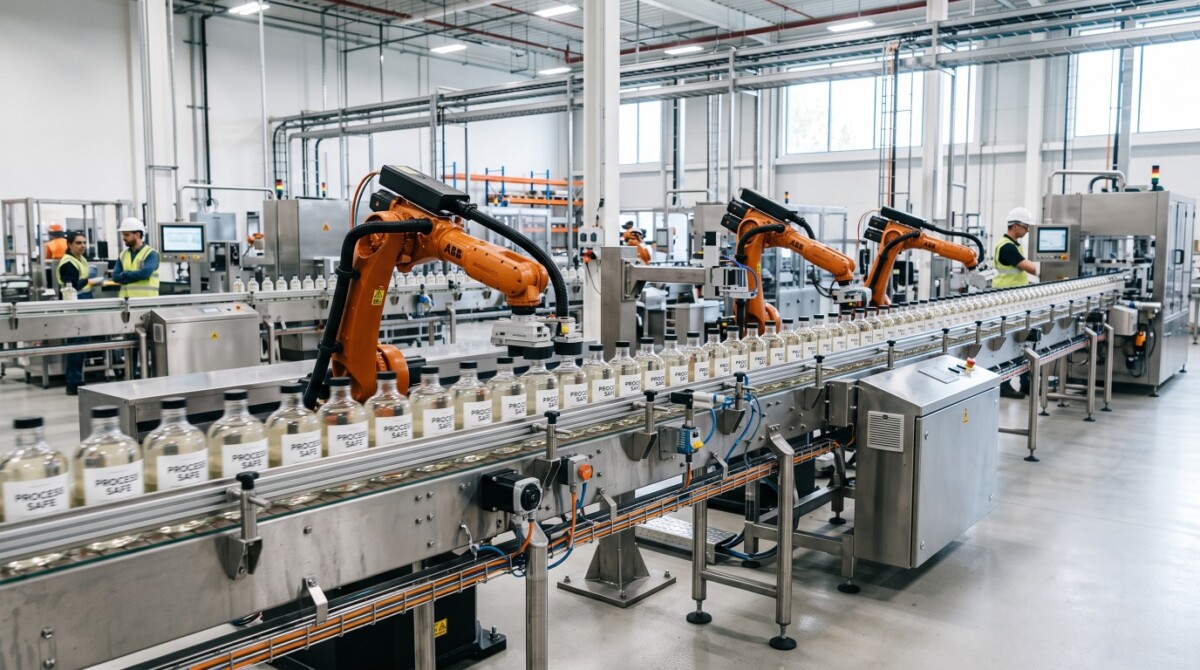
To design an efficient industrial processing line, start with material characterization, build a pull-based flow, and engineer every transition, control loop, and maintenance plan so the line stays synchronized, predictable, and easy to keep running at target throughput.
A processing line that runs fast and reliably is never built by speeding up conveyors first – it is built by understanding the material, designing flow as a pull system, controlling transitions, and closing the loop with feedback and maintenance.
Simply focusing on cycle times and conveyor speeds won’t push up production rates or efficiency. It also won’t reduce maintenance costs related to overworking motors and drives on conveyors that can’t be programmed to run at the optimum speed downstream.
Many poorly designed processing lines have one failure in common: the equipment was picked before the material was truly known. Particle size distribution, moisture content, bulk density, cohesiveness, and abrasiveness aren’t afterthoughts – they’re the prerequisites that pre-select every piece of equipment on the floor.
A system tuned for free-flowing plastic pellets will collapse under the load of a hygroscopic powder that clumps when exposed to moist air. Suddenly, the angle of repose changes. Flowabilities plummet. Hoppers block, and what looked like a clean process on paper becomes a manual intervention every thirty minutes.
Perform a proper material characterization audit long before you have your first conversation with a vendor. Get your sieve analysis data. Track your moisture content over the course of the seasons if you’re dealing with agricultural or chemical feeds. Measure your cohesiveness in the actual temperature and humidity conditions the plant operates at. That data is now the overarching stricture that governs every piece of equipment downstream.
There’s a basic philosophical question of design that defines everything else: is the line going to push material through from the front, or is downstream demand going to pull it through at the rate it needs?
Push systems build up. If your prime mover is dumping material onto a conveyor belt faster than the processing unit at the end can consume it, you need surge hoppers to soak up the surplus. They take up room, add time lag, and create extra opportunities for flow to become stationary or for different grades of material to disconnect.
Pull design sets the feed rate of every upstream machine equal to the maximum processing capacity of the station directly downstream. Thus the system stays lean, the equipment has a far smaller footprint, and an entire class of flow problems is excluded from consideration. It does require more careful design work at the beginning, but the ease of operation it offers will easily repay that additional capital expense.
Among the most frequent reasons for unanticipated equipment stoppages in bulk handling systems are bridging and ratholing. Neither condition is good for processing, but both can be avoided with the right solution. Bridging occurs when material forms an arch over an outlet rather than flowing through it. Ratholing happens when material forms a channel and flows preferentially through that channel rather than flowing evenly over the entire hopper outlet.
When material bridges or ratholes, you have a full hopper and an empty processing line. And the traditional cure – operators whacking the outside of the hopper with a mallet until the obstruction clears – is even worse. Not only does it waste labor and risk damaging equipment (especially bin vibrators or other auxiliary equipment attached to the outside of the hopper or silo) but the violent shock can result in a mass of material suddenly heading downstream the moment the blockage breaks loose.
Inconsistent outflow in a processing line is also bad news for any sorting, coating, or thermal process downstream that depends on an even, steady stream of material to work properly. The idea behind automatic vibration and aeration systems is to avoid these problems by making sure that a bulk solid is always in a state of managed flow or fluidization.
The issue with gravity chutes is not only that they increase negative outcomes, from waste to rework to lost production time, but that the problems cascade. If you’re coating a product and wastage rates go up because you don’t have consistent inputs, it’s costing you to run the recoat unit more frequently. Those high waste and rework rates also mean your maintenance team is constantly changing out parts on the scraper or downstream conveyors, and operators need to deal with blockages from clumps of material.
The obvious ‘solution’ is to put an operator with a shovel and a hard hat there all the time, but you didn’t automate your plant just to hire another laborer. In more modern times, they’ll be wearing a fit-for-purpose respirator and visor and they still won’t be preventing the issuing of fine particulate into the production environment.
This is where vibratory feeders answer a specific and important need. They are not just a means to drop material – as with gravity chutes, you can have precise, adjustable control over discharge rate. The amplitude and frequency of the vibration can be approximated to the feed rate required by the next station, and flow will be relatively easy. This gives you the engineering term for what’s going on here: a relatively uniform “blanket depth” on downstream conveyors. Discussing demands for uniform processing with bulk handling engineers, they make it clear that this is how you obtain it.
The electromagnetic feeds can respond effectively to variable speed commands and they tend to have fewer wearing parts. If your data in hand suggests you will rapidly need to change flow rates in the line, electromagnetic drives will give best service. On the other hand, electromechanical drives can handle a heavier load, and their controls are often better suited to automated systems that carry a consistent tonnage over long time spans. They also tend to be less fussy about abrasive material, but, again, you buy per your material characterization data and the requirements of the line.
Each time bulk material free falls from a height – from a hopper to a feeder, from a feeder to a conveyor, from a conveyor into a mixer – the potential energy introduced by gravity is converted into kinetic energy driving air out of the way and transporting any fines present in the product off into the air. It’s more than a hygiene issue.
Combustible dust poses a real industrial risk. Many organic materials, fine metals and artificial powders form explosive dust clouds at the right concentration. As well as safety, the costs of airborne particulate include contamination to adjacent product streams, clogging of mechanical seals and bearings, increased maintenance throughout the plant.
Designing enclosed chutes and transfer hoods at every point of free fall costs less to engineer into an original design than to retrofit later. Where that isn’t possible, local exhaust ventilation located at the point where dust is introduced collects particulate before it has a chance to disperse. But these are capital expenses, not operating ones – so ignore them at your project managers’ peril.
A well-designed production line doesn’t just move material from A to B – it adjusts continuously to maintain the target throughput rate. That requires feedback, and feedback requires instrumentation.
Load cells integrated at key points in the line measure material weight in real-time. When a PLC receives that weight data and compares it to the target, it can send a signal to the variable speed drive on the upstream feeder and adjust the flow rate in milliseconds. Overfeeding a batching station creates waste and potential overfills. Underfeeding it starves the downstream process and drops output below target. Neither is acceptable in a well-run plant.
This kind of closed-loop control also feeds the OEE calculation that plant managers use to evaluate true manufacturing productivity. OEE combines availability, performance, and quality into a single number, and all three components are affected by how precisely material flow is controlled. Unplanned stops drag down availability. Inconsistent feed rates reduce performance. Variable product depth and handling damage affect quality. Fixing the material flow architecture addresses all three simultaneously.
The cost of not doing this is substantial. Unplanned downtime costs industrial manufacturers an estimated $50 billion annually, with equipment failure and poor material flow synchronization among the leading causes. That figure covers the obvious costs – idle labor, late shipments – but not the less visible ones like product rework, accelerated equipment wear, and the management time consumed by chasing root causes that were designed into the line from day one.
While throughput is obviously important to any production line, how fast a line can run is only part of the picture. The time needed for product changeovers, regular line cleaning, and sanitation adds up quickly and reduces the Overall Equipment Efficiency (OEE) of your line.
Plant managers often overestimate the OEE of their lines by averaging fast run rates with several minutes of downtime for cleaning between every few dozen cases. The reality is those slower rates are your actual production speed. Less obvious, this deadtime is also a deterrent to investment in a faster line; why bring a faster machine up to speed when it will be stopped again in a few minutes?
There is a hidden cost of deadtime in the overdesign of stopgap machinery to increase run rate and reduce the visible proportion of total down time. Dead time is dead weight on productivity. A machine designed for clean storage rather than fast, thorough sanitation slows the line during sanitation steps in the name of returning to production as soon as possible.
The best-designed production line still has mechanical components that wear out. Drive units add hours of operation, springs get fatigued, bearings get worn out. The issue is whether those failures occur as planned by you or the machine.
Preventive maintenance will only be effective if it’s incorporated into the plant’s operation lifecycle. This requires the use of equipment with easily accessible inspection points, building scheduled servicing intervals into the production plan, and keeping warehouse spares for components with a known wear rate. Production lines where failures happen instead of scheduled maintenance don’t just face repair costs – they face the unpredictable shutdowns that underlie poor OEE scores.
A steady, appropriately fast production line is not created by increasing the load. All sources of variability must be eliminated between machines to ensure this – characterizing the material, managing transitions, regulating the supply, and integrating the feedback systems to ensure that everything stays synchronized. This kind of engineering work, which must be carried out during the design phase, separates the plants that regularly achieve output goals from those that are always close to their capacities.
Material characterization is more important than picking equipment first because properties like particle size, moisture content, bulk density, cohesiveness, and abrasiveness determine which conveyors, feeders, and hoppers will actually work with your product. If you choose machinery before understanding the material, you risk designing a line tuned for free-flowing pellets and then feeding it a hygroscopic powder that clumps and blocks hoppers. Accurate characterization data – including sieve analysis, seasonal moisture tracking, and cohesion tests under real plant conditions – gives you constraints that guide every downstream equipment choice.
A pull-based processing line improves efficiency by matching every upstream feed rate to the maximum processing capacity of the station directly downstream, which keeps the system lean and synchronized. Push systems overfeed conveyors and require surge hoppers to absorb surplus, increasing footprint and creating stagnant zones where material grades can separate or block. A pull system avoids these issues, reduces flow-related stoppages, and simplifies operation, even though it demands more upfront design work and careful control integration.
Bridging occurs when bulk material forms an arch over a hopper outlet, blocking flow, while ratholing happens when material forms a narrow channel that flows preferentially, leaving stagnant product around it. Both conditions cause full hoppers and empty processing lines, often prompting risky manual fixes like hitting equipment with mallets. You can prevent bridging and ratholing by designing hoppers and outlets based on material properties, and by using automatic vibration and aeration systems that keep solids in managed flow or fluidization.
Use electromagnetic vibratory feeders when your line needs rapid, frequent changes in flow rates and you want drives with fewer wearing parts for responsive control. These feeders handle variable speed commands well and suit lines where demand fluctuates. Electromechanical drives are better for heavier loads and automated systems carrying consistent tonnage over long periods, especially with abrasive materials, and are chosen based on material characterization data and expected duty cycles.
PLC integration and real-time feedback improve OEE by allowing the line to adjust feed rates dynamically to maintain target throughput and limit overfeeds or underfeeds. Load cells measure material weight at key points and PLCs compare that data to targets, then signal variable speed drives to correct deviations within milliseconds. This reduces unplanned downtime, stabilizes performance, and helps maintain quality by avoiding overfills, starvation, and inconsistent product depth, all of which are central components of OEE.




