





Key takeaways 
Effective dropshipping marketing is essential for gaining a competitive edge and attracting high-quality customers, emphasizing the importance of tailored messaging and product positioning.
As competition in dropshipping grows, refining your marketing strategy through owned channels like email and SMS, as well as discovery and paid channels, is crucial for driving sales.
Leveraging customer reviews, exceptional service, and unique product descriptions can significantly enhance customer trust and differentiate your store in a crowded market.
Utilizing social media strategically, particularly platforms like TikTok and Instagram, can amplify your brand’s visibility and engagement, driving organic growth without a hefty budget.
Dropshipping marketing is your competitive advantage for stealing sales and winning higher-quality customers over other stores. It’s control over how you reach people, what you say to them, and how you position identical products as must-haves.
Refining your dropshipping marketing strategy now is absolutely the right thing to do because the competition is increasing all the time, with a compound annual growth rate of 22.0% (Grand View Research) expected between 2025 and 2030.
Your owned channels, such as email and SMS, discovery channels like search, and paid ones, including ads, all require attention to increase sales.
This article provides 15 dropshipping marketing strategies, tips, mistakes to avoid, and tools that will make your tech stack contribute a whole lot more.
Join Omnisend to grow your dropshipping sales with email and SMS automations
Quick sign up | No credit card required
1. Collect and display customer reviews
Neglecting reviews is not an option for your dropshipping store because your customer experience, not your products, differentiates you here, with customers buying and returning primarily because they trust your operation.
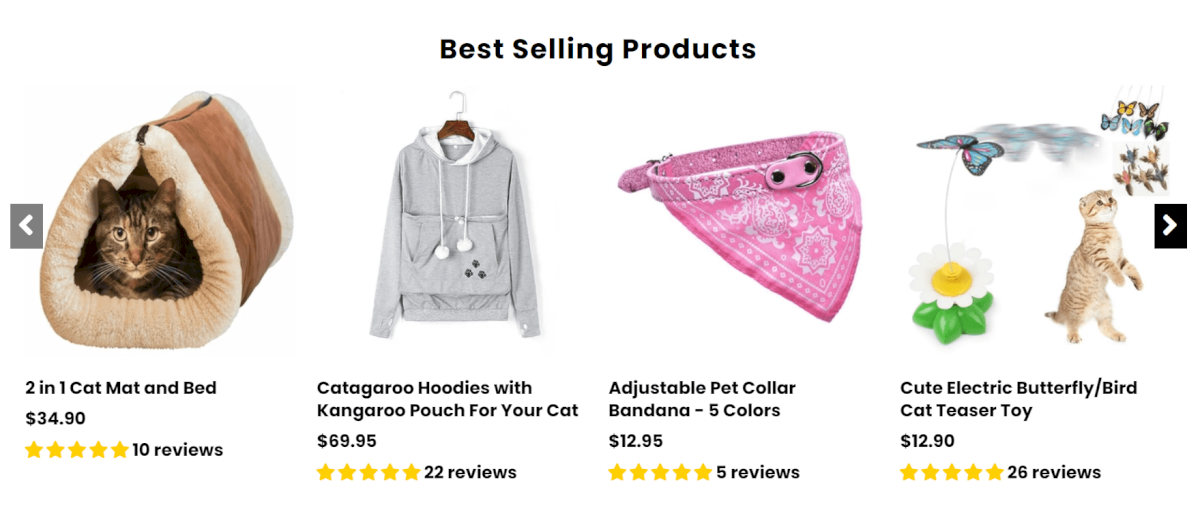
Pet Clever is a prime example of a dropshipping store using reviews to encourage new customers to buy. Its homepage uses star ratings:
You can collect reviews in a few different ways:
- Send out post-purchase emails with review requests
- Include a QR code with your packing slips for reviews
- Create competitions with reviews counting as entries
- Add a review or leave feedback button to customer accounts
Additionally, you can collect reviews in multiple formats:
- Star ratings are OK for display on product pages and for integrating into Schema markup for display within search engine results
- Photo reviews are fantastic if they are high-quality photos, and you get your customer’s permission to share them elsewhere
- Video reviews, honestly, are the best review type, especially if your site supports automatic playback of videos and you compress them for fast load times
- Social media reviews, you can copy these and use them across all channels
Whichever format appeals, your product, category, cart, and checkout pages, blog, social profiles, emails, and print media will benefit from them.
As far as collection goes, email is the most effective way. Omnisend makes collecting reviews straightforward with pre-built email automations, which you can edit to match your customers’ timing and frequency expectations:
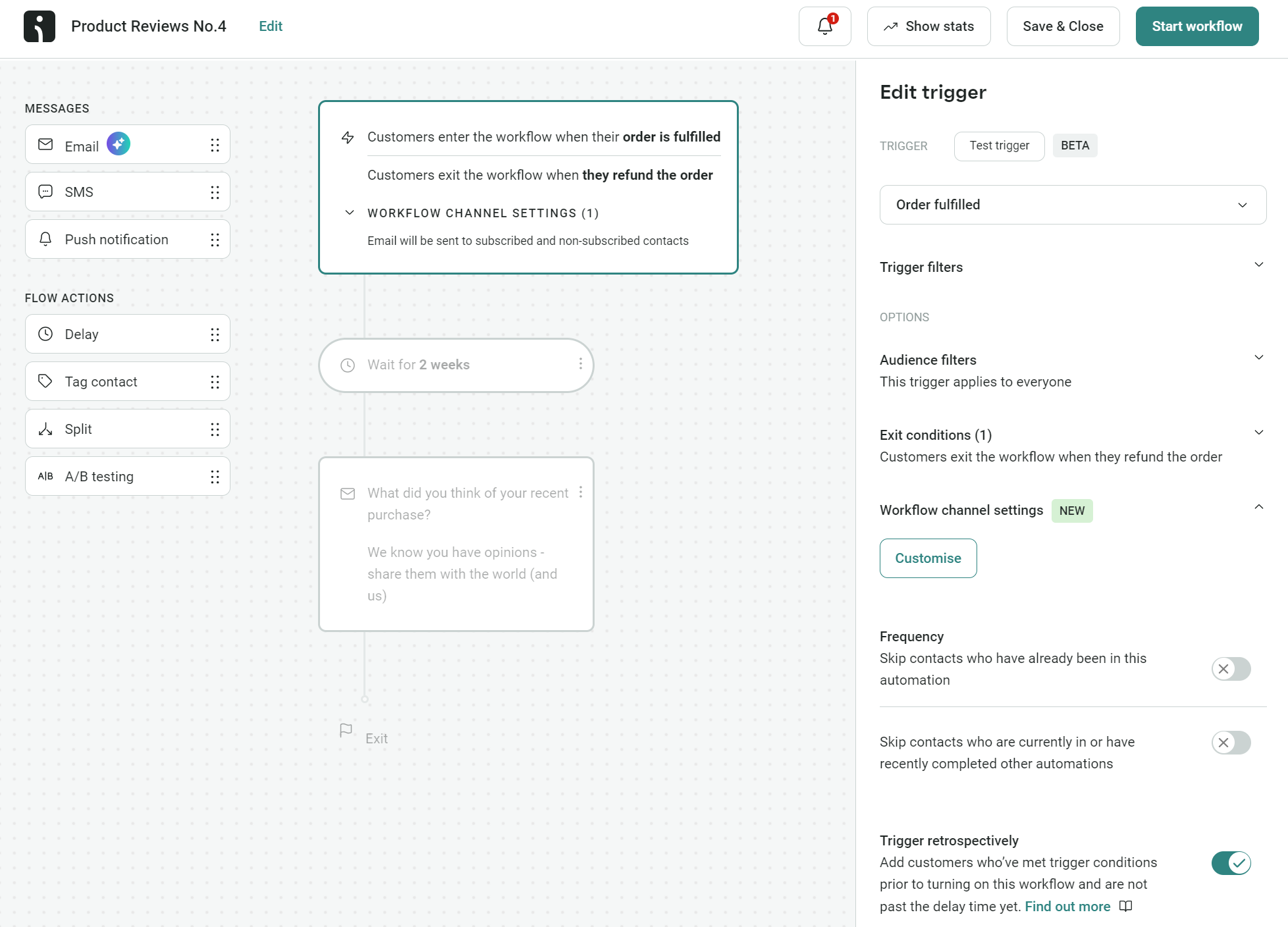
Access this automation by heading to Automations in the Omnisend dashboard, selecting + Create workflow, and finding the Product Reviews among the pre-built flows. Once you set it live, your customers receive your review request according to the conditions you set.
2. Provide exceptional customer service
The most successful dropshippers have excellent customer service to compensate for the lack of control over fulfillment and supplier issues.
When suppliers mess up, own it, apologize, compensate if needed, and fix the problem for customers. Sort out the supplier after. Your customer doesn’t care that a third party let them down, and in fact, they might have no idea that you’re dropshipping.
Some communications are automated, such as order and shipping confirmations, which significantly reduces the number of inquiries you receive. But sometimes, customers are going to want to speak with you for one reason or another.
As a starting point, just being available across the channels your customers may want to contact you on is enough, such as:
- Live chat
- Phone
- Social DMs, which customers increasingly treat as support channels
However, having those channels available and providing slow responses (or no response at all) will negatively impact your customer experience.
Aim for under five minutes via live chat and same-day on email and social media. Anything slower and customers start questioning your professionalism.
If you’re going to have a phone number on your site, list your operating times, and do not let it ring out. Set up a message service and promise a callback instead. Fashion retailer Suta includes a phone number, opening times, and a floating WhatsApp icon on its contact page:
3. Customize product descriptions and images
Your dropshipping supplier probably has images and product descriptions you can use, and perhaps even an import tool that makes your life easy.
Avoid all of this generic content if you want to stand out from other sellers and get Google and other search engines to rank your site above them.
For photos:
- Order physical samples and get a professional photographer to snap them, or take pictures yourself
- Send your samples to people you know, and get them to take photos
- Take photos with a white background to highlight your product, in addition to lifestyle and background shots
For your product descriptions:
- Take your item’s headline features and make them outcomes, so, for instance, that “3000mAh battery” is “three nights of light on a single charge”
- Write from experience, noting how it feels and what surprised you
- Lead with what the customer cares about, not the technical specs, unless those technical specs are why your customer is there
- Keep paragraphs short and use bullets for specifications
- Add a comparison chart if you sell variants
- Include your primary keyword in the title and weave related terms through naturally for SEO purposes
LitLamps’ product descriptions stand out, with the example in the image below using emotional triggers and over-the-top language for uniqueness:
4. Use social media strategically
Your brand needs to be on social media to increase its visibility to searchers and improve discoverability. The question is, which platforms do your customers spend time on? That’s the information you need for strategic social media marketing for dropshipping.
A quick rundown of potential channels:
- TikTok is popular with Gen Z and younger millennials (16-34), and it’s the perfect platform for you in the early stages of dropshipping because it pushes new accounts into feeds for rapid organic growth. You can use TikTok Shop to sell without customers leaving the platform. It also works as a paid ad platform via TikTok Ads, and it’s the golden standard for trendjacking, where you jump on another brand’s trends to increase your visibility and relevance.
- Instagram lets you build a Shop, Stories allow you to show off your brand, and you can use in-app messaging to send deals to subscribers (primarily Millennials and Gen Z, 18-44). It’s owned by Meta (which also owns Facebook) and provides access to all the filters you need to get paid ads in front of customers. Organic social works exceptionally well, with Reels providing an alternative to TikToks.
- Facebook is no legacy tool. It has the best ad targeting of any social media platform, and Millennials to boomers (35-65+) use it. You can use Marketplace to dropship and create an online storefront with purchase links. Some of your customers might also leave reviews on it, and you can run competitions from your accounts.
- Pinterest’s 70% women audience makes it ideal for ages 25-54 with high purchase intent, plus pins remain searchable indefinitely. You can’t sell via Pinterest, but any unique photos will get seen, leading to clicks to your site.
- YouTube is where you want to be to reach all adults (18-65+) and get long-form video content ranking in Google. If you’re an eligible creator, you can use YouTube Shopping to promote products from your stores in your content. Ad revenue could also become a big earner if you build your subscriber base and commit to content production.
The table below summarizes which platforms to pick:
| Your goal | Target age | Best platform | Why |
|---|---|---|---|
| Quick viral growth | Under 35 | TikTok | Algorithm favors new accounts |
| Quick viral growth | 35+ | YouTube Shorts | Crossover audience |
| Precise targeting | Any (with budget) | Facebook Ads | Best targeting available |
| Precise targeting | Any (no budget) | Facebook Groups | Organic community access |
| Search visibility | Planning purchases | Pins live forever | |
| Search visibility | General research | YouTube | Google ranks videos |
| Visual social proof | Under 45 | UGC and influencers | |
| Visual social proof | 45+ | Marketplace and groups |
You can then branch into separate strategies that make the most of them:
- Meme page marketing: Build niche meme accounts or buy established pages with engaged followers. Use a 4:1 ratio, with four entertaining posts per product mention. Integrate items naturally into content.
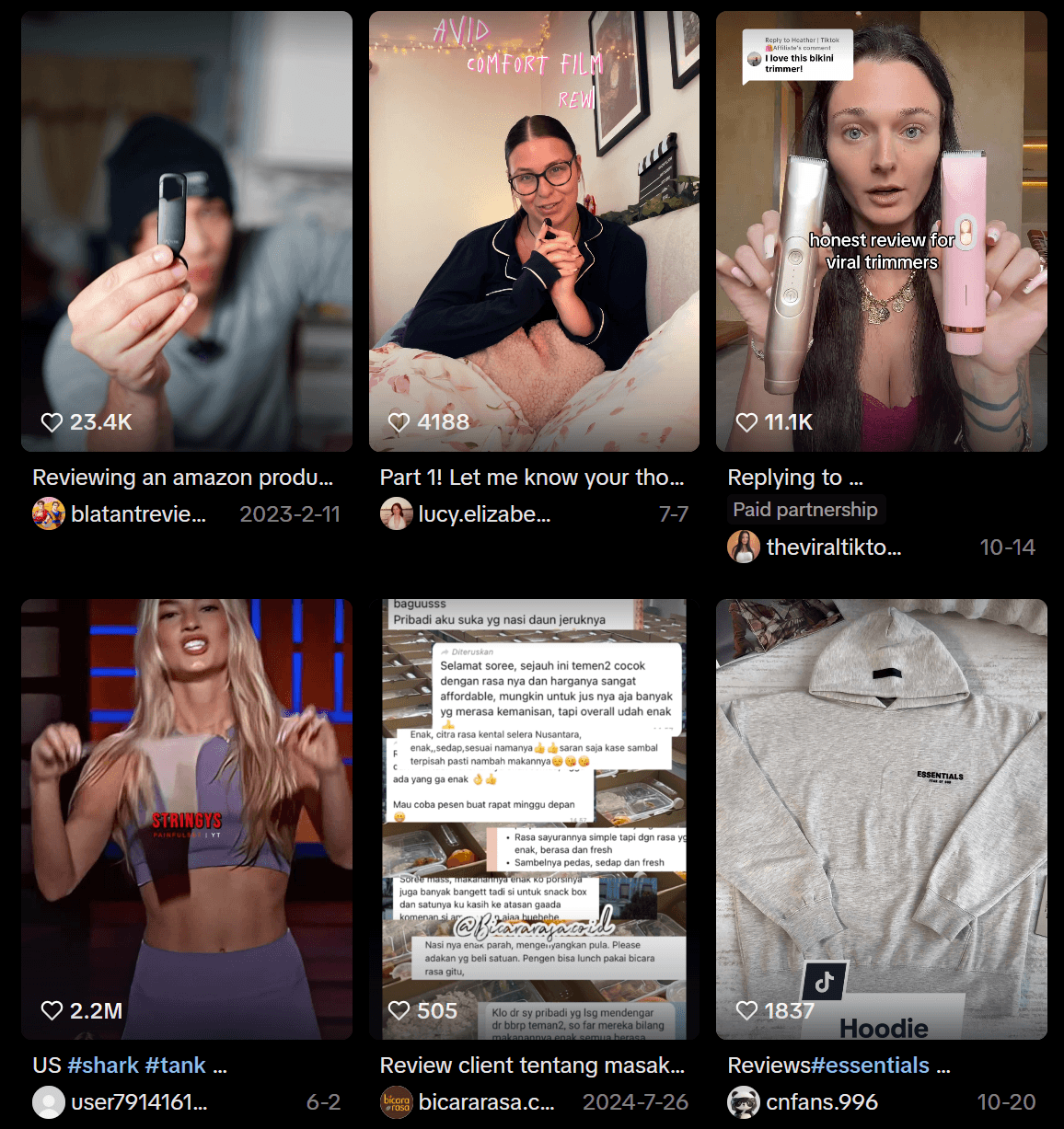
- User-generated content (UGC): Provide influencers with products to review, and send review request emails to customers using Omnisend, with a link to your social media submission page. Run a hashtag for your UGC so it all groups together, and repost customer content with permission for social proof across your dropshipping marketing services and channels. The image below shows multiple UGC videos on TikTok:
- Hashtag and keyword strategy: Instagram and TikTok need broad plus niche hashtags, such as “doglife” and “LEDcollarfordogs”. YouTube titles and descriptions need SEO phrases based on keyword research. Facebook hashtags matter less than joining the right groups and posting in them, but they do help you appear in the search results for general terms, such as “#babybibs”.
5. Build a YouTube presence
YouTube can be one of your biggest dropshipping earners if you consistently publish high-quality content to reward your subscribers.
For instance, bracelet retailer Pure Vida started as a dropshipper and successfully used YouTube to establish a loyal customer base. Its YouTube channel now has over 5,300 subscribers:
Content that works for dropshipping includes unboxing videos, reviews, UGC, demos, and niche-related spotlights, such as dog videos if you have a pet store.
Collaborations, giveaways, and cross-channel promotions, such as video links in emails and in Facebook posts, are proven ways to market your channel and grow your subscriber count.
Follow these steps to set up your channel:
- Sign in to YouTube
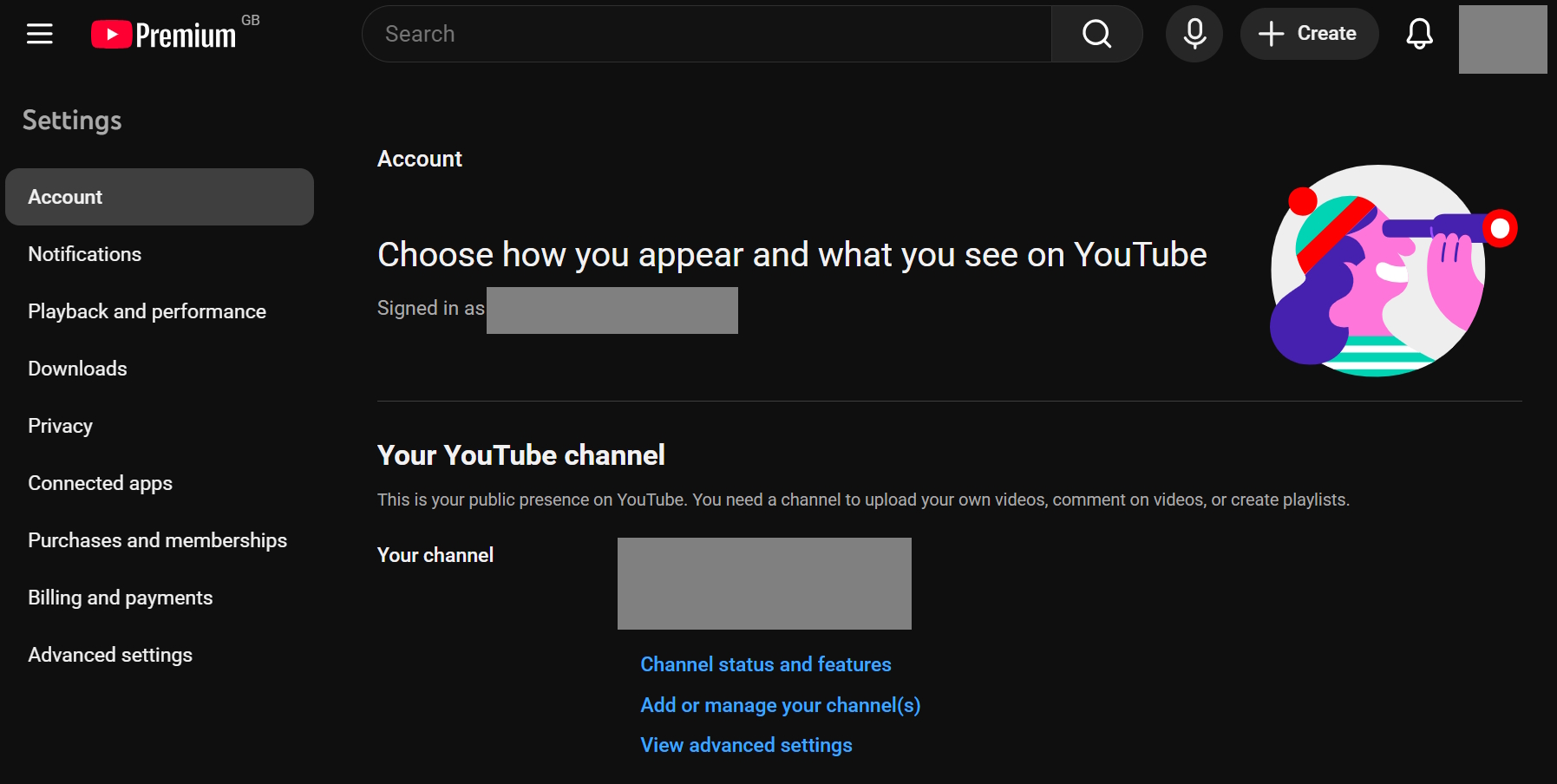
- Click your profile picture and head to Settings
- Go to the Account section and select Add or manage your channel(s):
- Create a branded channel with your store name and logo
- Optimize for SEO, starting with your about section with keywords (the same ones you use for SEO), add a store link to confirm the connection, and create a custom thumbnail with alt text that describes your business
- Upload your first video, ideally a brand showcase
- Promote videos across your other social channels and email list
You can then monitor your channel in YouTube Analytics, including views, watch time, and set subscriber growth targets for your first six months, such as 200 subscribers.
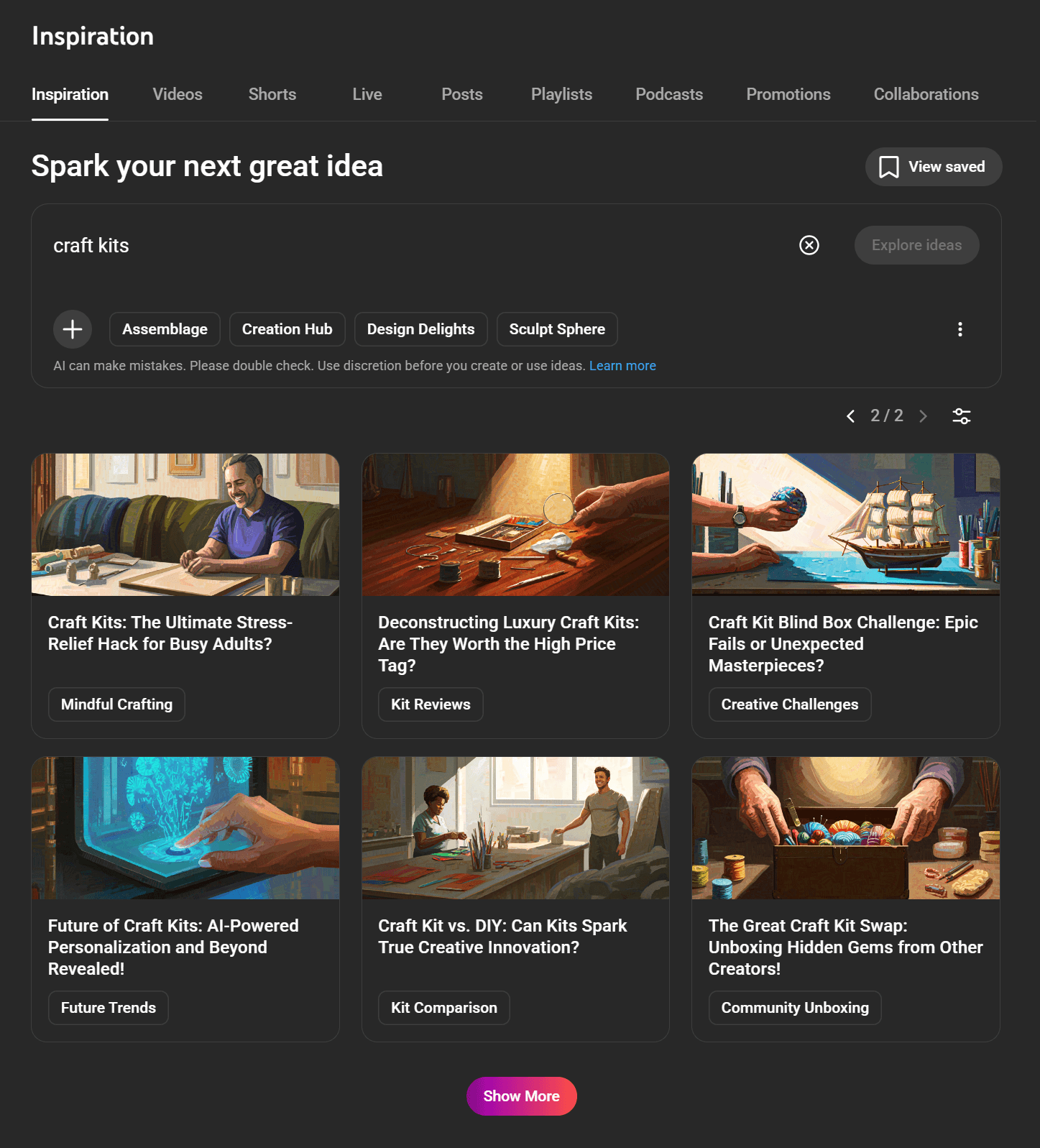
If you get stuck for content ideas, the Trends tab in YouTube Analytics is extremely helpful for inspiration. Here’s an example search for “craft kits”:
6. Leverage email and SMS campaigns
The ROI from email and SMS marketing is astonishing. Omnisend customers see an average return of $68 for every $1 spent, and most companies see an email ROI of between 10:1 and 36:1 (Litmus), with ecommerce stores averaging 45:1.
Using email and SMS in your marketing is not the same as confirmation emails, which Shopify and most other ecommerce platforms handle without additional apps.
Marketing includes one-time and scheduled campaigns, plus automations (flows), such as welcome emails and cross-sells, which trigger via segment activity and customer behavior.
A combination of all these is necessary to grow your sales. Omnisend’s 2025 Ecommerce Marketing Report found that automated emails accounted for 37% of sales from just 2% of email volume, while SMS hit 18% of sales from 9% of sends.
Your email and SMS efforts should include:
List-building tactics
Via embedded signup forms, flyouts, popups, and landing pages on your site to capture first-time visitors and abandoners, and with competition and giveaway entries on social media.
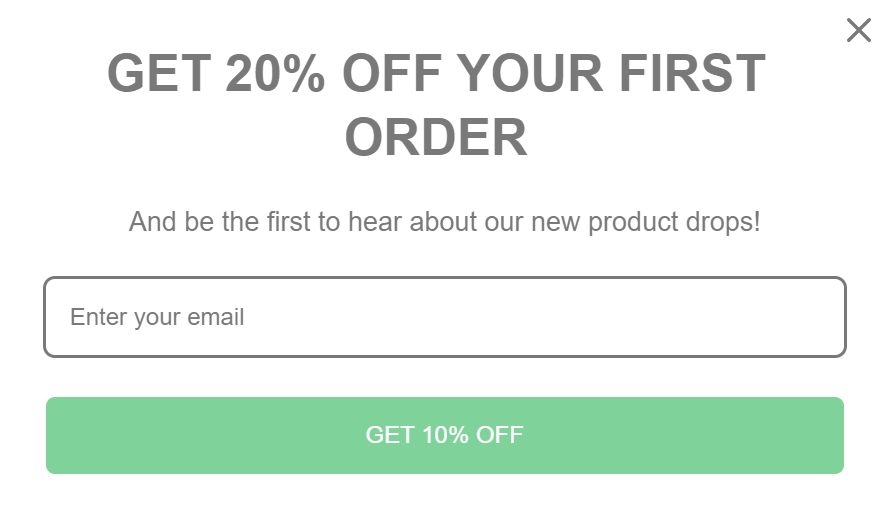
Exit-intent popups have high engagement rates on abandonment pages, such as cart and checkout, and first-time visitor popups can work if you offer heavy discount incentives in return for their email address, such as 20% off on their first order, as shown in the example below:
Segmentation
Segmenting your audience means placing customers into groups based on their purchase activity, signup method, age, location, and many other filters, so that you can send targeted and appropriate emails and SMS.
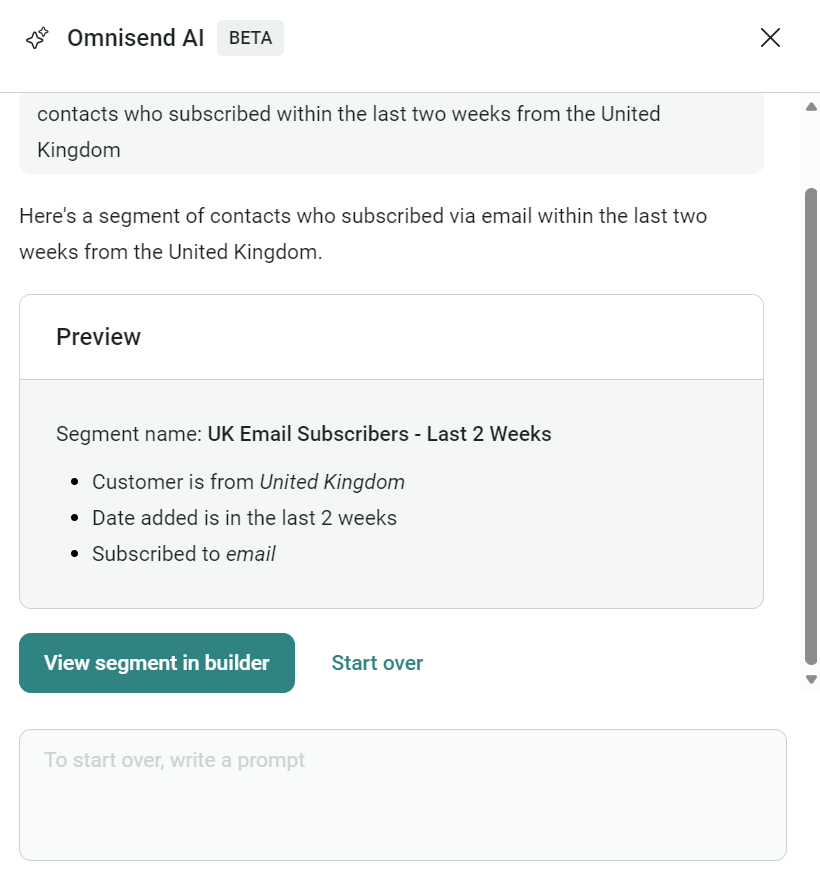
Omnisend has 20+ pre-built segments for the likes of active email subscribers, window shoppers, those who started checkout but didn’t place an order, and deal hunters. Alternatively, you can use our AI segment builder:
Pro tip
Omnisend’s AI segment builder is but one impressive AI feature it offers. It also has an AI writer, a subject line generator, and brand assets.
Find out more about > Omnisend AI.
Automations
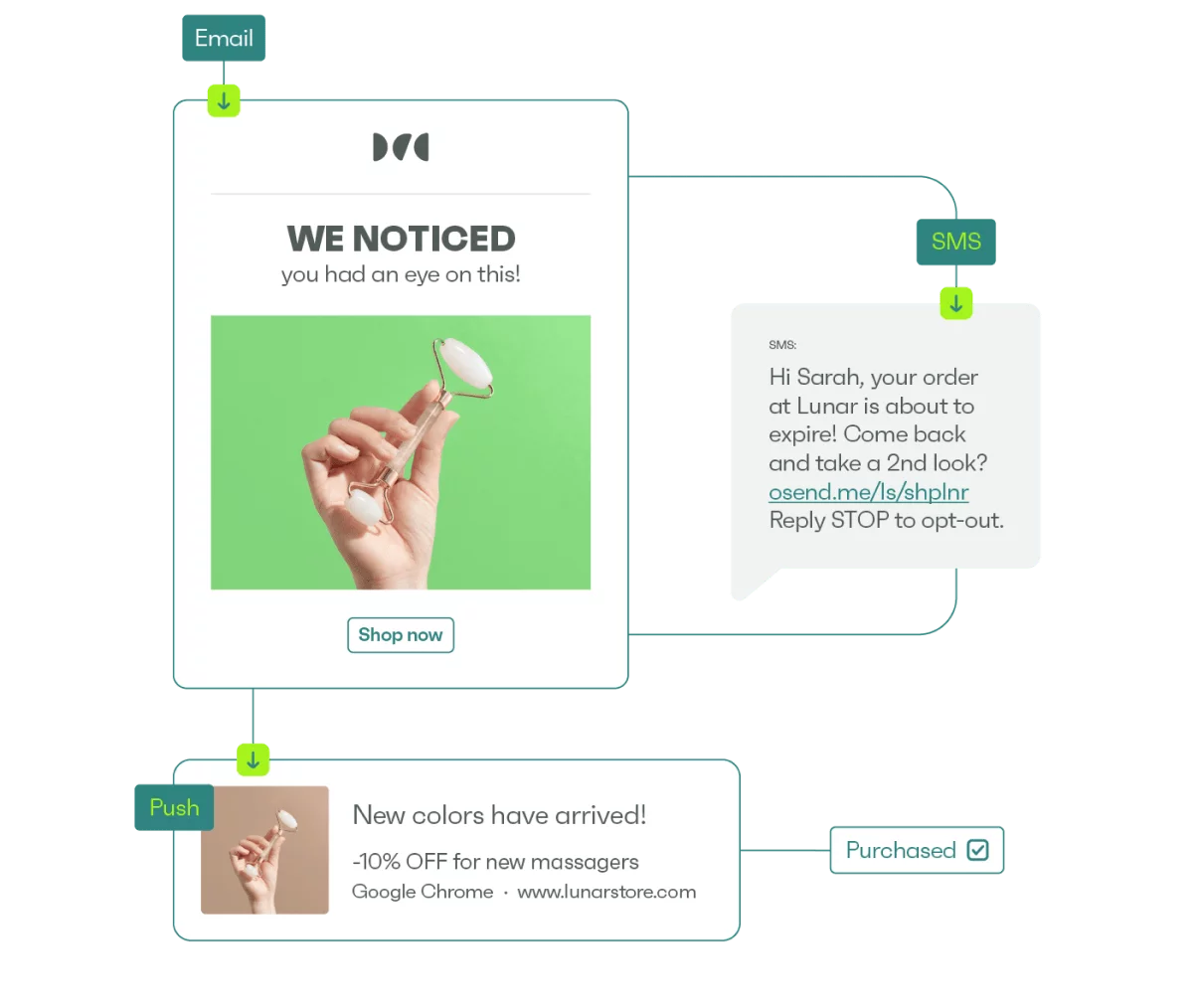
Your automations, or flows, trigger for the segments you create, effectively engaging your customers at timely moments in their journey. Omnisend has 28 pre-built automations, and you can add an SMS or push message to any of them:
Recommended automations include:
- Welcome emails: To link up with your signup forms and immediately deliver on any discount promises. Send within five minutes of subscribing.
- Abandoned cart reminders: For those who add items to their cart but don’t purchase, ideally with a multichannel approach (email within an hour, an SMS two hours later).
- Product reviews: Your existing customers will receive these to help collect social proof, with decent response rates when sent one to two weeks after delivery.
- Back-in-stock alerts: Crucial if your dropshipping store experiences stockouts and needs a way to notify customers about restocks. They trigger based on stock updates, rather than customer activity.
Campaigns
Campaigns are one-time and scheduled sends for all customers or segments. You’ll send them to share information, generate sales, and announce launches.
These campaigns will see good results for your dropshipping store:
- Product launches: Preview emails go out three to five days before release with exclusive first looks at what’s dropping. Launch day announcements include direct purchase links and mention limited quantities to push immediate action. Schedule these for 2 PM or 8 PM on Tuesdays or Fridays for maximum opens.
- Sales announcements: Flash sales and discount codes perform best on Fridays at 8 PM when conversion rates peak. Avoid Mondays when click-through rates drop, the lowest of any weekday.
- Educational content: Post-purchase tutorials showing product usage get read more than generic brand updates. Outfit combinations for apparel, skincare routines for beauty products, and setup guides for electronics. Send these on Tuesdays or Thursdays at 2 PM with weekly spacing to stay visible without overwhelming subscribers.
Watch this video to learn the secrets to successful email marketing:

Compliance
You can only send marketing emails and SMS to customers who agree to receive them.
Some customers will only give you their email at checkout when they buy. Unless they tick the box to receive marketing, you can’t email them promotions. Add the checkbox and ask them to opt in for discounts and offers.
SMS works the same way under TCPA and CTIA guidelines, which require explicit opt-in, sender identification, and an opt-out option in every message you send.
Treat email addresses and phone numbers with respect because spam destroys your sender reputation and tanks deliverability, sending your messages to junk folders.
SMS tips
SMS can’t get away with long messages and complicated links. Your texts should use shortened URLs and concise language. Avoid ALL CAPS and strange characters because these appear spammy, leading to your number going on people’s block lists.
You have a 160-character limit before your texts get spread across two messages, costing you double. Omnisend automatically shortens links in SMS messages and provides a length and pricing calculator to help plan your campaigns.
7. Prioritize customer retention
Your existing customers are your most profitable ones, no question. Acquiring a new customer costs anywhere from five to 25 times more than retaining an existing one, and because they know you, they are much more likely to respond to rewards.
The first step to retaining customers is building personalized experiences across your multichannel campaigns. Use what you know:
- Address customers by name in emails
- Use “you” and “your” in your writing
- Recommend products based on their purchase history
- Send browse, cart, and checkout abandonment reminders when they view items but don’t buy
Set up sequences that trigger based on customer behavior:
| Flow type | Trigger | Timeline | Goal |
|---|---|---|---|
| Win-back | No purchase in 60-90 days | Three-email sequence | Reactivate dormant buyers |
| Browse abandonment | Product viewed, no add to cart | Send within two hours | Convert browsers to buyers |
| Cart abandonment | Items added, no checkout | Send within one hour, follow up within 24 hours | Recover lost sales |
You can also build loyalty programs to encourage your existing customers to continue spending money with you instead of competitors, such as:
- Points systems: Award points per dollar spent, redeemable for discounts or free shipping
- VIP tiers: Bronze, silver, and gold levels provide perks, such as early access or discounts
- Referral bonuses: Give both referrer and referee a discount when new customers convert
For consumable products like supplements, pet food, or skincare, offer subscriptions with 10-15% discounts. Customers get convenience, you get revenue and lifetime value.
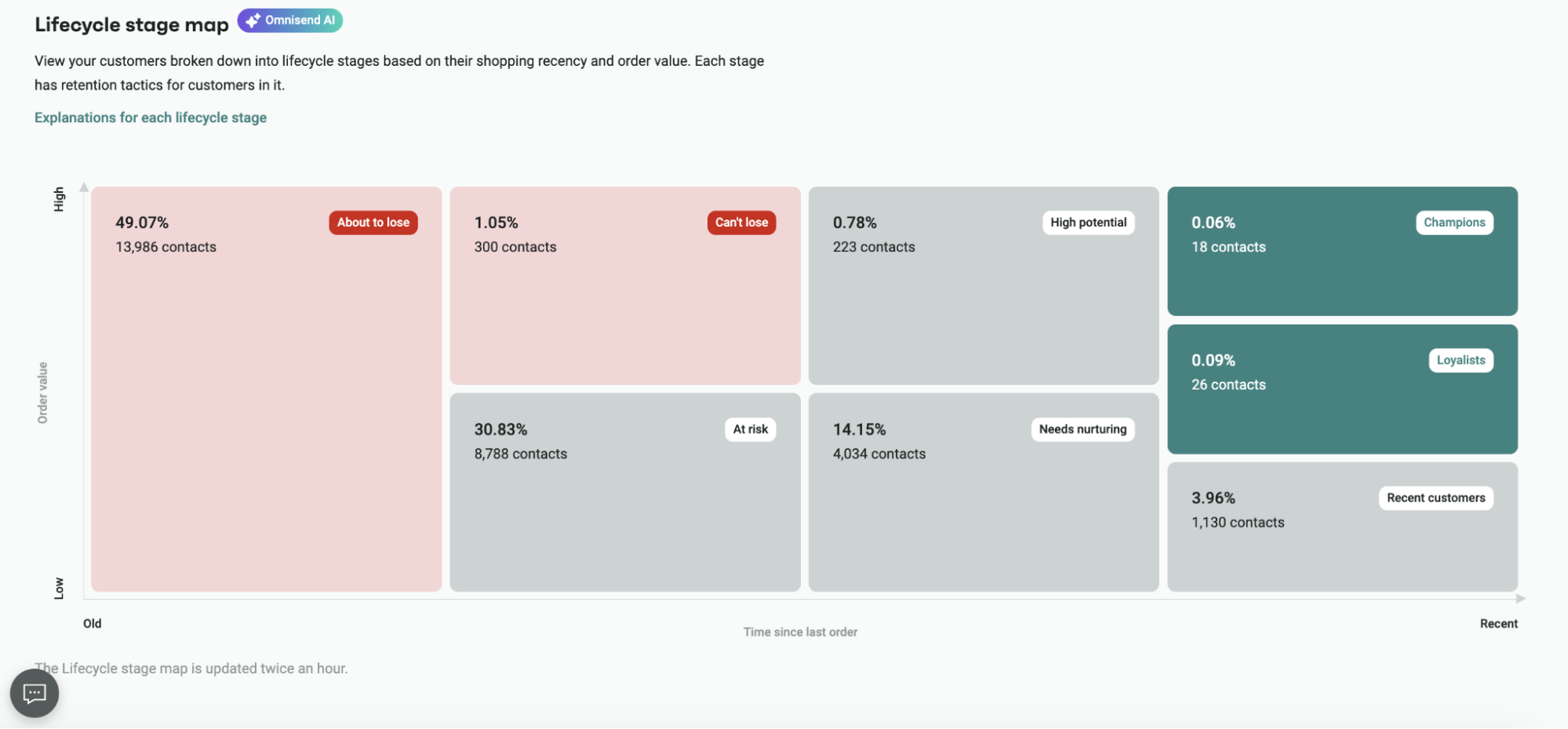
Track your retention efforts by segmenting customers based on recency, frequency, and monetary value. Omnisend’s customer lifecycle tools group contacts into stages like “recent customer,” “needs nurturing,” or “at risk,” so you can target the message to each group:
Pasignia rebuilt its retention strategy from the ground up after migrating to Omnisend with help from Ecommerce Boost.
It implemented segmented automations that treated VIP customers, repeat buyers, and first-time purchasers differently instead of blasting everyone with the same message.
Post-purchase sequences built loyalty after each sale. Milestone reminders encouraged customers to commemorate anniversaries and memorable moments with new kits. Win-back campaigns re-engaged buyers who’d gone quiet.
It folded SMS and push notifications into its flows so every channel worked together. Revenue increased 25% directly from the new automations and campaigns, and the streamlined workflow lets it launch campaigns 50% faster than before.
Read the Omnisend customer story: Pasignia.
8. Run retargeting campaigns
A portion of your website visitors will leave without purchasing or subscribing, but that doesn’t spell the end of your relationship because you can retarget them.
Retargeting gets you back in front of customers in the ads they see and the emails they receive, giving you additional opportunities to nurture and sell to them.
How it works
Install Facebook’s pixel on your store, and it tracks everyone who visits. When someone spends five minutes browsing your leather jackets but doesn’t buy, those jackets follow them to Instagram an hour later.
Meta’s ad platform lets you segment audiences by products viewed, time spent on site, or pages visited to reach the best audience.
Google Display Network puts your ads on millions of websites, not just social platforms. A customer researches your dog collars, leaves to read a news article, and sees your collar ad in the sidebar and in ads on YouTube.
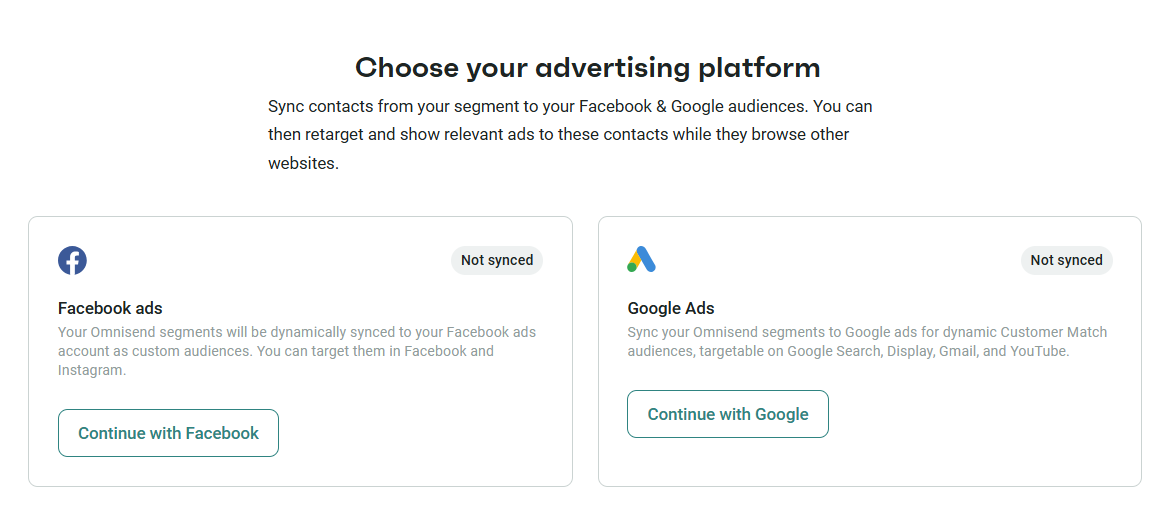
Omnisend integrates with both platforms, letting you sync contacts from your segments to Facebook and Google for retargeting purposes:
SMS reaches cart abandoners directly on their phones, and email sequences let you send multiple touchpoints over days or weeks, building a case for why they should buy with product education, social proof, and deadline pressure.
Building your audiences
Cart abandoners are your hottest leads because they got 90% of the way to buying. Product page viewers showed interest in items. Collection browsers explored categories without drilling down. Homepage-only visitors are barely engaged and need the most convincing.
Set your retargeting window based on purchase urgency:
- A seven-day window works for trending products or impulse buys
- Stretch to 30 days for most products
- Go 90 days for expensive items, where people compare for weeks before deciding
Upload your customer email list to Facebook and Google to create lookalike audiences. Their algorithms find new people who share characteristics with buyers who have already converted.
Creative approaches
Dynamic product ads pull directly from your product catalog, automatically generating ads with images, prices, and descriptions for whatever each person viewed.
So, someone who browses three different sunglasses sees all three in a carousel ad without you manually building it.
Reminder ads acknowledge the abandoned action. “Forget something?” with their cart items displayed underneath performs better than generic brand ads because it’s personalized to their behavior.
Stock counters work the same way, showing “Only three left” or countdown timers for sales endings, adding urgency that breaks indecision.
Discount ladders increase incentives over time. Day one shows standard pricing. Day three offers 10% off. Day seven bumps to 15% off. The escalating discount rewards patience but also creates FOMO that eventually pushes people to buy.
Frequency caps prevent burnout
Cap the frequency of impressions to three to five per person before you stop targeting them or switch creative. Rotate images, copy, and incentives every three days so your ads don’t become invisible background noise.
Web push notifications delivered by Omnisend are more subtle, retargeting browsers the moment they return to their device, while cart abandonment flows can trigger across email and SMS simultaneously to maximize recovery rates.
9. Use SEO, AEO, and GEO to grow your dropshipping store
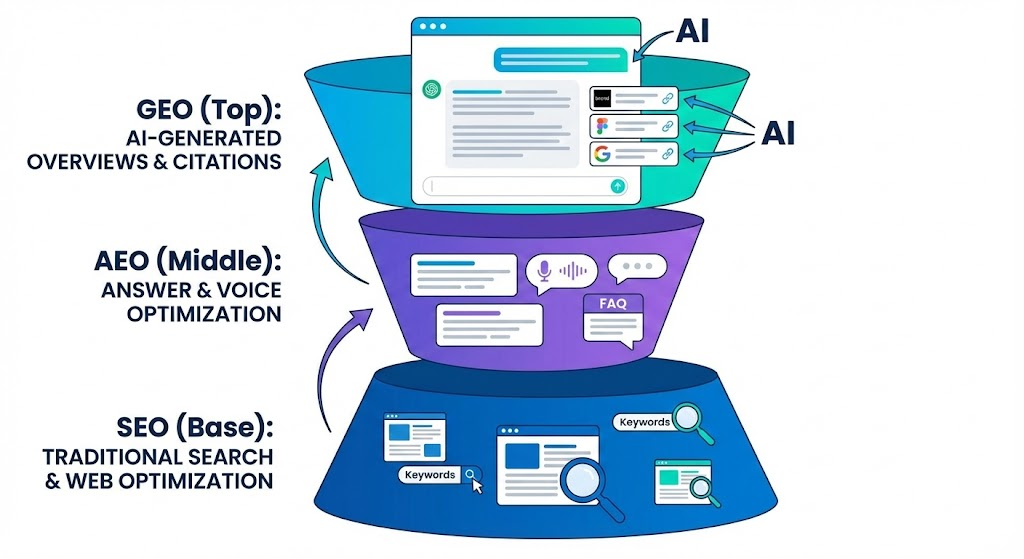
SEO, AEO, and GEO each work differently, but together they cover how people find products today through traditional search results, answer boxes, and AI-generated summaries.
Getting your dropshipping store to appear in search and AI results will provide long-term discoverability and reduce your dependency on expensive ads and other paid channels. The image below shows how each appears in the discovery funnel:
SEO, the foundation
SEO for dropshipping gets your pages ranking in Google and Bing through keywords in your product titles, descriptions, and collection pages.
What your buyer types matters less than why they type it. “Waterproof hiking backpack 40L” signals comparison shopping. “Is a 40L backpack enough for a week?” signals uncertainty. Write for the intent.
Site speed, mobile responsiveness, and clean structure affect how search engines crawl you. Backlinks from bloggers, directories, and referenced content signal credibility.
AEO, answering questions directly
Answer Engine Optimization targets the boxes above search results that answer questions without a click. Siri and Alexa pull from these.
FAQ sections on product pages help you appear here, especially those that use buyer questions and keep answers short.
GEO, getting cited by AI
Generative Engine Optimization focuses on appearing in AI-generated summaries, the responses from tools like ChatGPT, Perplexity, and Google’s AI Overviews.
Generic product descriptions won’t get cited because AI systems look for original, fact-rich content they can reference.
Any detailed guides you write about your niche are more likely to get cited than thin overviews. EEAT also matters here. Experience, expertise, authority, trust.
Making them work together
- SEO brings traffic via traditional search
- AEO captures featured snippets and voice queries
- GEO positions you as a source that AI systems trust enough to cite
Start with SEO fundamentals, then layer in FAQ sections with schema for AEO, and build original content for GEO.
10. Partner with influencers
Not just any influencers. Logic dictates you should go big, but micro-influencers (10K to 100K followers) outperform larger accounts when marketing for dropshipping. IQFluence reported an 11.4% engagement rate for this tier in 2025, compared to 1-3% for mega accounts.
The tiers break down as follows:
- Nano: 1K to 10K followers
- Micro: 10K to 100K followers
- Macro: 100K to 1M followers
- Mega: 1M+ followers
Vet accounts before reaching out by checking niche alignment and calculating engagement rate with total engagements divided by follower count. Authentic comments from people matter more than emoji spam, and sudden follower spikes usually mean purchased audiences.
You can compensate through gifted products for nano and micro accounts when testing a relationship, affiliate commissions for ongoing partnerships where payment follows sales, or flat fees for larger accounts and guaranteed deliverables.
Content requests that work include:
- Unboxing videos
- Tutorials
- Lifestyle posts
- Sponsorship mentions
A one-off campaign is a decent enough way to start. You can test it and then move into a long-term partnership if the numbers work.
Influencer outreach templates
Getting the attention of influencers requires high-quality outreach to the right people. These are busy individuals, perhaps with agencies, so you need their email address first of all, and a fantastic subject line and email content to grab their interest.
Here are four templates you can steal:
General collaboration request
Use this for new relationships with creators whose content aligns with your brand.
Subject: [Topic] collab
Hi [Influencer Name],
Your [content reference] caught my attention because you went deep on it rather than skimming the surface. I run [Brand Name], and we sell [product description]. Your audience overlaps with the people we’re trying to reach. There’s something worth exploring here.
Let me know if you’re open to a quick chat about what a collaboration could look like.
[Your Name]
Product gifting
Use this for micro-influencers or when testing a potential relationship.
Subject: Free [product name]
Hi [Influencer Name],
Been watching your content on [platform] for a while.
I want to send you [product name] to try. Not a pitch, not a campaign, not a contract, and if you like it enough to mention it, great. If you don’t, no problem at all.
Where should I send it?
[Your Name]
Paid partnership
Use this for professional influencers who expect structured offers.
Subject: [Amount] for [number] posts
Hi [Influencer Name],
Paying [amount] for [number] posts featuring [product name] on [platform], live by [date]. Usage rights for [duration]. Open to negotiation. Interested?
[Your Name]
Event invitation
Use this for launches, VIP previews, or brand experiences.
Subject: [Event name] on [date]
Hi [Influencer Name],
Hosting [event name] at [location] on [date]. Travel and accommodation covered, plus [perks]. The event brings together [description of attendees] for [purpose of event]. Expect [what will happen]. Limited spots, and I’d like you there.
RSVP by [date], and I’ll send the full details.
[Your Name]
11. Publish valuable blog content
Blogging is not busywork without any reward to show for it. It is among your best audience-building assets, and a reliable traffic source across organic search and AI citations, plus it gives you new stuff for your newsletter.
Follow these pointers to publish valuable blog content:
- Blog strategy positioning: Every post should tie to a product, answer a buying question, or capture an email address. Content without a commercial purpose belongs somewhere else.
- Content types that convert: How-to guides solving problems your product addresses, product comparisons for purchase decisions, industry trend analysis, and customer spotlight features.
- SEO integration: Long-tail keywords are your best opportunities. You can find them using Ahrefs or Twinword. Keywords with good search volume and low competition are ripe for the taking. Link internally to product pages, and structure content to capture featured snippets.
- Lead generation: Even your informational and personality posts can have CTA placement, opt-in form integration, and downloadable guides and checklists. For example, Notebook Therapy publishes blog posts with downloads, and its CTA buttons are always at the bottom of articles:
- Content calendar approach: A consistent schedule is best if you’re building a readership. Two to four posts/month will keep your readers happy.
- Repurposing strategy: Blog > email newsletter > social posts > video topics. Rinse and repeat to use one post across multiple channels.
12. Run limited-time promotions and discounts
The fact is that your customers do not want to miss out and end up paying more, nor do they want to waste time on other sites. They’re on your site to spend now, and that opens the door to urgent sales tactics that make them act.
Your psychological foundation looks like this:
- Urgency with time-limited offers
- Scarcity with low stock counts on product pages
- FOMO with real-time alerts, such as “10 people have this in their basket” popups
Fear of missing out (FOMO) is going to be your most effective psychological trigger because seeing other people snag deals makes other customers jealous. No one wants to be late on the deal. You can use that behavior to your advantage.
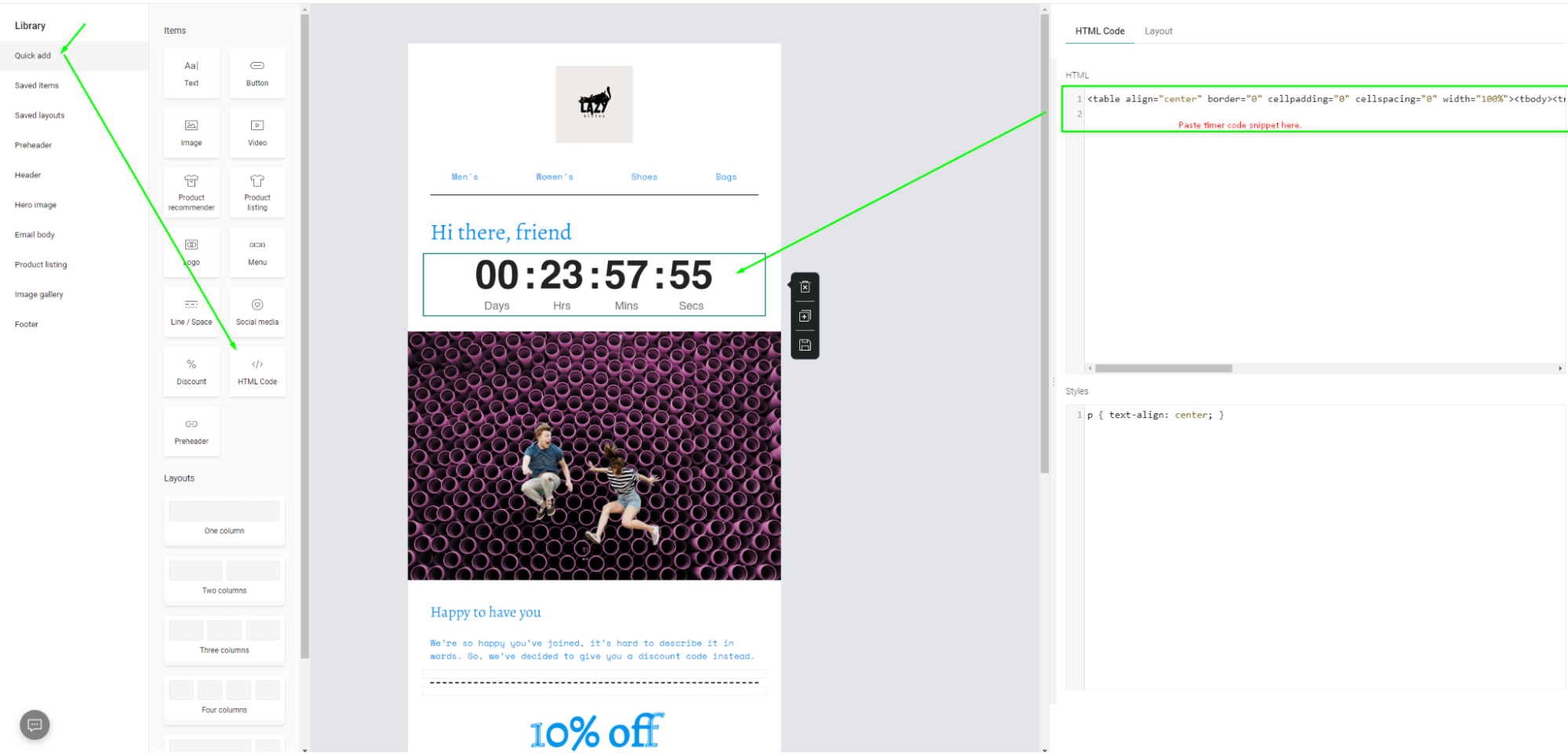
A 24 to 48-hour flash sale with an email with a countdown timer creates enough pressure without rushing people out the door, plus it can complement Black Friday and other seasonal campaigns when your customers are already in buying mode.
The image below shows a countdown timer embedded in an Omnisend email, with the HTML code necessary to create the element:
Subscriber-only deals make your list feel like insiders rather than targets, so create VIP offers to reward your biggest spenders.
Of course, there’s some risk with urgency tactics if you use fake countdown timers and make up stock levels. Customers who catch on won’t come back. Say when a sale ends and mean it, and tie your alerts to store data, not fake app settings.
Discounts also convert better when they’re personal. Someone who browsed a product yesterday and got 10% off that item today will bite faster than someone staring at a generic “SALE” banner.
Omnisend ties this together. You can schedule emails to land the moment a promotion starts, drop countdown timers into the message itself, and segment your list so different customers get different offers based on what they’ve done on your site.
13. Leverage TikTok organic marketing
TikTok is the best dropshipping social media channel because it requires a $0 budget, and its algorithm does not care how many followers you have.
A video from your brand new account can hit a million views if it holds attention, and the more videos you produce, the more the algorithm will reward you for the volume.
Trend-jacking is how smaller accounts punch above their weight. Scroll your For You page daily, spot audio or formats gaining traction, and adapt them to your product before the trend peaks.
Post one to three times daily during your growth phase. The algorithm needs volume to figure out who wants your content. Test posting times against when your target audience is scrolling, typically early morning, lunch breaks, and late evening in their time zone.
Hashtags should mix broad trending tags with niche ones. Use three to five per post and check out the TikTok Creative Center to see what’s currently performing.
TikTok Shop lets customers buy without leaving the app. Once you have consistent content and some traction, apply for it and get your products listed within your TikToks. The image below shows how it works. Viewers click Buy and can then shop the products in your video:
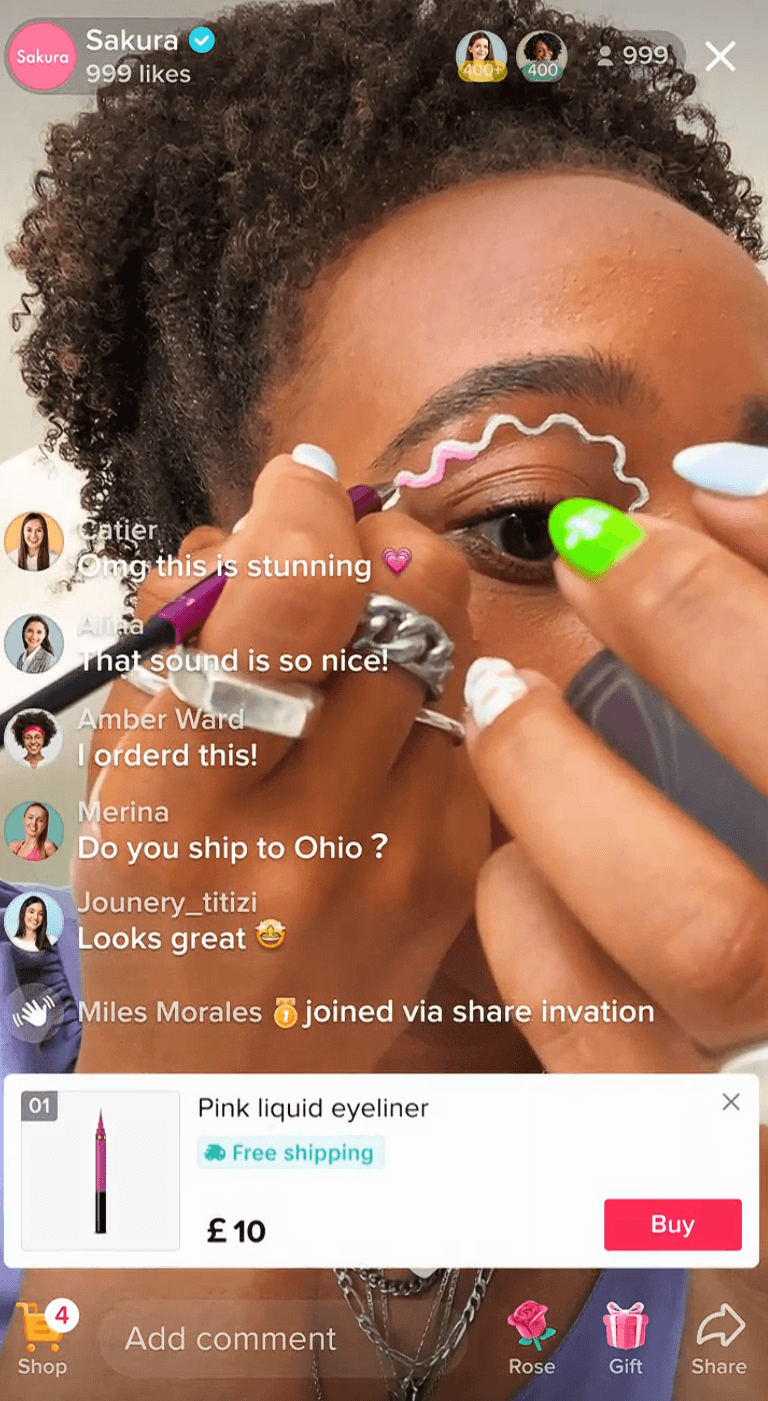
Your fulfillment needs to be tight for orders via TikTok Shop, though, because slow shipping and poor reviews will impact your reputation and lead to unsubscribes.
14. Build community-driven marketing
You can slash your number of one-time customers and those who leave without engaging with your brand with a community approach to your marketing.
A community can include customers and non-purchasers, and you should take a value-first approach to all your posts and commentary without promotional discussion. The purpose here is to build relationships, not sell.
A few channels stand out:
- Discord attracts people who want ongoing conversation and deeper engagement
- Telegram works for broadcasts and quick updates
- Facebook Groups feel familiar to most demographics and require less onboarding
- Reddit and Quora are not community platforms you own, but answering questions publicly builds authority over time and can steer people your way
One of the best parts of running a community is that you can assign moderators and let your members create the content. A self-sufficient group chat, forum, or Discord won’t cost you any time, and your responses can focus purely on providing value.
However, there will be some moments where promotion is necessary or beneficial, such as when customers are looking for a particular product, or can’t decide. In these instances, you should follow these dropshipping marketing tips:
- Your members want advice that’s a bit more unique than what they can find online, so provide plain product advice and explain why you recommend it, without copying and pasting your product descriptions and ad copy.
- Follow your own moderator guidelines about promotional language and links, so that other people don’t copy you.
- Tag other members, moderators, and experts within your communities for additional explanations. For instance, if they have already purchased the product in question, they are in a fantastic position to help others.
- Monitor brand mentions and clarify anything you don’t understand, such as if people want to know more about pricing or returns.
- Encourage engagement with a thank you note at the end of all your messages, and consider sending your best members exclusive discounts.
15. Implement AI-powered marketing tools
Think AI, think about only ChatGPT and other chatbots at your peril. There are now AI integrations in leading marketing suites and apps, such as Omnisend, helping your dropshipping store improve its email and SMS marketing, writing, customer management, and more.
To say you need to adopt AI now is a bit drastic, because the entry point is accessible anytime, but we can’t ignore the fact that it’s making its way into more tools by default. That means your adoption of AI isn’t always a choice, which is no bad thing.
With the right AI dropshipping marketing tools, you can:
- Speed up your workflow
- Automate routine tasks, such as inventory predictions
- Design packaging
- Negotiate with suppliers
- Handle customer service requests
- Help you build better customer experiences than you ever could manually
A case in point, Omnisend’s Brand Assets for AI, which applies your branding consistently across all emails. Additional tools Omnisend offers include the AI assistant for strategies and ideas, and an AI email generator (see more tools).
If your dropshipping store is on Shopify, an interesting development happened recently with OpenAI, ChatGPT’s creator. Now, your products can appear in ChatGPT, and customers can buy within their chats without leaving them.
The AI opportunity does, however, carry the risk of adding complexity to your store and wasting your time due to the sheer number of tools out there, not all of which are standouts. Follow these tips to adopt AI in ways that benefit your store:
- Locate your biggest time saps right now. What’s eating into your time that an app or chatbot could potentially solve?
- Search for that problem in your ecommerce platform’s app store
- Make a shortlist of at least five apps that promise solutions to your problem
- Prioritize apps with free forever plans and generous free trials, and ideally, those that do not demand payment card information at first
- Test the app thoroughly, go through all the setup, and test the customer support on offer, so you aren’t stuck with a tool you can’t use and get help with later
If you’re using a chatbot as your primary AI approach, you’ll find these ChatGPT email prompts extremely helpful in your marketing strategy:

Dropshipping marketing tools
Check out these dropshipping marketing tools to cover your email and SMS, product sourcing, social media management, sales funnels, and more:
| Tool name | Category | Best for | Pricing tier |
|---|---|---|---|
| Omnisend | Email/SMS automation | Stores of all sizes using email, SMS, and push notifications for marketing | Free plan available, Standard from $16/month, Pro from $59/month |
| Printify | Product sourcing | Print-on-demand sellers wanting access to thousands of products | Free plan available, Premium from $29/month |
| AdScale | Paid ads | Dropshippers running Google and Meta ads | From $149/month for stores with up to $1,000 ad spend |
| DSers | Product sourcing | AliExpress dropshippers who process orders in bulk and manage stores | Free plan available, Advanced $19.90/month, Pro $49.90/month, Enterprise $499/month |
| Buffer | Social media management | Stores that schedule posts across social platforms and manage community engagement | Free plan available, Essentials from $6/month per channel, Team from $12/month per channel |
| CartFlows | Sales funnel builder | WooCommerce stores that need checkout optimization, order bumps, and upsells | Free plan available, Plus from $189/year, Pro from $299/year, Woo Toolkit from $449/year |
| AliDropship | Product sourcing | WordPress users who want full store ownership with a one-time payment model | $89 one-time or $39/month subscription |
| TrueProfit | Analytics | Stores that track net profit, COGS, and marketing attribution in real time | Basic from $35/month, Advanced from $60/month, Ultimate from $100/month, Enterprise from $200/month |
Common dropshipping marketing mistakes
Avoid these common mistakes in your dropshipping marketing strategy:
Mistake one: Expecting overnight results
So many people expect overnight results and panic when they don’t come in. Reddit user Wasiffaisal20 explains that a reality check is needed because dropshipping is “not a get rich quick side hustle”, instead requiring “testing, learning, and patience”.
The lesson here is that your dropshipping marketing is most effective when you adapt it to your failures and successes, not following launch, so be realistic about timelines.
Mistake two: Ignoring email list building
Quora users regard email marketing as “very important,” and building your email list is the first step to harnessing it.
Over on Reddit, a thread by Ayoub0234 shows that marketing agencies and ecommerce store owners feel that an email list is crucial, especially for retention. Floriandotorg says, “It’s really hard to get profitable on first order, so customer retention = profit.”
The good news is you can start building your list before and after launch with Omnisend’s forms and popups, including the Wheel of Fortune.
Mistake three: Using generic product descriptions
Duplicate content hurts SEO and provides no reason for customers to pick you, so make uniqueness a core part of your marketing strategy for dropshipping.
More dropshippers are realising that generic product descriptions kill sales, and AI is exacerbating the problem. Reddit user zennaxxarion is hitting the “same brick wall “with AI tools, so the advice from most is to edit generic descriptions to make them human.
“I’ve found the biggest wins come when you stop thinking about descriptions like a sales pitch and start writing them like you’re answering customer questions before they ask them,” says best-tutor15 in another Reddit thread.
Your best product descriptions will be those that address everything your customers need to know before purchase. Aim for detail with a touch of personality.
Mistake four: Overrelying on paid ads
Paid ads can generate significant ROI, but they can also burn your dropshipping marketing budget and significantly reduce lasting, built-in value. Compare it to email, which can reach customers at any time, and the short-termness of ads is clear.
“I’ve come to realize that getting new customers is way more expensive than keeping the ones who already bought from you,” says j6r278 on Reddit, which led him, and should lead you, to building loyalty with existing customers and diversifying your channels.
Mistake five: Poor supplier communication
Supplier issues, such as logistics bottlenecks and product quality inconsistencies, are your problems as a dropshipper, and your customer will complain to you.
You need to be in contact with your suppliers at every stage of your business and make sure you can solve any problems your customers face.
The logistics side of communication is relatively simple via an app or an EPR, as Reddit user Weekly-Inspection 48 says. Note down your supplier’s phone number, WhatsApp, and email so you can contact them anytime when you need to.
Mistake six: Neglecting mobile commerce
Mobile commerce is your best friend, with estimates suggesting it will reach 2.5 trillion US dollars in 2025 (Statista), a doubling over the preceding four years.
Before picking a theme for your dropshipping store, check its speed on Google PageSpeed Insights and GTmetrix to ensure it can reach decent load times.
Additionally, look for features that make mobile shopping easier, such as one-tap checkout, sticky add-to-cart buttons, and image zoom with pinch gestures.
Mistake seven: Inconsistent branding
Use your brand colors, fonts, logo, and other media consistently across your website and marketing channels, including online and offline, to build trust and recognition.
A fragmented brand experience will erode customer trust and reduce your sales. Even something as simple as a text-based confirmation email without a logo can give customers cause to pause before interacting with you again.
Conclusion
Your dropshipping sales will hit peaks when you scrap the notion of separate marketing channels and embrace a multichannel mindset, in which all your channels play a role in reaching your customers and providing a fantastic experience.
For example, the quality of your ad copy influences your campaign’s click-through rate > when your visitor lands on your site, the professionalism of your signup form determines whether they subscribe > your welcome series then captures initial sales.
That’s only two channels, but you can imagine the cascade across social, search, influencer, and other marketing types.
The appropriate mix for your dropshipping business depends on who your customers are and where they spend time. Also, how hesitant they are to purchase, which will change your discount strategy and product positioning.
Email is the channel that binds most of your dropshipping marketing activities together because it is both confirmation and activity-based. Your customers need communications, and that makes it your most active channel on an automation, one-time, and scheduled basis.
Omnisend is a top pick for your email tool, no matter your dropshipping store size. It combines email, SMS, and push without any additional integrations, in an intuitive interface, and it even uses AI to build segments and write for you.
Omnisend helps you master email and SMS marketing with pre-built automations, segments, and more
Quick sign up | No credit card required
FAQ
What is dropshipping marketing?
Dropshipping marketing is the process of reaching customers via the channels where they spend time, and also the tactics that you use to engage with them, such as running popups on your site to encourage email signups.
How can I effectively market my new dropshipping business?
Start with your owned channels (email and SMS) because these provide complete control over who, how, and when you reach customers. Build your email list and use segmentation for the appropriate targeting of campaigns and automations.
Another day-one channel is SEO, requiring you to optimize your site for keywords so Google and other search engines know what you sell and should rank for.
What strategies do successful dropshippers use in 2026?
Fear of missing out (FOMO) is a big one, with stock counters, time-sensitive discounts, and flash sales all proving their worth. Your site will also do well with real-time shopping alerts, bundles and upsells, social proof, search suggestions, and product AR and 360 demos.
Automated email is where most dropshippers earn the best ROI, with automations, such as welcome and abandoned cart messages, generating 37% of sales from 2% of email volume.
How do I market my Shopify dropshipping store online without a big budget?
Sign up for a free forever plan with a highly-rated email tool, such as Omnisend, and do the same for advertising and SEO apps. Apps that automate your tasks, such as segment building, and provide low-cost plans as you grow, are best.
Assign a percentage of your marketing budget to each channel and change your approach as you learn which channels give you the best ROI.
How to advertise dropshipping products online?
TikTok and Instagram have young audiences who are used to social commerce features such as shoppable videos, not to mention influencers. If you can build a TikTok Shop and an audience, your products will sell themselves.
However, even with successful ads, you need a customer retention strategy to maximize profits, which is where email comes into play. Ask your customers to opt into marketing messages during checkout, and you can retarget them in the future.
Can I make $2,000–$10,000 per month dropshipping?
You can definitely make those sums, but it’s all about the margins. Let’s assume that $2,000/month is your target. With a 10% margin, then you need $20,000/month in sales.
Those are big numbers, but with the right marketing strategies for dropshipping, they can work. Aim for maximum volume and refine your margins as you go.
