
Managing multiple retail stores is an exciting endeavor. More square footage means more opportunities to reach your target market, host more in-store experiences, and increase revenue.
But expansion comes with challenges. Rather than simply duplicating what you’ve been doing already, you need to shift your staffing, tech, and inventory-management strategies as you expand your retail footprint.
This guide explains how to manage multiple locations and outlines key factors to consider before expanding your retail business.
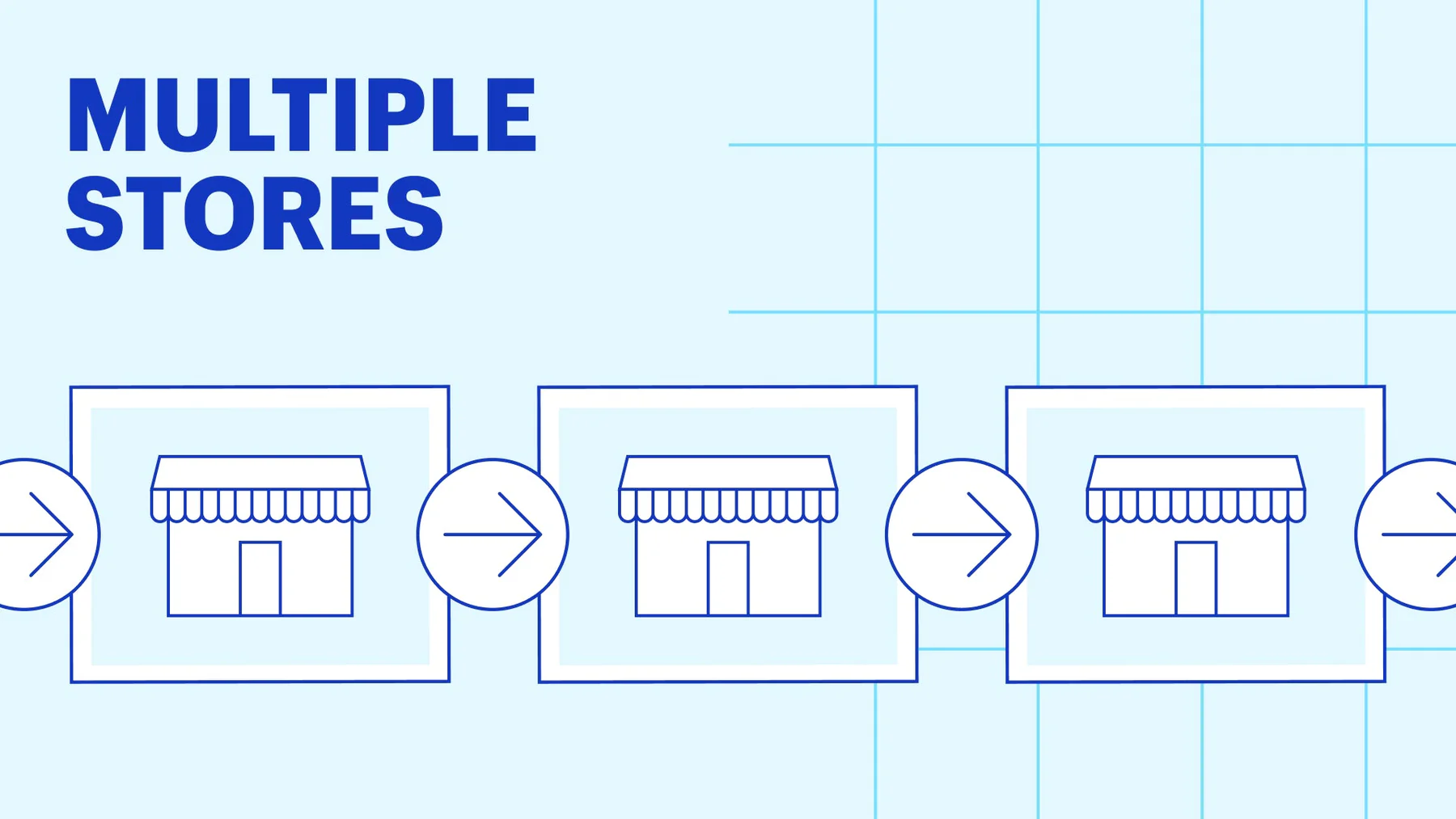
Multistore management means overseeing daily store operations across two or more brick-and-mortar locations. Often, multistore management also involves running an ecommerce site with national or international delivery options.
Operating multiple stores comes with additional responsibilities, such as managing more employees, offering new order-fulfillment options, and using enterprise-level technology to help you scale.
Locations change how you operate, and stores change what customers see. That’s why “managing multiple retail store locations” can mean very different things in practice. Sometimes you need operational flexibility behind the scenes; other times, you need a completely separate storefront experience.
Shopify supports all of these categories—but in very different ways:
Most growing retailers won’t, and don’t, fit neatly into just one category. A common setup is one brand running multiple stores, with each store tied to several physical locations. The key is choosing the model that matches the customer experience you’re trying to deliver.
If your retail store is doing well and you’re considering opening a second location, you have several reasons to take the plunge.
Even though online shopping is popular, shopping in a store is hard to beat. Customers can try before they buy and speak with brand representatives and product experts.
With more stores, you can serve more customers, expand your customer base, reach new regions, and generate more revenue overall.
Rent may very well be the new customer-acquisition cost, since storefronts act as billboards for your business. Your store’s signage and window displays boost brand awareness by luring customers in and enticing passersby to visit you online.
Plus, having multiple retail store locations builds brand credibility. It’s easier to build trust with customers when you can speak to them face to face, rather than being online-only.
With more stores, you can fulfill online orders faster. Customers can choose in-store pickup and get their orders from whichever shop is closest to them, and you can choose to fulfill online orders from the nearest store.
Whether you’re self-shipping your products or partially outsourcing, assigning the best location to ship orders from is critical to drive down costs, present accurate shipping fees and transit times to shoppers, and shorten delivery times.
Pro tip: With smart order routing from Shopify, you can automatically fulfill orders based on the closest location to the customer or the location with the most inventory. Brands like Element Brooklyn use this feature to save $1.14 in shipping costs per order, on average, and reduce delivery time by an average of 1.2 days.
“Shipping is by far our number one expense—it’s more than the cost of the product and more than the cost of labor. … Now we can deliver over 94% of our orders in one business day,” says founder and CEO Andrew Nicol.
Read more: What is AI Inventory Management? Benefits and Challenges
Before you expand into multilocation retail operations, you have to make sure you have the resources in place to operate several stores simultaneously.
Conducting market research helps ensure you’re expanding into locations with sufficient demand, minimal risk, and strong growth potential. It relies on customer feedback, competitive analysis, and local economic conditions to find the best place for expansion.
When you think you’ve scouted the right location, use feasibility studies to determine how viable it is to set up shop there. This includes revenue projections, rent estimates, staffing costs, and break-even analysis.
For example, a retail coffee chain might initially plan to open a second location on a busy street. Further research shows that, despite higher foot traffic, the area is already dominated by three major coffee brands. It might be more profitable to set up shop in a less crowded area—perhaps near a university or industrial park—where competition is less fierce, but people nearby still have money to spend on quality coffee.
Rent, fittings and fixtures, inventory—opening another brick-and-mortar store is no small feat. Studies estimate it costs $40,000 to open a retail store. Go back to your retail business plan to ensure you have the finances to fund an expansion.
That said, opening a second location tends to be cheaper than your first because you can benefit from economies of scale. Leverage existing relationships with suppliers to place bulk orders and buy inventory at a lower cost per unit. Most cloud-based software vendors also offer multistore discounts to reduce costs.
Not everything should be localized, and not everythingshould be centralized. The strongest multistore operators make these decisions explicitly.
As a baseline:
If every store negotiates its own rules, consistency collapses. Equally, if every store is forced into the same mold, performance will suffer. Expansion works when governance is shared, but execution is allowed to flex.
An enterprise point-of-sale (POS) system is the command center powering your entire retail business. It’s more than just a tool to process transactions—the right POS software also tracks staff schedules, collects customer data, and initiates payments.
Most enterprise POS platforms say they support multistore retail, but what they usually mean is that you can connect stores if you’re willing to bolt systems together. That’s how teams end up with numbers that don’t match or inventory that’s technically “available” but not actually sellable.
The alternative is a unified commerce model. That’s where POS and ecommerce operate on the same data layer, where sales, inventory, and customer records update once and stay consistent across channels. As store count and sales channels increase, this architectural difference becomes operationally significant.
A leading independent research firm found retailers using this unified commerce approach inside Shopify POS experienced:
✨Shopify power up: When Australian baby brand Riff Raff expanded into the US, it needed a fully localized storefront without adding a physical footprint or significantly growing its team. Already running on Shopify, Riff Raff moved to Shopify Plus to support international expansion without fragmenting operations. The brand launched its US site in weeks, increased revenue by 34%, grew its US customer base 2,784% year over year, and scaled customer support with just five additional staff hours per week.
Check that your enterprise POS system offers customizable roles, each with its own permission levels and access settings. For example, you may want to configure roles so sales associates working in a store known to be targeted by serial returners require a manager’s approval to process a return or exchange.
With Shopify POS, you can assign different roles and permissions. This sets boundaries on what store staff can do without manager approval, like changing a product’s price or applying a custom discount on a sale.
You can also equip store managers with POS permissions needed to best manage their location. This includes accessing reports, closing cash tracking sessions, applying discounts, and authorizing returns or refunds.

As you add more inventory to your shelves, it becomes more difficult to control. It can be harder to understand which items are popular at which stores, forecast demand accurately, or calculate sell-through rates per product. And with more products across more stores, you need more efficient ways to know what you have and when you need to reorder.
Look for a POS system with multistore inventory management features like:
Pro tip: Shopify POS provides an overselling warning and confirmation if an item is sold out, committed, or not in stock. If that item is added to the cart, sales staff will be notified and can decide if they want to complete the sale or remove the item from the cart and create a ship-to-customer order instead.
Operations might not be the most exciting part of running a retail business, but they ensure that no matter which store a customer walks into, they receive the same quality experience.
To standardize retail operations management:
If pricing, promotions, or returns policies are managed separately by store—or worse, tracked in spreadsheets—it’s the customers that start noticing the gaps: things like a discount works online but not in-store, or one location accepts a return while another escalates it to a store manager.
A unified commerce setup reduces this risk by centralizing the rules that shouldn’t vary. With Shopify, core logic for pricing, discount codes, gift cards, and returns lives in a single back end and applies across both POS and ecommerce.
Because changes are made in one place, updates propagate automatically, without manual syncing.
Shopify power up: Founded in Spain in 2016, Blue Banana Brand started as an online-only business before expanding rapidly into physical retail. Since 2020, the brand has opened 20 stores across Spain, while continuing to scale ecommerce and marketplace sales. Blue Banana runs POS, ecommerce, and customer data from a single system, using Shopify as its core commerce platform.
The results speak for themselves: 50% lift in conversion rate, more than €7 million in stock sold without technology bottlenecks, and 20 fully integrated retail stores supporting international expansion into Mexico and wholesale across Europe.
“Shopify is our single source of truth. Having all customer data and transaction data on Shopify makes our lives easier by ensuring there is consistency across sources,” says Javier Gurney, head of digital.
A larger retail workforce means you need to be more strategic in how you manage staff. By putting systems in place, you can spend less time on staff management decisions as each new location opens.
Create an employee training checklist for managers that helps ensure all staff members at every location receive the same training and can fill in for each other when needed. On the checklist, include topics like how to use your store’s technology, how to process inventory, how to restock shelves, and how to interact with customers—including handling customer complaints.
Continue building product knowledge and maintain compliance by standardizing training with a learning management system. By uploading courses and worksheets to this platform, retail staff receive consistent training, regardless of their store location.
Managing staff schedules across multiple retail store locations can be complex, especially when dealing with varied store sizes, customer traffic, employee availability, and local labor laws.
To manage these differences:
Inventory shrinkage grows in severity as your retail footprint expands, especially if you’re managing locations from afar. Shoplifters might push their luck and target one store by stealing inventory or making fraudulent returns, for example, and move to another when caught.
Using technology that supports collaboration and keeps lines of communication open between stores can prevent this. For instance, cashiers at one location can flag bad actors inside the POS system, alerting all your stores to certain customers. Automated workflows in Shopify Flow can then block new orders or returns from that customer at any other store.
Other ways to bolster store security when managing multiple locations include:

Retail shrink—the gap between what inventory should be on the books and what’s actually available—is a real driver of lost profit. While historical shrink benchmarks (around 1.6% of sales) still provide a baseline, today’s risk picture requires tracking incidents and theft patterns.
“As the nature of retail loss has evolved, it has become clear that a broad study about retail shrink is no longer sufficient,” says Mary McGinty, the National Retail Federation’s vice president of communications and public affairs, in an interview with Retail Dive, explaining that the NRF is moving toward more targeted reporting focused on retail theft and violence.
In the NRF’s 2025 Impact of Retail Theft & Violence report, respondents reporting incidents from January to June 2025 said they expect retail loss to continue rising: 65% flagged phone scams, 63% pointed to ecommerce or digital fraud, and 53% cited shoplifting and merchandise theft as growing concerns.
Returns, another key source of loss, are now a persistent operational challenge: retailers estimate roughly 15.8% of annual sales would have been returned in 2025, with online returns approaching 19.3% of ecommerce sales.
Instead of relying on an annual shrink percentage alone, multistore teams should track a small set of indicators monthly:
The customer experience should be consistent across your brand, regardless of store location, or if customers are shopping in person or online. Consistency between channels helps reinforce your brand values and positioning, while giving shoppers the omnichannel experiences they expect.
Standardized operating procedures help maintain brand consistency in visual merchandising, customer service, and promotional activities. Share planograms, store layout designs, upcoming promotions, and marketing calendars with each store in advance. This unified foundation ensures customers experience your brand consistently, without confusion.
Sometimes, things happen unexpectedly. Establish clear communication channels—for example, a company Slack channel or WhatsApp group—to help teams learn from each other. Encourage them to share wins and challenges, building team culture and ensuring consistency across locations.
Pro tip: Allow customers to switch between channels with a POS system that lets them shop in whatever way is most convenient. It should enable you to offer in-store pickup for online orders, ship-to-customer fulfillment for in-store purchases, and buy online, return in-store for maximum convenience.
Understanding the performance of each storefront—and how it compares to other locations—gets trickier the more stores you have.
Your POS should allow you to view business performance as a whole or focus on individual locations. You need a way to isolate or combine store reports to compare and contrast performance based on venue, geography, and average store benchmarks.
With access to unified reporting, you’ll reach the right business decision faster. Shopify Analytics, for example, has more than 60 prebuilt reports to:
Focus on a short, consistent KPI set and review it monthly by location:
Benchmarking these KPIs across locations makes underperformance visible early.
Small differences in how things are run between stores can add up to a fragmented brand experience. Audits help ensure your standard operating procedures are followed and customer experience remains consistent across locations.
Run periodic reviews—either by store managers or third-party auditors, such as mystery shoppers—to ensure compliance with brand standards. Your goal is to answer questions like:
To identify areas of improvement, combine your store performance reports with audits. Learn which stores are excelling and which are falling behind and do something about it.
For example, POS data might show your New York store has the lowest revenue per square foot. Maybe the audit reveals the location isn’t displaying current promotions in window displays like better-performing locations are. Knowing this information, you can make sure the promotions are in window displays, and, thus, increase sales, while also improving consistency between stores.
If your business needs more than one storefront, Shopify expansion stores give you a clear way to scale.
Expansion stores are additional “.myshopify.com” stores that live under the same organization and contract on Shopify Plus. Each store runs independently, with its own settings, configurations, and storefront, while users and billing are managed centrally at the organization level.
They’re designed for common, real-world expansion scenarios, including:
And because Shopify Plus organizations can run up to 10 stores (one primary plus nine expansion stores) at no additional cost, you can expand without renegotiating your platform every time.
Managing multiple stores is commonly referred to as multistore management. For retail store owners running a retail store chain, it means overseeing operations, staff, inventory, and customer experience across multiple locations. The goal is to standardize what should be consistent—pricing, policies, brand experience—while still allowing flexibility at the store level.
Retail store owners typically manage multilocation retail stores by combining centralized systems with clear operating standards:
You can manage multiple locations in Shopify by running one Shopify store with multiple retail locations. Inventory, fulfillment, and staffing are tracked by location, while the storefront and catalog remain the same. This setup works well for retail store owners who operate several brick-and-mortar locations under a single brand and customer experience.
Manage multiple Shopify storefronts by setting them up as separate stores under one organization, rather than trying to run everything from a single store. On Shopify Plus, this is done using expansion stores, which let you operate multiple independent storefronts while keeping user access and billing centralized.





