

Selling coral online works when the guarantee, the ship calendar, and the claim process are treated as the product. Coral, live plants, and perishable cargo are excluded from standard Shopify shipping insurance, so the seller absorbs every transit loss directly.
The shipping insurance most Shopify merchants quietly rely on excludes perishable cargo, live animals, flowers, plants, and seeds. If you sell something alive, every box you ship is self insured whether you planned it that way or not.
Most ecommerce sellers worry about a crushed corner or a carrier delay. Coral sellers worry about all of that plus keeping an animal alive inside a sealed bag for 24 to 48 hours, then convincing a stranger that what lands on their doorstep is the same organism they saw in a photo taken under different lighting three days earlier.
This is ecommerce with the difficulty turned up, and the operators who do it well have solved a set of problems that most product retailers never encounter. The interesting part is that almost none of those solutions are specific to coral. They apply to anyone shipping live plants, cut flowers, fresh seafood, bakery, or feeder insects, which is a much larger slice of the Shopify merchant base than the category’s visibility suggests.
Here is what actually goes into building a coral business that holds up online, and where the same mechanics transfer.
Coral is one-of-one inventory that changes condition daily, which means every listing is effectively a single-unit SKU with a shelf life measured in weeks rather than a stocked product with reorder points. A frag that looked full and vibrant on Tuesday can show visible stress by Thursday. Nothing in a standard Shopify catalog workflow is built for that, because the platform assumes a SKU represents a repeatable unit rather than a specific animal.
The practical consequence is that a coral seller’s listings have to track real conditions, not a static catalog photo taken months ago. Stores like Matt’s Corals & Service, which run a physical shop in Gahanna, Ohio alongside an online store, tie listings closely to current stock for exactly this reason. A customer ordering coral is trusting that what they see is what is actually swimming in the system right now.
At $10K to $50K per month, this is manageable with disciplined manual publishing: photograph, list, sell, archive, on a fixed weekly cadence. Past roughly $100K per month the manual approach starts leaking, and the fix is not another app. It is a photography and listing rhythm your team runs on the same two days every week so nothing sits live for more than seven days without a condition check. Merchants in the $500K to $2M range almost always try to solve this with tooling before they solve it with cadence, and the tooling never works, because the underlying variable is how recently a human looked at the animal.
The same constraint governs any inventory where condition drifts in storage. If you are working through the operational layer of that problem, the mechanics of temperature-controlled shipping for perishables map closely onto reef livestock, since both are ultimately about holding a narrow environmental band from your facility to a doorstep.
Visual content carries more conversion weight in livestock than in any other ecommerce category, because the buyer cannot inspect, handle, or smell the product and has no branded reference point to fall back on. Shopify’s own data puts roughly 75 percent of online shoppers naming product photos as a deciding factor in the purchase, and that figure is measured across categories where the buyer already knows what a sweater is. For coral, the photo is the entire basis of the transaction.
Coral color shifts dramatically with lighting temperature, camera white balance, and the specific aquarium fixture used for the shot. This creates a real integrity problem: a heavily blue-shifted photo under actinic lighting can make a mediocre piece look extraordinary, and the customer discovers the gap on arrival. The sellers who last set a fixed lighting and camera configuration, shoot every piece under it, and publish that standard on the site so buyers can calibrate their expectations.
Video does work that stills cannot. Polyp extension and flow response are the two clearest health signals a buyer can read, and neither survives a still frame. A 10 to 15 second clip per listing costs a few minutes of handling time and removes the single largest source of pre-purchase doubt. The same logic that governs product video on a Shopify store applies with more force here, since the video is not enhancing the product description, it is functioning as the health certificate.
At $10K per month, a phone on a tripod with a fixed white balance and a consistent background beats an expensive camera used inconsistently. Above $100K per month, the constraint shifts from equipment to throughput, and the answer is a dedicated shooting station with the settings locked so any staff member can produce identical output without a judgment call.
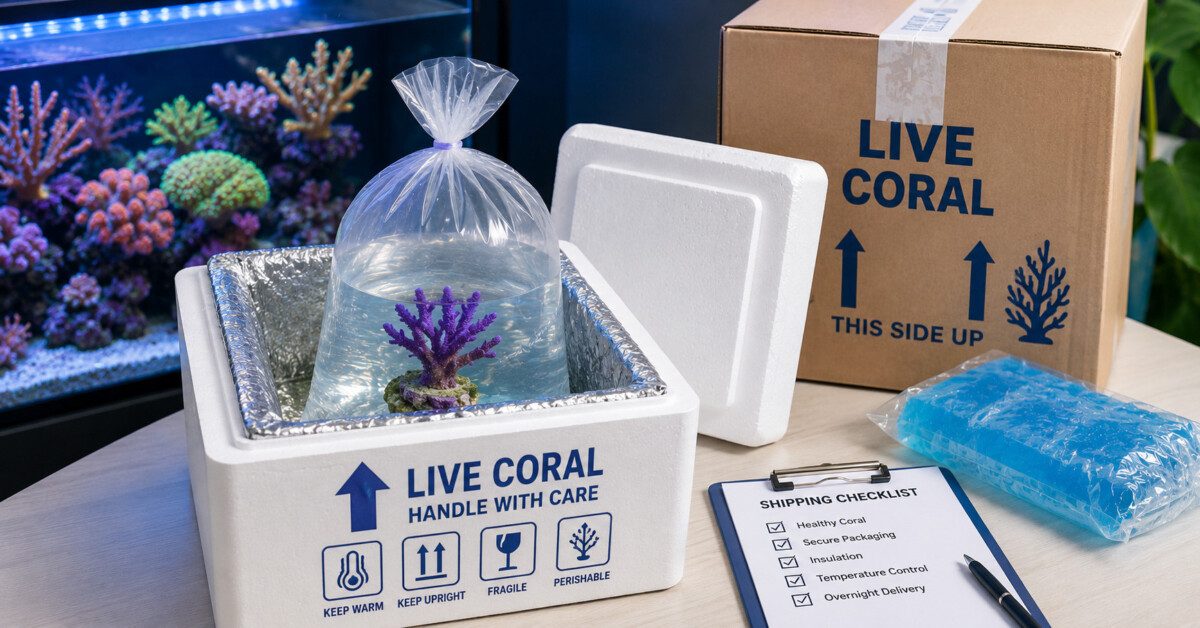
Shipping coral is not a variation on standard parcel shipping, it is regulated live animal transport, and carriers treat it that way. FedEx requires prior approval before a business can ship live animals, including submitting a packaging sample to its packaging lab for testing, and restricts all live shipments to First Overnight, Priority Overnight, or Standard Overnight service. Merchants who discover this after their first denied drop-off have already lost a box.
The packaging stack is insulated boxes, oxygenated and double-bagged water, heat or cold packs matched to the season and the destination climate, and IATA-compliant live animal labeling. None of that is optional and none of it is cheap. Expect the fully loaded per-box packaging cost to sit well above a standard parcel, which is precisely why free shipping thresholds that work for dry goods destroy margin here.
The ship calendar matters as much as the packaging. Livestock sellers conventionally ship Monday through Wednesday only, avoiding shipments that would sit in a facility over a weekend or a holiday, because a 24 hour delay that costs a t-shirt seller a complaint costs a coral seller the animal. Enforce this at checkout rather than in a policy page nobody reads: a delivery date picker app such as Zapiet or Order Delivery Date can hard-block non-shipping days, and a weather hold rule should let you pause a region when the destination forecast goes outside your survivable band.
The broader discipline here is standard cold chain thinking, and the fundamentals of shipping perishable goods efficiently apply directly, with one difference: a perishable product degrades, while an animal dies. There is no partial credit on a coral shipment.
A live arrival guarantee in this category is not a marketing feature, it is an uninsured liability you are funding entirely out of gross margin, and most sellers have never confirmed that. The coverage terms for Shopify’s shipping insurance program spell out an exclusion list that explicitly excludes perishable cargo, live animals, flowers, plants, and seeds. The same terms exclude losses arising from decay, inherent vice, deterioration, or changes in temperature and humidity, which describes essentially every way a coral shipment fails.
Read that plainly. The $0.89 per $100 of domestic coverage that a typical Shopify merchant buys as a routine line item does nothing for you. Third-party protection apps sit on the same underwriting logic; a Shopify-native option like Parcelis is a genuinely useful tool for merchants shipping durable goods, but livestock sits outside what any of these products are built to cover. Every guarantee you offer is self funded.
That changes how the guarantee should be priced. Treat it as a reserve rather than a promise. Take your trailing 90 days of shipments, count DOA replacements at cost, divide by boxes shipped, and you have a per-box loss rate you can build into pricing the same way you would build in card processing fees. Illustrative benchmark: a seller running a 3 percent DOA rate on a $180 average order is carrying roughly $5.40 of unfunded liability per box, which is real money at 200 boxes a month and invisible until someone calculates it.
The guarantee terms themselves should be short, specific, and generous within a tight window. Vague conditions and long claim windows are what erode trust in a category where buyers compare policies in forums before they buy.
A DOA claim is the highest-leverage retention moment in a livestock business, and it should resolve inside one business day. Even with correct packaging and a clean ship window, losses happen. What separates sellers who compound reputation from sellers who bleed it is entirely how the next 24 hours go.
Make the documentation requirement precise and easy: a photo or short video of the animal in the unopened bag, taken within a stated window of delivery, usually two to four hours. Precision here protects you from ambiguity later and it protects the customer from a claim denial on a technicality. Publish the window on the product page, not buried in a policy link, and restate it in the shipping confirmation email so it arrives before the box does.
Then resolve fast. A helpdesk such as Gorgias can route anything tagged DOA to the front of the queue and pull order and tracking context automatically, which matters more than it sounds when a customer is standing over a failed shipment at 7am. Offer store credit or replacement on the next available ship day without argument. The economics favor generosity: replacing a $60 frag costs you wholesale, while a public complaint in a reefing forum costs you an unknown number of first orders you will never see.
Support does not end at resolution either. Acclimation questions arrive in the 48 to 72 hours after delivery, and that window is where a first-time buyer decides whether to order again. A simple three-email post-purchase flow in Klaviyo covering acclimation, placement, and a 14 day check-in converts a transaction into a relationship at close to zero marginal cost.
The reefing community functions as the distribution channel, not as an audience to advertise into, and sellers who treat it the second way get filtered out within weeks. Hobbyists are concentrated in forums, Facebook groups, and Discord servers where they trade husbandry advice, post tank builds, and name the sellers they trust and the ones they do not.
What earns standing there is participation that has nothing to do with selling: answering husbandry questions, posting failures honestly, sharing what a coral looked like six months after it left your system. Illustrative benchmark: in tight-knit hobby categories, a meaningful share of a seller’s repeat revenue traces back to community referral rather than paid acquisition, which is the inverse of most Shopify stores at the same revenue level.
This is also why paid social underperforms here relative to what a merchant at $50K per month would expect. The buying decision is a judgment about animal welfare and seller integrity, and no ad creative resolves that question. A single unprompted vouch from a respected hobbyist outperforms a month of retargeting spend.
The practical version at any stage is a fixed time budget rather than a campaign: two or three hours a week of genuine participation, no promotional posts unless the community’s rules explicitly allow them, and a policy of answering questions about competitors honestly when they come up. That last one feels expensive and is not.
A hybrid model where customers can walk into a physical shop and also order online builds trust faster than an online-only store can purchase it, because in-person credibility converts into reviews and referrals that reassure buyers who will never visit. Matt’s Corals & Service is a useful example of the pattern: local customers verify the operation with their own eyes, then buy online repeatedly and vouch publicly.
The mechanism is straightforward. A local buyer sees the holding systems, the water quality, and the person running them. That verification produces reviews with a specificity that online-only sellers cannot manufacture, and those reviews do the persuasion work on customers three states away. Shopify POS keeps the inventory and customer record unified across both channels, which is what stops the model from creating two disconnected businesses.
The honest counterpoint is that a physical location carries fixed costs that an online-only seller does not, and it only pays off if the local market has enough reef hobbyists to support the overhead. In a thin market it is a liability. The transferable lesson for online-only sellers is that the asset is verifiable proof, not the storefront itself, and proof can be manufactured other ways: facility tours on video, named staff, published water parameters, and a track record of public claim handling. If you are working through where trust breaks in your funnel, the stage-by-stage Shopify CRO playbook is a reasonable place to start diagnosing which stage is actually leaking.
Any category where the product can arrive dead, spoiled, or unusable through no fault of the buyer runs on the same three variables: transit window, primary failure mode, and who absorbs the loss. The specifics change and the operating model does not.
The column that matters most is the one not in the table. In every one of these categories, the standard shipping insurance path excludes the product, which means the merchant is the insurer. Sellers who know that price for it. Sellers who do not find out during their worst month.
Selling coral online is a trust business with a logistics problem attached, not a logistics business with a marketing problem attached. The buyer is deciding whether to hand a stranger responsibility for something living, sight unseen, on the strength of photos, a guarantee, and whatever the community says about you.
The sellers who last treat that trust as the product. The packaging spec, the Monday through Wednesday ship calendar, the priced guarantee, the one-day claim resolution, and the forum presence are not seven separate initiatives. They are one system, and its output is a customer who believes you will do the right thing when a box goes wrong. Everything else in this category follows from that.
Ship coral overnight only, in an insulated box with oxygenated double-bagged water and a heat or cold pack matched to the destination climate, on Monday through Wednesday so no package sits over a weekend. Carriers treat coral as live animal freight, which means you need prior carrier approval and packaging that has passed their testing process before your first shipment moves. Add a weather hold rule that pauses shipping to any region where the forecast falls outside your survivable temperature band. The single largest controllable variable is not the packaging, it is the ship day, because a 24 hour delay in a facility is what turns a healthy shipment into a claim.
No. The coverage terms for Shopify’s shipping insurance program exclude perishable cargo, live animals, flowers, plants, and seeds, and separately exclude losses caused by decay, deterioration, inherent vice, or changes in temperature and humidity. That combination rules out essentially every failure mode a coral shipment experiences. Third-party package protection apps generally sit on the same underwriting logic and are built for durable goods. The practical result is that any live arrival guarantee you offer is entirely self funded out of your own margin. Merchants selling livestock should confirm this against their current provider’s terms rather than assuming coverage exists, and should price the guarantee as a reserve against a measured claim rate.
A live arrival guarantee should cover the animal arriving dead, with a short documentation window, a clear claim process, and resolution by store credit or replacement on the next available ship day. Keep the window tight, typically two to four hours from delivery, and require a photo or short video of the animal in the unopened bag. Publish the terms on the product page rather than in a policy footer. Exclude losses caused by the buyer refusing delivery, providing a wrong address, or failing to be present for a shipment they scheduled. Generous terms inside a tight window build more trust than broad terms with restrictive conditions attached.
Ship livestock Monday through Wednesday only, and never the day before a holiday. The reason is transit risk rather than convenience: a package tendered Thursday or Friday can sit in a carrier facility across a weekend, and a coral does not survive that. Enforce the rule at checkout with a delivery date picker rather than in a policy page, since customers who select an unavailable date create a support ticket and a fulfillment exception. Build in a weather hold that suspends shipping to regions where the destination forecast is outside your safe range, and communicate holds proactively rather than waiting for the customer to ask why their order has not moved.
A hybrid local and online model is worth it when the local market has enough hobbyists to carry the fixed overhead, because in-person verification produces reviews and referrals that online-only sellers cannot manufacture. Local customers inspect your systems directly, and their reviews carry a specificity that persuades buyers who will never visit. Shopify POS keeps inventory and customer records unified so the two channels function as one business. In a thin local market the overhead is a liability, and the better move is to manufacture verifiable proof another way: facility video, named staff, published water parameters, and a public track record of how you handle claims.





