

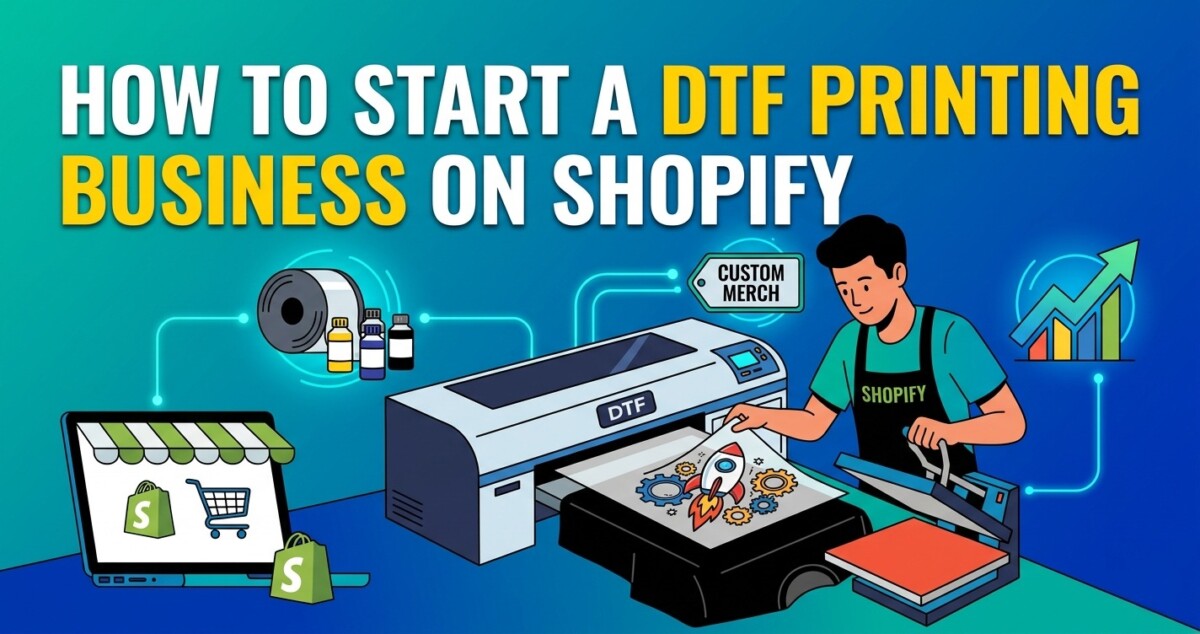
Most custom apparel businesses fail not because the printing quality is bad, but because the owner never built a real traffic system. The equipment is the easy part. Getting consistent eyes on your products is the work.
Most people who start a custom apparel business spend weeks researching equipment and almost no time thinking about where their first customer is going to come from. They get the printer dialed in, they set up the Shopify store, they build a product catalog, and then they wait. The orders do not come. Not because the products are bad, but because nobody knows the store exists.
The DTF printing model is genuinely compelling. Direct-to-film technology lets you produce full-color, detailed designs on almost any fabric without the setup costs or minimums that traditional screen printing requires. Whether you are doing $5K months or working toward $50K, the core operational logic is the same: efficient production plus consistent traffic generation equals a business that compounds. This guide covers both sides of that equation, starting with the production setup and moving through the traffic channels that actually work for small apparel operators.
If you are also evaluating whether a fully managed print on demand model makes more sense for your situation, the guide on building an AI-powered print on demand operation on Shopify covers the platform comparison and unit economics in detail. The two models are not mutually exclusive, and understanding both will help you make the right call for your stage.
The production question is not which equipment is the most advanced. It is which setup performs reliably when you need it most. A DTF printing business lives and dies on its ability to fulfill orders consistently, and that means your equipment needs to work on the slow Tuesday with two orders and on the Friday after a viral TikTok post when you suddenly have forty.
The failure mode I see most often with new DTF operators is building a setup that works great during testing and falls apart under real order pressure. The printer jams. The heat press temperature drifts. A maintenance issue takes the whole operation offline for two days. Every one of those failures is a customer who did not get their order on time, a refund request, and a review that hurts your conversion rate for months.
A reliable DTF printer is the core of the operation. It needs to perform consistently across a range of order volumes without requiring time-consuming maintenance between runs. Pair it with the best heat press machine you can afford for your volume, because inconsistent heat application is one of the most common sources of quality complaints in custom apparel. Heat transfer vinyl rounds out the setup, giving you the flexibility to handle quick customizations, names, numbers, and design variations without running every job through the full DTF workflow.
The practical goal here is a setup that you can operate alone, that produces consistent results across different garment types, and that does not require you to be a technician to maintain. For a deeper look at why owning your own equipment changes the economics of a Shopify apparel business, the article on why owning a DTF printer gives Shopify sellers a production advantage is worth reading before you finalize your equipment decisions.
A focused Shopify store outperforms a sprawling one at every stage of growth, and this is especially true when you are starting out. The instinct to load up your store with every product you can print is understandable, but it works against you. Too many choices slow down decision-making, and a customer who cannot decide quickly usually leaves without buying.
Start with three to five products that represent your strongest designs and your most likely buyers. Your homepage needs to communicate clearly and immediately what you sell and who it is for. Your product photography needs to show the item in a real context, not just a flat-lay on a white background. Your product descriptions need to answer the questions a buyer actually has: what is this made of, how does it fit, how does the print hold up after washing, and who is this for.
The Shopify setup itself is straightforward. Choose a clean, fast-loading theme. Configure your payment processing and shipping rates before you launch, not after. Set up your email capture from day one, even if you only have a handful of visitors at first. That list is an asset that compounds over time, and the merchants who build it early have a significant advantage over the ones who treat it as an afterthought. For a practical overview of printing methods, cost structures, and what actually drives conversion on custom apparel product pages, the guide on printing methods and cost breakdown for custom apparel is a useful reference as you build out your product catalog.
The most expensive mistake in custom apparel is producing inventory, or even just building a catalog, around designs you personally like rather than designs the market has already shown interest in. Your taste is not the product. The buyer’s taste is the product. Those two things are sometimes the same, and often they are not.
The categories that consistently outperform generic designs are the ones with a specific, identifiable audience. Fitness communities, gaming communities, pet owners, local sports teams, hobby-specific groups, and regional pride niches all share one characteristic: the people in them already know they want custom apparel that speaks to their specific identity. They are not browsing for something interesting. They are looking for something that feels made for them.
Your DTF printer handles full-color, detailed graphics extremely well, which means you are not limited to the simple one-color designs that screen printing favors. Use that capability to produce designs with real visual complexity, the kind of artwork that would be expensive or impossible with other printing methods. Heat transfer vinyl handles the personalization layer: names, numbers, custom text additions that turn a standard design into something specific to the buyer. That combination, a strong base design plus personalization capability, is what separates a product that sells once from a product that generates repeat orders and referrals.
Before you invest time in production, validate the design. Post it in the community it is made for. Share it with people who fit the target audience. Run a small paid test if you have the budget. The goal is to confirm that real people want to buy this specific thing before you build a catalog around it. The merchants who skip this step are the ones sitting on a beautiful product catalog that generates no revenue.
TikTok remains the most accessible organic reach platform available to small product businesses in 2026, and the DTF printing model is uniquely well-suited to it. The reason is simple: the process of making a custom apparel product is genuinely interesting to watch. People want to see how it is done.
You do not need to go viral. You need to be consistent. A single viral video is a spike. Consistent posting is a compounding asset. The accounts that build real, sustainable traffic from TikTok are the ones posting three to five times per week with content that is genuinely useful or interesting to their target audience, not just promotional.
The content formats that work best for DTF printing businesses are the ones that show the work. Order fulfillment videos where you walk through printing and pressing a real customer order. Before-and-after clips showing a blank garment and the finished product side by side. Close-up shots of the print detail that demonstrate the quality of your output. Behind-the-scenes looks at how you set up a design, run it through the DTF printer, and press it with the heat press. These formats work because they build trust and they answer the question every potential customer has before they buy: is this actually good quality?
The practical approach: batch your content creation. Set aside two hours twice a week to film everything you are working on, then edit and post from that footage over the following days. Do not try to create and post in real time. It is unsustainable and the quality suffers. Consistency matters more than frequency, and frequency matters more than production value, especially when you are starting out.
Reddit works differently from every other social platform, and the merchants who try to use it the way they use Instagram or TikTok get nowhere fast. Direct promotion on Reddit is not just ineffective. It actively damages your credibility in the communities you are trying to reach. The platform’s culture is built around authentic participation, and any post that reads like an advertisement gets flagged, removed, or downvoted into invisibility.
The approach that works is genuine community participation over time. Join the subreddits where your target audience already gathers. For a fitness apparel business, that might be running communities, CrossFit communities, or sport-specific groups. For a gaming apparel business, it is the game-specific subreddits where the most passionate fans spend their time. Spend the first few weeks just participating: answering questions, sharing relevant knowledge, being a useful member of the community.
When you do share your work, frame it as sharing, not selling. Post a photo of a design you made and ask for feedback. Document your business journey and share the honest version of what is working and what is not. Show the process of going from a design concept to a finished garment. These posts generate organic interest because they are genuinely interesting, and the traffic they drive to your store is qualified because it comes from people who already know what you do and have seen evidence that you do it well.
Reddit traffic converts at a higher rate than most paid traffic sources for niche apparel businesses, because the people clicking through have already spent time in a community that validated your work. That pre-qualification is worth more than a cold ad impression from someone who has never heard of you.
Facebook groups are underestimated by most ecommerce operators who have moved their attention to newer platforms, and that underestimation is your opportunity. The groups are still active, the audiences are often highly specific, and the barrier to entry for a genuine community participant is low.
The approach mirrors Reddit: find the groups where your target audience gathers, join them, and participate authentically before you ever mention your products. Local community groups, hobby groups, sports parent groups, and niche interest communities all have members who actively want to find products made for their specific interests. When you show up as a genuine community member first, the transition to sharing your work feels natural rather than promotional.
Practical tactics that work well in Facebook groups: sharing a product you made that is relevant to the group’s interest and inviting feedback, offering a small discount to group members as a genuine gesture rather than a marketing tactic, and posting customer photos when buyers share their own content. Social proof from real customers in a community context is more persuasive than any ad you could run to the same audience.
Many small apparel businesses generate their first $2K to $5K in monthly revenue entirely through Facebook groups before they ever run a paid ad. That organic foundation is valuable not just for the revenue but for the customer feedback it generates. The people who buy from you in a community context will tell you exactly what they like and what they would change, and that feedback is worth more than any market research tool.
The fulfillment workflow is where most DTF printing businesses lose the gains they made on the marketing side. Getting orders is the goal, but fulfilling them accurately and on time is what determines whether those customers come back and whether they tell other people. A single bad fulfillment experience, a late order, a quality issue, an item that arrived damaged, can undo weeks of community building and trust development.
The workflow needs to be documented, not just understood. Write down exactly what happens from the moment an order comes in to the moment it ships. What gets printed first? How do you handle customization requests? What is your quality check process before an item goes into a package? When does a customer get a tracking notification? These questions need answers that exist outside your head, because the moment you are trying to fulfill thirty orders at once is not the moment to be figuring out your process.
The practical sequence for most DTF printing operations: print the design, apply any heat transfer vinyl customizations, press the garment, inspect the finished product against the order, package it, and ship. That sequence sounds simple, but each step has failure modes. The DTF print can have a color shift if the film was not stored correctly. The heat press can leave marks if the temperature or pressure is off. The packaging can fail if you are using the wrong materials for the garment type. Building a quality check into each step costs a few seconds per order and saves hours of customer service work per week.
As your volume grows, the automation layer becomes essential. Shopify handles order routing automatically, but your notification workflow, your shipping label generation, and your inventory tracking all benefit from automation tools that connect the pieces. The time you save on manual administrative work is time you can spend on design, marketing, and community building.
The most common reason DTF printing businesses take six months to generate their first meaningful revenue is not bad products or bad marketing. It is over-optimization before there is anything to optimize. The founder spends weeks perfecting the store design before the store has a single visitor. They spend hours refining a product description for an item that has not been validated. They delay launching because the photography is not quite right yet.
Perfection is a moving target that recedes as you approach it. Consistency is a practice that compounds as you maintain it. The businesses that generate real revenue in the first 90 days are almost always the ones that launched imperfect and improved in public, not the ones that waited until everything was ready.
What consistency looks like in practice: posting content three times a week whether or not you feel inspired. Responding to every comment and message within 24 hours. Shipping orders within your stated timeframe even when it requires working late. Improving one thing in your store or workflow each week based on actual customer feedback rather than hypothetical scenarios. These habits feel small in isolation. Over six months, they are the difference between a business that is growing and one that is still preparing to launch.
The merchants doing $10K months in custom apparel are not operating with better equipment or more sophisticated marketing than the ones doing $500 months. They are operating with more discipline, more consistency, and a willingness to learn from real data rather than waiting for certainty before they act.
The startup cost for a DTF printing business on Shopify typically ranges from $3,000 to $8,000 depending on the quality of equipment you choose. A reliable entry-level DTF printer runs $1,500 to $3,000. A quality heat press machine adds $300 to $800. Initial supplies including DTF film, powder, and ink run $300 to $600. Shopify’s Basic plan is $39 per month. Add $500 to $1,000 for initial blank garment inventory to test your setup. The biggest variable is equipment quality: cheaper equipment often costs more in the long run through maintenance issues, inconsistent output, and downtime. If budget is a constraint, start with a smaller, reliable setup and scale the equipment as revenue supports it rather than buying the most advanced printer before you have proven demand.
The product categories that consistently outperform generic designs are niche-specific apparel with a clear, identifiable audience. Fitness community apparel, gaming and hobby-specific designs, pet breed-specific items, local sports team merchandise, and regional pride products all share the same characteristic: the buyer already knows they want something made for their specific identity. Full-color, detailed graphic designs perform particularly well with DTF printing because the technology handles complexity that screen printing cannot. Products that combine a strong base design with personalization options, such as adding a name, number, or custom text, consistently generate higher average order values and stronger repeat purchase rates than non-personalized items.
The three organic channels that work best for small custom apparel businesses are TikTok, Reddit, and Facebook groups. TikTok rewards consistent posting of genuine process content: order fulfillment videos, before-and-after design transformations, and behind-the-scenes production footage build trust and generate qualified traffic over time. Reddit requires authentic community participation before any product sharing, but the traffic it generates converts at a high rate because it comes from pre-qualified buyers who already know your work. Facebook groups work best for niche and local audiences where community trust is high. Most small DTF printing businesses generate their first $2,000 to $5,000 in monthly revenue through these organic channels before investing in paid advertising.
DTF (direct-to-film) printing and heat transfer vinyl (HTV) serve different purposes in a custom apparel operation and work best when used together. DTF printing excels at full-color, photographic, and detailed graphic designs. The design is printed onto a special film, coated with adhesive powder, cured, and then heat pressed onto the garment. The result is a vibrant, durable print that handles complexity that HTV cannot. Heat transfer vinyl is better suited for simpler designs, text, names, numbers, and solid-color graphics. It cuts faster, applies cleanly, and is the right tool for quick customizations and personalization. Most DTF printing businesses use both: DTF for the primary design and HTV for the personalization layer that makes each item specific to the buyer.
A single DTF printing order typically takes 15 to 30 minutes to fulfill from print to packaged and ready to ship, depending on design complexity, garment type, and whether personalization is involved. At low volume, one person can comfortably fulfill 10 to 15 orders per day while managing other business tasks. As volume grows, the fulfillment time per order decreases as your workflow becomes more efficient, but the total daily time commitment increases. The critical variable is equipment reliability: a printer that requires frequent maintenance or a heat press with inconsistent temperature control can turn a 20-minute fulfillment process into a 45-minute one. Building a documented workflow and a quality check process into each order from the start is what allows you to scale fulfillment without scaling errors.





