
A swimwear brand survives its first season by launching narrow and early: five styles rather than eight, samples budgeted for two rounds, returns priced into the cost sheet before launch, and product pages live and indexed by March, when US demand is already climbing.
Brands rarely die in season one because the product was wrong. They die holding 1,600 units of perfectly good product, in the wrong sizes, arriving in May.
US retailers expect 15.8% of their 2025 sales to come back, worth about $849.9 billion, and 19.3% of online sales specifically, according to the annual returns study run by the National Retail Federation with returns platform Happy Returns. Free returns now matter to 82% of shoppers when they decide where to buy, up from 76% a year earlier.
For a new swimwear label, that turns returns from an after sales chore into a line on the cost sheet from day one. Swimwear carries its own pressure on top of the category average. Fit is unforgiving, the selling season is short, and a suit that comes back with the hygiene liner removed often cannot go back on the shelf at full price.
What follows are the decisions a first season founder meets in the order they arrive, from the first assortment call to the week the product pages go live. Whether you are launching your first apparel brand or adding swim as a category to a store already doing $500K, the sequence is the same. The size of the bet is what changes.
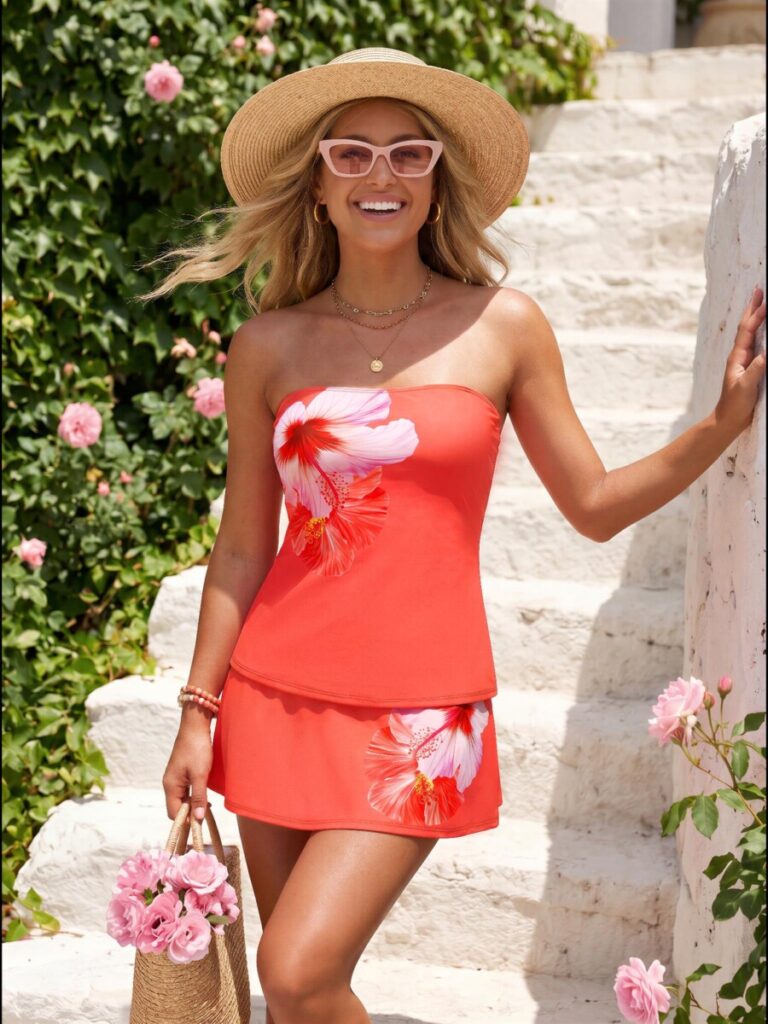
A first swimwear collection should serve one customer in one use case, because every extra style multiplies fabric orders, fit sessions, and photography at the exact moment cash is tightest. A lap swimmer wants chlorine resistant fabric and straps that stay put through a hundred lengths. A vacation shopper wants coverage options, prints that photograph well, and a piece that works as well at lunch as it does in the water. Trying to serve both in season one doubles the work and halves the focus.
The arithmetic makes the case faster than any brand argument. Take an illustrative plan of eight styles in two colors, each offered in six sizes. That is 96 SKUs. If the factory quotes a minimum of 100 units per style per color, you are holding 1,600 units before a single sale. Cut the plan to five styles in one color and the same minimum puts 500 units on the shelf. The difference is roughly 1,100 units of cash sitting in a warehouse through a season you have no sell through data for, which is the same trap that shows up when forecasting demand at the variant level gets skipped in favor of a round number the factory suggested.
Established catalogs show how an assortment usually splits once a brand has the data to support it. Modlily swimwear, for instance, divides its range into tankinis, bikinis, one piece suits, and cover ups, each answering a different wearer and a different day at the water. A new label rarely needs more than one of those lines at launch. Choosing which one comes first is the customer decision in its most practical form.
Trend reports belong later in the process. A collection designed around one season’s standout silhouette ages at the speed of that trend, while a stable shape can carry new prints and colors for several seasons. Trends earn their place as a layer on top of a proven block, not as the reason a style exists at all.
Budget at least two sampling rounds per style before committing a dollar to bulk, because swimwear rarely clears fit in a single round. Stretch fabric behaves differently on a body than it does on a fit form, and the gap only shows up when someone wears the sample wet. Each round means fabric, pattern changes, freight, and waiting. Planning for one round is how a calendar slips two months in its first quarter.
The first real fork is the production route. Custom development means original patterns and a tech pack for every style, which buys full control over fit and fabric but brings pattern fees, more sampling rounds, and higher minimums. Blank customization starts from an existing base suit and adds prints, trims, or labels, so upfront spend drops and so does differentiation.
A founder at $0 to $50K with limited capital can open on blanks to find out which silhouettes and prints actually sell, then move the proven sellers into custom patterns for season two. The tradeoff is real and worth stating plainly: fit on a blank belongs to somebody else’s pattern, and fit is the single thing swimwear customers most often send a suit back over. A brand already doing $500K with cash to deploy is usually better served going custom on two or three styles than going blank on six.
Four questions asked before the first sample invoice change the budget more than any spreadsheet will. Ask what the minimum is per style and per color, and whether it drops for a first run. Ask whether stock fabric colors are available, since those usually carry lower minimums than custom dyeing. Ask how sample fees and revision rounds are billed, and how long each takes in calendar weeks rather than working days. Ask whether samples are tested for stretch recovery and for sheerness once the fabric is wet, because a suit that goes transparent in water is a return and a review problem at the same time.
The answers feed straight back into the SKU math above. A factory that allows a lower first run minimum on stock colors can make a five style launch workable where a custom dye requirement would not. If you are still shortlisting suppliers, the evaluation criteria in this guide to finding a clothing manufacturer that fits your brand cover the contract, lead time, and certification questions that sit underneath the four above.
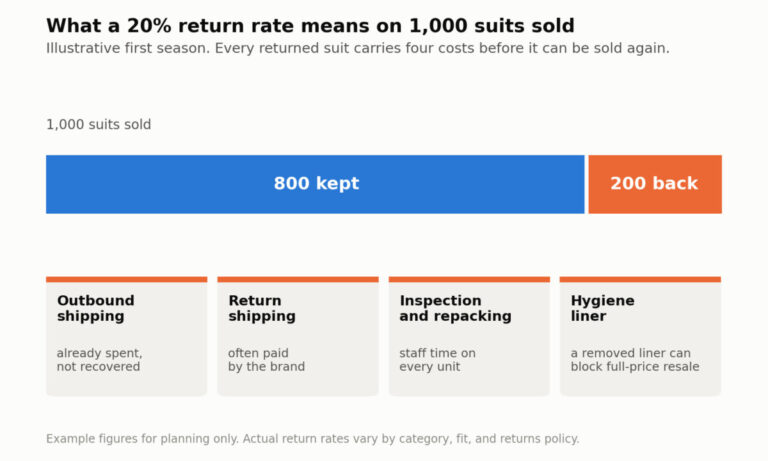
Price returns into the cost sheet before launch, because every returned swimsuit costs outbound shipping, return shipping, inspection time, and often the full price resale itself. Illustrative benchmark: a brand that sells 1,000 suits at a 20% return rate gets 200 back. Public benchmarks specific to swimwear are thin, so treat 20% as a planning figure rather than a measured one. The NRF study above puts online returns across all categories at 19.3% of sales, and apparel generally runs above the all category average because fit drives it.
Running that estimate before launch changes decisions upstream rather than after the fact. It shows whether free returns fit the margin at all, whether an exchange first policy makes more sense for a category this fit sensitive, and how much each point of return rate is worth fighting for. Keeping the customer’s money inside the business through an exchange based returns program or store credit is usually a better first move for a new brand than absorbing refund costs on a first run you are still learning from.
Most of that fight happens in the size run. Breadth is how many sizes a style comes in, and depth is how many units sit behind each size. A wide, shallow run reaches more customers but sells out of the middle sizes in the first month, while a narrow, deep run piles up the sizes that move slowly. Extended sizes need their own patterns rather than a graded version of the base. Grading a base pattern straight up tends to distort proportions at the top of the range, and those distorted fits come back. Drafting larger sizes separately adds sampling work, and it almost always costs less than the returns a stretched pattern produces.
The product page does the rest of the work, because an online shopper has no mirror and no second size to grab. A measurement chart for each style does more than a single sitewide chart, since cuts fit differently. The model’s height and the size being worn let a shopper translate a photo to their own frame. Fabric content, lining, and the return policy belong on the page before checkout rather than in an email after it. The same pattern shows up across conversion work on fashion product pages, where fit information placed above the imagery consistently does more for both conversion and return rate than another photo angle.
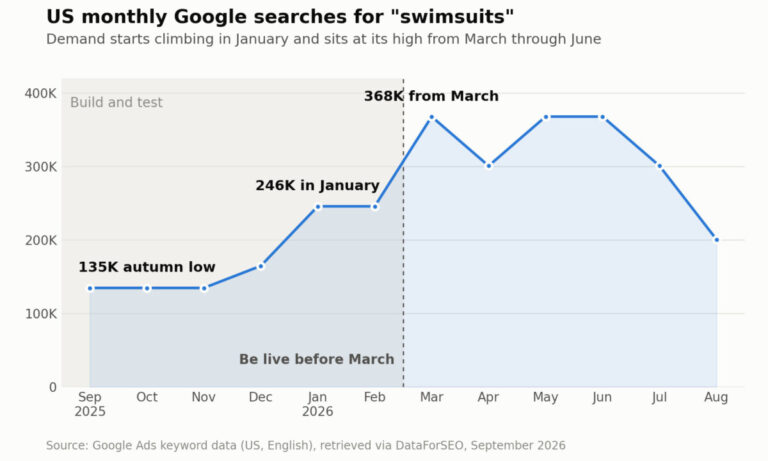
Have product pages live and indexed by March, because US demand for swimwear climbs long before the weather does. Monthly search volume data from Ahrefs for the United States puts searches for “swimsuits” at about 34,700 in October 2025, rising to 73,300 in January 2026, reaching 116,300 in March and peaking near 166,000 in June. That is a swing of roughly five times from trough to peak. The pattern repeats on more specific terms: “one piece swimsuit” moves from about 18,000 in October to 89,300 in June, and “swimwear” from 8,800 to 39,700 over the same window.
The shape of that curve is worth checking for your own product keywords in Google Trends before you commit to a date, since a cover up brand and a competitive swim brand do not peak in the same week. The conclusion for most founders is the same either way. A first season needs to be live and indexed by March, not May. By the time summer heat arrives, the shoppers who planned ahead have already bought, and a page published in June is competing for the back half of a curve that is already falling.
Working backward from a March launch gives a usable calendar.
Slippage anywhere in that chain pushes stock into the late part of the curve, where it either waits a full year or gets discounted to clear. Building two or three weeks of slack into the freight and photography steps costs far less than either outcome. The two steps that slip most often are the second sampling round and product photography, because both depend on other people’s calendars.
Use Shopify pre-orders to size the bulk order by style and by size, because a deposit is a firmer demand signal than a waitlist sign up. Shopify’s own documentation states that merchants can sell products that are out of stock or not yet available, and can collect full, partial, or no payment at the time the order is placed. Shopify positions pre-orders explicitly as a way to forecast demand for a new product before release.
Two practical constraints are worth knowing before you build the plan around it. Pre-orders require a pre-order app from the Shopify App Store to display pre-order details on the product page, and they cannot use accelerated checkouts such as Shop Pay, Apple Pay, or Google Pay. Neither is a blocker at first season scale, but both affect how the storefront and the checkout experience get set up.
The useful output is the breakdown, not the total. Pre-orders by style and by size show which pieces deserve deeper stock and which should be cut before the bulk order is placed. Shopify’s guidance on using preorder results to set purchase order quantities makes the same point: results by product variant give a store a basis for deciding how much stock to order. If you have not run a pre-order campaign before, the mechanics of using pre-orders to validate a product before manufacturing it cover the campaign side that the documentation does not.
Pre-order customers also need honest timing. A clear ship date on the product page, repeated at checkout and in the confirmation email, keeps early buyers from becoming the first wave of cancellations. A first swimwear season rarely rewards the brand with the most styles. It rewards the one that launched early, stocked the sizes people actually ordered, and priced its returns before they arrived. Every one of those is a spreadsheet decision made months before the first suit ships.
Plan on 500 to 600 units for a first swimwear run, not the 1,500 or more that a wider assortment forces on you. The number is set by your factory’s minimum per style and per color, not by your sales forecast. A plan of five styles in one color against a 100 unit minimum lands at 500 units. The same minimum applied to eight styles in two colors lands at 1,600 units, which is roughly 1,100 extra units of cash committed before you have a single week of sell through data. Ask whether the factory reduces minimums on stock fabric colors or for a first run, because that one answer often decides whether a narrow launch is affordable.
Blank customization is cheaper upfront, and it costs you control over the thing swimwear customers complain about most. Starting from an existing base suit and adding prints, trims, or labels avoids pattern fees, cuts sampling rounds, and usually carries lower minimums. Custom development gives you original patterns and full control over fit and fabric, at the cost of pattern fees, more sampling, and higher minimums. The practical sequence for a founder under $50K is to open on blanks, find out which silhouettes and prints sell, then move the proven sellers onto custom patterns for season two. A brand with capital to deploy is usually better off going custom on two or three styles than blank on six.
There is no reliable public benchmark for swimwear specifically, so plan with 20% as an illustrative figure and measure your own as soon as you have data. The National Retail Federation and Happy Returns put online returns across all retail categories at 19.3% of sales in 2025, with overall returns at 15.8%. Apparel generally runs above the all category average because fit drives returns, and swimwear sits at the difficult end of apparel: fit is unforgiving, and a suit returned with the hygiene liner removed often cannot be resold at full price. Model the cost per return including outbound shipping, return shipping, inspection, and lost resale value before you set a returns policy.
Product pages should be live and indexed by March, which means working backward to a bulk order placed around November. US search volume for “swimsuits” sits near 34,700 a month in October, climbs to roughly 73,300 in January, reaches 116,300 in March and peaks near 166,000 in June. A store that publishes in June is competing for the back half of a curve that is already falling. Working backward from March: photography and product pages finished in February, stock landing in January or early February, bulk order placed in November, sampling between August and October, and a pre-order demand check in October while quantities can still be changed.
Yes, and the per size breakdown is the part worth having, not the revenue. Shopify supports selling products that are out of stock or not yet available, with full, partial, or no payment collected at checkout, and positions pre-orders as a way to forecast demand for a new release. Running a pre-order window in October and November, before the bulk order goes in, shows which styles deserve deeper stock and which should be cut. A deposit is a firmer signal than a waitlist sign up because the shopper has committed money. Two constraints apply: you need a pre-order app from the Shopify App Store to show pre-order details on the product page, and pre-orders cannot use accelerated checkouts.