

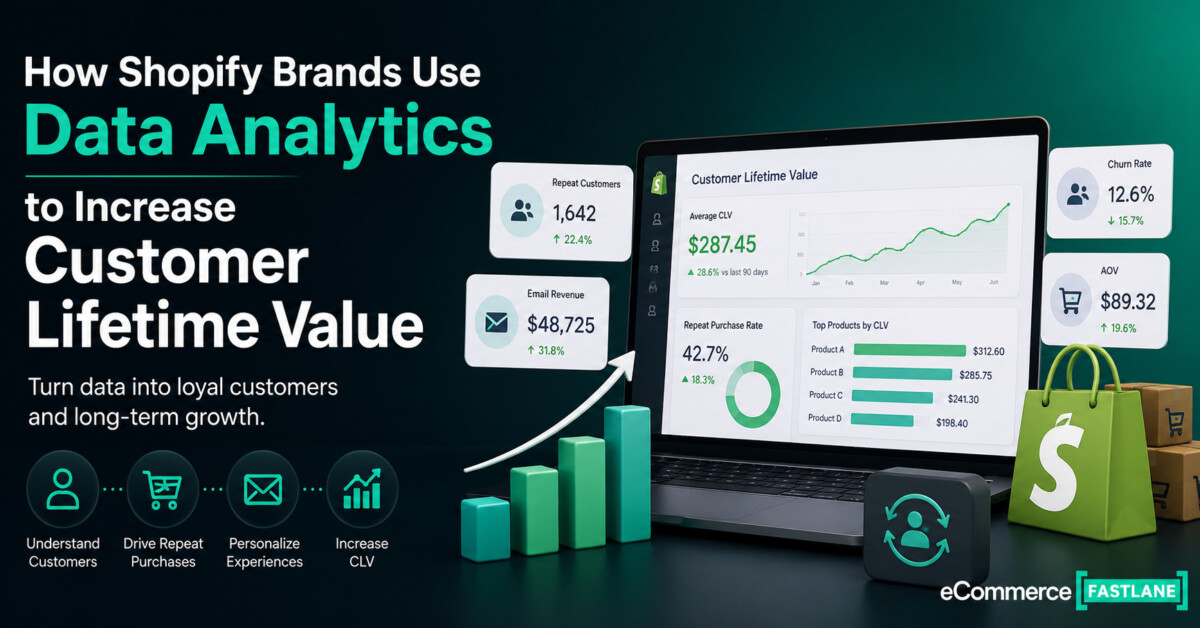
Shopify brands grow customer lifetime value by using existing data, order history in Shopify, behavioral events in Klaviyo, and channel engagement in Meta, to identify repeat-purchase patterns and time outreach to real buying cycles. The leverage at every stage is segmentation discipline, not buying more tools.
The brands quietly beating their categories in 2026 are not winning the ad auction. They are winning the second purchase.
If you ask most Shopify store owners what they want more of, the answer is usually the same: more sales.
But after the first few years, many brands realize something important. Growth does not only come from getting new customers. A huge part of sustainable growth comes from getting existing customers to come back again and again.
That is where customer lifetime value starts to matter.
Customer lifetime value, often shortened to CLV or LTV, is simply the total amount a customer spends with your brand over time. A customer who buys once during a sale is helpful. A customer who buys every few months for three years is what builds a real business.
The good news is that Shopify brands now have access to more customer data than ever before. The challenge is knowing what to do with it.
This is where data analytics changes everything.
Let’s say you run a skincare brand on Shopify.
You spend $40 to acquire a customer through Meta ads. That customer buys a $60 product once and never comes back. After shipping, fees, and product costs, your margin is pretty thin.
Now imagine another customer buys the same product, signs up for email, comes back two months later for a refill, then buys a bundle during Black Friday.
Suddenly, that same $40 acquisition cost becomes far more profitable.
That is why smart Shopify brands are focusing less on vanity metrics and more on retention. They want to know:
Data analytics helps answer those questions clearly.
The funny thing is that many brands already have the information they need.
It is sitting inside:
The problem is that the data is scattered everywhere.
One founder might check Shopify for revenue, Meta for ads, and Klaviyo for email performance, but never connect the dots between them.
That creates blind spots.
For example, a campaign may look profitable based on ROAS alone, but the customers it brings in may never purchase a second time. Another campaign might look average upfront but quietly brings in highly loyal customers who spend thousands over the next year.
Without analytics, both campaigns can appear identical.
One thing successful ecommerce brands do well is pay attention to patterns.
They do not just ask:
“How many orders did we get?”
They ask:
“What are our best customers doing differently?”
That small shift changes everything.
A coffee subscription company might notice customers who buy a sampler pack are three times more likely to subscribe later.
A fashion brand may discover shoppers who purchase within seven days of signing up for SMS tend to become repeat buyers.
A supplement company might realize customers who buy bundles stay active far longer than customers who buy single units.
These insights are incredibly valuable because they help brands guide more customers toward high retention behaviors.
Email is one of the easiest places to see data analytics working in real life.
Years ago, many Shopify brands blasted the same email to everyone.
Now brands segment customers based on behavior.
Someone who purchased once six months ago should not receive the same message as someone who buys every month.
Analytics helps brands understand:
A pet food brand, for example, might know customers usually reorder every 45 days. If someone has not purchased by day 55, an automated reminder email can go out before the customer disappears completely.
That feels helpful instead of spammy because it matches real customer behavior.
Have you ever noticed how some brands seem to recommend exactly what you were already thinking about buying?
That is rarely random.
Smart Shopify brands use analytics to study product relationships and customer journeys.
For example:
When recommendations feel natural, customers buy more often and feel understood.
That emotional side matters more than people think.
Customers stay loyal to brands that feel convenient, personal, and easy to shop with.
A lot of ecommerce founders eventually hit the same wall.
Ads get more expensive.
Margins get tighter.
Customer acquisition costs rise.
That is when retention suddenly becomes a priority.
Keeping an existing customer is usually far cheaper than finding a new one. Data analytics helps brands improve retention without guessing.
One apparel brand might discover customers who receive a post purchase fit guide have lower return rates and higher second purchase rates.
Another brand may learn customers who engage with educational content spend more over time.
These are not huge dramatic discoveries. They are often small patterns that quietly improve profitability month after month.
A few years ago, advanced analytics felt like something only large companies could afford.
That has changed.
Today, even smaller Shopify brands can build strong reporting systems using affordable tools and no code website builder platforms that connect easily with ecommerce apps and dashboards.
You no longer need a full engineering team to understand customer behavior.
That accessibility is changing the ecommerce world fast.
Smaller brands can now make decisions based on actual customer patterns instead of instinct alone.
And honestly, that levels the playing field more than most people realize.
One overlooked area where analytics helps is inventory planning.
Poor inventory decisions quietly hurt customer lifetime value all the time.
If products constantly go out of stock, customers leave.
If slow moving products eat up cash flow, marketing budgets shrink.
Good analytics helps brands forecast demand more accurately.
A beauty brand may notice certain products spike every payday weekend.
A fitness company might see seasonal buying patterns tied to January goals.
A candle company may discover repeat buyers reorder every 90 days almost like clockwork.
Those insights help brands stay prepared without overstocking.
People are overwhelmed with marketing messages now.
Most consumers ignore generic promotions because they feel mass produced.
But personalized experiences still work.
Not creepy personalization.
Helpful personalization.
Things like:
When done properly, personalization makes customers feel recognized instead of targeted.
That emotional connection increases loyalty far more than endless discount codes.
One thing people sometimes forget is that analytics is really about understanding people better.
Behind every dashboard is a real customer.
Someone bought your product because they hoped it would improve something in their life.
The brands that grow long term are usually the ones that listen carefully to customer behavior instead of treating people like numbers.
Good analytics simply helps brands listen more clearly.
As brands grow, analytics can become harder to manage internally.
Data starts living across dozens of platforms. Reporting becomes inconsistent. Teams disagree on which numbers are accurate.
That is why some brands eventually work with specialists in data analytics service to centralize reporting and build cleaner decision making systems.
Instead of manually stitching together spreadsheets every week, they create dashboards that give the whole team a clearer view of the business.
This becomes especially important once brands scale across multiple sales channels.
One of the smartest things a growing ecommerce brand can do is build systems early.
Not overly complicated systems.
Just clear, reliable processes.
The best brands usually:
Some companies even work with technical teams like data analytics managed services, when building more advanced reporting systems tied to operations, forecasting, and customer insights.
The goal is not complexity.
The goal is clarity.
Customer lifetime value is not improved through one magical tactic.
It grows through hundreds of small improvements:
Data analytics simply helps Shopify brands see those opportunities more clearly.
The brands winning today are not always the ones spending the most money on ads.
Often, they are the brands paying the closest attention to their customers.
And honestly, that is probably how it should be.
Customer lifetime value is the total amount a customer is expected to spend with your Shopify store over time. It helps brands understand long term profitability instead of focusing only on first purchases.
It helps businesses understand how valuable customers really are over time. Brands with strong customer lifetime value usually grow more sustainably and rely less on constant ad spending.
Data analytics helps brands understand customer behavior, buying patterns, churn risk, and repeat purchase timing. This allows businesses to create smarter marketing and retention strategies.
Yes. Modern ecommerce tools make analytics much more accessible than before. Even smaller brands can track customer behavior, email performance, and repeat purchase trends without large technical teams.
Brands should also monitor:
These metrics provide a more complete picture of business health.
Personalized experiences help customers feel understood and supported. Relevant product recommendations, refill reminders, and loyalty rewards often encourage repeat purchases and long term loyalty.
Common tools include Shopify Analytics, Google Analytics, Klaviyo, Triple Whale, Looker Studio, Recharge, and customer data platforms that centralize reporting.
Not at all. Smaller brands often benefit the most because analytics helps them make smarter decisions with limited budgets and resources.
Customer lifetime value is the total gross profit a Shopify brand expects to earn from a customer across all their purchases over the relationship. CLV is measured by combining average order value, repeat purchase rate, and gross margin across the typical customer relationship horizon (often twelve to thirty-six months in DTC). A brand with $80 AOV, 35% gross margin, and a customer who buys an average of 3.2 times in eighteen months has a CLV of roughly $90 in gross profit. Comparing that figure to acquisition cost is the unit-economics test that decides whether the brand can grow profitably or only grow.
CLV is more important than ROAS in 2026 because rising paid acquisition costs have pushed the breakeven point past the first purchase for most Shopify brands under $5M annual revenue. ROAS only measures the first transaction. A campaign with a 2.5x first-purchase ROAS can still be unprofitable if the customers it acquires never reorder. CLV captures the second purchase, the third purchase, and the resulting payback math. Brands optimizing only for ROAS often discover after six months that the campaigns delivering the best ROAS are the ones bringing in the worst long-term customers. CLV catches this earlier.
Data analytics improves customer retention by surfacing the behaviors, time windows, and product combinations that separate one-time buyers from repeat customers, so brands can send the right message at the right moment. Practical examples include identifying the typical reorder cycle for each SKU (45 days for pet food, 60 days for skincare), spotting which post purchase email behaviors predict a second order, and flagging when a customer crosses their usual repurchase window without buying. Each of these patterns is observable in tools the brand already uses. The work is asking the right questions of the data, then building retention flows around the answers.
Yes. A small Shopify store can run an effective analytics practice using Shopify’s native reports, Klaviyo’s behavioral data layer, and a single weekly review cadence. At $10K to $50K monthly revenue, the minimum viable analytics stack is Shopify Analytics plus Klaviyo plus a Google Sheet that tracks four numbers each week: new customer revenue, returning customer revenue, repeat purchase rate, and email-attributable revenue. This costs nothing beyond the platforms the brand already uses, and the weekly review takes thirty minutes. The discipline of looking at the same four numbers consistently produces more retention insight than a $500 monthly customer data platform reviewed quarterly.
Shopify brands should track customer lifetime value, repeat purchase rate, average order value, 90-day churn, email-attributable revenue, and customer acquisition cost as the core retention set. Together these metrics produce a complete picture of unit economics. CLV and CAC determine whether the business is profitable on a customer basis. Repeat purchase rate and 90-day churn show whether retention is moving in the right direction. AOV and email-attributable revenue identify the highest-leverage levers for raising CLV without raising acquisition cost. Brands tracking only ROAS see one slice of the picture and miss the slices where retention and profit actually compound.
Personalization increases CLV when it uses real behavioral data to time helpful messages, not when it adds a first name to a subject line. Effective personalization shows up as replenishment reminders timed to actual reorder cycles, product recommendations built on observed adjacencies in the brand’s own order data, lapsed customer reactivation triggered at the right window, and VIP recognition for top spenders. Each of these uses what the customer has done, not what the brand assumes about them. Surface level personalization, dynamic first name fields, or generic browsing-based recommendations tend to register as marketing noise and do not move CLV.
Shopify brands typically combine Shopify Analytics, Klaviyo, Triple Whale or Lifetimely, Recharge, and Looker Studio or a similar dashboard layer, with the exact mix shifting by stage. At $10K to $50K monthly, Shopify plus Klaviyo plus a Google Sheet is enough. At $50K to $500K, a dashboard layer like Triple Whale or Lifetimely earns its place by consolidating Shopify, Klaviyo, and Meta into one weekly view. At $500K to $2M, brands often add a more structured BI layer (Looker Studio, Hex, or a custom data warehouse) and a retention specialist who owns the reporting cadence. The tool list is downstream of the operational stage.
Bring in outside analytics help once data lives across more than four platforms, weekly reporting consumes more than two hours, or your team disagrees about which numbers are correct. The threshold is operational complexity, not revenue. Some $300K monthly brands need outside help because their data is fragmented across Shopify, Klaviyo, Meta, Recharge, Gorgias, and a loyalty platform with no shared definitions. Some $3M monthly brands do not need outside help because their internal operator built clean reporting habits from the start. The signal that triggers the search is the cost of the disagreement: when the founder, the operator, and the marketer pull from different tools and arrive at different versions of the truth.





