

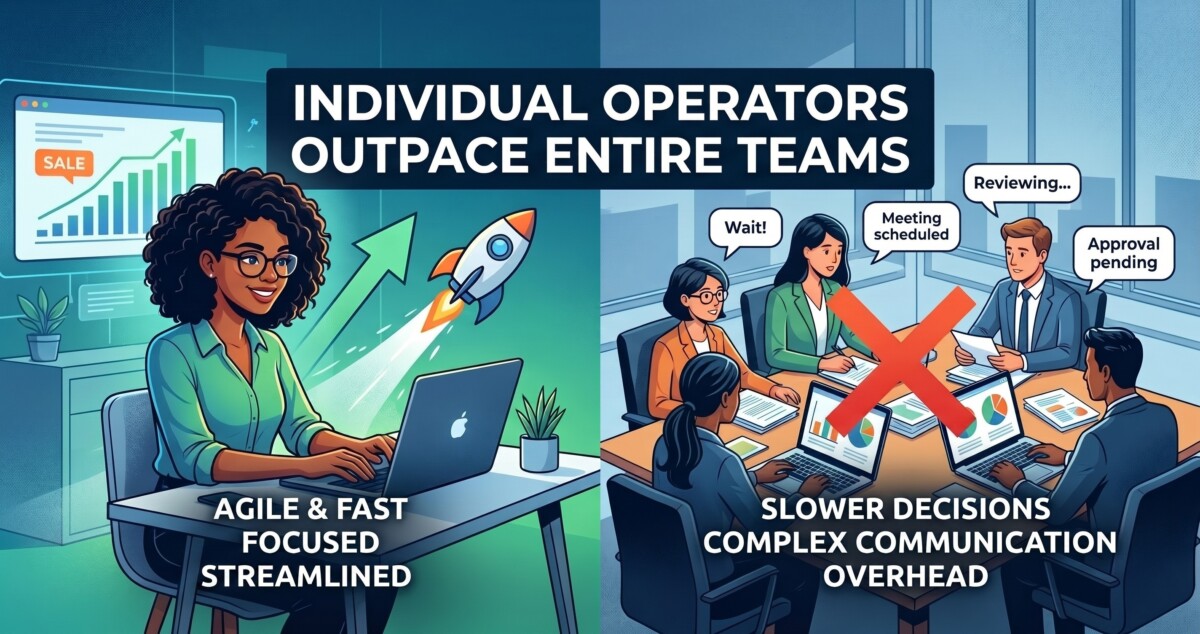
The brands hardest to compete with in 2026 are not the ones with the biggest teams or the loudest paid presence. They are the ones AI systems have something specific to say about, while their competitors are still treating brand differentiation as a marketing exercise instead of a data problem.
The question I keep hearing from Shopify merchants in 2026 is some version of “do I need to hire?” More support staff. More marketers. More ops help. The honest answer for most brands at the $100K to $5M stage is that headcount is not the constraint right now, and acting like it is means missing the more important question.
This piece draws on a sharp observation from Shane H. Tepper, cofounder of Resonate Labs, a company that helps B2B businesses analyze and improve how they get represented inside AI-driven discovery systems. Tepper calls the moment we are in the Peak Merchant window, and the framing matters because it captures something most ecommerce coverage is missing: the leverage individual operators have right now is real, but it is also temporary, and the operators who treat it as permanent are going to lose their lead inside 18 months.
The shift underneath all of this is simple. Execution has been compressed. Production has been compressed. What remains as a real moat is something most brands have not built yet: clarity that AI systems can read, extract, and cite.
The Peak Merchant window is the brief period right now where individual operators with sharp positioning, clean structured data, and AI-readable brand signals can outperform larger teams that are still optimizing for execution speed and paid reach. It exists because the leverage tools that used to require a team have collapsed in cost and time, while the discovery layer itself has shifted faster than most operators have noticed.
Tepper captures the compression directly: a seasonal product shoot that cost a Shopify brand five to ten thousand dollars and three weeks of calendar time in 2024 now produces hundreds of on-brand visuals in an afternoon for around fifty dollars in AI credits. That same collapse has happened across copy, lifecycle flows, product page production, and frontline support. What used to require a team now sits with a single operator directing systems instead of producing assets.
The leverage is real. The trap is assuming the leverage is the moat. It is not. Every brand in your category gets the same compression at the same time. Twelve months from now, the brand whose creative production looked exceptional in late 2025 will look identical to four competitors who picked up the same tools. The window where execution itself was a differentiator is closing fast.
What replaces it is harder to fake and slower to catch up to: brand clarity that AI systems can extract, cite, and recommend without ambiguity.
Execution stopped being a moat the moment AI tools made high-quality output broadly accessible across an entire category at the same time. When the gap between average and exceptional collapses, the variable that determines which brand a customer chooses moves upstream from production quality to brand recognition, and from brand recognition to whether the buyer’s AI assistant has anything specific to say about you.
The lookalike store problem most operators associate with low-effort dropshipping has now expanded into legitimate brands with real teams and real products. The convergence shows up in three places that matter for ecommerce: Klaviyo flows across brands in the same category have started using identical structural moves, product detail page copy is converging into the same vocabulary and pacing, and hero imagery has a recognizable generative aesthetic that signals AI-assisted production at a glance.
None of this is intentional. It is what happens when an entire category gains access to the same tools and applies them to the same problems. Outputs converge. Customers lose the ability to distinguish between brands. And the decision-making process moves to whichever channel can still differentiate brands at scale, which increasingly is AI.
For founders who built their brand in the last cycle on creative quality, faster shipping, and tighter funnels, this is uncomfortable to read. Those advantages were real. They are also no longer enough on their own.
AI-driven product discovery has shifted from a curiosity to a primary acquisition channel inside 18 months, and the brands that show up in AI-generated answers are not the ones with the biggest budgets but the ones whose data is most extractable. According to Adobe Digital Insights, AI-driven traffic to U.S. retail sites grew 393% year over year in Q1 2026. That is not a trend signal you can plan around. That is a structural shift already in progress.
The behavior of that traffic is more interesting than the volume. Similarweb data shows 35% of consumers now use AI at the product discovery stage, with meaningful usage continuing through evaluation and purchase. And the conversion math has flipped completely. In March 2025, AI-driven retail traffic converted 38% worse than traditional channels. By March 2026, it converted 42% better. A complete reversal in 12 months.
The reversal is happening because of how AI users behave. They do not arrive to browse. They arrive to confirm a recommendation the AI already made. They have read the comparison. They have seen the trade-offs. They have a shortlist. The visit to your store is the verification step, not the discovery step.
What this means operationally is that the brand AI systems learn to recommend sets the frame for everything the buyer does next. By the time the buyer lands on a competitor’s product page, the recommendation you earned upstream is doing more work than any retargeting flow you could run. The corollary is harder. If you are invisible to AI search, you are not in the comparison set. Paid traffic can still buy attention, but it cannot buy you into a recommendation that already happened before the buyer was on the open web at all.
AI systems cite specific, extractable, machine-readable claims and skip vague positioning language entirely, because their job is to assemble defensible answers and vague claims are not defensible. This is the single most important shift in brand language since the SEO-keyword era, and most Shopify brands are still writing for humans skimming product pages instead of for the systems that determine whether humans ever see those pages.
Tepper puts the principle cleanly: industry-leading materials tells a language model nothing. Recycled nylon shell sourced from post-consumer fishing nets gives the model something to extract, attribute, and reuse in a recommendation.
The pattern repeats across every category. AI systems are constantly choosing between vague language they cannot defend and specific claims they can stand behind, and they consistently choose the second. Below is what that looks like in practice for a Shopify brand:
For Shopify merchants, this is where individual operator advantage shows up most clearly. Rewriting product descriptions to be specific, factual, and extractable is methodical work. It is the kind of work that gets perpetually deprioritized inside a team because it is not glamorous and does not show up in this week’s revenue. A focused operator can run that rewrite on a rolling schedule across the top 20% of SKUs by revenue and produce a structural improvement in AI-readable signal that compounds across months.
The three-step playbook for capturing AI visibility before your competitors do is technical readability first, visibility audit second, and AI-extractable content production third, in that exact order. Most operators reverse the sequence and start with content, which is why most AI optimization efforts produce no measurable visibility lift.
Before any content work, confirm that AI crawlers can actually access and parse your site. Many Shopify storefronts have key product information hidden behind client-side rendering, blocked by default robots configurations, or buried inside JavaScript that AI crawlers do not execute. The result is a brand that is technically online but functionally invisible to ChatGPT, Perplexity, and Google AI Overviews. Audit your robots.txt and llms.txt files, validate your structured data using Schema.org markup on every product, and confirm that critical content renders server-side. This is not optional. Every other step in the playbook depends on it.
Run 15 to 25 structured queries across ChatGPT, Perplexity, Claude, and Google AI Overviews using the exact phrasing your buyers use. Best running shoes for wide feet under $150. Most sustainable workout apparel for women. Best electric toothbrush for sensitive gums. Document who shows up, in what order, with what claims attached. In most cases, the audit reveals the same three patterns: your brand is absent from key comparisons, present but described incorrectly, or present but described less compellingly than competitors. Each pattern points to a different fix.
Manual queries are the right starting point. If you want to scale beyond ad-hoc testing, the current generation of LLM monitoring tools automates query tracking and benchmarks you against direct competitors weekly, which is the difference between a one-time audit and an actual visibility program.
The content layer is what AI systems actually cite. This is the discipline of answer engine optimization for ecommerce, and the principles are different from traditional SEO content production. That means claims libraries with specific, defensible data points. Detailed product specifications written in clean factual language. Transparent comparison content that names competitors directly. Founder perspectives and expert commentary that AI systems can attribute by name. This is not more content. It is different content, designed from the start to be extracted and reused inside an AI-generated answer rather than to rank in a list of blue links.
Your stage matters here, because the right first action is not the same for a $100K brand and a $5M brand. The grid below maps the realistic first move at each revenue tier:
The pattern across stages is the same: invest in the structural layer first, then the content layer, then the operational layer that maintains both. Reversing the order is the most common mistake I see merchants make, and it is the reason most AI visibility work produces no measurable lift.
The Peak Merchant window will close inside the next 18 to 24 months, not because AI discovery becomes less important, but because the techniques being used to capture it now will become standard practice across the category. When every brand has structured data, AI-extractable content, and a documented visibility strategy, the operators who established their narrative early will keep the citation share they earned, and the operators who waited will be in the same competitive position they currently occupy on traditional search: paying to catch up to a field that already established its authority.
The brands building that foundation now will have a structural advantage the rest of the category will spend the next two years trying to catch up to. That is the real argument for moving in 2026 rather than waiting for ROI to be proven by someone else. Brands that wait until 2027 will be looking at hiring AEO marketing agencies to do retroactively what early movers built once and kept. The cost of catching up is always higher than the cost of moving early, and AI visibility is no different.
For Shopify merchants reading this, the operational question is not whether AI visibility matters. It does, and the data is no longer ambiguous. The question is whether you act on the window while it is open or wait until your competitors have proven the math for you, at which point the cost of catching up will be measured in years rather than weeks.
The brands that move now do not need a larger team or a bigger budget. They need a sequence: technical readability, visibility audit, content built for extraction. Run that sequence over the next 60 days and you will have moved further on AI visibility than 80% of the brands in your category.
The Peak Merchant window is the current period where individual Shopify operators with sharp positioning and AI-readable brand signals can outperform larger teams in AI-driven discovery, before those techniques become standard across the category. It matters because AI-driven retail traffic grew 393% year over year in Q1 2026 according to Adobe, and that traffic now converts 42% better than traditional channels. The window is real, the math has flipped, and the operators who act on it before competitors will hold the citation share they earn for years afterward.
AI-driven traffic arrives further down the funnel because the buyer has already read comparisons, evaluated trade-offs, and built a shortlist before clicking through. They do not browse. They confirm. That is why AI traffic now converts 42% better than traditional channels in Q1 2026, a complete reversal from a year earlier when it converted 38% worse. Practically, this means AI visibility is doing the work that paid acquisition and retargeting used to do, and the brand named in the AI response captures the buyer before any competitor gets a fair shot at the comparison.
Start by validating that your product content renders server-side rather than through JavaScript that AI crawlers do not execute. Add Schema.org structured data to every product page covering name, brand, price, availability, and detailed specifications. Audit your robots.txt and add an llms.txt file that explicitly welcomes AI crawlers to your site. Confirm that key product details appear in the raw HTML when you view source, not just in the rendered page. Most Shopify themes handle this correctly out of the box, but apps that inject content client-side often break it without the merchant realizing.
AI systems cite specific, extractable, defensible claims and skip vague brand language. That means detailed product specifications, named materials and components, specific performance numbers, third-party certifications, founder commentary attributed by name, transparent competitor comparisons, and dated review counts. Industry-leading materials gives the model nothing to work with. Recycled nylon shell sourced from post-consumer fishing nets gives the model an extractable, citable claim. Build your content to be quotable inside an AI-generated answer, not just readable on your site.
Hire when the work has become genuinely non-routine at scale, when channel complexity outpaces what one person can maintain with quality, or when the founder’s time has become the direct constraint on revenue-generating work. Hire after the operating system is designed, not before. Adding a team member to a brand with inconsistent catalog data, no AI visibility strategy, and a fragmented brand voice does not fix those problems. It adds coordination overhead to issues that should have been solved with systems first. The right sequence is operating system, then automation, then headcount.




