Illustration by Diego Blanco
Influencer marketing is expected to generate $13.8 billion in 2021, with 67% of brands using Instagram for this type of marketing.
Instagram has over one billion monthly active users, which makes it a leading choice among businesses when it comes to influencer marketing. Add to this the fact that influencer marketing generates an average return on investment (ROI) of $5.78 for every dollar spent and it becomes easy to see why so many ecommerce brands are putting it to work.
If you’re still sitting on the sidelines and feeling unsure of how to approach Instagram influencer marketing for your ecommerce brand, you’re in the right place.
In this post, we’ll dive deep into how ecommerce brands can take advantage of influencer marketing on Instagram.
We’ll cover:
Brands invest in Instagram influencer marketing because it works. Data shows that, on average, businesses generate $6.50 in revenue for each $1 spent on influencer marketing via Instagram.
Take the example of Daniel Wellington, a luxury watch and jewelry brand that grew to over $180 million in just under five years—all via Instagram influencer marketing.
It makes sense: Instagram influencers are modern celebrities. As a result of years of nurturing their audiences, these influencers have built large followings within their niches. These followers then trust the influencers’ recommendations when it comes to products, which then leads to sales.
Influencer marketing on Instagram, then, is a strategy brands can invest in to promote their products by partnering with Instagram influencers who align with their audiences and goals.
There are quite a few benefits ecommerce brands can expect to achieve with Instagram influencer marketing:
A solid rule of thumb is to approach Instagram influencer marketing when your product is ready and your existing customers love it. In other words: when you have product-market fit. Without a proven product, measuring the success of your campaigns can be challenging.
“Influencer marketing isn’t direct response, although it can lead to direct sales,” says Shama Hyder, CEO & founder of Zen Media. “You have to play the long game. The more you invest in your brand, the more it pays dividends.”
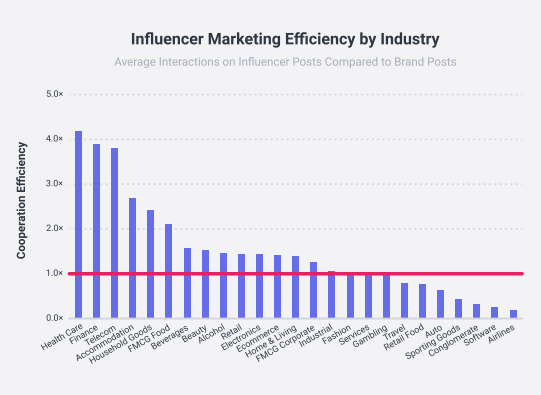
Most brands with a proven product can benefit from influencer marketing, but the efficiency varies depending on the industry.
The answer to this question is not a cut-and-dried one. It depends on the number of influencers you want to work with as well as the niche you choose.
The cost depends on several factors, such as:
On average, you can expect to pay these ballpark rates based on the influencer’s follower count:
Other reports indicate slightly different averages that vary by audience size and content type:

The bottom line: The larger the audience, the larger the price tag.
If the benefits aren’t convincing enough for you to consider Instagram influencer marketing, here are some additional statistics that illustrate the current state of this market:
Keep in mind that Instagram influencer marketing is ever evolving. Staying on top of trends, privacy changes, and data policies is essential.
User privacy changes from Apple and Google heightened the need for brands to work with first-party data. Every marketer should use influencer or affiliate marketing platforms powered by first-party tracking technology that enables accurate attribution. The right technology partner helps brands report accurate ROI and cultivate a trusting relationship with their influencers with accurate and on-time commission payments.”
—Raj Nijjer, CMO of Refersion
Now that we know the growth opportunities and importance of Instagram influencer marketing, let’s look at how you can get started with it.
Sixty-one percent of marketers agree that it’s difficult to find the right influencers for a campaign. This is not surprising considering the number of influencers out there.
Joel Contartese, Marketing Director at Instaco, has managed over $10 million in influencer spend. He shared that the numbers around influencer marketing can be surprising:
The one thing you absolutely must know about influencer marketing is that the numbers don’t always tell the whole story. After spending millions on ‘celebrities,’ I’ve seen better results from influencers with a smaller but much more niched following than from the widely popular ones.”
Much of a campaign’s success depends on product/partner fit … which is what we’ll look at next.
Brands first need to have clarity around goals before approaching influencers. Influencers should only come into the picture once there is a clearly defined persona identifying target audience demographics, following size, etc.
When it comes to finding the right influencers, there are three factors you need to consider:
Brand fit is the most crucial thing to look for in an influencer, as you want to partner with someone who reflects your brand values and ethos. By working with an influencer who aligns with your brand, partner content is more apt to authentically connect with the audience.
Brands should prioritize efficient, high-quality creator discovery with large opt-in creator networks. An opt-in creator network of prequalified partners is a key tool for rapidly identifying the right creators for campaign work. Brands can proactively discover influencers, searching by data points such as audience size, geography, niche, etc.”
—Blaire Kang McClure, Associate Product Marketing Manager at Impact
So, how do you determine if an influencer is relevant to your brand? Consider these methods:
The “influence” of an influencer is often defined by how their audience engages with them. Don’t be fooled by the engagement an influencer gets on an average post—the engagement rate on sponsored posts tends to be on the lower end of the spectrum.
To establish a more accurate engagement rate, follow these steps:
Unfortunately, this number will not give you the true “reach” of the post (which is calculated by adding the likes, comments, and saves divided by the follower count), as this data is not public. But even without the data, this approach can help you more accurately discern an influencer’s engagement averages.
Travis Hawley, VP of Business Development and Partnerships at Viral Nation, explains this well:
“Some influencers can get people to like or comment easily. Some can’t. Some can get people to take social action: follow, screenshot, or repost. Some can’t. And some can actually get people to click and buy. There are different kinds of influence, different levels of engagement.”
Also keep in mind that, compared to macro-influencers, micro-influencers tend to generate better results for brands. Bigger isn’t necessarily better in the influencer world.
Getting to know an influencer’s track record around past partnerships is another way to help you evaluate potential partners. Ask questions like: What kind of brands did they partner with in the past six to 12 months? Do they maintain consistency around the type of sponsors they work with?
These insights will help you find highly relevant partners that do quality work.
Next, it’s time to do some outreach. If your brand aligns with the influencer’s values, many will happily work with your brand—sometimes with a monetary payment, sometimes without it.
Here are three popular ways to pay an influencer:
There’s no perfect way to determine influencer compensation; it will depend on the size of the following, engagement rate, and several other factors. However, if you’re working with a tight budget, you can still partner with an influencer. Leverage other options like product seeding and reaching out directly.
Here’s how Zach Benson, founder of Assistagram, suggests going about it:
“Start with a direct Instagram message. Just let them know that you’re interested in working together. Keep your DM short, clear, and conversational. Include the relevant accounts, a direct request, and your trade.”
Here’s one of the messages Benson used in the past:

That simple DM led to a host of micro-influencer posts, like this one:

In other cases, taking a more personalized approach may be the way to win over partners.
Leverage the recent movement of the creator economy by working with influencers on a deeper level than just paying or gifting for posting their products. Consider doing a curated bundle collaboration where influencers can pick their favorites from existing products or, if the budget and time allow, consider a capsule collaboration where influencers can sell a product that they worked with you on. Brands will see greater engagement because the products are more relevant to their audience, and creators will get the chance to be a part of something bigger.”
—Jason Wong, Managing Partner at Wonghaus Ventures
Once you have a list of influencers you want to work with, you need to create a budget for the campaign.
One of the easiest ways to do this is simply allocating 5% to 10% of your annual marketing budget to influencer marketing. Data indicates this is a fairly common practice: 47% of marketers allocate 20% of their marketing budget to influencer marketing, while 11% of marketers dedicate more than 40% of their budget to influencer marketing.
The annual influencer marketing budget you’ve defined will be spread over the year.
From there, it’s time to get more granular. If you want to estimate the cost of a single campaign, start by defining your campaign goals and key performance indicators (KPIs) to track.
Here are some examples of campaign goals and their corresponding KPIs:

Now that you know which KPIs to track, there are two ways you can budget for your campaign:
Let’s start with the first method, which will depend on two metrics:
You can expect to pay between $5 to $10 per 1,000 followers and $0.05 to $0.1 per like based on additional factors.
So, suppose you decide to partner with an influencer who has 10,000 followers and receives 1,000 likes on average. For this example, let’s take the cost per 1,000 followers as $10 and the cost per like as $0.01.
Here’s how you calculate the cost per post:
There you have it—the golden number! Based on the parameters of this example, you can expect to pay $120 per post per influencer.
Assuming you need one post and 10 influencers per campaign, your campaign would cost around $1,200.
Let’s move on to the next method: defining your budget based on your overall marketing budget.
Continuing the above example, suppose your influencer gets 100,000 unique monthly views. There are two factors to consider:
To take a conservative number of 1%, the calculation would be: 100,000 x .01 = 1,000 potential viewers. Of the 1,000 potential viewers, let’s assume 1% will convert.
So, we have 1,000 x .01 = 10 potential buyers.
These are the two important metrics to track.
A customer’s lifetime value (LTV) is the total amount that an average customer would spend on your brand. And the customer cost of acquisition is the amount you spend acquiring that customer.
For example, let’s calculate the LTV as:
So, we get:
Lifetime value = 50 x 0.3 = 15 x 4 months = $60
Now, we have to divide this number by three, because the ideal ratio of customer acquisition cost to lifetime value is 1:3, which means every dollar spent should make you a profit 3 times over.
Cost of acquisition = 60 / 3 = $20
Now that we have the basic numbers in place, we can calculate the final budget. To do this, multiply the cost of acquisition with the estimated number of conversions:
20 x 10 = $200
Thus, $200 is your budget for one influencer. Multiply this with the number of influencers you want to partner with to get the cost of the entire campaign.
According to a Mediakix report, marketers consider measuring the ROI of an influencer campaign to be the biggest challenge. That’s because influencer marketing can give you an illusion of success even if your goals haven’t been met. A post can get a lot of likes, but fail to meet your actual goal of conversions. This is why having clear goals from the get-go is so important.
Using free tools like Google Analytics, a link tracker, and your store dashboard on Shopify is a great place to start. For example, if your aim is lead generation, track metrics like the number of store visits and link clicks.
Other common metrics to track are:
Next, let’s look at a few brands that have successfully put Instagram influencer marketing to work and see what we can learn from them.
Glossier is a makeup and skincare brand that started on social media and has grown to an active and engaged Instagram following of 2.7 million. It offers customizable products and focused on marketing via micro-influencers to develop a cult-like following.
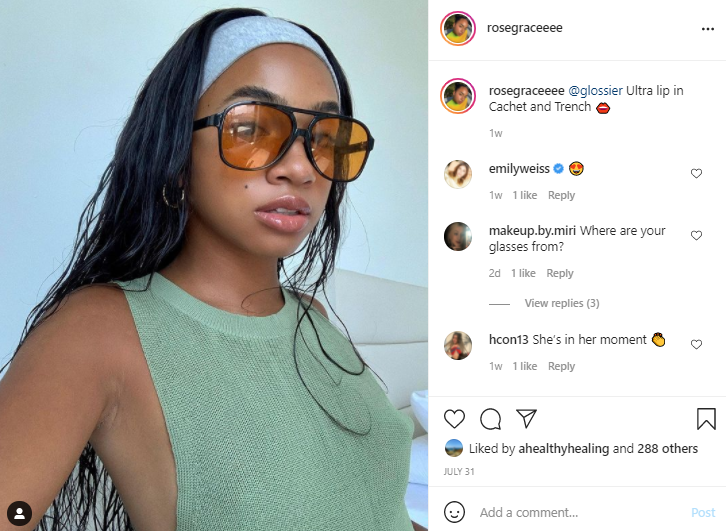
It also gives promotional codes to its influencers, who then get a commission on every product sold via that custom code. With the cross-promotion of content created by influencers, it has curated its Instagram feed with high-quality user-generated content (UGC) that attracts buyers and drives sales.
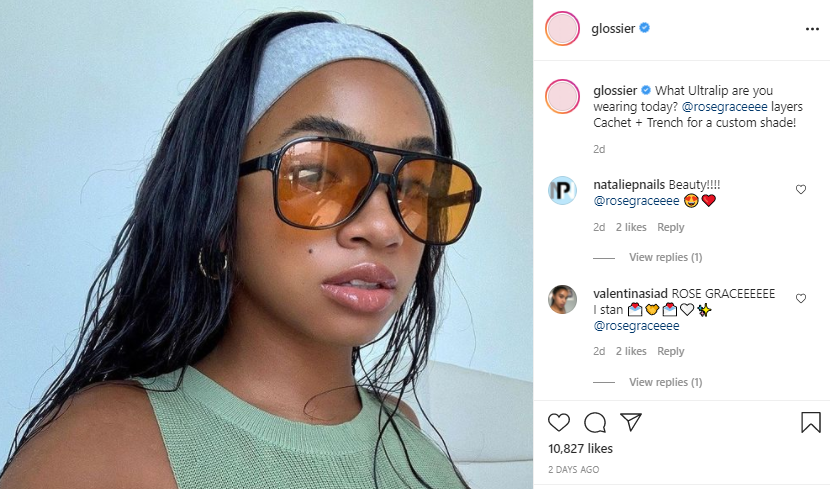
Emily Weiss, the founder of the brand, revealed that 70% of its online sales and traffic comes from peer-to-peer referrals (of which 8% is a direct result of Instagram influencer marketing).
Warby Parker is a direct-to-consumer eyeglass retailer that disrupted the eyeglass industry by offering glasses at a lower price and a try-on-at-home program.
However, influencers remain a huge part of its success. For example, it shortlisted seven influencers for one campaign based on the audience it wanted to attract. The influencers selected had audiences of different sizes (at the time of the campaign):
Warby Parker had clear goals: increasing brand awareness and engagement. Using these KPIs, it was able to measure the campaign results, which were:
Here comes the most interesting bit: Franklin Leonard, the influencer with the least number of followers, generated the highest engagement rate, at 6%.

Again, the largest following doesn’t always mean the best results.
Away, a luxury luggage brand, disrupted its industry by offering direct-to-consumer travel goods.
To reach its target market, it collaborated with a variety of influencers with small, medium, and large audience sizes.
The influencers integrated Away products seamlessly into their content with the help of storytelling around how the products tied into their everyday lives. Unsurprisingly, the posts with a narrative around the product received the most engagement.
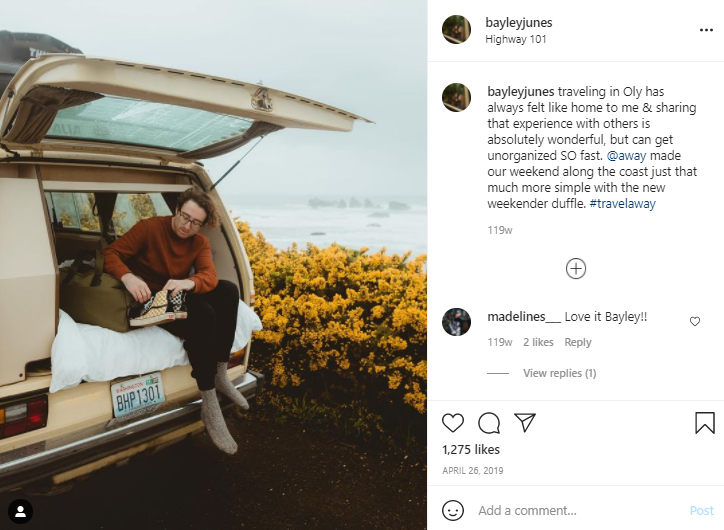
As a result of collaboration with 13 influencers, the brand was able to generate over 58,000 likes with a 5.22% overall engagement rate, thus helping it reach its goal of increasing brand awareness.
Clothing brand Sozy is an advocate of micro-influencer marketing because it found it’s cheaper to manage compared to other types of influencer marketing.
With a budget of just about $900, it has created 35 collabs that generated 100+ photos and 35 short videos. Partnering with micro-influencers has allowed it to scale the campaign even on a strict budget.
The brand sees an increase of 30% to 40% in engagement with influencer-driven UGC over professional content produced for its website. It also has an ambassador program and sends its influencers a store gift card upon acceptance into the program that can be used to purchase items to feature within content.
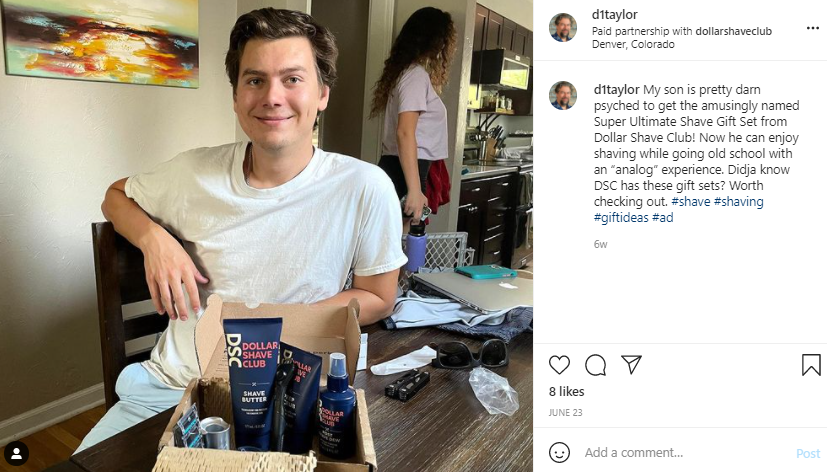
Dollar Shave Club, a personal grooming brand, illustrates the value of choosing the right influencers. The brand generated over 4.6 million impressions with the help of only nine influencers. With over 10,300 clicks driven to its website, Dollar Shave’s influencer marketing campaign has been a huge success.
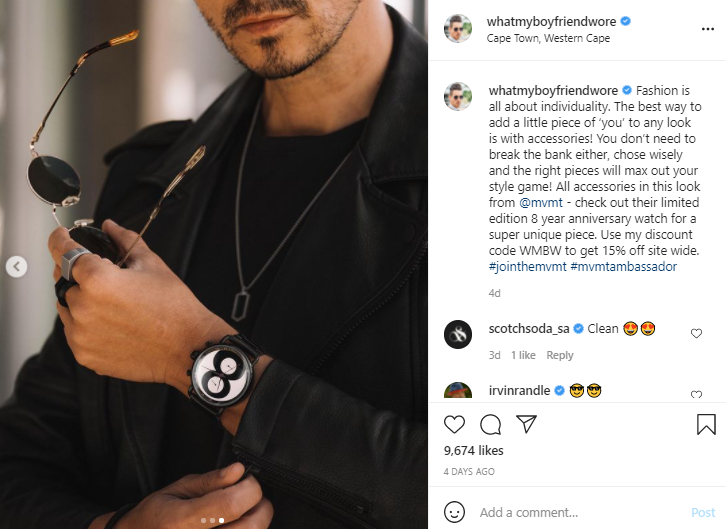
MVMT, a watch accessories company, is an example of a brand using the influencer marketing platform GRIN.
It chose influencers with a following between 30,000 to 500,000 who aligned with its brand qualities for this campaign. Once it realized the potential of influencer partnerships, it shifted to the influencer marketing platform to grow further.
In doing so, MVMT saw 100,000 affiliate code conversions and 39,000 influencer-generated posts as a result of its continued influencer marketing efforts on Instagram.
Instagram influencer marketing is one of the most profitable ways to market your ecommerce store.
While it can be a challenge to initially find the right influencer for your brand, there’s no stopping once you get it right. Influencers look for a long-term partnership with brands, and it pays dividends to stick with the ones that bring you results.
For help with growing your ecommerce store with Instagram influencer marketing, check out our list of Shopify Plus Certified App Partners, where you’ll find the perfect marketing solutions for your business.