


Disconnected ecommerce and POS systems cost the average multi channel Shopify merchant somewhere between two and five percent of annual revenue in lost sales, manual labor, and customer churn, and the fix is a real time inventory integration layer that treats one system as the source of truth and syncs every other channel to it in seconds. Shopify merchants doing $500K to $5M with both an online store and a physical location can typically implement this through native Shopify POS integration plus one or two specialized apps; merchants above $5M with multiple warehouses, wholesale channels, or international fulfillment usually need a dedicated inventory management system sitting between Shopify and their other systems.
The brands that win at omnichannel are not the ones with the most sophisticated tech. They are the ones whose stock count is the same number on every screen at every hour of every day.
Your online store shows 50 units in stock. Your POS says 12. A customer orders 30. Now you have a problem. This is the everyday reality for retailers running disconnected cloud-based systems. Orders get oversold. Staff manually reconcile spreadsheets. Customers receive cancellation emails. The chaos builds quietly until it costs real money.
According to IHL Group’s 2025 research, global retail loses 1.73 trillion USD annually due to inventory distortion. Overstocks and out-of-stocks drive it. Much of that loss ties directly to identify key systems that do not talk to each other. That is why ecommerce integration and POS system integration are no longer optional upgrades. They are operational necessities.
When companies have to manage sales teams across a variety of channels, sound inventory management integration is the core around which everything else revolves.
Integrating inventory systems to run your store, your site, and your warehouse creates more problems than it solves. The gaps between those ERP systems quietly drain revenue every single day.
Disconnected systems do not just slow your team down. They directly impact your bottom line and your customer relationship management.
When your ecommerce and POS platforms do not share data, mistakes happen fast:
Relying on manual updates between systems is slow and error-prone:
There has been a change in customer expectations. Customers no longer make a distinction between the in-store and online experience. They also classify both as working together. As omnichannel inventory management has become a minimum requirement, businesses should provide:
Businesses that are unable to meet these expectations lose clients quickly. And it is a risk no retailer can take in a competitive market.
Understanding the mechanics behind integration helps you make smarter decisions. Here is what happens under the hood when your systems finally work together.
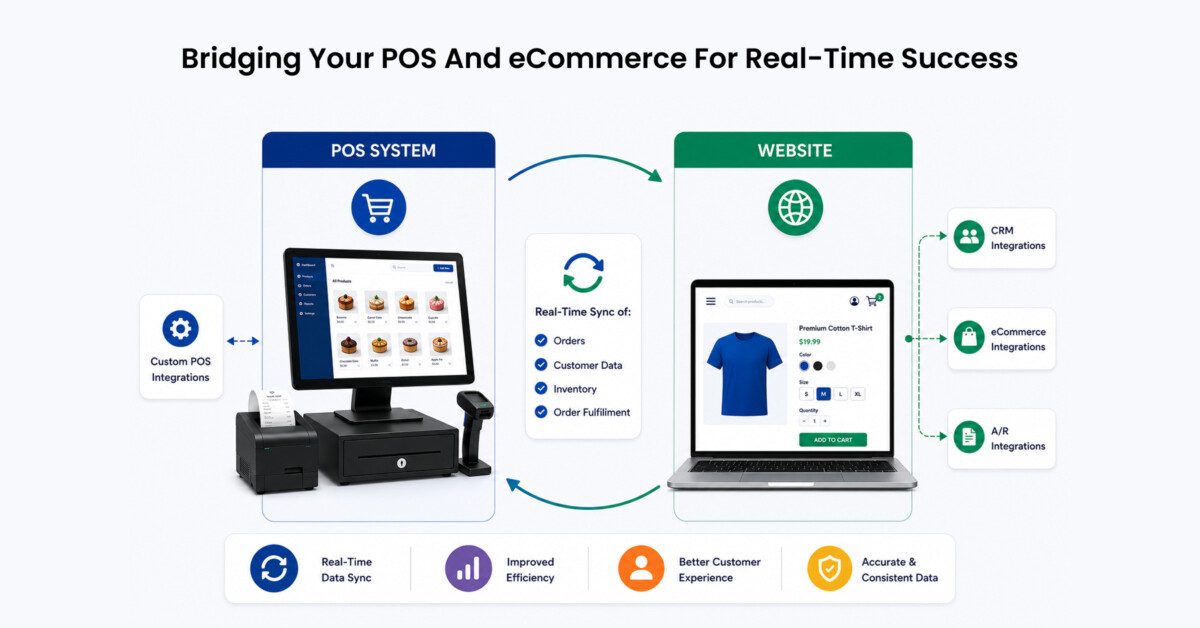
APIs (Application Programming Interfaces) are interfaces that allow two independent systems to share data. The two servers will connect via an API and will therefore respond immediately.
This can be done without affecting your current setup with professional API integration services. A well-built API layer:
APIs move the data. But in what place might that data reside? A centralized inventory management system is an ideal source of truth for your entire business. Each platform, be it your site, your mobile application, or your store, can pull and push to the same data hub.
This eliminates version conflicts. It removes duplicate financial records. And it gives your team one reliable view of stock at all times.
At this location, integration has its most pronounced effect. Because it has real-time inventory updates across multiple channels, each sale, restock, or return is immediately reflected on all platforms. No lag. No manual refresh. No mismatched numbers.
| Scenario | Without Integration | With Integration |
| Item sold in-store | Online store still shows stock | Online store updates instantly |
| Online order placed | POS unaware of stock change | POS syncs in seconds |
| Stock replenished | Manual update required per platform | All channels reflect new stock automatically |
| Return processed | Inventory adjusted on one system only | All platforms updated simultaneously |
This kind of sync is what separates reactive retailers from reliable ones.
Integration does more than fix data gaps. It creates a connected operation where every accounting system works in sync, and the results show up across your entire business.
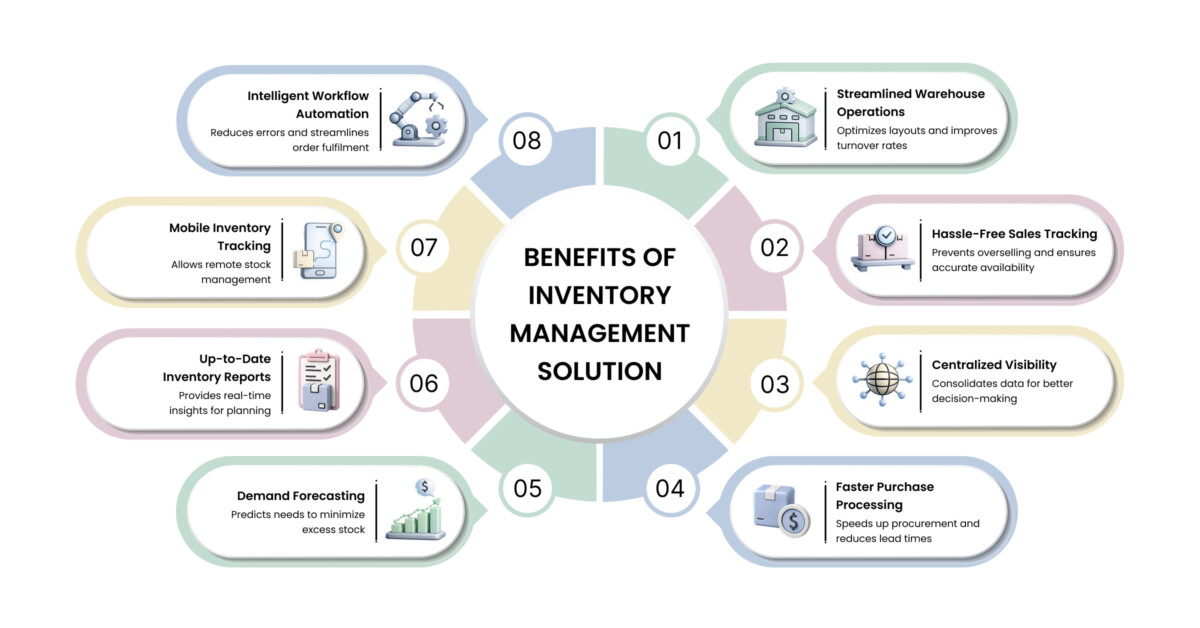
With real-time inventory tracking, your team always sees the current, optimal inventory levels across all locations. No guessing. No manual counts between shifts. You have full inventory control: exactly what is available, where it is, and when to reorder.
Inventory automation for ecommerce businesses removes the delays caused by manual processing. Orders route faster, warehouse management systems and teams act on accurate data, and customers get their products sooner. Speed becomes a built-in feature, not an exception.
As ecommerce inventory management is integrated with your physical store systems, customers receive accurate information at each touchpoint. Omnichannel inventory management means a customer can research online, pick up in a physical store, and drop off at any channel, with no friction.
Divide and conquer. Disconnected systems will create hidden inventory costs. It includes redundant data entry, excessive ordering of materials, and wasted staff time in the reconciliation process. These inefficiencies are eliminated by integration. Store inventory management software that connects across platforms helps businesses reduce excess stock and significantly cut the carrying inventory audits value.
Integrated systems enable decision-makers to have a single, trusted view of inventory system integration performance. The sales trends, reorder patterns, and channel-level customer demand and financial data can be viewed at a single location. This facilitates quicker, more assured decisions regarding purchasing, logistics, and planning.
NetSuite estimates that each team in an organization with disconnected business systems wastes 16 hours a week on manual inventory data syncing and spends over $21,000 per entry-level employee each year on it.
Not all businesses are the same, nor are their solutions. The appropriate integration style will be determined by your system’s size, complexity, and current building method.
Ready-made store inventory software is suitable for smaller, streamlined operations with typical work processes. It has fast deployment times, lower initial costs, and simple common use cases. Off-the-shelf multiple warehouse management tools, however, are limited.
As your channels grow, gaps appear:
For businesses with complex operations or specific workflows, custom retail software development is a better long-term fit. The solution is customized to how your business actually functions, not vice versa.
According to Gartner’s 2025 CIO and Technology Executive Survey, over 80% of CIOs plan to increase investments in seamless integration technologies and APIs in 2025. That indicates a definite change: inventory integration is no longer treated as an afterthought but as a strategic priority. When considering enterprise system integration services, consider the following service capabilities:
The goal is not just connectivity. It is a solid, safe basis on which you can rely for all aspects of your enterprise resource planning ERP.
Inventory integration requirements differ across platforms. Knowledge of how ecommerce and POS inventory systems can be integrated into your current system will help you make the right technical decisions at the outset.
Shopify, Magento, and WooCommerce platforms have API-supported middleware connectors for ecommerce inventory integration. They all interrelate with warehouse management systems, payment gateways, and retail POS system integration layers to ensure excess inventory data is always kept up to date across all sales channels in real-time data.
Other systems, such as Square, Lightspeed, and Clover, are designed for use in a physical store. However, without proper POS system integration, they operate independently. By linking them to your ecommerce back office, you can be sure that all in-store sales are promptly reflected across all your online stores.
Disconnected inventory systems and business operations cost more than most businesses realize. Missed sales, manual errors, and poor customer satisfaction add up fast. Solid POS system and ecommerce integration remove these friction points. They give your team accurate inventory data, automate key workflows, and provide a single view of various complex supply chain platforms.
Investing in the right inventory management integration is not just a technical decision. It is a business one. The sooner your connecting inventory systems work together, the sooner your operations run the way they should.
Author Bio:
Ankit Kumar
The Business Development Head at SPEC India brings extensive experience in helping enterprises adopt custom software, AI, data, and product engineering solutions. With deep insight into evolving business and technology landscapes, they share practical perspectives on digital transformation, enterprise innovation, and emerging technology trends. Their focus is on helping organizations make informed, future-ready technology decisions.
Integrating Shopify with a POS system depends on which POS you use. Shopify POS integrates natively with your Shopify online store with no additional setup required beyond enabling locations and configuring fulfillment rules in the Shopify admin. For non Shopify POS platforms like Square, Lightspeed, or Clover, integration requires either the vendor’s official Shopify integration app or a third party connector like Shopify Flow, Stock Sync, or a dedicated middleware platform. The implementation timeline ranges from same day for Shopify POS to two to six weeks for non native POS platforms, depending on configuration complexity and the number of locations involved.
Real time inventory sync means that a change in stock at any location or channel propagates to every other channel within seconds, not minutes or hours. The technical implementation is usually webhook based, where each sale triggers an event that updates the central inventory database, which then pushes updates to every connected channel. The distinction matters because batch synced systems that update every 15 minutes or every hour have a known lag window where overselling can occur, and merchants who think they have real time sync often actually have batch sync that runs frequently enough to feel real time until the wrong customer orders at the wrong moment.
Inventory integration for a Shopify merchant typically costs between $100 and $500 per month for merchants in the $500K to $5M range using Shopify App Store solutions, and between $500 and $2,500 per month for merchants using dedicated inventory management platforms like Cin7 Core or Brightpearl. Implementation services add a one time cost ranging from $0 for simple Shopify App Store setups to $30,000 or more for full enterprise inventory platform implementations. The total cost of ownership over three years usually lands between $5,000 and $150,000 depending on platform choice and complexity, which is meaningful but typically a fraction of the lost margin from disconnected systems.
Move from Shopify App Store apps to a dedicated inventory management platform when you have three or more locations, an active wholesale channel, or third party fulfillment that the App Store apps cannot cleanly accommodate. The revenue threshold is usually $3M to $5M, but revenue alone is the wrong indicator. The right indicator is the cost of the workarounds you are running to keep your current setup functional. When operations staff are spending more than five hours per week reconciling between systems, or when your monthly inventory accuracy drops below 95 percent at any location, the cost of staying on app stitched together infrastructure has exceeded the cost of consolidating onto a real platform.
You can usually do basic Shopify inventory integration yourself for setups involving only Shopify POS and one or two App Store apps, and the work is mostly configuration rather than development. For non Shopify POS integration, third party fulfillment connections, wholesale channel integration, or any custom workflow requirement, you will need either a developer or implementation services from the platform vendor. The honest test is whether the integration you need is documented in the vendor’s setup guides as a standard workflow. If yes, do it yourself. If you find yourself reading vendor support forums and stitching together edge case solutions, hire help. The cost of a developer for two weeks is meaningfully less than the cost of an integration that breaks at the wrong moment because it was configured incorrectly.





