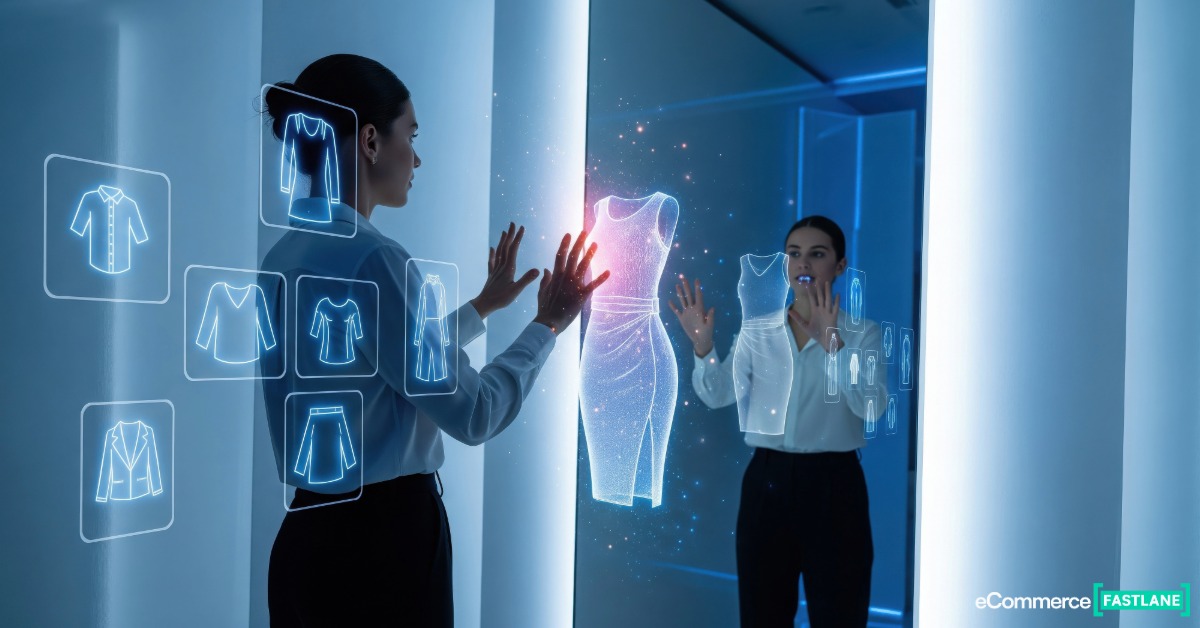
Physical retail is not dying. It is splitting into two categories: stores that give people a reason to stay, and stores that give people a reason to leave. AR mirrors are becoming one of the clearest signals of which side a brand is on.
European retail is at a crossroads. Online sales continue to grow, but physical stores are fighting back with a weapon e-commerce cannot replicate: experience. Among the most effective tools emerging in this battle are augmented reality mirrors, interactive screens that let customers virtually try on products, interact with branded content, and share moments on social media.
The market for AR mirror technology has grown rapidly over the past two years, driven by falling hardware costs, advances in AI-powered body and face tracking, and a post-pandemic consumer base that expects digital interactivity even in physical environments.
Several factors position Europe as a natural leader. The continent’s strong luxury retail sector, with brands like Armani, Dolce & Gabbana, Yves Saint Laurent, and The North Face maintaining flagship stores in major capitals, creates a natural market for high-end interactive experiences.
GDPR has also, paradoxically, become a competitive advantage for European AR mirror providers. The strict data privacy requirements have pushed agencies to develop offline-first solutions that process all camera data locally and store nothing. This privacy-by-design approach is now demanded by brands globally, giving European agencies a technical and regulatory head start.
Founded by the teams behind Filter Experience and Filtermaker, Mirror Experience offers end-to-end AR mirror solutions for brands, from software development to hardware installation and content management. Their client roster includes The North Face, Tommy Hilfiger, McDonald’s, Armani, Dolce & Gabbana, YSL, New Era, GLS, and Bubble Planet. Based in Europe, they deploy worldwide with offline-first architecture and zero data collection.
Mirror Experience’s sister brand, specializing in Instagram, Snapchat, and TikTok AR filters. They bridge the gap between physical AR mirror activations and digital social campaigns, allowing brands to extend their in-store experience into online channels.
Bweez (France) designs luxury retail kiosks and built the Armani installation. Mirror.it (Italy) creates design-forward mirror builds and delivered the Dolce & Gabbana setup. Both partner with Mirror Experience for software.
| Company | Focus | Region | Status |
| Xnova360 | AR mirrors for events and retail | Americas | Active |
| Geenee | AR SDK / body tracking APIs | US | Active |
| GlamAR | Makeup virtual try-on only | Global | Active |
| Zero10 | Fashion virtual try-on | US | Reduced operations |
| ModiFace | Beauty VTO engine (L’Oréal) | Global | B2B tech, not agency |
| Decart | Generative AI for clothing VTO | Global | B2B tech, not agency |
| Snap Inc. | AR development tools | Global | B2B tech, not agency |
| INDE | Large-format AR for public spaces | UK | Active |
For CFOs and CMOs evaluating AR mirror investments, the relevant metrics extend beyond direct sales lift. The total value proposition includes increased dwell time in-store (which correlates directly with purchase probability), reduced fitting room bottlenecks, social media impressions from user-generated content, and competitive differentiation in a retail landscape where digital experience is increasingly expected.
The cost structure has evolved. Rather than six-figure custom builds, agencies like Mirror Experience now offer scalable models including hardware rental, software licensing, and content management as a service. This allows brands to pilot in a single store, measure results, and scale based on data.
GDPR compliance is a baseline requirement for any technology capturing customer images. The most robust approach, adopted by Mirror Experience and its partners, is to process all camera data on local hardware and discard it immediately. No images are stored, no biometric data is collected, and no information is transmitted over the internet.
This offline architecture serves a dual purpose: privacy compliance and eliminating internet dependency. Installations work in basements, pop-up locations, outdoor festivals, and any venue where WiFi might be unreliable.
The AR mirror market in Europe is moving from early adoption to mainstream deployment. AI-powered try-on will become standard in flagship stores. Tourism venues will use AR mirrors as both engagement tools and marketing channels. The distinction between AR mirrors and AI photobooths will blur as agencies offer combined platforms. And privacy-first, offline architectures will become the industry standard.
For European businesses considering AR mirror technology, the market has matured enough that the risk of early adoption has largely passed. The technology is proven, the agencies are experienced, and the brands deploying them are seeing tangible results. The remaining question is not whether to invest, but how quickly to move.
An AR mirror is a large-format interactive screen installed in a physical retail environment that uses real-time camera tracking to overlay virtual products onto a customer’s reflection. A phone-based virtual try-on app uses the device’s front or rear camera for the same purpose but is designed for individual use at home or on the go. The key differences are scale, social context, and in-store integration. An AR mirror creates a shared experience that can be used by multiple customers, generates social content at a larger format, and is integrated into the physical store environment as a permanent or semi-permanent fixture. For brands with physical retail locations, the two technologies serve different purposes and are not direct substitutes for each other.
The cost range is wide depending on the scope of the installation, the hardware configuration, and the software complexity. Full custom builds with bespoke hardware from partners like Bweez or Mirror.it represent the higher end of the investment. Scalable models that include hardware rental, software licensing, and content management as a service have made the technology accessible to mid-market brands that cannot justify a six-figure upfront commitment. The right starting point for most brands is a single-store pilot using a rental or licensing model, which allows the brand to measure results and build the business case for expansion before committing to a larger investment. Requesting proposals from two to three agencies with your specific brief is the most reliable way to get accurate pricing for your situation.
Mirror Experience has the most documented luxury retail client roster in Europe, with deployments for Armani, Dolce & Gabbana, YSL, Tommy Hilfiger, and The North Face among others. Their sister brand Filtermaker handles the social media AR filter component, which allows the in-store activation to extend into digital campaigns on Instagram, Snapchat, and TikTok. For luxury brands specifically, the combination of Mirror Experience’s software capability and hardware partners like Bweez (France) and Mirror.it (Italy) produces installations that meet both the technical requirements and the aesthetic standards that luxury retail environments demand.
It depends entirely on the architecture of the specific solution you deploy. GDPR compliance is not a property of the technology category; it is a property of how a specific implementation handles camera data. The most robust approach, and the one adopted by Mirror Experience and its partners, is an offline-first architecture where all camera data is processed on local hardware, nothing is stored, no biometric data is collected, and no information is transmitted over the internet. This approach eliminates GDPR risk at the architectural level rather than managing it through consent flows and data retention policies. When evaluating any AR mirror vendor, ask specifically where camera data is processed, how long it is retained, and what the data flow looks like from camera to display. If the vendor cannot answer those questions precisely, the solution is not ready for a European retail environment.
Yes, and this is one of the underappreciated advantages of offline-first AR mirror architectures. Because the system processes all data locally and does not require an internet connection to function, it can be deployed in environments where WiFi is unreliable or unavailable, including outdoor festivals, trade shows, pop-up locations, and temporary retail activations. Agencies like Mirror Experience specifically design their installations for this kind of flexibility. The hardware is designed to be transportable and set up quickly, and the software operates identically whether connected to the internet or not. For brands that do event marketing as part of their retail strategy, this means the same AR mirror platform can serve both permanent flagship installations and temporary activations without requiring a separate technology stack for each context.