

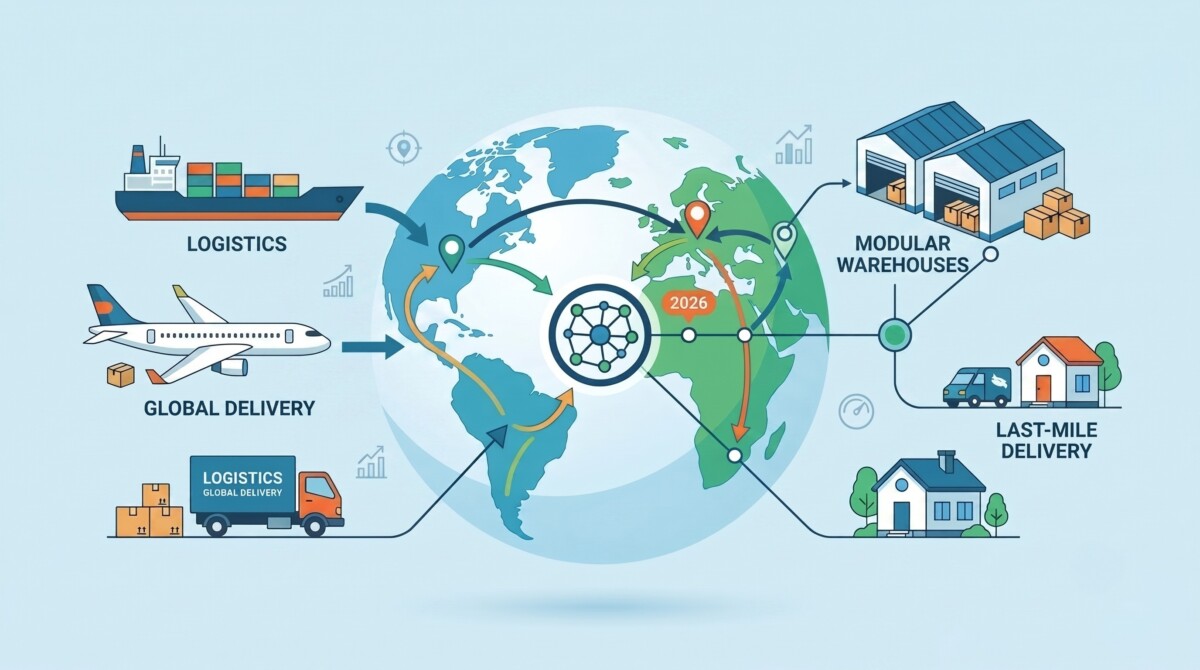
Most Shopify merchants under $1M in revenue should master domestic fundamentals before shipping internationally. Those ready to expand win on four things in 2026: duty inclusive DDP pricing, a carrier strategy matched to each destination, real returns infrastructure, and a landed cost model that survives the July 2026 tariff handoff.
The brands that lose money going global rarely lose it on shipping rates. They lose it on the duties they did not price in, the returns they did not plan for, and the four new markets they opened at once before the first one was profitable.
In fiscal 2024, roughly 1.36 billion low-value parcels entered the United States duty-free under the de minimis rule, averaging about $54 each. As of August 29, 2025, that lane closed. Every shipment into the US, regardless of value, now faces duties and a customs entry. For any merchant selling cross-border, or planning to, the economics of international logistics changed overnight.
Then they changed again. On July 24, 2026, the 10% global surcharge that had governed US import costs since February hit its statutory expiry and was replaced within the same minute by a different tariff regime with no expiry date attached. If you built your landed cost model in the first half of 2026, the number in your spreadsheet is already wrong.
That is the headline most logistics content leads with. What it skips is the harder question underneath: should you be shipping internationally at all yet, and if so, how do you structure it so the new costs do not quietly eat your margin? This guide answers both, with stage-specific guidance for stores from $250K to $10M. The goal is not to talk you into going global. It is to help you make the call clearly.
Ship internationally only when you already have evidence of international demand and your domestic operation is profitable and stable. International expansion is not a growth hack you reach for when domestic sales plateau. It is an operational commitment that adds customs, currency, longer transit, and harder returns to a business that needs to be running cleanly before you layer any of that on.
The pattern I have watched play out across hundreds of merchant conversations is consistent: the brands that struggle at the $500K to $2M stage almost always struggle because of premature complexity, and international expansion is one of the most common forms it takes. A founder sees orders from Germany and Australia in their analytics, reads that cross-border could double their revenue, and opens five markets at once. Six months later they are managing duties they did not price in, support tickets in three time zones, and a return rate they cannot economically service. The international revenue is real. The margin is gone.
The honest test has three parts. First, is there demonstrated demand? Look at your international traffic, abandoned carts from non-domestic visitors, and direct customer requests. Second, is your domestic business healthy enough to absorb the operational load? If your home market still has conversion or retention problems, fix those first. Third, can you start with exactly one adjacent market rather than the whole world? Three yeses and you are ready to expand deliberately. If you are still proving product-market fit at home, you are not. For merchants who clear the test, there is a step-by-step approach to selling internationally on Shopify that starts with a single market and Shopify Markets rather than a global launch.
The end of de minimis means every parcel entering the US now requires a customs entry and owes duty, no matter how small the order. It came in two waves, by executive action rather than clean statutory repeal, which is the nuance most guides flatten. China and Hong Kong lost the exemption on May 2, 2025. Every other country lost it on August 29, 2025, under the executive order suspending duty-free de minimis treatment. The practical effect is that a $40 order shipped from abroad to a US customer now requires a formal or informal customs entry, where before it cleared free with almost no paperwork.
For your cost model, the change is not mainly about the duty rate. Merchants shipping direct into the US are seeing roughly $4 to $25 in added entry, broker, and bond costs per parcel, plus two to five extra days in transit. Those costs land on every parcel regardless of order value, so they hit a $35 order far harder than a $350 one. If you built a US-facing business on sub-$800 parcels clearing free, that model needs rebuilding around bulk import, US-based fulfillment, or duty-inclusive pricing. It helps to understand why international shipping costs add up the way they do before you reprice.
The suspension is also less settled than vendor content admits. It rests on emergency authority the Supreme Court rejected for tariffs in February 2026, and the statutory basis for de minimis is separately scheduled for permanent repeal on July 1, 2027. A challenge is live at the Court of International Trade, and a Congressional Research Service analysis of what the ruling left unresolved is the clearest neutral read on where that stands. Plan for the suspension holding. Do not build a business that only works if it is reversed.
On July 24, 2026, the 10% Section 122 global surcharge expired by operation of law and was replaced the same minute by Section 301 duties of 10% or 12.5%, depending on country of origin, covering roughly 60 economies. Section 122 was capped at 150 days from its February 24 start date and Congress did not extend it. The replacement carries no statutory expiry, which is the part that matters for planning: the previous regime had a known end date, and this one does not.
Two consequences hit cross-border merchants directly. First, standard duties now apply to postal shipments for the first time. Postal lanes had been running on a flat surcharge rate; from July 24 they are subject to the same MFN, Section 232, and Section 301 duties that commercial shipments have carried since August 2025. If you route through postal networks to keep costs down, that lane just got more expensive and more variable by product origin. Second, your effective rate now depends on where your goods are made rather than a single global number. EU-origin goods sit under the trade deal’s 15% ceiling. USMCA-qualifying goods are largely insulated from the Section 301 action, though a separate Section 338 measure on select Canadian goods takes effect August 19, 2026.
The takeaway is unglamorous and urgent: rebuild your landed cost assumptions by country of origin, not by destination alone. At $250K to $500K with one or two SKU origins, that is an afternoon in a spreadsheet. At $2M and above with a diversified supply base, it is a real project worth booking time with your customs broker. Either way, the merchant who repriced in March and has not looked since is quoting a number that stopped being true in July.
Use Delivered Duty Paid so your customer sees the full cost, duties included, at checkout instead of getting a surprise bill at the door. This single decision does more for cross-border conversion and trust than almost any other logistics choice, because the surprise-fee problem is one of the biggest reasons international customers abandon carts and refuse deliveries. Roughly half of cart abandonment is linked in part to unexpected shipping and fee costs, and nothing produces a worse post-purchase experience than a courier demanding duties before they will hand over the box.
The alternative, Delivered Duty Unpaid, pushes duties onto the customer at delivery. It is simpler for you and worse for them. They face a bill they did not expect, often plus a carrier handling fee, and your brand owns the resentment even though the carrier collected the money. For any merchant who cares about repeat purchase rates, DDU is a false economy, and the July 2026 rate changes widen the gap between a stale estimate and the real duty.
You have three practical routes to DDP. Shopify’s own Managed Markets collects duties and import taxes at checkout and handles customs documentation across 150-plus destinations, which is the lowest-friction option if you want it built into the platform. Landed-cost software like Zonos or Passport gives you more control and works across carriers, at the cost of an added tooling layer. And many cross-border carriers and brokers offer DDP directly as part of their service. Whichever route you choose, the principle is the same: the customer should never be surprised. If you want the broader context, these are the cross-border shipping mistakes that quietly drain margin, and skipping DDP sits near the top of the list.
Assign each destination to the carrier or broker that serves that route best, rather than forcing one provider to handle every market. The most common carrier mistake is loyalty to a single integrator, which overpays on lightweight parcels and underperforms where a regional specialist is stronger. A deliberate multi-carrier approach cuts both cost and operational risk, and it is the norm among merchants who ship cross-border profitably. It also helps to know how international freight costs are shifting this year before you lock in providers.
The options sort into a few categories by best fit:
For light parcels going into Europe at meaningful volume, a cross-border broker often beats a general integrator on price, because brokers aggregate volume across postal and commercial networks to access rates a single small merchant could not negotiate alone. Spring GDS, the cross-border arm of PostNL, is one such option: it routes through postal and commercial partners to around 190 destinations, runs a pan-European returns network of roughly 120,000 drop-off points, and launched a postal DDP service into the US in response to the de minimis change. Its sweet spot is merchants shipping lighter goods (fashion, cosmetics, consumer electronics) at roughly 100 or more international parcels a month, where its specialist cross-border ecommerce shipping services earn their place. It is less suited to heavy, high-value, or very low-volume shipping, where an integrator or a software-led DDP setup will serve you better.
Add a shipping automation layer once you are running more than one carrier and manual label and customs work is consuming hours every week, not before. This is the objection most carrier advice skips: multi-carrier sounds obviously correct until you operate it, at which point four carriers means four label workflows, four sets of customs paperwork, and four tracking experiences your support team has to explain. The strategy is right. The admin load is what kills it at $500K to $2M, where nobody has a dedicated logistics hire yet.
Starshipit is one option here: an international shipping software platform that connects Shopify with more than 60 couriers, automates customs documentation, and can display and collect duties at checkout. Plans start at around $30 per month on the Shopify App Store, and the platform is used by roughly 30,000 retailers.
ShipStation and Shippo are the closest alternatives and are worth evaluating alongside it. Starshipit has particularly strong integrations with carriers such as Australia Post, NZ Post, Royal Mail, DHL and Aramex, while also supporting major US carriers, including USPS, UPS and FedEx. This makes it a strong option for merchants shipping domestically or internationally across the United States, Australia, New Zealand, the UK and other global markets. The best fit will depend on your shipping locations, preferred carriers, international requirements and order volume.
The stage guidance matters more than the tool comparison. Below roughly $500K, or on a single carrier, Shopify Markets plus that carrier is enough, and a software layer is exactly the premature complexity that stalls stores at this level. Between $500K and $2M with two or more carriers live, the math flips: if labels and customs forms eat five hours a week, a $30 to $100 monthly tool that halves it is not a cost, it is a part-time hire you did not have to make. Above $2M it is table stakes.
Plan international returns before you launch international sales, because reverse logistics is where cross-border profitability quietly dies. A return that crosses a border twice can incur duties on the original shipment and again on the way back, a double-taxation risk that turns a modest refund into a net loss. Most merchants discover this only after the first wave of returns lands, which is the worst possible time to build a process.
The economics force hard rules. For lower-value items, store credit or a keep-it-and-we-will-refund-you policy is often cheaper than shipping the product back across a border and re-clearing customs. As a working threshold, once round-trip shipping and re-entry costs exceed 50% of an item’s landed value, the physical return is destroying money. Reserve physical international returns for higher-value goods where recovered inventory justifies the cost. Standardized procedures and local drop-off points, the kind regional brokers maintain across Europe, separate a returns process customers trust from one that generates support tickets and chargebacks.
This is also a trust lever, especially for first-time international buyers. A clear, predictable returns policy is one of the strongest conversion signals you can offer a customer who has never bought from you and is wary of ordering from abroad. The merchants who treat returns as a first-class part of the logistics design, rather than an afterthought, convert better at checkout and lose less on the back end. The ones who bolt it on later pay for that omission twice.
The right international logistics move depends entirely on your stage, and applying a $5M brand’s playbook to a $300K store is how merchants get into trouble. The fundamentals are universal, but the sequencing is not.
If you are under $250K, focus on domestic fundamentals and do not ship internationally yet, beyond fulfilling the occasional organic order at a transparent price. If you are between $250K and $500K and seeing real international demand, open exactly one adjacent market, lean on Shopify Markets and a postal or broker option, and set DDP from day one so you never train customers to expect surprise fees. If you are in the $500K to $2M range, this is the premature-complexity danger zone: expand one market at a time, prove each is profitable before opening the next, and add the second carrier and the software layer only when the first one is genuinely constrained. If you are at $2M to $10M or above, you can justify a dedicated multi-carrier strategy, DDP as standard, real returns infrastructure, and in some cases local fulfillment in your strongest markets to cut transit time and duty exposure.
Across every stage, the durable principles hold: demonstrated demand before expansion, transparent landed cost always, the right carrier for each route, and a returns plan built before the first international order ships. The tariff regime moved twice in the first seven months of 2026 alone. The operators who stay profitable through that are not the ones who predicted it. They are the ones whose landed cost model can be updated in an afternoon.
Only ship internationally under $500K if you already have clear evidence of international demand and your domestic business is profitable and stable. For most stores at this stage, international shipping is premature complexity that adds customs, currency, and returns headaches before the fundamentals are solid. The exception is when you see consistent international traffic, abandoned carts from non-domestic visitors, or direct customer requests. If that demand exists, start with exactly one adjacent market rather than opening several at once, use Shopify Markets to manage localization, and set duty-inclusive pricing from the start. If you are still working on domestic conversion or retention, fix that first. The international revenue will still be there once your home market is running cleanly.
The end of the $800 de minimis rule means every shipment into the US now owes duties and requires a customs entry, regardless of value. China and Hong Kong lost the duty-free exemption on May 2, 2025, and all other countries lost it on August 29, 2025. A $40 order that previously cleared free now requires a formal or informal entry, and merchants are seeing roughly $4 to $25 in added entry, broker, and bond costs per parcel, plus two to five extra days in transit. Those per-parcel costs hit small orders hardest. The suspension was made by executive action and is being challenged in court, and the statutory repeal is separately scheduled for July 2027, so the regime remains fluid even though the suspension holds today.
On July 24, 2026, the 10% Section 122 global surcharge expired at its 150-day statutory limit and was replaced the same minute by Section 301 duties of 10% or 12.5% depending on country of origin, covering roughly 60 economies. Unlike Section 122, the replacement has no built-in expiry date. The change that matters most for ecommerce is that standard MFN, Section 232, and Section 301 duties now apply to postal shipments for the first time, so postal lanes are no longer the flat-rate workaround they were earlier in 2026. EU-origin goods sit under the trade deal’s 15% ceiling, and USMCA-qualifying goods are largely insulated. If you built a landed cost model before July 24, rebuild it by country of origin.
DDP, or Delivered Duty Paid, means you collect duties and taxes at checkout so the customer pays the full landed cost upfront and faces no surprise bill at delivery. For cross-border ecommerce, you almost certainly need it. Surprise fees at the door are one of the biggest causes of refused deliveries and cart abandonment, and your brand absorbs the resentment even though the carrier collected the charge. The alternative, DDU, is simpler for you but pushes an unexpected cost onto the customer, which damages repeat purchase rates. You can implement DDP through Shopify Managed Markets, through landed-cost software like Zonos or Passport, or directly through many cross-border carriers and shipping platforms. The method matters less than the principle: the customer should always see the true total before they buy.
Shopify Markets is enough until you are running more than one carrier, at which point dedicated shipping software usually pays for itself. Markets handles localization, duty collection at checkout, and customs documentation across 150-plus destinations without adding another vendor, which is the right setup for most stores under roughly $500K. Once you have two or more carriers live and you are spending several hours a week on label generation, customs forms, and tracking queries, a platform like Starshipit, ShipStation, or Shippo consolidates that into rules for roughly $30 to $100 a month. Match the tool to your carrier mix: Starshipit is strongest across Australia Post, NZ Post, Royal Mail, and DHL, while ShipStation and Shippo are the more common first choice for US domestic volume.
Handle international returns by planning them before you launch international sales and by setting value-based rules that avoid shipping low-value items back across borders. A return that crosses a border twice can incur duties on both the original shipment and the return, so for lower-value products, store credit or a refund-without-return policy is usually cheaper than physical return logistics. A useful threshold is that when round-trip shipping and re-entry costs exceed roughly half the item’s landed value, the physical return destroys money. Reserve physical returns for higher-value goods where recovered inventory justifies the cost. Standardized procedures and local drop-off points, which regional brokers maintain across Europe, keep the process predictable and reduce support load. A clear returns policy also converts better at checkout.




