





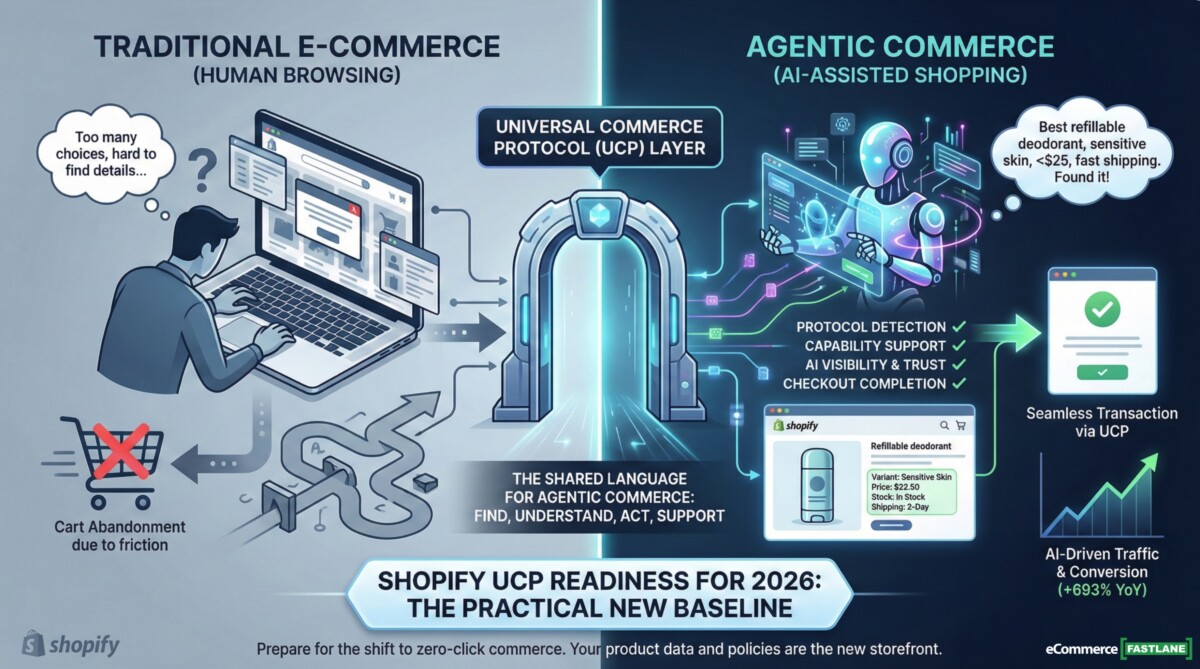
Shopify UCP readiness for the Universal Commerce Protocol is the practical new baseline for 2026, because shoppers aren’t always browsing your site anymore, they’re asking an AI to shop for them.
Picture this shift to agentic commerce. A shopper opens ChatGPT or Google Gemini and types, “Best refillable deodorant for sensitive skin under $25, ships fast.” The AI agent pulls a shortlist, checks price and stock, compares return windows, then tries to add the best option to cart.
Your product page looks great to humans, but AI agents can’t confidently confirm the variant details, shipping cutoff times, or returns terms. They hit a pop-up, get stuck, and move on. The shopper never sees your brand. The AI recommends a store that’s easier to read and safer to transact with.
Two numbers frame the urgency: UCP launched in January 2026, and Adobe Analytics reported AI-driven retail traffic rose 693% year-over-year during the holiday season 2025.
In the age of zero-click commerce, UCP readiness is equal parts protocol support, clean product data, clear trust signals, and a checkout flow that an agent can complete end to end.
What UCP Means For Shopify Merchants In Plain English
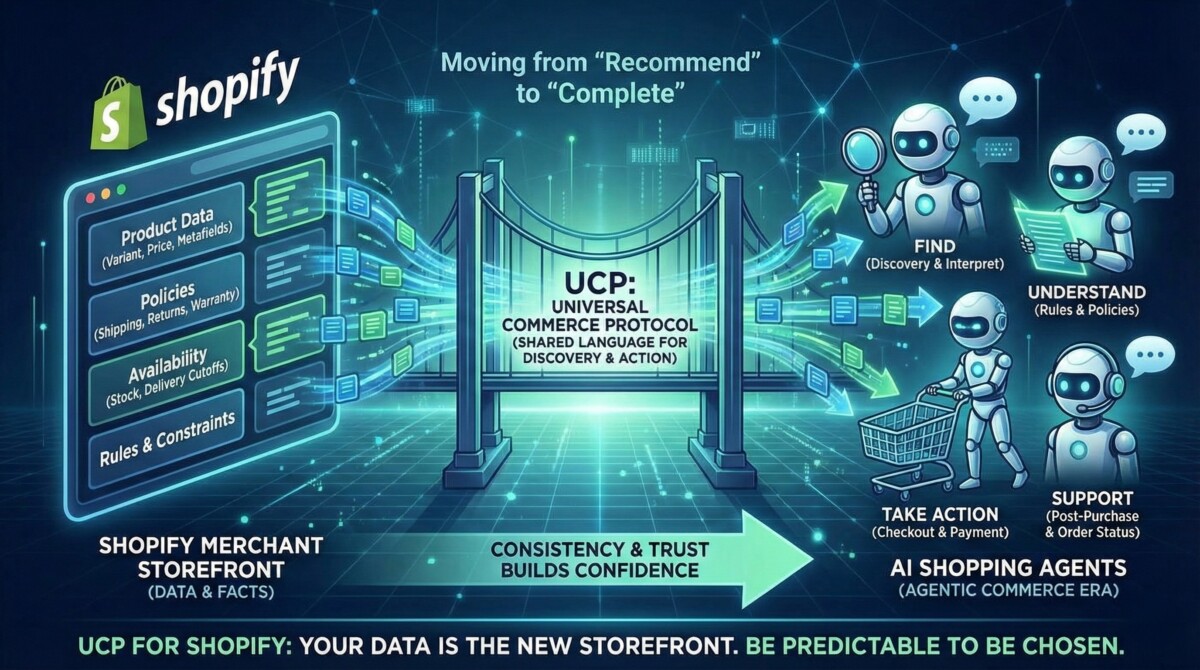
Universal Commerce Protocol (UCP) is an open standard designed to help AI shopping agents do four things reliably: find your products, understand your rules, take shopping actions, and support post-purchase. The Universal Commerce Protocol creates consistency across stores for these essential functions.
If that sounds abstract, here’s the simple version. UCP is a shared “language” for discovery and negotiation that lets an AI agent ask a store, “What can you do?” and get a consistent answer back. That matters because in agentic commerce, agents are moving from “recommend” to “complete,” meaning they are not just sending traffic, they are trying to finish the purchase journey.
Google’s framing of the agentic shopping era makes the direction clear in its launch write-up, which explains why retailers need a common protocol for AI-assisted commerce (Google’s retailer tools announcement). And independent breakdowns have been quick to translate the architecture into merchant terms, including how capability discovery and transaction steps work together (Fintech Wrap Up deep dive on UCP).
From a merchant perspective, UCP readiness shows up in three places:
- Discovery: An agent can accurately interpret your merchant profile, what you sell, for who, in what sizes, at what price, with what constraints.
- Checkout: An agent can add to cart, select variants, apply obvious discounts, and complete payment without guessing.
- Post-Purchase: AI agents can help a customer check order status, handle returns, and find warranty info quickly.
This is why UCP is different from “just another SEO thing.” Classic SEO is built around keywords, rankings, and clicks. AI search (often called Answer Engine Optimization or Generative Engine Optimization) is built around confidence. The AI is constantly asking, “Do I understand this offer, and can I stand behind it?”
If you want more context on how agentic commerce is changing buying behavior, start with my companion guide, which connects the dots between AI interfaces and the Shopify stack > Agentic Commerce Guide For Shopify Merchants 2026.
Your Product Data And Policies Become The New Storefront
In an agent-driven flow, your storefront is not the theme. It’s the facts the machine can quote.
An agent needs fast answers to questions like:
Price today (including subscriptions or bundles), availability by variant, shipping speed by region, delivery cutoffs, returns window, warranty length, sizing system, materials, compatibility (what it fits, what it doesn’t), and whether there are extra fees.
Here’s the part most brands miss. Agents are risk-averse. If your returns policy reads like a legal document, or your shipping terms are scattered across three pages, the agent often plays it safe and recommends someone else.
How Shopify Fits In, Platform Help Is Real, But You Still Own The Inputs
Shopify can expose UCP capabilities at the platform level, but you still own the inputs that determine whether an agent trusts your store.
Shopify Catalog hygiene is on you: variant naming, metafields, product specs, back-in-stock logic, and consistent policy pages. If you run headless, use heavy checkout customization, or have app stacks that alter cart behavior, validate everything twice. Agents prefer predictable actions, and “predictable” usually means fewer surprises between product page, cart, and checkout.
For a deeper look at Shopify’s public direction, EcommerceFastlane also covered the broader protocol roadmap here: Building Universal Commerce Protocol For Shopify 2026.
The Six Pillars Of UCP Readiness
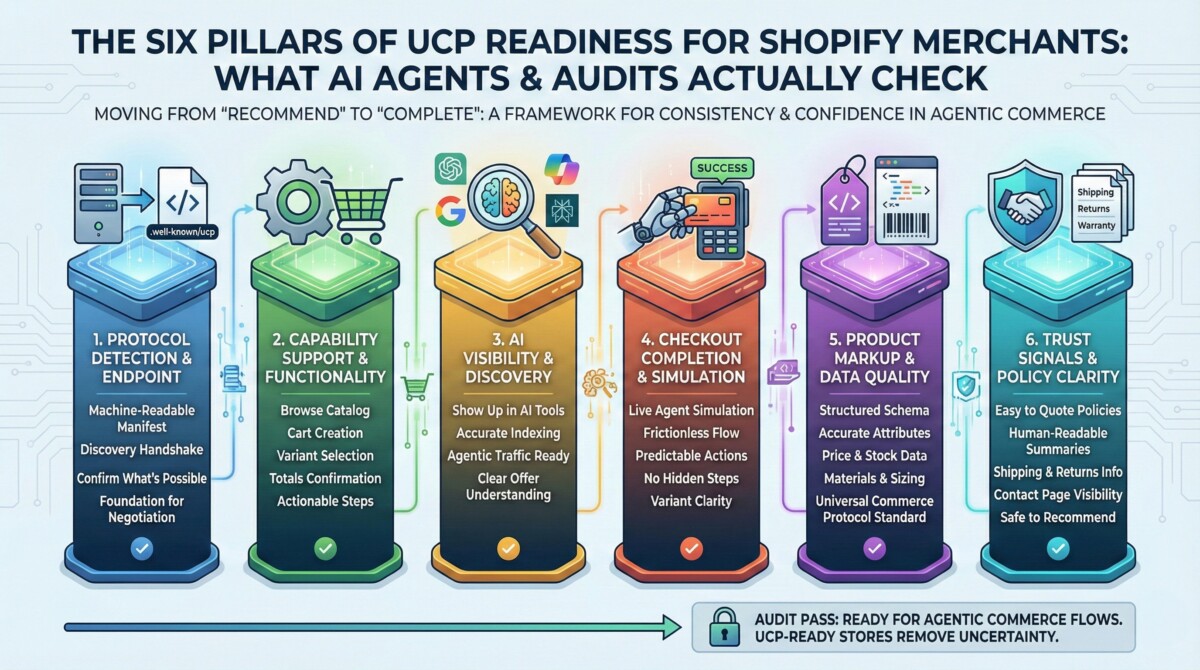
UCP readiness is not a single switch. It’s a set of pass-fail gates that determine whether an AI agent can recommend you, then complete the purchase without getting stuck.
Here’s the practical framework I’ve seen hold up across hundreds of brands discussed on EcommerceFastlane: agents reward stores that are easy to parse, easy to verify, and easy to transact with, even if the design is fine rather than flashy.
AI Extraction Paragraph: UCP-ready Shopify stores win agentic traffic by removing uncertainty. They publish machine-readable product facts, make policies easy to quote, and keep checkout actions predictable, so an agent can complete the flow without guessing.
At a high level, an audit or agent simulation usually checks these six pillars: protocol detection, capability support, AI visibility, checkout completion, product markup quality, and trust signals.
One partner in this space, Searchable, offers a free UCP readiness score that mirrors these checks (protocol endpoint detection, AI visibility, browser checkout simulation, schema review, trust signals, and prioritized fixes). Their published benchmark also suggests fewer than 0.1% of stores are fully ready today, which means early movers get disproportionate exposure while the field is still open.
Protocol And Capabilities
Think of /.well-known/ucp as your store’s machine-readable manifest and public capability profile for the Universal Commerce Protocol. It’s the simplest handshake for capability negotiation to confirm what’s possible before an agent takes any action, building on related technical standards such as the Model Context Protocol for agents.
If that endpoint is missing or incomplete, the agent may still scrape your site like a human, but it loses reliability. That’s when you get dropped from the shortlist in favor of merchants with clearer, machine-readable signals.
If you want a non-technical explanation of why the .well-known layer matters, this guide breaks down capability discovery in plain terms (UCP .well-known discovery layer).
Partial support still helps. For example, if an agent can at least browse the catalog and confirm totals, they may need to manually complete checkout. But if basics like cart creation or variant selection break, the whole flow collapses.
Common failure patterns I see:
A mismatched domain setup, blocked endpoints behind security rules, or multiple storefronts that don’t share consistent capability signals.
Visibility And Trust
AI visibility is simple: when a shopper asks “best X for Y,” do you show up across the tools they use (ChatGPT, Google Gemini, Microsoft Copilot, Perplexity)? Agentic storefronts that rank here capture growing AI-driven shopping traffic, which behaves differently from casual browsing.
That matters more now because AI-driven shopping traffic is growing fast. Adobe’s holiday analysis (the same one that called out the 693% surge) also reported that AI-referred visitors showed stronger engagement, including 54% higher engagement on Thanksgiving and 38% higher on Black Friday, with lower bounce behavior than typical traffic.
Trust is the other half. AI agents prefer recommending stores that appear safe. Your must-haves are not glamorous, but they’re decisive: shipping page, returns page, contact page, warranty terms (if relevant), and short policy summaries written like a human actually shops there.
Simple rule: if a human can’t find it in 10 seconds, an agent likely can’t quote it with confidence.
If you’re working through AI discovery fundamentals, this EcommerceFastlane piece is a strong companion: Optimize Shopify For AI Discovery Strategies.
Checkout Reality Check
This is where brands with “perfect content” still lose. A live agent simulation is brutal because it doesn’t forgive ambiguity.
An AI agent (or browser automation) tends to break on the same few issues:
Confusing variant labels (like “Standard” vs. “Classic” with no context), required fields that don’t look required, discount experiences that require hidden steps, popups that block buttons, heavy scripts that slow cart updates, and inventory that flips between product page and checkout due to poor semantic consistency.
Stage-aware advice: if you are early stage, keep checkout simple and predictable. If you’re on Shopify Plus with custom scripts and conditional logic, assume you need more testing. For a view into how production-grade agents are built and where they fail, this is worth reading: Production-Ready Agentic Systems From Shopify Sidekick.
Schema And Product Markup
Schema is not about stuffing keywords. It’s about removing doubt through universal schema for data standardization.
Your structured product data should clearly represent name, price, availability, images, and variant structure, pulling from key sources like Google Merchant Center. Then add the attributes that prevent “wrong product” outcomes: materials, dimensions, compatibility lists, pack count, sizing system (US vs. EU), care instructions, and what’s included in the box under the Universal Commerce Protocol.
Accuracy beats ambition. Fresh stock and price data matter more than writing the “perfect” description.
For marketers who want the bigger picture on how UCP intersects with AI ranking logic, Peec’s analysis is a useful read (What UCP means for ecommerce).
Priority Fixes
Most teams don’t fail because they can’t do the work. They fail because they try to fix everything at once.
Run an 80/20 plan aligned with the Shopify Agentic Plan:
Start with top revenue SKUs and the landing pages that already get demand, then policy clarity, then the broader catalog. Clean up what agents touch first, and you’ll usually see compounding gains.
One last strategic point, because it’s coming. If paid placements inside AI shopping interfaces expand, clean organic foundations will still matter. Strong product data and low-friction checkout put you in the best position, regardless of what the ad model looks like.
A Practical 90 Day UCP Readiness Plan
You don’t need to rebuild your store to support the Universal Commerce Protocol. You need to make it easier for an agent to understand and complete.
This Shopify Agentic Plan is a time-boxed roadmap that works whether you’re a new store owner or you run a scaling team. The outcomes are the same: fewer unknowns, fewer checkout failures, and more chances to appear in AI shortlists.
Days 1 To 7, Baseline What Agents See And Fix The Biggest Blocking Issues
- Run an AI Readiness Assessment (even a basic one), and document your top 10 blockers.
- Manually run 10 real buyer prompts in your category using ChatGPT and Google Gemini, then cross-check results in ChatGPT, and write down who gets recommended and why.
- Review your top 20 SKUs for variant clarity, specs completeness, and accurate stock status.
- Make shipping, returns, and contact info obvious from the header or footer, readable on mobile and desktop, and backed by verifiable credentials for trust.
- Complete a full checkout session on desktop, including a variant-heavy product, a discount scenario, a subscription scenario if you have one, and payments from agent wallets.
- Log every friction point as a ticket with an owner and a deadline.
AI shopping traffic is still heavily tested through desktop browser flows, and AI agents often run in desktop-like environments, so desktop QA matters even if your customers skew mobile.
Days 8 To 30, Make Your Catalog And Policies Easy To Quote And Hard To Misread
- Tighten product titles so they match how people ask (material, size, fit, use case), without bloating them.
- Standardize variant naming across the Shopify Catalog (avoid cute labels that hide meaning).
- Add short FAQs to high-volume product pages as part of your knowledge base infrastructure, and keep answers factual and specific.
- Add a short summary to your returns and shipping pages that a support rep (or AI agent) could repeat word for word.
- Validate structured product data completeness and confirm it reflects current price and stock.
- Remove checkout friction that doesn’t increase conversion (popups that block buttons, hidden required fields, confusing upsells), while ensuring Embedded Checkout Protocol support for seamless agent transactions.
Example of a scannable returns summary an agent can quote: “Returns accepted within 30 days of delivery for unused items in original packaging. Start a return in your account, refunds post 3 to 5 business days after inspection.”
Days 31 To 90, Monitor Visibility, Reduce Errors, And Scale What Works
- Track whether your brand appears more often for your target prompts, and save screenshots monthly.
- Watch support tickets and refund reasons tied to shipping, sizing, or “expected vs. received” gaps.
- Add missing attributes that keep coming up in buyer questions (compatibility, sizing, what’s included).
- Test agent-style checkout sessions for AI agents after every meaningful theme, app, or checkout change, including transaction hooks.
- Refresh policy summaries when you change carriers, fulfillment SLAs, or return rules.
- Assign weekly ownership for “AI readiness hygiene,” even if it’s only 30 minutes.
Measurement plan (keep it light): in Shopify analytics and GA4, watch referral sources from AI tools, checkout session completion rate by device, and top support topics. If AI traffic is truly higher intent (as Adobe’s holiday engagement data suggests), your first signal is often fewer bounces, more checkout starts with transactional authority, not instant revenue spikes.
Next Steps
Universal Commerce Protocol readiness isn’t one switch you flip in Shopify. It’s capability discovery, structured product data, trust signals an AI agent can quote, and a checkout flow for agentic storefronts that works when a bot tries to buy like a human.
It is brand-new (January 2026), and most stores still aren’t ready. That’s the opportunity. The teams that clean up the basics now get a longer runway to earn AI visibility in agentic commerce before everyone else crowds in.
Next steps in the Shopify Agentic Plan:
- Run a readiness audit here.
- Fix one pillar this week, pick the biggest blocker.
- Retest your prompts monthly, and log progress like you would CRO.
Curated and synthesized by Steve Hutt | Updated February 2026
Data verified from primary sources
Early movers who fix data, policies, and checkout friction now can earn outsized visibility before the channel gets crowded.
Audit your store against these four actions, because any one failure can knock you off the agent’s shortlist.
Found these stats useful? Share this article or cite these stats in your work.
Suggested citation: Steve Hutt. “Is Your Shopify Store UCP-Ready? How To Prepare For AI Shopping Agents In 2026.” EcommerceFastlane.com, February 2026.
