


AI-powered conversational commerce is revolutionising Shopify discovery. Optimise product data, schema markup, and team readiness now to dominate ChatGPT Shopping and future-proof your eCommerce growth effectively. ,
Let’s start with the obvious: AI isn’t just knocking at the door for eCommerce — it’s already inside and beginning to rearrange the furniture. With tools like ChatGPT Shopping rolling out and Shopify quietly building the connective tissue to support it, the industry is in the midst of a paradigm shift. Natural language is becoming the new search. Conversations, not queries, are guiding product discovery. If your store isn’t ready, it risks becoming invisible. But for brands willing to adapt, this moment presents a rare opportunity to future-proof their growth.
Conversational search has been a topic banded about for a number of years now, but in 2025 we’re witnessing the rise of truly conversational commerce. A world where discovery happens not through endless scrolling through ads and search result listings or comparison charts, but via AI-powered chats.
Imagine a customer asking, “What’s the best cruelty-free moisturiser for under £30?” and receiving curated, purchase-ready suggestions and shopping links — all within a conversation. That world is no longer theoretical, it’s already here.
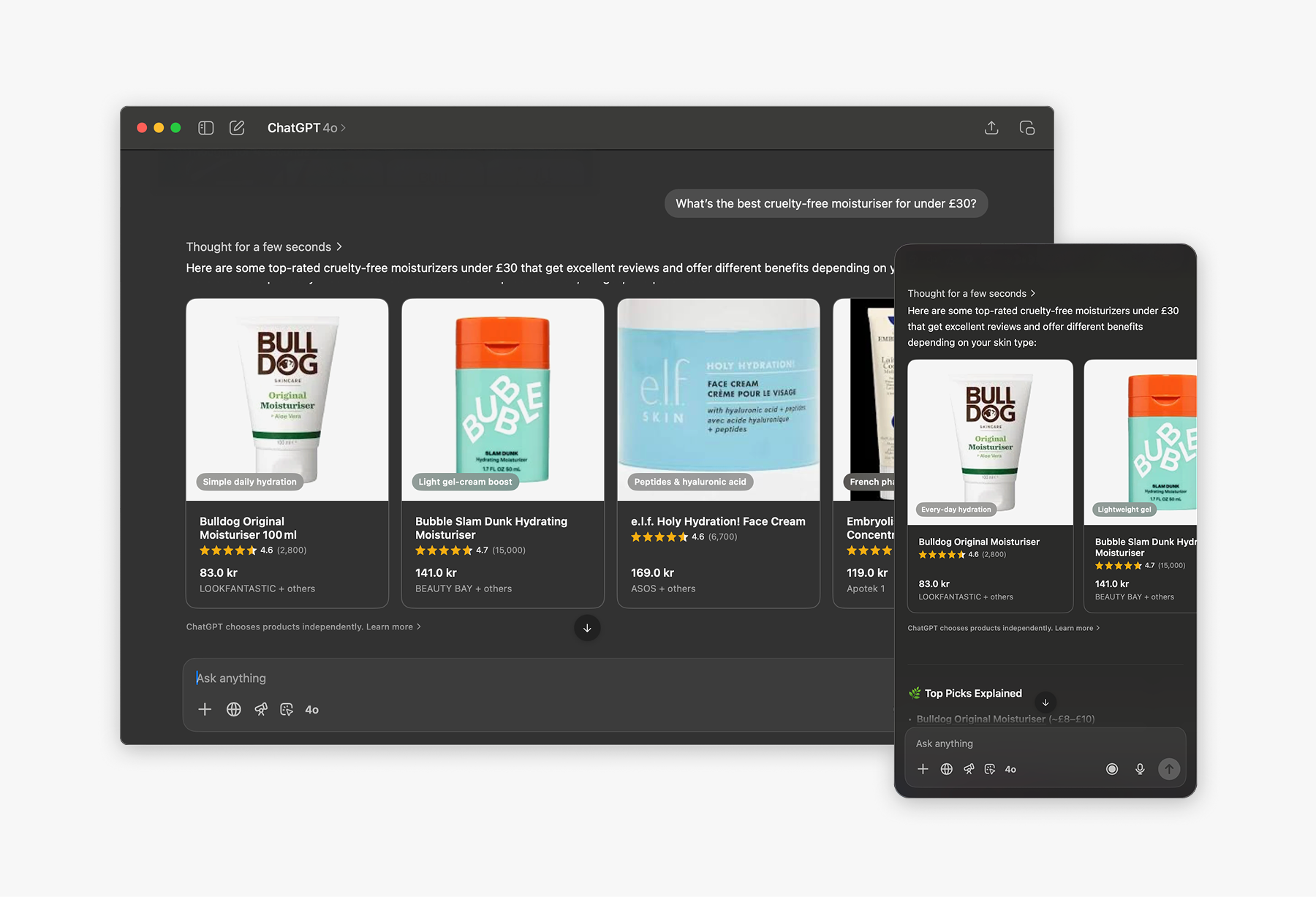
AI chatbots, like ChatGPT and Google’s Gemini, are already becoming shopping assistants, interpreting nuance, suggesting relevant products, and even streamlining checkout. We can see this already in store data, with most Shopify brands experiencing 1000%+ growth in ChatGPT as a referral source Year-on-Year. For brand-loyal customers, your website will remain essential. But for functional or impulse-driven buys and new-to-brand customers, these AI bots may soon handle the entire journey. If you’re not optimising for this conversational layer of commerce, you’re leaving discoverability — and revenue — on the table.
OpenAI’s ChatGPT Shopping feature enables users to ask natural-language product search questions and receive curated responses. The system reads context and intent — not just keywords — offering a tailored, human-like experience. Product results are returned within the chat, and soon, users may be able to complete purchases without ever leaving the interface. OpenAI are already inviting brands to sync their product catalogues with ChatGPT by integrating their product feeds directly into ChatGPT. While this functionality remains limited, it’s only a matter of time before broader adoption takes hold. This isn’t just a new channel, it’s a reinvention of product discovery and will become a crucial channel consideration as part of overall marketing mix planning.
Recent code leaks uncovered in May 2025 point to a deepening connection between Shopify and ChatGPT. Terms like shopify_checkout_url and product_id found in code snippets inside the ChatGPT web app suggest users may soon browse, select, and buy Shopify products entirely within ChatGPT. A logical next step? Full-scale integration.
If this becomes the default discovery path for millions of users, your brand’s AI-readiness will determine whether it’s found, or forgotten.
Here’s how ambitious Shopify brands, keen to remain ahead of the curve can prepare their stores — and their teams — for the AI-driven future of commerce.
Clear, detailed product titles and natural-language descriptions are no longer just nice-to-haves, they’re essential. ChatGPT and similar Large Language Models (LLMs) need human-readable, attribute-rich content to make accurate recommendations. Think: “Waterproof men’s trail running shoes in size 10” instead of “Men’s Running shoes”.
Schema markup is already critical – but now even more so. Product, Offer, Review and Breadcrumb schema helps AI understand content and context at scale. Use tools like Google’s Rich Results Test to audit and refine your implementation.
Avoid vague or overly broad categories. Use naming conventions that mirror how customers talk and search for products, not how marketers label. A well-organised structure helps AI models match queries with the right products.
AI queries mimic human questions. Tailor your content to match how people ask, not just what they search for. Consider adding FAQs or Q&A-style copy to pages that talk to customer considerations and use purposes.
Fast, clean, and mobile-optimised pages are more likely to be surfaced by AI systems — and less likely to lose customers at the final click.
Structured, crawlable reviews (not trapped in iframes) offer powerful trust signals for AI. Invest in platforms that prioritise visibility to both search engines and LLMs.
Consider how customers can become advocates for your products and brands. Encourage reviews from satisfied customers post-fulfilment with automated email flows and CRM.
Clean product feeds are likely to be the backbone of AI integrations. Ensure your Google Merchant Centre, Klaviyo, or Shopify JSON feeds are rich in detail and free of inconsistencies.
AI discovery may diverge from Google, but the existing pillars of good SEO — authority, trust, engagement, content depth and quality — still matter. Keep building quality content, earning links, and focusing on user experience.
This isn’t just a tech shift changing how consumers search and shop — it’s a business-critical change to how internal teams think, plan, and operate by leveraging AI-powered Shopify solutions to remain competitive. Cross-functional teams must understand the role of AI in modern commerce.
Even before ChatGPT Shopping goes mainstream, brands can tap into a suite of AI tools:
Help customers discover the right products based on behaviour, preferences, and purchase history.
AI chatbots and tools that offer 24/7 assistance, reduce support load, and improve satisfaction.
Improve product discoverability with smarter, faster, and more relevant on-site search.
Automate and optimise email, SMS, and ads using AI insights and content generation.
AI tools that streamline product imagery, copywriting, and creative assets.
Use AI to understand trends, forecast demand, and make smarter decisions.
AI to improve conversion rate and overall user experience through testing and automation.
AI shopping isn’t coming — it’s here. The brands that succeed won’t be the ones who wait and see. They’ll be the ones who move with direction and intention in the here and now. This is your moment to build an eCommerce presence that speaks the language of tomorrow’s consumer: fluid, fast, and conversational. Get your data right, your content clearer, and your team aligned. The rules of discovery are changing — and EastsideCo is here to help you win in this new era. If you’d like an audit of your Shopify AI readiness and clear roadmap of action to provide you with direction through this AI change, contact us today.
We are one of the world’s most trusted and experienced Shopify Plus Partners. A full-service, fully in-house digital agency of over 50 talented people, we’ve helped hundreds of ambitious brands exceed their goals.
Eastside Co leads the way in UX-focused Shopify web design, results-driven marketing strategies, and best-in-class Shopify applications and software. We help online businesses escape the ordinary and achieve ecommerce success.




