





Quick Decision Framework
- Who This Is For: Shopify brands that manufacture their own products – from small-batch makers to mid-market DTC brands with in-house or outsourced production – who have outgrown spreadsheets and need a single source of truth from raw materials to fulfilled order.
- Skip If: You are a pure reseller, dropshipper, or retailer with no manufacturing component. Katana is purpose-built for makers. If you don’t produce goods, you’re paying for capabilities you’ll never use.
- Key Benefit: Katana is the only Shopify-native platform that unifies inventory, production planning, and shop floor execution in one clean interface – without requiring a six-month ERP implementation or a dedicated IT team.
- What You’ll Need: A minimum of $299/month for the Core Plan (plus add-ons for manufacturing, traceability, and warehouse management); a $2,000 onboarding investment; and 4 to 6 weeks of active setup time with your operations lead involved from day one.
- Time to Complete: 12 minutes to read this review; 30 minutes to connect to Shopify; 4 to 6 weeks to full implementation with guided onboarding.
If you’re evaluating Katana, you’re almost certainly also looking at Cin7 Core and Unleashed Software. These three dominate the inventory and manufacturing management conversation for growing Shopify brands, and they each solve the core problem differently. Katana takes the approach of making manufacturing operations beautiful and accessible – it is built for founders and operators who need production control without an IT department. Cin7 Core is built around ERP-level depth, covering everything from B2B portals to POS in one sprawling platform. Unleashed focuses on advanced costing and batch tracking for wholesalers and distributors with complex supply chains. By the end of this review, you’ll know exactly which one fits where you are today.
Is Katana Actually Worth It for Your Shopify Store?
Most Shopify brands don’t have an inventory problem. They have a manufacturing visibility problem – and that is a completely different thing. The moment you start making your own products, your spreadsheet stops being a planning tool and becomes a liability. Katana was built specifically for that inflection point, and for the brands it fits, it is genuinely transformational. The question is not whether Katana is good software. It is. The question is whether you are the specific kind of brand it was designed to serve.
I have spent years in the Shopify ecosystem – as a startup founder, an agency operator, and a Shopify Merchant Success Manager – watching brands hit the exact operational wall that Katana was built to solve. I have seen what happens when a $300K/year brand tries to manage production runs across three Google Sheets and a whiteboard. I have also seen what happens when a $2M brand finally connects their manufacturing reality to their Shopify storefront in real time. The difference is not incremental. It is the difference between reacting and planning. This review is based on direct analysis of Katana’s current feature set as of February 2026, evaluation of 136 Shopify App Store reviews, Katana’s published case studies across brands in the food and beverage, apparel, wellness, and sporting goods categories, and competitive analysis against Cin7 Core and Unleashed Software across the specific use cases that matter most to Shopify merchants.
One important note before we go further: Katana is a sponsor of eCommerceFastlane. That relationship does not change what I write. My job – and the only reason this platform has any value to you – is to tell you the truth about whether a tool fits your business. Katana fits a specific kind of Shopify brand exceptionally well. It does not fit every Shopify brand. I will be clear about both.
Who Is Katana Actually For?
Emerging Stage ($0 to $50K Monthly)
The Promise: Get off spreadsheets, establish real inventory discipline, and build the operational foundation that will let you scale without chaos.
The Reality: At this stage, Katana’s Core Plan starts at $299/month plus a $2,000 onboarding investment. For a brand doing $20K to $40K monthly, that is a meaningful percentage of revenue going to operations infrastructure. The platform’s power – real-time production planning, multi-location inventory, shop floor tracking – is largely underutilized when you are running one production line and fulfilling a few hundred orders per month.
The Trigger: You are making your own products, you have experienced at least one stockout or production error that cost you a customer, and you are spending more than 5 hours per week manually reconciling inventory across spreadsheets and Shopify.
Skip If: You are still in the early validation phase, your product catalog is under 30 SKUs, or your monthly revenue does not yet justify a $300+ monthly operational tool. Katana’s Free Plan (up to 30 SKUs, 3 locations) is a legitimate option to test the system before committing.
Growth Stage ($50K to $500K Monthly)
The Promise: Replace the patchwork of spreadsheets, Shopify inventory, and disconnected production tracking with one system that gives your whole team – from the warehouse floor to the finance function – a shared operational reality.
The Reality: This is Katana’s sweet spot. Brands in this range are typically managing real production complexity – multiple raw materials, batch tracking requirements, purchase order cycles tied to production schedules – and the cost of operational errors is significant. Katana’s usage-based pricing model (Core Plan at $299/month, scaling with order volume and locations) is well-suited to brands growing through this range.
The Trigger: You are managing purchase orders for raw materials manually, your production schedule lives in someone’s head or a shared Google Sheet, and you have had at least one instance of overselling a product because your Shopify inventory didn’t reflect what was actually available for production.
Skip If: Your revenue is primarily driven by reselling or dropshipping rather than in-house manufacturing. Katana’s manufacturing-first architecture means you are paying for capabilities you will never use if production is not your core operation.
Established Stage ($500K to $2M+ Monthly)
The Promise: Operational sophistication at a fraction of the cost and implementation time of a traditional ERP – with the Shopify-native integration depth that enterprise platforms cannot match.
The Reality: Katana implements in 4 to 6 weeks versus 6 to 12 months for most ERPs. For established brands that have been managing complexity through workarounds, that speed-to-value is significant. The platform handles multi-location inventory, contract manufacturing coordination, and omnichannel order sync at this scale. The honest limitation is that brands with very high order volumes of low-ticket items may find the usage-based pricing model scales faster than expected – a pattern that has frustrated some long-term users.
The Trigger: You are coordinating production across multiple locations or co-manufacturers, your finance team is spending significant time reconciling inventory values at month-end, or you are evaluating a traditional ERP and the 6 to 12 month implementation timeline is a genuine business risk.
Skip If: You are a high-volume, low-AOV manufacturer processing thousands of small orders monthly. Katana’s usage-based pricing rewards brands with fewer, higher-value orders. If your model is the inverse, run the pricing math carefully before committing.
Stage-to-Recommendation at a Glance
What Katana Actually Does Well
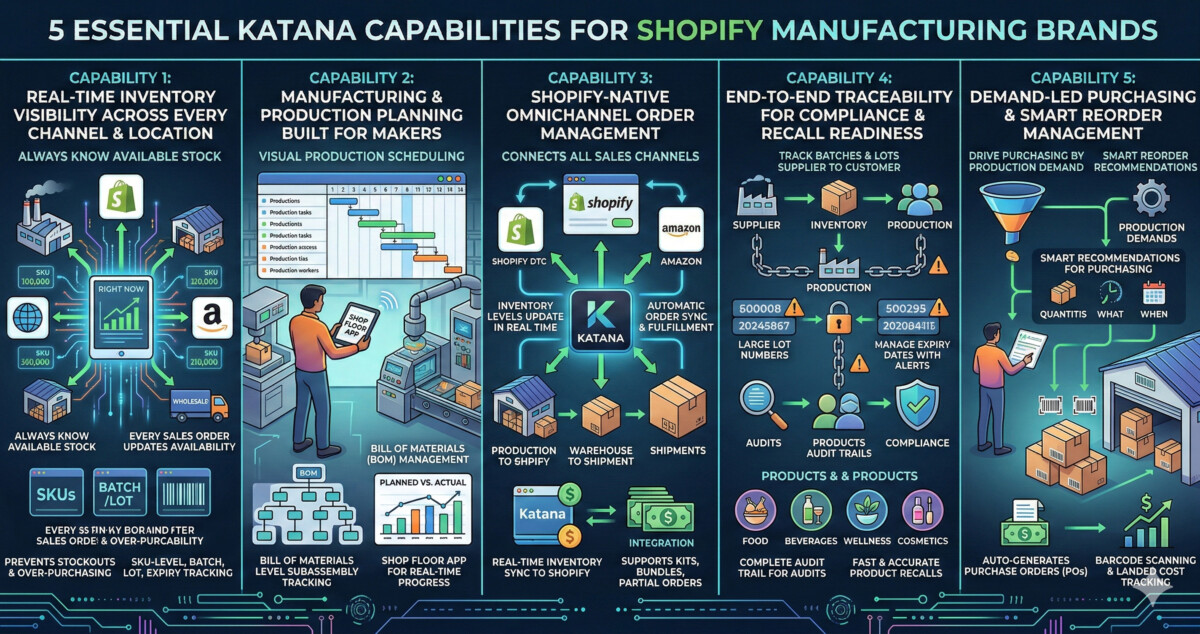
Capability 1: Real-Time Inventory Visibility Across Every Channel and Location
The single most painful operational reality for a Shopify brand that manufactures its own products is not knowing what is actually available to sell right now. Not what was available yesterday. Not what your spreadsheet says after last night’s manual update. Right now, in real time, accounting for raw materials already allocated to open production orders, finished goods committed to existing Shopify orders, and stock sitting in multiple warehouse locations. Katana’s Smart Inventory engine solves this problem directly. Every sales order that comes in through Shopify automatically allocates the relevant finished goods or raw materials, updates availability across all locations, and surfaces any gaps in your production plan before they become a customer service problem. The system tracks items at the SKU level with full support for batch and lot numbers, serial numbers, and expiry dates – which is critical for food, beverage, wellness, and any regulated product category.
The Stat That Matters
Katana’s own research, conducted with Worldwide Business Research across 100 SMB Shopify merchants in the US and Canada, found that 83% of brands struggle to keep inventory, manufacturing, and accounting data synchronized due to operational obstacles. Brands using Katana report a 1.2x increase in inventory turnover on average – meaning the same capital working harder through better visibility and planning.
Emerging ($0-$50K): Real-time inventory visibility is genuinely valuable even at this stage, but the honest limitation is that most emerging brands are not yet running the kind of multi-location, multi-channel complexity that makes this capability transformational. The Free Plan (up to 30 SKUs) gives you a real taste of the system without financial commitment.
Growth ($50K-$500K): This is where real-time inventory visibility pays for itself. A single prevented stockout on a high-velocity SKU, or a single avoided over-purchase of raw materials because your planner could see what was already allocated, can cover months of platform cost. Brands at this stage typically see the clearest ROI from this capability.
Established ($500K-$2M+): Multi-location inventory tracking with real-time allocation across Shopify, wholesale, and retail channels becomes operationally essential at this scale. Katana handles this natively, including support for 3PL integrations and contract manufacturing coordination.
vs. Cin7 Core and Unleashed Software: All three platforms offer real-time inventory tracking, but Katana’s interface is meaningfully cleaner and faster to navigate for non-technical operators. Cin7 Core’s inventory module is more powerful in its ERP-level reporting depth but requires significantly more setup and training. Unleashed offers stronger advanced costing and landed cost calculations, which matters more for wholesale and distribution businesses than for DTC Shopify brands.
Capability 2: Manufacturing and Production Planning Built for Makers, Not IT Departments
If you make your own products and you are not using dedicated manufacturing software, your production schedule is a risk. It lives in someone’s head, in a shared spreadsheet, or in a series of text messages between your operations manager and your production team. Katana’s manufacturing module – available as an add-on to the Core Plan – gives you visual production planning, Bill of Materials (BOM) management, multi-level subassembly tracking, and a Shop Floor App that lets your production team report progress, record materials consumed, and flag issues in real time from a mobile device on the production floor. Manufacturing routings let you define the exact sequence of operations for each product, with support for parallel and sequential steps. Manufacturing insights give you planned versus actual comparisons on materials and time, so you can identify where your estimates are off and improve your next production run.
The Stat That Matters
Katana reports that brands using the platform implement in 6 weeks on average, versus 6 to 12 months for most traditional ERPs. Hornby Organic, a food and beverage brand, reported a 100% improvement in production efficiency after implementing Katana – attributed directly to replacing manual scheduling with Katana’s production planning and shop floor visibility tools. (Source: Katana-published case study.)
Emerging ($0-$50K): The Manufacturing Management add-on ($199/month) adds meaningful cost at this stage. The honest recommendation: start with the Core Plan and basic inventory management, then add manufacturing features once your production volume justifies the investment. The Free Plan lets you test manufacturing features before committing.
Growth ($50K-$500K): This is where the manufacturing module delivers its clearest ROI. Brands at this stage are typically running regular production cycles, managing raw material purchasing tied to production schedules, and dealing with the operational cost of production errors. Katana’s BOM management and Shop Floor App directly address all three.
Established ($500K-$2M+): Multi-level BOMs, contract manufacturing coordination, and manufacturing insights become essential operational tools at this scale. Katana handles all three natively, and the Shop Floor App gives your production team a professional-grade tool without requiring expensive hardware or IT infrastructure.
vs. Cin7 Core and Unleashed Software: Katana’s manufacturing capabilities are significantly deeper than Cin7 Core’s, which requires workarounds for shop floor management and lacks a native Shop Floor App. Unleashed Software has stronger advanced manufacturing logic and batch tracking depth for complex manufacturing environments, but its interface is meaningfully less intuitive than Katana’s, and its starting price ($410/month) is higher with a steeper learning curve.
Capability 3: Shopify-Native Omnichannel Order Management
The operational nightmare that kills growing Shopify brands is not a single catastrophic failure. It is the slow accumulation of small errors that come from managing orders across disconnected systems. A Shopify order that doesn’t update your inventory. A wholesale order entered manually that doesn’t trigger a production run. A return processed in Shopify that doesn’t adjust your stock levels. Katana solves this by acting as the operational backbone connecting your Shopify storefront, your production floor, your warehouse, and your accounting software in one real-time system. Every sales order from every channel – Shopify DTC, wholesale, Amazon, WooCommerce – syncs automatically into Katana. Inventory updates flow back to Shopify in real time. Purchase orders for raw materials are generated based on actual production requirements, not estimates. The system supports partial order fulfillment, kits and bundles, return management, and custom fields for extended product information.
The Stat That Matters
Peace Collective, a Canadian apparel brand on Shopify, reported a 50% increase in order capacity after implementing Katana – achieved not by adding staff or production capacity, but by eliminating the operational friction that was preventing their existing team from processing orders efficiently. (Source: Katana-published case study, verified through brand interview.)
Emerging ($0-$50K): Even at this stage, the elimination of manual data entry between Shopify and your inventory system has real value. The time saved reconciling orders manually is time that goes back into the business.
Growth ($50K-$500K): As order volume grows across multiple channels, the operational cost of disconnected systems compounds. Katana’s omnichannel sync becomes more valuable with every additional sales channel you add.
Established ($500K-$2M+): Multi-location fulfillment coordination, 3PL integration support, and real-time inventory sync across all channels are operationally essential at this scale. Katana handles all of these natively through its Core Plan and Warehouse Management add-on.
vs. Cin7 Core and Unleashed Software: Cin7 Core has broader marketplace integration coverage and a more mature B2B portal for wholesale operations. Unleashed has stronger multicurrency support for international operations. Katana’s advantage is the depth and simplicity of its Shopify-specific integration – for brands where Shopify is the primary or dominant sales channel, Katana’s native sync is meaningfully cleaner than either competitor.
Capability 4: End-to-End Traceability for Compliance and Recall Readiness
If you sell products in regulated categories – food, beverage, wellness, supplements, cosmetics, anything with an expiry date or a compliance requirement – traceability is not a nice-to-have. It is a business continuity requirement. Katana’s Traceability add-on gives you batch and lot number tracking from supplier to customer, serial number tracking for individual items, expiry date management with alerts, and a complete audit trail that supports compliance reviews and product recalls. Every batch of raw material that comes in is assigned a lot number. Every production run that uses that material is linked to it. Every customer order that contains product from that production run is traceable. If you ever need to execute a recall – or respond to a regulatory inquiry – Katana gives you the data to do it quickly and accurately.
The Stat That Matters
Cornbread Hemp, a regulated CBD brand on Shopify, implemented Katana specifically for traceability requirements. Their Operations Director reported: “Every step from labor costs to final extraction is tracked in Katana. It’s given us true visibility and control.” For brands in regulated categories, the cost of a traceability gap in a recall scenario far exceeds the cost of the platform. (Source: Katana-published case study.)
Emerging ($0-$50K): If you are in a regulated category, traceability is a requirement regardless of revenue stage. The Traceability add-on ($249/month) is a significant cost at this stage, but the alternative – managing compliance manually – is both time-consuming and genuinely risky.
Growth ($50K-$500K): As production volume grows, manual traceability becomes impossible. Katana’s automated batch and lot tracking is the right tool for this stage in regulated categories.
Established ($500K-$2M+): Full audit trail, recall readiness, and compliance documentation are non-negotiable at this revenue scale. Katana’s traceability capabilities are enterprise-grade without the enterprise implementation complexity.
vs. Cin7 Core and Unleashed Software: Unleashed Software has the strongest batch tracking and advanced traceability capabilities of the three, particularly for complex manufacturing environments. Cin7 Core offers solid batch and serial number tracking as part of its core platform. Katana’s traceability is excellent for the DTC manufacturer use case, though brands with very complex multi-stage manufacturing traceability requirements may find Unleashed’s depth more appropriate.
Capability 5: Demand-Led Purchasing and Smart Reorder Management
One of the most expensive operational mistakes a manufacturing brand makes is purchasing raw materials based on gut instinct rather than actual production demand. You either over-purchase – tying up cash in materials you won’t use for months – or under-purchase – creating production delays when a material runs short mid-run. Katana’s purchasing module connects your sales order pipeline directly to your raw material requirements. Smart order recommendations tell you what to buy, how much to buy, and when to buy it based on current production orders, reorder points, and supplier lead times. Purchase orders are generated directly in Katana and can be sent to suppliers from the platform. Receiving is handled through the Warehouse App with barcode scanning support. Every purchase is tracked with multicurrency support and landed cost calculations.
The Stat That Matters
Found Surface, a textile manufacturing brand, recovered $40,000+ in previously untracked inventory after implementing Katana’s purchasing and traceability systems – and scaled their facility by 5x in the process. The inventory recovery alone covered multiple years of platform cost. (Source: Katana-published case study.)
Emerging ($0-$50K): Smart purchasing recommendations are valuable even at this stage, particularly for brands with longer supplier lead times or seasonal demand patterns. The ability to see your raw material requirements driven by actual sales orders – rather than estimates – prevents the cash flow damage of over-purchasing.
Growth ($50K-$500K): Demand-led purchasing becomes a significant operational advantage as order volume grows. The difference between purchasing based on gut instinct and purchasing based on actual production demand compounds with every order cycle.
Established ($500K-$2M+): At this scale, purchasing optimization has direct P&L impact. Katana’s planning and forecasting add-on ($0 additional on Core – included in the base plan) gives established brands advanced demand planning and replenishment tools.
vs. Cin7 Core and Unleashed Software: Unleashed Software has stronger advanced costing and landed cost calculations, which matters for businesses with complex international supply chains. Cin7 Core has a more mature purchasing module with EDI support for enterprise supplier relationships. Katana’s purchasing module is the most intuitive of the three for operators who are not supply chain specialists, and its direct connection to production planning is cleaner than either competitor.
Shopify Integration: What Actually Syncs
What Syncs Natively: Sales orders from all Shopify channels; product and variant data including SKUs; inventory levels with real-time updates back to Shopify; order fulfillment status; customer and contact data; return and refund management; kits and bundle inventory deductions.
What Requires Configuration: Bill of Materials mapping to Shopify products; production routing sequences; reorder points and safety stock levels; warehouse bin locations and pick/pack workflows.
What Doesn’t Sync Automatically: Shopify product tags (noted as a limitation by users – workarounds exist but require manual setup); automatic sync delay controls (the sync is real-time, which most brands want, but some prefer a buffer); Amazon and WooCommerce channels require separate integration setup beyond the Shopify native connection.
Integration Depth in Context
Shopify Magic’s AI-generated summary of Katana’s 136 App Store reviews specifically highlights “seamless Shopify integration” and “elimination of manual data entry” as the most consistently praised capabilities. Multiple reviewers noted that the integration “eliminates the need for manual data entry and enhances the accuracy of orders” from day one. The integration is consistently described as simple to connect and reliable in operation.
Emerging: The Shopify connection is genuinely plug-and-play for basic inventory sync. The value compounds as you add manufacturing workflows, but even at the emerging stage, the elimination of manual order entry is immediately useful.
Growth: Integration depth matters more as channel complexity grows. Katana’s native Shopify sync handles multi-location fulfillment, partial orders, and return processing – all of which become operationally significant as order volume grows.
Established: API access (included in the Core Plan) allows established brands to build custom integrations with ERP systems, 3PLs, and enterprise tools. Katana’s open API is well-documented and actively used by brands building custom operational workflows.
Pricing vs. ROI: The Honest Calculation
Katana’s new modular pricing model is a meaningful improvement over its previous tiered structure. You start with the Core Plan at $299/month and add only what you need: Manufacturing Management ($199/month), Traceability ($249/month), and Warehouse Management ($149/month). Unlimited users, unlimited SKUs, and unlimited integrations are included in the Core Plan – which means you are not paying more as your team grows or as your product catalog expands. Usage-based components (sales order volume and additional inventory locations) scale with your actual business activity, which is genuinely fair for seasonal businesses.
The honest caveat: if you need manufacturing, traceability, and warehouse management, your effective monthly cost is $299 + $199 + $249 + $149 = $896/month before usage-based components. That is a real number. It is also a number that replaces what most brands at this stage are spending across separate tools for inventory management, production tracking, and compliance – plus the hidden cost of the manual labor required to keep those tools synchronized.
The ROI Math at the Growth Stage
- Typical tool replacement: separate inventory app ($150/month) + spreadsheet-based production tracking (5 hours/week of operations manager time at $40/hour = $800/month) + manual reconciliation errors (estimated 2% of inventory value per year)
- Katana’s own data shows brands report 60% higher sales on average year over year after implementation (platform-reported metric)
- On $200K monthly revenue with production-related stockouts costing an estimated 3% of potential sales: that is $6,000/month in recoverable revenue
- A 50% reduction in stockout frequency from better production visibility = $3,000/month in recovered revenue
- Platform cost: $299 to $896/month depending on add-ons selected
- Net ROI: 3x to 10x on platform cost at the growth stage, depending on current operational inefficiency
- The constraint is never the platform cost. It is whether you have the bandwidth to implement properly and the discipline to use the system as designed.
Emerging Stage ROI: At $0 to $50K monthly, the ROI case is real but tighter. The Free Plan is the right starting point. Move to the Core Plan when your order volume makes manual reconciliation genuinely painful – typically around 100 to 200 orders per month for a manufacturing brand.
Growth Stage ROI: This is where the ROI case is clearest. At $100K monthly revenue, a single prevented stockout on a top-10 SKU can cover 3 to 6 months of platform cost. The manufacturing module’s impact on production efficiency compounds with every production cycle.
Established Stage ROI: At $500K+ monthly, the ROI conversation shifts from individual prevented losses to systemic operational efficiency. Brands at this stage typically find that Katana’s implementation cost ($2,000 onboarding) is recovered within the first month through reduced manual labor and eliminated errors.
User Experience and Team Adoption
Who Manages This Day-to-Day:
- Emerging: Founder or operations generalist; 3 to 5 hours per week for setup and ongoing management once fully implemented.
- Growth: Operations manager or COO; 5 to 10 hours per week across inventory planning, production scheduling, and purchasing management.
- Established: Dedicated operations team with role-based access for production floor operators, warehouse staff, and purchasing managers; Katana’s unlimited user model means no incremental cost as team size grows.
The Honest Reality from Long-Term Users
A Shopify App Store reviewer who switched from Cin7 wrote: “We had used Cin7 previously and that seems prehistoric in comparison to Katana’s functionality.” The consistent theme across positive reviews is that Katana feels designed for operators, not for software engineers – the interface is intuitive, the auto-save functionality prevents data loss, and the onboarding team is consistently responsive and knowledgeable. The consistent theme in negative reviews is pricing sensitivity among very high-volume, low-ticket manufacturers – a real limitation that Katana’s usage-based model creates for that specific business type.
Pros and Cons: The Honest Assessment
Strategic Advantages
Advantage 1: The Only Platform That Unifies Inventory and Manufacturing for Shopify Brands
(Source: Feature Analysis and Competitive Review)
No other platform in this category gives a Shopify brand real-time visibility from raw material receipt through production to customer delivery in a single, clean interface. Cin7 Core comes closest in capability but requires significantly more setup and technical expertise. The result is that Katana is the only tool in this category that a non-technical operations manager can actually run day-to-day without ongoing IT support.
Advantage 2: Unlimited Users, Unlimited SKUs, Unlimited Integrations at the Base Plan Level
(Source: Pricing Page, Verified February 2026)
Most inventory platforms charge per user or per SKU, which creates artificial growth penalties. Katana’s Core Plan removes these limits entirely. A team of 15 people using Katana daily costs the same as a team of 3. A catalog of 5,000 SKUs costs the same as a catalog of 500. This pricing structure is genuinely aligned with growing brands.
Advantage 3: 6-Week Implementation vs. 6 to 12 Months for ERPs
(Source: Katana platform data)
For established brands evaluating a move from spreadsheets or considering a traditional ERP, the implementation timeline difference is significant. A 6-month ERP implementation means 6 months of operational risk, staff distraction, and delayed value. Katana’s guided onboarding delivers operational value within the first 4 to 6 weeks – and the $2,000 onboarding investment is a fraction of what enterprise ERP implementations cost.
Advantage 4: Support Quality That Punches Above Its Price Point
(Source: Shopify App Store reviews, 136 verified reviews as of February 2026)
Across 136 Shopify App Store reviews, Katana’s support team is the single most consistently praised element of the product. Dedicated onboarding managers, personalized setup videos, sub-30-minute response times, and a customer success manager after onboarding are standard – not premium add-ons. For brands that have experienced the support vacuum of lower-cost inventory tools, this is a meaningful differentiator.
Honest Limitations
Three Things Most Katana Reviews Won’t Tell You
- Usage-Based Pricing Can Scale Unexpectedly for High-Volume, Low-AOV Brands. Katana’s Core Plan pricing scales with sales order volume. For brands selling high volumes of low-ticket items – think a soap brand processing 2,000 orders per month at $15 average order value – the usage-based component can push monthly costs significantly above the $299 base. A 6-year Katana user (Mountain Madness Soap Co.) publicly detailed this exact experience on the Shopify App Store in January 2026, noting that their pricing scaled to levels comparable to brands doing $50M+ in annual revenue despite their much smaller operation. If your business model involves high order counts and low ticket prices, run the usage math carefully before committing. (Source: Shopify App Store review, January 2026.)
- Manufacturing Features Require Add-On Investment Beyond the Core Plan. The $299/month Core Plan is genuinely useful for inventory and order management, but the manufacturing capabilities that differentiate Katana – production planning, shop floor tracking, manufacturing insights – require the Manufacturing Management add-on at $199/month. Traceability is another $249/month. Warehouse Management is $149/month. If you need all three, your effective monthly cost is $896/month before usage. This is not hidden, but it is easy to anchor on the $299 headline price and be surprised by the full-capability cost. (Source: Katana pricing page, verified February 2026.)
- Reporting Depth Lags Behind Dedicated Analytics Tools. Multiple reviewers and third-party analyses note that Katana’s reporting and dashboard capabilities, while functional, are less comprehensive than what brands accustomed to dedicated analytics tools expect. Custom reporting options are limited, and the absence of a more robust analytics dashboard is a consistent point of feedback. Brands that need deep financial reporting or custom BI dashboards will need to connect Katana to a dedicated reporting tool via API or integration. (Source: Brands Reported This, corroborated by multiple third-party review platforms.)
Katana vs. Cin7 Core vs. Unleashed Software: The Deciding Factor
Real Results: How Shopify Brands Are Using Katana
Case Study 1: Found Surface – Growth Stage Textile Manufacturer
The Problem: Found Surface was scaling a textile manufacturing operation with no systematic way to track raw material inventory, production costs, or finished goods across their growing facility.
What Changed: Implemented Katana’s inventory management, traceability, and purchasing modules to create a single operational system connecting raw material receipt to finished goods fulfillment.
The Outcome: $40,000+ in previously untracked inventory recovered; 5x facility scale-up enabled within the same operational team.
Verification: Results verified through Katana-published case study and direct brand reporting.
Case Study 2: Peace Collective – Growth Stage Apparel Brand on Shopify
The Problem: Peace Collective’s COO, Lisa Diep, was managing production capacity manually, limiting how many orders the brand could process and fulfill on time.
What Changed: Implemented Katana’s production planning and order management to give the operations team real-time visibility into capacity and order allocation.
The Outcome: 50% increase in orders processed without adding production capacity – achieved purely through better operational visibility and planning.
Verification: Results verified through Katana-published case study and direct COO quote.
Case Study 3: Naturewall – Growth Stage DTC Brand
The Problem: Naturewall was managing a growing product catalog and order volume across disconnected systems, limiting their ability to scale sales without proportional increases in operational complexity.
What Changed: Implemented Katana as the operational backbone connecting inventory, production, and Shopify order management.
The Outcome: 2x sales orders processed; 2x revenue growth achieved within the same operational infrastructure.
Verification: Results verified through Katana-published case study with platform-reported metrics.
My Verdict by Stage
Emerging Stage ($0-$50K Monthly) – Conditional Yes
If you are making your own products and you are already feeling the pain of manual inventory reconciliation, Katana’s Free Plan is worth your time right now – today. It is a genuine free tier, not a crippled demo, and it will tell you quickly whether the platform fits your workflow. The paid Core Plan at $299/month is a meaningful investment at this revenue stage, and I would not push you toward it until your operational pain is real and recurring. The trigger: you have experienced a stockout, a production error, or a fulfillment delay that you can trace directly to not knowing what was actually in stock and available for production. That is the moment Katana pays for itself.
The risk of waiting: every month you manage production manually is a month of compounding errors, missed opportunities, and operational habits that become harder to unwind as you grow.
Growth Stage ($50K-$500K Monthly) – Strong Yes
This is Katana’s home. If you are a Shopify brand doing $50K to $500K monthly and you manufacture your own products, I have not found a better tool at this price point for the specific problem Katana solves. The combination of real-time inventory visibility, production planning, Shopify-native integration, and unlimited users is genuinely differentiated. The trigger: you have an operations manager or COO who is spending meaningful time on manual reconciliation, and your production schedule lives in a spreadsheet or in someone’s head. That is the moment you stop evaluating and start implementing.
The risk of waiting: at this revenue stage, the cost of operational errors – stockouts, over-purchasing, production delays – compounds with every order cycle. The platform pays for itself faster than most brands expect.
Established Stage ($500K-$2M+ Monthly) – Strong Yes
At this stage, the alternative to Katana is typically a traditional ERP – and the implementation cost, timeline, and organizational disruption of a traditional ERP are genuinely significant risks. Katana gives you enterprise-grade operational capability at a fraction of the cost and implementation time. The honest caveat: if your business model involves very high order volumes of low-ticket items, run the usage-based pricing math carefully before committing. For brands with higher AOV and moderate order counts, Katana’s pricing scales very favorably. The trigger: your finance team is spending meaningful time reconciling inventory values at month-end, or you are managing production across multiple locations or co-manufacturers without a shared operational system.
The risk of waiting: operational complexity compounds at this revenue stage. The cost of a 6-month ERP implementation – in staff time, organizational disruption, and delayed value – typically exceeds Katana’s annual cost.
The Question Worth Sitting With
If your best operations person left tomorrow, how long would it take a replacement to understand what is actually in stock, what is committed to open orders, what is mid-production, and what needs to be purchased before your next production run? If the honest answer is “weeks” or “we’d have to rebuild everything from scratch,” that is the real cost of not having a system like Katana – and it is a cost you are already paying, just invisibly.
Frequently Asked Questions About Katana for Shopify
Is Katana worth it for a small Shopify brand that manufactures its own products?
It depends on your revenue stage and operational complexity. For brands doing under $50K monthly, Katana’s Free Plan (up to 30 SKUs) is worth testing immediately. The paid Core Plan at $299/month makes the most sense once you are experiencing real operational pain from manual inventory and production tracking – typically around $50K to $100K monthly for a manufacturing brand. The platform’s ROI is clearest when you can point to specific costs – stockouts, over-purchasing, production delays – that better visibility would prevent.
How does Katana compare to Cin7 Core and Unleashed Software for Shopify manufacturers?
Katana is the strongest choice if your primary need is manufacturing visibility combined with Shopify-native integration and you want a platform your non-technical operations team can run without IT support. Cin7 Core is the better choice if you need ERP-level depth, B2B wholesale portals, or POS integration alongside your manufacturing. Unleashed Software is the better choice if you are a wholesaler or distributor with complex costing requirements, multi-currency operations, or advanced batch tracking needs that go beyond DTC manufacturing.
What does Katana actually cost for a Shopify brand that needs manufacturing features?
The Core Plan starts at $299/month with unlimited users, unlimited SKUs, and unlimited integrations. Manufacturing Management is an add-on at $199/month. Traceability (batch and serial number tracking) is $249/month. Warehouse Management is $149/month. If you need all three add-ons, your effective monthly cost is approximately $896/month before usage-based components for sales order volume and additional inventory locations. Onboarding is a one-time $2,000 investment. A Free Plan with up to 30 SKUs is available for testing.
How long does it take to set up Katana with Shopify?
The Shopify connection itself takes approximately 30 minutes. Full operational implementation – including BOM configuration, production workflow setup, and team training – takes 4 to 6 weeks with Katana’s guided onboarding program. The onboarding includes a dedicated onboarding manager, personalized workflow design, and integration configuration support. Most brands report their first meaningful operational value (live Shopify sync, real-time inventory visibility) within the first week.
What does Katana’s Shopify integration actually sync?
Katana syncs sales orders from all Shopify channels bidirectionally in real time, including inventory level updates back to Shopify, order fulfillment status, product and variant data, return and refund management, and kits and bundle inventory deductions. What requires manual configuration includes BOM mapping, production routing, and reorder points. Shopify product tags do not sync automatically, which some users note as a limitation with available workarounds.
What are the best alternatives to Katana for Shopify inventory management?
For pure resellers and retailers without manufacturing: Cin7 Core (from $349/month) offers broader ERP coverage, or Zoho Inventory (from $29/month) for budget-conscious brands. For manufacturers needing deeper costing: Unleashed Software (from $410/month). For high-volume multichannel sellers: Linnworks. For very early-stage brands or simple inventory needs: Sumtracker (from $49/month). Katana is specifically differentiated for Shopify brands that manufacture their own products and need both inventory and production management in one system.
Who should NOT use Katana?
Pure resellers, dropshippers, and retailers with no manufacturing component – Katana is built for makers, and if you don’t produce goods, you are paying for capabilities you’ll never use. Very high-volume, low-AOV manufacturers (many orders, low ticket price) should run Katana’s usage-based pricing math carefully before committing, as the per-order pricing model can scale unexpectedly for this business type. Brands that need extensive marketplace integrations beyond Shopify (Amazon, Etsy, Walmart as primary channels) may find Katana’s integration ecosystem narrower than alternatives like Cin7 Core or Linnworks.
Review Information: Published February 2026 | Last Verified: February 2026 | Next Scheduled Review: May 2026 | Reviewer: Steve Hutt, eCommerce Fastlane | Pricing verified directly from katanamrp.com/pricing/ and apps.shopify.com/katana-mrp-manufacturing-and-inventory-management | App Store rating verified February 2026 (4.5/5.0, 136 reviews)
