


Shopify’s summer 25 edition have just rolled out, unveiling over 150 new features and updates designed to empower merchants, streamline operations, and prepare businesses for the future of commerce. When paired with Tresl’s Segments Analytics—which instantly translates Shopify data into ready-to-use customer cohorts—these upgrades become an even stronger growth engine. This edition, dubbed “Horizons,” focuses heavily on infusing the core platform with AI, simplifying global expansion, and supercharging in-person retail experiences.
Here are the key takeaways every merchant should know to strategically leverage these advancements for their business.
As part of the Summer 2025 Edition, Shopify has reimagined its theme architecture through Horizon, a new design foundation built for design flexibility, speed, and AI-driven customization.

Key highlights include:
A new structural base that embraces modular Shopify theme blocks, making it easier to customize every part of the storefront.
Prebuilt themes like Ritual, Fabric, Tinker, Dwell, Pitch, Vessel, Heritage, Savor, and Atelier offer varied design styles and high performance out of the box.
Simply describe your brand or design goals, and Shopify will generate a personalized storefront or custom theme block—ideal for merchants and developers alike.
New skeleton theme, Liquid improvements (e.g., LiquidDoc, static params), and updated theme store requirements (resubmission by July 2025) support easier development and better theme discoverability.

Beyond the design system overhaul, Horizon themes now integrate seamlessly with Sidekick AI for faster storefront iteration. You can:

A highly requested feature—discount code entry directly in the cart—is also now live, helping improve conversion rates by reducing checkout friction.
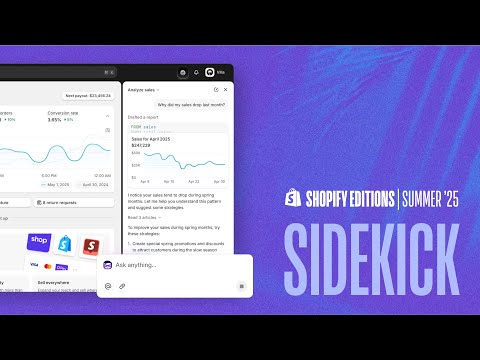
Shopify’s Sidekick has received several significant updates, transforming it into a more powerful and integrated AI assistant for merchants:
Sidekick is now smarter and more powerful, leveraging multi-step reasoning to provide data-driven strategies and solve complex problems based on an analysis of your business.
It now speaks 20 languages and is available in all supported admin languages, broadening its accessibility for global merchants.
Users can generate visuals directly within the admin simply by providing a few keywords.
Sidekick is now available on the Shopify mobile app, allowing merchants to complete tasks while on the go.
A new screen share feature with voice chat is rolling out for new Shopify users, enabling them to share their screen and speak with Sidekick to be guided through tasks in the admin.
Shopify’s CEO, Toby Lütke, has indicated that Sidekick is designed to integrate deeply with Shopify apps and third-party services. Developers will be able to expose functions that Sidekick can access, facilitating seamless AI-augmented commerce flows. The vision is for Sidekick and Shopify apps to communicate, blurring the lines between Sidekick and the core Shopify experience, making it feel more like a unified “operating system” where functions work together intuitively. This deep integration is seen as a key area of future development.
Sidekick is positioned as an AI tool that accelerates real commerce work, such as generating SEO-friendly product titles and descriptions.
Shopify has revamped its Markets functionality, streamlining cross-border selling and making it more intuitive for merchants to manage various international settings. Key updates include the ability to create submarkets for more granular customization and, significantly, Markets are now available for B2B storefronts, allowing businesses to tailor catalogs, currencies, and themes for different B2B segments. This update recognizes the growing demand for B2B e-commerce to offer a B2C-like experience.
To further facilitate international trade, Shopify Payments has expanded to 16 new countries, and additional local payment options, including Klarna, are now supported across various European markets. For B2B transactions, native VAT validation is available for EU and UK companies, automating tax deductions. Duties collection has been simplified for all plans, making it easier to collect taxes and tariffs at checkout or even embed them directly into product prices, with the new Tariffguide.ai tool assisting in product classification.
Shopify is making significant investments in its POS (Point of Sale) system, transforming it into an open platform for developers to build integrated in-store experiences. The redesigned Shopify POS (version 10) offers faster navigation, smarter search with typo handling, and a more adaptable cart. Merchants can now brand their customer display screens with logos, colors, and media. This extensibility with open APIs allows agencies to create “wow moments” for tailored retail experiences.

Key POS features include:

Merchants will find powerful new tools to enhance their daily operations:
As part of the Summer 2025 Edition, Shopify is rolling out a next gen dev platform that strips away boilerplate and lets you ship production-ready commerce experiences in record time. You can now work end-to-end on your local machine—no tunnels, near-instant hot-reload—and spin up dev stores that mirror any plan, even Plus, for pixel-perfect testing. Data persistence is also simpler: just declare metafields or metaobjects once in your apps.toml, and Shopify propagates them automatically to every store that installs your app.
The Built for Shopify program has been trimmed from 104 requirements to 19, unlocking faster reviews and broader placement on the App Store homepage and category pages. Shopify Ad placements already average a 33 % click-to-install rate on desktop, 30 % on mobile, and a 3× ROAS (2024 data). Targeting by plan tier or geography can lift ROAS another 60 %. Focus on durable, differentiated features—AI content generation, personalization, hardware, or compliance nuance—to stand out.
A summer edition highlight, Storefront MCP is Shopify’s new developer layer for building AI shopping agents in any store:
Shopify Catalog is a new global API that works like a mega-search index across every Shopify store. It lets AI agents and apps surface products from millions of sellers—enabling personalized discovery, cross-store search, and future features like a Global Cart. Early‐access APIs (version 2025-04) already let developers query for rich media products (e.g., 3D models) and build next-gen shopping experiences.
The summer 25 edition, “Horizons,” represents a significant leap forward for Shopify, weaving AI and advanced functionalities into the very fabric of the platform. From AI-powered design and operational assistance to streamlined global and in-person commerce, these updates are designed to help merchants navigate an increasingly complex landscape with greater ease and efficiency. For merchants, this means a more powerful, intuitive, and adaptable platform that can drive growth and reduce friction. For partners and developers, it opens up new opportunities to build integrated, high-value solutions in areas like retail POS, B2B, and AI-driven experiences. By embracing these new tools and strategies, Shopify aims to ensure that businesses, regardless of size, can thrive in the evolving world of commerce. The focus on extensibility, AI, and simplified operations ensures that Shopify remains at the forefront, helping its ecosystem build better, faster, and more competitively.
Brought to you by John Chao – Cofounder & CEO, Tresl
Insights from Shopify Editions Summer 2025





