

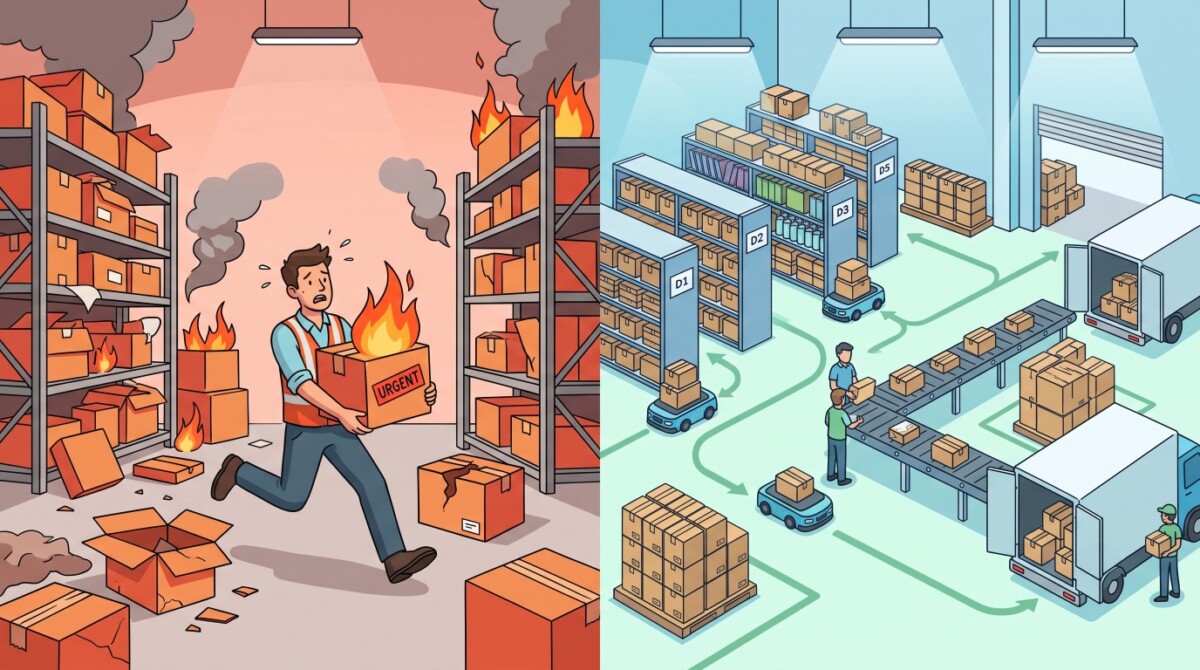
Lean fulfillment replaces peak-season firefighting with stable, flow-based operations by mapping order journeys, removing process waste, standardizing work, and only then layering automation on top of a predictable system.
Speed that depends on heroes vanishes when the hero burns out or leaves; speed built on flow and standard work becomes the quiet operating system of your brand.
Most e-commerce operations run on adrenaline. Peak season hits, orders spike, someone discovers the inventory count was wrong, and the team spends a week firefighting. The costs are documented and brutal: 38% of shoppers abandon orders when delivery exceeds a week (Comscore/Econsultancy, 2025), 60% abandon carts over unexpected shipping costs, and every shipment error costs retailers around $120 per order. Meanwhile 51% of e-commerce companies report rising fulfillment costs, with labor — 35–40% of total fulfillment expense — squeezed by shortages that 59% of retailers cite as their top pressure.
The firefighting isn’t a staffing problem. It’s a process problem — and the fix was invented on factory floors decades ago. Lean thinking treats an order the way a plant treats a product moving down the line: anything that stops, delays, or damages the flow is waste to be found and removed.
The first lean tool worth stealing is value stream mapping: trace one order from click to doorstep and time every step — including the waiting between steps, which is usually where most of the elapsed time hides. Teams doing this for the first time typically discover that actual work (pick, pack, label) takes minutes while the order spends hours or days queuing between systems, batches, and shifts.
Common waste patterns in e-commerce fulfillment map directly onto the classic lean categories:
The case studies read like lean textbooks translated into DTC language. Warby Parker split inventory across four U.S. fulfillment centers, cutting delivery times by two days and shipping costs by 20% — a classic reduction of transport waste through regionalization; distributed models are showing 15–37% cost savings versus centralized ones. Zappos attacked the waiting waste in returns, automating inspection and cutting restocking from 7 days to 2, with a 30% lift in customer satisfaction. Allbirds reduced shipment count 25% while raising average order value 18% through bundling — removing waste the customer never even saw.
Speed you get from heroics disappears with the hero. Speed you get from flow compounds every quarter.
Automation is the loudest trend — warehouse automation adoption is heading toward 75% by 2027, and AI-driven efficiency gains of 65% are being reported — but lean practice adds a critical caveat: automating a chaotic process just produces chaos faster. The sequence that works is stabilize, standardize, then automate. Standard work for picking and packing, visual management for exceptions, and root-cause analysis for recurring errors come first; robots and AI routing come second.
This discipline — process mapping, waste identification, standard work, measurable control — is teachable, and operations leaders increasingly formalize it: many put their fulfillment and ops managers through structured onsite lean six sigma training so the whole team shares one method for finding and killing waste, instead of each shift improvising its own workarounds.
With 89% of consumers calling fast shipping critical to repeat purchase and 45% expecting two-day delivery, the direction for 2025–2026 is set: distributed inventory closer to customers, AI-accelerated returns processing, hybrid last-mile models mixing carriers with crowdsourced and in-house fleets, and predictive analytics for demand spikes. Fulfillment center count is growing 15% annually toward 17,000 globally by 2027 — capacity is coming online everywhere; the differentiator is who runs it without firefighting.
Start small: map one order’s journey this week, time the waits, and fix the single largest one. Lean isn’t a transformation project — it’s a habit of removing friction, one bottleneck at a time, until peak season is just another Tuesday.
You start applying lean to e-commerce fulfillment by mapping a single order from checkout to delivery and timing every handoff, then using that map to identify where the order is waiting rather than being worked. Once you see where queues and delays cluster, you can categorize those issues using classic lean wastes—defects, inventory inaccuracy, transport and motion, and waiting—and prioritize fixes that reduce total lead time and error risk. The key is to begin with observation and measurement, not with tools or software; your first win should be eliminating a specific bottleneck, not buying a robot.
Your fulfillment chaos is usually a process problem, not a staffing problem, because most bottlenecks arise from how work is sequenced and handed off rather than how many people you have on the floor. Value stream mapping often reveals that actual pick‑pack‑ship work takes minutes while orders spend hours waiting between systems or shifts, which means adding staff alone simply pushes more work into the same broken queues. When you redesign flow, standardize work, and tighten exception handling, your existing team can usually handle significantly more volume with less stress.
The most common wastes in DTC fulfillment operations include defects in the form of mis‑picks and wrong‑address shipments, inventory inaccuracy across multi‑warehouse networks, transport and motion inefficiencies from centralized shipping and poor slotting, and waiting in returns and exception queues. Defects directly erode margin through replacement and support costs, while inventory errors create both oversells and dead stock. Transport and motion waste increase per‑order shipping and labor costs, and waiting locks up inventory that could be sold. Lean practice treats each of these as a solvable design problem rather than as the inevitable cost of doing business.
Lean practitioners say “stabilize, then automate” because automating an unstable process tends to freeze bad decisions into code and machinery, making future improvements harder and more expensive. When you first standardize work, clarify exception paths, and establish basic control metrics, you create a predictable baseline that automation can safely accelerate. Robots and AI routing deliver their promised efficiency gains only when they operate in a system where the inputs and outputs behave consistently; otherwise they just move chaos faster and further.
Your 2026 fulfillment roadmap should focus on distributed inventory closer to key customer regions, accelerated and more intelligent returns processing, hybrid last‑mile delivery strategies, and predictive analytics to anticipate demand spikes, all framed by lean principles. As global fulfillment capacity expands, your competitive edge will come from running that capacity without firefighting—designing flows that absorb peaks, using data to pre‑empt bottlenecks, and building a culture where continuous improvement is a standard part of the work rather than an occasional project. Starting with one mapped order and one fixed bottleneck this quarter is the most reliable way to begin.





