
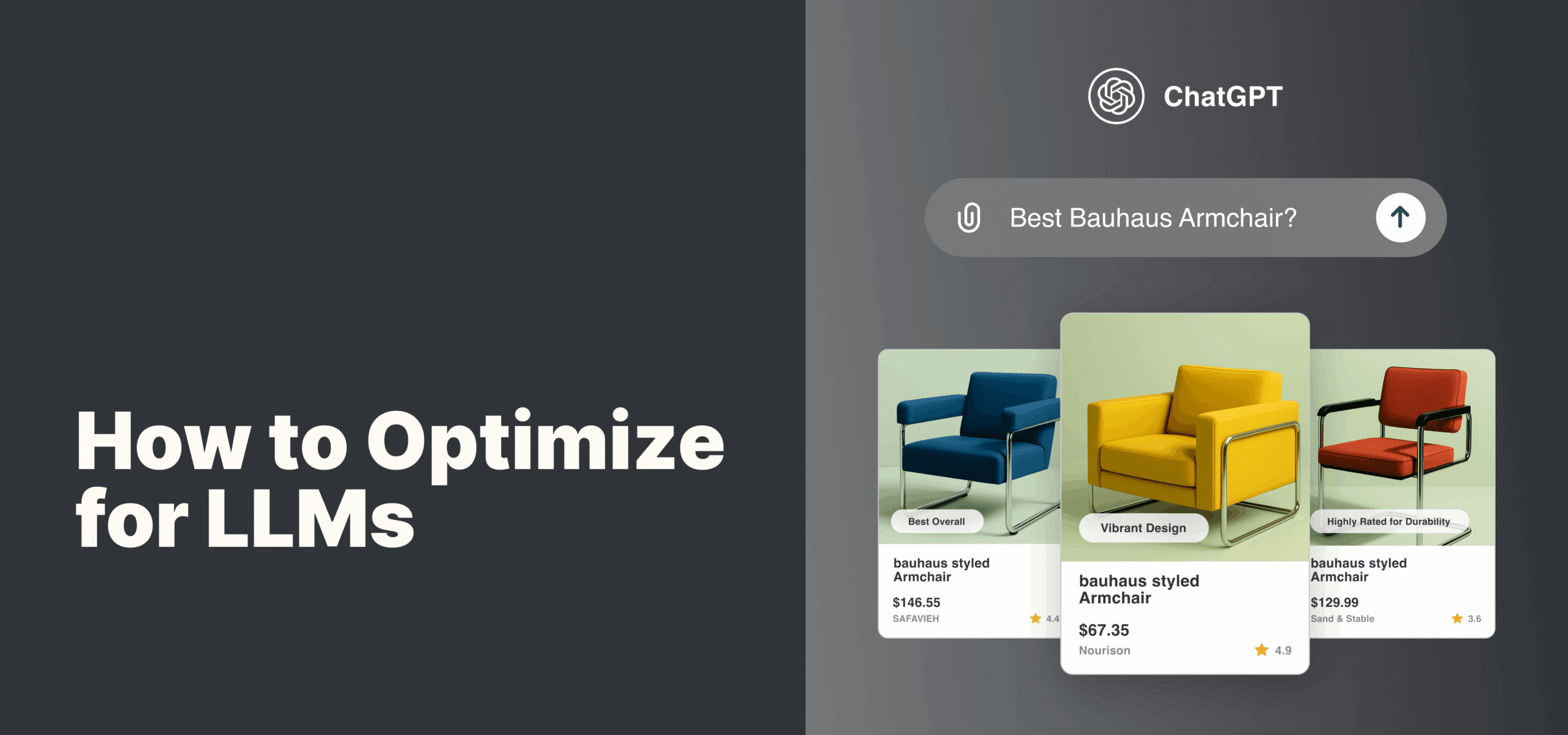
Think about the last time you searched for a product. Chances are, you didn’t just type a keyword; you asked a question. Your customers are doing the same, delegating their research to AI agents like ChatGPT and Perplexity. They expect a direct answer, not a homework assignment of links to sift through.
This shift means visibility is no longer about just ranking #1—it is about being the cited recommendation. LLM Optimization (LLMO) is the strategy of ensuring that when an AI explains your category, your brand is the verified solution.
As the search landscape evolves, marketing teams often hear “LLM Optimization” and “Generative Engine Optimization” used interchangeably. While they both address visibility in an AI-driven world, they represent different mechanisms. To build a coherent strategy, it helps to distinguish the foundation (LLMO) from the tactic (GEO).
LLM Optimization (LLMO) is the strategic process of establishing your brand’s “entity” within the training data and retrieval layers (RAG) of Large Language Models. Think of LLMO as “Brand Readiness” for machines. It focuses on Entity Association—helping the model understand who you are, what you sell, and who you serve before a user ever types a query.
When an LLM (like GPT-4 or Gemini) processes a prompt, it relies on semantic vectorization—converting words into numerical values to understand relationships. If your brand is not mathematically associated with concepts like “enterprise-grade,” “sustainable,” or “high-performance” in the model’s data, retrieval becomes difficult. LLMO involves technical structuring (such as Schema markup) and authoritative consistency to ensure your brand is recognized clearly.
Generative Engine Optimization (GEO) is the tactical execution of influencing the specific outputs of generative engines (like Google’s AI Overviews, Perplexity, or ChatGPT Search) for distinct user queries. If LLMO is about identity, GEO is about visibility.
GEO focuses on earning the “citation”—the hyperlinked reference that appears in the synthesized answer. This requires optimizing content for “extraction” rather than just “indexing.” Strategies here involve increasing Fact Density, utilizing direct answer formatting (the “Inverted Pyramid”), and structuring data in ways that RAG (Retrieval-Augmented Generation) systems can easily parse.
Effectively executing GEO often requires the foundation of LLMO. If a generative engine does not clearly recognize your entity (LLMO), it may be less likely to cite you as a source (GEO), regardless of your content quality.
We are witnessing a divergence between ranking position and traffic volume. In the past, the top spot on Google guaranteed a predictable click-through rate. Today, the metric of success is evolving toward “Share of Model Voice.”
According to Gartner predictions, search engine volume is expected to drop 25% by 2026 as users migrate to AI chatbots. This doesn’t mean demand is disappearing; it is concentrating. Data from Seer Interactive indicates that brands explicitly cited in AI answers see a 35% lift in organic clicks compared to uncited competitors.
The digital economy is seeing more “Zero-Click” interactions. Recent data indicates that nearly 58% of Google searches now end without a click to a publisher’s website. However, traffic is not disappearing—it is concentrating. The implication is that in an Answer Engine world, becoming a cited source is the most reliable way to drive high-intent traffic.
To optimize for an AI, it helps to understand how it “reads.” Unlike traditional search engines that index content based on keyword matching, Large Language Models (LLMs) process information through Semantic Vectorization.
LLMs convert text into numbers. When a crawler scrapes your product page, it converts your content into “vectors”—strings of numbers that represent the meaning and context of your text in a mathematical space. In this vector space, concepts that are semantically related are clustered together. If your brand’s content is not mathematically aligned with the vectors of your target category, the model is less likely to retrieve it.
This means the goal is Vector Space Proximity. You want to ensure your brand entity is “embedded” as close as possible to the high-value concepts your customers care about. As e-commerce expert Ben Salomon suggests:
“In this new landscape, brand authority is defined by semantic consistency. The goal is for the model to predict your brand as the logical answer to a relevant prompt.”
Most commercial AI search tools use a process called RAG (Retrieval-Augmented Generation). They rarely scan the entire internet for every live query. Instead, the system performs a rapid “pre-search” to pull a limited number of high-confidence documents—often fewer than 20. This is the Seed Set. The LLM reads these documents to synthesize an answer. To be part of the answer, you generally need to be retrieved in this Seed Set.
Understanding the mechanics is the first step. Execution requires a structured approach. The following strategy moves beyond theory into tactical Generative Engine Optimization (GEO).
In a Zero-Click economy, broad traffic volume may be less valuable than high-intent visibility. Focus on “Answer Revenue”—visibility on high-intent queries where the AI recommendation drives a conversion. Instead of optimizing for generic volume, optimize for the specific questions your highest-value customers ask.
Because there is no “Search Console” for ChatGPT yet, you can perform Adversarial Prompting. Query major engines (ChatGPT, Gemini, Perplexity, Claude) with three tiers of prompts:
Keyword research tools show what people typed into Google. They don’t always show what people are asking AI. Users speak to LLMs conversationally. Look at customer support tickets, sales call transcripts, and community threads to find the natural language questions your customers are asking. If customers constantly ask, “How does your product integrate with Klaviyo?”, create a dedicated content asset titled exactly that.
LLMs prioritize information found at the very top of the content when processing lists. Structure articles using the Inverted Pyramid:
LLMs are trained to filter out “fluff.” Content that repeats known information offers less value to the model. Increase the density of unique facts. Aim to include statistics, unique definitions, proprietary data points, or SME quotes regularly to signal that your content is a primary source.
In the past, content teams wrote for humans and algorithms. Today, there is a third audience: the RAG Scraper.
While content is the fuel, technical infrastructure is the engine.
Optimizing for Google’s Gemini requires a different approach than optimizing for Perplexity or ChatGPT.
In a world where AI synthesizes answers, “Brand Authority” acts as a technical retrieval signal. AI models prefer citing entities that appear “safe” and supported by consensus.
Traditional analytics platforms are built on the “click,” but value is often delivered on the results page.
Fresh, verified content is the fuel for LLM visibility. AI models crave “living” data to confirm a business is active and trusted. Yotpo Reviews provides a continuous stream of user-generated content, ensuring your product pages are updated with fresh, keyword-rich text that machines can parse.
Furthermore, by aggregating verified sentiment, you create a semantic footprint that associates your brand with specific, high-value attributes like “quality” and “fit,” helping you secure your place in the answer economy. Additionally, Yotpo’s integration with Google Seller Ratings can increase ad click-through rates by up to 17%, signaling trust to both the algorithm and the user.
The transition to LLM Optimization is a structural evolution of how information is accessed. Search results are expanding to include synthesized answers alongside traditional links. Brands that adapt by optimizing for synthesis rather than just retrieval are better positioned to capture high-intent traffic. By building a high-trust entity, structuring data for machine readability, and leveraging verified reviews, you can ensure your brand remains part of the conversation.
SEO focuses on ranking links in a list by optimizing for keywords and backlinks. LLMO focuses on becoming a cited entity in a synthesized answer by optimizing for semantic authority, entity association, and fact density.
Perplexity prioritizes freshness and community validation. It leans heavily on sources that have been updated recently and brands that have active discussions on “consensus” platforms like Reddit.
Yes. AI engines prioritize “Information Gain.” A small business with a highly specific, expert-written guide can often outperform a generic enterprise page because the AI values the depth and unique data over domain authority alone.
It is not yet mandatory, but it is an emerging standard. Creating an llms.txt file is a strong signal that allows AI agents to easily identify and read your most important content, potentially improving retrieval accuracy.
Reviews are critical for “Entity Sentiment.” LLMs scan user-generated content to understand the qualitative attributes of a brand. A high volume of detailed reviews reinforces the semantic connection between your brand and positive traits, increasing the likelihood of a recommendation.
The best defense against hallucinations is “Entity Consistency.” Ensure your core brand data (pricing, features, return policy) is consistent across your website, schema markup, and third-party review platforms. Contradictory information across the web increases the probability of the AI generating an incorrect synthesis.
Since you cannot track “impressions” in ChatGPT, focus on “Share of Model Voice” (SoMV) and “Share of Citation.” Track how often your brand is mentioned in response to category prompts (e.g., “best enterprise e-commerce platform”) and monitor referral traffic from AI engines like Perplexity or Bing Chat.
No, they are complementary. Traditional SEO captures users in the “information retrieval” phase (looking for options), while LLMO captures users in the “information synthesis” phase (looking for answers). A holistic strategy requires optimizing for both the search engine crawler and the LLM reasoning engine.
This is often a rendering issue. Many AI crawlers are “text-first” and struggle to execute complex JavaScript. If your site relies heavily on Client-Side Rendering (CSR), the bot may see a blank page. Implementing Server-Side Rendering (SSR) ensures your content is legible to RAG systems.
Results vary based on the engine. For “Freshness-First” engines like Perplexity, changes can appear within days as they index the live web. For core LLM training data (like ChatGPT’s base model), establishing entity authority is a long-term play that can take months or years to influence deep model associations.






