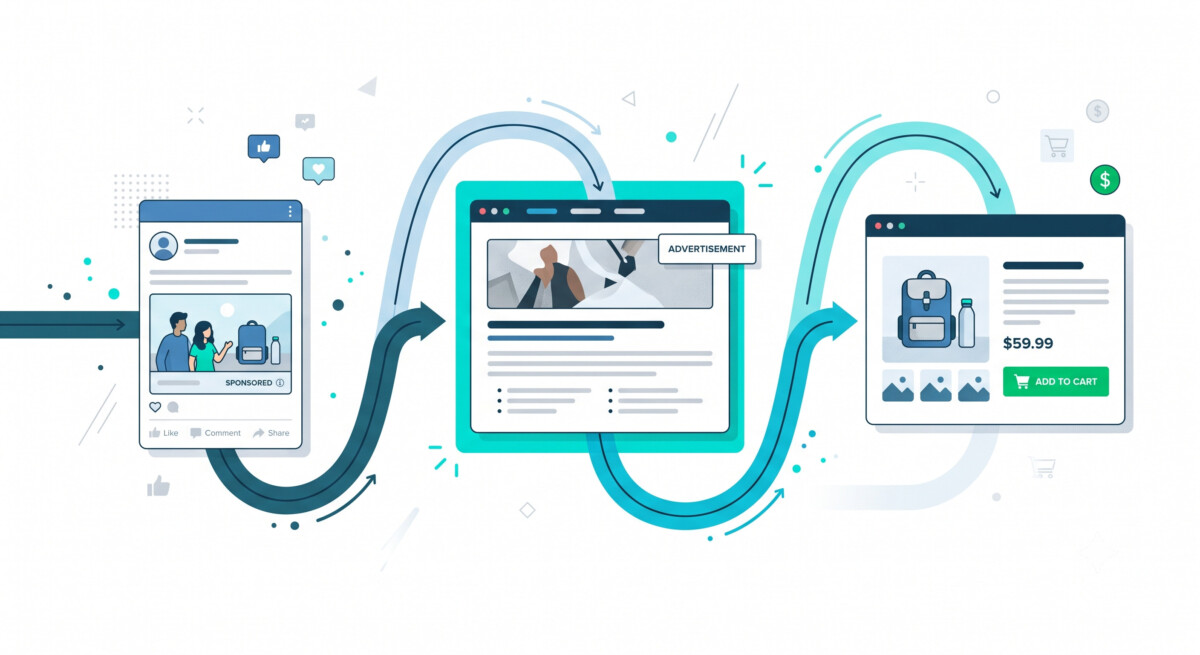
Advertorials lower customer acquisition cost by educating cold traffic before the product page, so the same ad spend converts more buyers. They fit Shopify brands spending $3K or more monthly on Meta or TikTok, and they require a clear Advertisement label to stay FTC compliant.
Cold traffic does not have a conversion problem. It has a context problem, and the page after the click is where context gets built.
Every Shopify operator running paid traffic has watched the same movie. CPMs creep up, audiences get colder, and the product page that converted fine two years ago now burns budget. The usual response is to fix the ads: new creative, new hooks, new audiences. That instinct is understandable, and it is also incomplete, because the structural causes behind rising CAC for Shopify brands live in the business model as much as the ad account. The less obvious fix sits one step after the click, on the page itself.
An advertorial is a landing page written like an article. Instead of a hero image and a buy button, the visitor gets a short piece of education or storytelling that ends in a product recommendation. It sits between the ad and the offer, which is why the broader category is often called a presell page. Media buyers and affiliates have leaned on the format for decades because it does one job well: it turns a stranger into someone ready to hear a pitch.
There are real numbers behind it, though they deserve honest framing. Ezra Rufino, founder of the DTC brand Pow, ran the same ads to an advertorial instead of his product page and reported a 46 percent drop in customer acquisition cost on his own supplement campaigns. That first-party test became the basis for Landra, an AI tool that writes, designs, and publishes advertorial, listicle, and presell pages for brands running cold traffic. One founder’s self-reported result is not a guarantee for your brand, and it has not been independently verified, but the direction matches what paid media teams have reported for years: cold traffic buys more when it is educated first. Whether you are doing $10K months or $1M months, the mechanism in this piece applies. The spend threshold where it earns real attention comes later.
Product pages struggle with cold traffic because they are built for someone who has already decided to consider you, and cold visitors have made no such decision. A product page assumes the visitor knows what the product is, roughly what it costs, and why it might matter to them. Cold traffic has none of that context. The person who stopped scrolling because your ad made a sharp point about afternoon energy crashes or frizzy hair is curious, and curiosity is a long way from intent. Drop that person onto a page that opens with a price and an add to cart button, and the most common outcome is the back button. As an illustrative benchmark, product pages receiving cold paid traffic commonly convert in the 1.8 to 2.5 percent range, a fraction of what the same page does with warm or retargeted visitors.
There is also a congruence problem. Good ads sell a promise or a feeling. Product pages sell specifications. When the page after the click looks and reads nothing like the ad that earned the click, trust drops and conversion rate follows. Media buyers call this losing the scent, and it quietly drains accounts that otherwise have strong creative. It is one of the reasons brands that scale Meta and Google Ads while protecting ROAS obsess over what happens after the click as much as the creative itself. The ad and the landing experience are one system. Optimizing half of it caps the return on the whole thing, no matter how good your hooks are.
An advertorial keeps the conversation going in the voice the ad started it in, holding the product back until the reader has context to want it. The common structures are a first person story, a problem and mechanism explainer, or a listicle, the familiar seven reasons format that works especially well for supplements, beauty, and household products. The product usually stays out of the first third of the page. By the time it appears, typically past the halfway point, the reader understands the problem, the mechanism behind it, and why the obvious solutions fall short, so the recommendation reads as a conclusion rather than an interruption.
The format earns its keep on consideration heavy products. Anything with a new ingredient, an unfamiliar mechanism, or a higher price point benefits from the room an advertorial provides. A reader who reaches your product page after that warm-up behaves differently from one who landed there cold. This is also where stage matters. If you are under $10K a month in revenue and still finding product market fit, an extra page layer is premature complexity; spend that energy on the offer and the product page itself. Once you are spending $3K or more a month pushing cold traffic, the presell layer starts paying for the effort it takes to build.
Advertorials lower CAC by raising the number of customers the same spend produces, not by making clicks cheaper. Customer acquisition cost is spend divided by new customers, so there are only two levers: pay less for clicks or convert more of them. If you are fuzzy on your baseline, start with how to measure and contextualize your CAC before touching the funnel, because a test without a trustworthy baseline proves nothing. Advertorials pull the second lever. When the same spend produces more purchases because the page does the persuading, CAC falls even if CPMs never move. Stronger post-click engagement can also feed back into delivery, since ad platforms tend to reward destinations people actually stay on, though treat that as a bonus rather than the plan.
The trade-off is an extra step. Some visitors will read the advertorial and never click through to the offer, and that is acceptable. The ones who do click arrive pre-sold, which typically shows up as a higher conversion rate on the product page and, for many brands, a healthier average order value, because a convinced buyer is more open to bundles. Run the math on your own numbers before building anything. A brand spending $15K a month at a $60 CAC acquires 250 customers. If a presell page lifts post-click conversion enough to bring CAC to $45, that same spend acquires 333 customers, an extra 83 buyers a month without a dollar of new budget. Even a result far short of the 46 percent headline number changes the P&L.
The pages that convert share a sequence, and the sequence matters more than the tooling. You can hand-build advertorial pages in any Shopify landing page builder such as PageFly, Replo, or Zipify Pages, or generate a first draft with an AI tool and edit from there. Agencies commonly quote around $2,000 and one to two weeks for a single hand-built advertorial, which is exactly why testing multiple angles used to be an eight-figure-brand luxury.
The sequence runs six steps. First, start from your winning ad: the hook that earned the click tells you the angle the page should carry through, in the same vocabulary. Second, open on the problem. The first few hundred words should read like something a magazine would publish, useful even to a reader who never buys. Third, hold the product back, introducing it only after the problem and the mechanism are established, usually past the halfway point of the page. Fourth, stack specific proof: customer quotes, usage numbers, and guarantees beat adjectives, and specifics are what skeptical readers scan for.
Fifth, use one call to action, repeated. Every link on the page should go to the same next step, with no site navigation to wander off into. A presell page with a menu is paying to hand visitors an exit. Sixth, label it as an ad, placed at the top of the page. That last step gets skipped more than any other, and the next section explains why skipping it is the most expensive mistake on this list.
Advertorials must be clearly labeled as advertising, and that is not optional housekeeping. The format borrows editorial clothing, which is exactly why regulators pay attention to it. The FTC’s native advertising guidance is direct on this point: if content is an ad, people need to be able to tell before they engage with it, in plain language, placed where they will actually see it. In practice that means a clear label such as Advertisement or Paid Advertisement near the top of the page, no invented publications or fake reporters, and no vague labels like Promoted, which the FTC flags as ambiguous.
Meta adds its own layer through landing page quality reviews, so exaggerated claims put both the page and the ad account at risk, and a suspended ad account costs far more than any conversion lift the page delivered. Brands that run this format at scale treat honest disclosure as part of the system rather than a legal afterthought. It keeps ad accounts alive, and readers who feel tricked do not become repeat customers. This aligns with a pattern worth internalizing at every revenue stage: the presell page is the start of a customer relationship, not the end of a transaction. A page that earns trust with a clear label and a genuinely useful first 500 words is doing retention work before the first purchase even happens.
Test an advertorial at the campaign level, judged on CAC and revenue per session, or the result will mislead you. Same audience, same creative, one ad set pointed at the product page and one at the advertorial. Judge the result on CAC and revenue per session rather than page conversion rate alone, since the advertorial adds a click and will always look worse on that single metric. This is the same discipline behind why a green ROAS can quietly hide an unprofitable business: a single dashboard metric, viewed in isolation, tells a story that your bank account may not confirm. If you run a measurement stack like Triple Whale, set the comparison up there so both arms are read through the same attribution lens.
Give the test enough spend to mean something. A weekend and fifty dollars will tell you nothing; plan on $500 to $1,000 per variant and two to three weeks, enough to clear the learning phase and collect a sample you can trust. And expect variance by angle, because the second or third advertorial concept often beats the first. That is normal, not failure, and it is the reason the format rewards brands that can produce and test angles cheaply.
None of this is new. Advertorials predate the internet, and they keep coming back because the underlying problem, selling to strangers at a profit, has not changed and will still be the problem in 18 months. If CAC has been creeping up while your product page has stayed the same, the page between the ad and the offer is usually the cheapest place to look next.
Yes, advertorial pages need a clear disclosure because the FTC treats advertorial content as advertising, and its commercial nature has to be evident before people engage with it, in words they understand. A visible Advertisement or Paid Advertisement label near the top of the page is the standard approach, and vague labels like Promoted are flagged as ambiguous. The requirement applies whether a person or an AI tool wrote the page, and it applies on top of any platform rules. Meta’s landing page quality reviews add a second layer of enforcement, so honest labeling protects your ad account as well as your legal standing. Treat the label as part of the page template, not a case by case decision.
Presell page is the umbrella term for any page that warms up traffic between the ad and the offer, while advertorial and listicle are two structures a presell page can take. An advertorial presents the argument as an editorial style article, often a first person story or a problem and mechanism explainer. A listicle organizes the same argument into a numbered rundown, such as seven reasons format, which scans faster and suits supplements, beauty, and household products. They do the same job with a different structure, and many brands test both formats against the same winning ad to see which angle their audience responds to.
An advertorial should be long enough to move a reader from curious to convinced, which for most DTC products lands somewhere between 800 and 1,500 words. Complex or expensive products can support more length because the reader needs more education before the recommendation feels earned. Padding actively hurts, since every unnecessary paragraph is another chance for the reader to leave before reaching the call to action. A useful editing test: if a paragraph does not build the problem, explain the mechanism, or stack proof, cut it. The goal is the shortest path to a convinced reader, not a word count.
Yes, Meta and TikTok approve advertorial landing pages when the page is honest, clearly disclosed, and functional. Rejections almost always trace back to exaggerated health claims, fake endorsements, fabricated publications, or missing disclosures rather than to the format itself. Both platforms run landing page quality checks alongside ad review, so a page that overpromises can drag down delivery or trigger account level penalties even if the individual ad was approved. Keep claims specific and supportable, label the page as an advertisement at the top, and make sure the page loads fast and works on mobile, since broken experiences also count against landing page quality.
No, advertorials do not work for every product; they do their best work on products that need explanation or justify a considered purchase. A new ingredient, an unfamiliar mechanism, or a higher price point gives the format room to add persuasion that a product page cannot. For a cheap impulse buy with instant visual appeal, a strong product page may be all you need, and the extra click can add friction without adding conviction. Stage matters too: brands under roughly $10K a month are usually better served fixing their offer and product page first, while brands spending $3K or more monthly on cold traffic have the volume to test the format properly.