
How one enriched product record makes adding a channel routine
A brand decides to add a new marketplace. Maybe it is Walmart, maybe eBay, or maybe TikTok Shop. The commercial case is easy to make, and the channel lands on the roadmap, where it can sit untouched for two quarters.
Retailers usually know where their shoppers are moving, but adding a new marketplace to reach them can seem onerous. Getting thousands of products into the format a new channel requires takes weeks, and the prospect of that work, sitting alongside worries about what might break on the website and the existing channels, is enough to push it to next quarter.
It does not have to work this way. Adding a sales channel can be as routine as adding a product, as long as the underlying product data is structured once to serve every channel. This article looks at why adding a marketplace takes so much work today and what changes for a brand that manages its product data from one source rather than many.
Every marketplace has its own product data specification. Walmart expects attributes structured one way, eBay expects another, and each social storefront enforces its own rules for titles, images, and categories. Adding a channel means re-authoring product titles and attributes to that specification and meeting its image standards, and then wiring up price and inventory sync so nothing goes stale and catching listing errors before the channel rejects them. Multiply that across a catalog of any real size and the effort rivals running a second storefront.
The effort traces back to how most catalogs were built. Product data was authored once, for the website, then patched channel by channel in separate spreadsheets and seller consoles. Each new marketplace starts again from close to zero, and over time the versions fall out of sync. The price on Amazon lags the price on the site, the Google feed carries last season’s description, and no single product record holds the version everyone can trust.
Those inconsistencies get expensive at scale. A retailer with 25,000 products already distributing to around 70 outbound channels is maintaining 1.75 million product-channel combinations. Every marketplace a brand adds layers another set of combinations onto a total that no team was staffed to manage by hand. Seen against that backdrop, the two-quarter delay makes sense. The operating model makes each new channel cost about as much as the last, so teams learn to treat every expansion as a fresh project rather than a repeatable move.
A single persona of product data is now not enough.
Mark Batson
Head of Go-to-Market Technical Operations, Athos Commerce
Think about how a merchandising team adds a product. Someone enters the item once, the attributes populate, and the product flows to wherever it needs to appear. No one treats a new SKU as a project with its own timeline. Adding a marketplace should feel about the same, and it can, once the brand holds one enriched product record instead of many channel-specific copies.
A single enriched product record carries the master attributes that never change, such as identifiers, materials, and dimensions. Channel-aware treatments layer on top of that record, so the Google title, the Walmart attribute set, and the social headline all generate from the same source. In that model, adding a marketplace means shaping product data the brand already owns to the new channel’s rules and publishing it, with no catalog to rebuild. The second channel costs a fraction of the first, and the tenth costs less again.
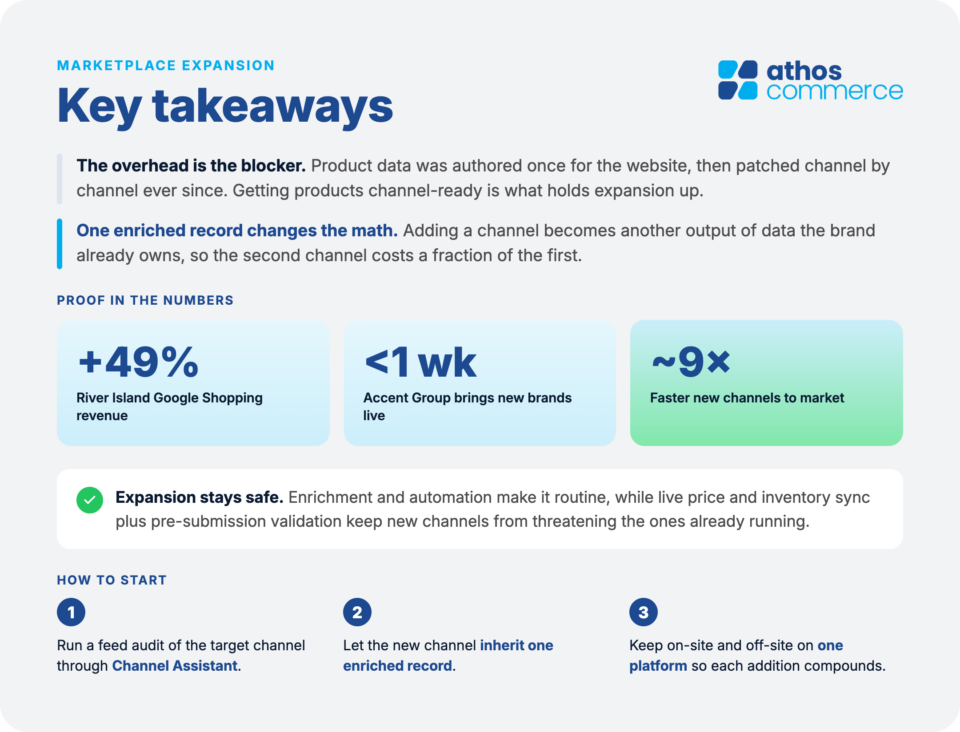
River Island saw the payoff of a well-structured product record. Launching product feeds on Google Shopping through this approach, the retailer grew revenue on the channel by 49%.1 Getting there did not require a new catalog or a separate team, because the product data was already structured well enough to move onto a new channel and perform there.
Two capabilities turn the one-record idea into daily practice. Enrichment shapes the canonical product record into channel-ready variants without a person rewriting each one. A product feed that satisfies Google’s relevance rules needs different fields from a marketplace attribute set or a social headline, and modern enrichment generates every version from the same source. For the field-level detail of what each channel rewards, our companion piece on optimizing one product record for Google, marketplaces, and social walks through it channel by channel.
Automation carries that work at scale. A team of ten merchandisers cannot hand-author a new channel across thousands of products, so the model only holds when software audits the product data and generates the channel-ready variants, then validates every listing before a marketplace has the chance to reject it. That continuous loop of audit, fix, and test is the operating model behind centralized feed management, which our guide to syndicating every channel without breaking operations covers in depth. Athos Commerce is the intelligent discovery and feed management platform that runs this loop across on-site and off-site discovery, unifying search, merchandising, and personalization with product feed management on a single system.
These capabilities also remove the risk that holds the decision back. Live price and inventory sync means a new channel never advertises a product the brand cannot fulfill, and pre-submission validation catches the errors that would otherwise surface as rejected listings or a suspended account. Expansion stops threatening the channels already running, which is often the real reason a brand hesitates in the first place.
When expansion becomes routine, the timeline drops from months to days. A brand that moves that fast reaches a new channel while competitors are still scoping the project, and on a channel that is still growing, arriving first is the whole advantage.
Accent Group runs its portfolio this way, handing Athos Commerce the source feed whenever it takes on a new brand and bringing that brand live within a week.2
When we add a new brand to our portfolio, we simply provide the source feed to Athos, and the brand goes live within a week. The onboarding is incredibly fast.
Hayley Sward
Digital Marketing Manager, Accent Group
The same pace carries across channels, well beyond onboarding. Brands running marketplace management from one product record are roughly nine times quicker to market on a new channel.3 For a growth leader, that speed shows up as revenue captured on each new channel sooner, and reached without the added headcount a manual launch would require. The number of marketplaces, social storefronts, and AI shopping engines worth selling on keeps climbing, and Gartner expects 20% of monetary transactions to be programmable by 2030. The brands that can expand quickly will reach those channels first.4
A brand does not have to solve every channel at once to make expansion routine. Three moves, taken in order, turn it from a project into a capability.
A centralized approach to marketplace expansion manages one enriched product record as the single source for every sales channel, then generates channel-ready variants from it. Instead of re-authoring product data for each marketplace in separate spreadsheets, a brand shapes the record once and points each new channel at it. Adding a marketplace becomes a configuration step rather than a project, so the operational overhead no longer holds expansion back as the number of channels grows.
Adding a new marketplace usually takes weeks because most product catalogs were authored once for the website, then patched channel by channel. Each marketplace has its own product data specification for titles, attributes, images, and categories, so a brand re-authors data for every destination and wires up price and inventory sync before launching. A retailer with 25,000 products across roughly 70 channels already maintains 1.75 million product-channel combinations, and every new marketplace adds another layer to manage.
Managing each channel separately means maintaining a distinct listing per marketplace, and those listings fall out of sync over time as prices and descriptions change in one place but not another. Centralized product data keeps one canonical record and generates each channel’s variant from it, so a single correction flows everywhere. The difference compounds at scale: separate management multiplies work with every channel, while a centralized product record lets the second and tenth channels cost far less than the first.
With product data centralized, launch times drop from months to days. Accent Group provides a source feed to Athos Commerce and brings each new brand live within a week, and brands running marketplace management from one product record are roughly nine times quicker to market on a new channel. Speed matters because the marketplaces, social storefronts, and AI shopping engines worth selling on keep multiplying, and the brands that expand fastest reach growing channels before competitors do.
Start with a product feed audit of the target marketplace before committing headcount or a timeline. An automated audit, such as Athos Commerce Channel Assistant, checks product data against the channel’s rules and reports blocking issues in days, so the decision rests on evidence. From there, point the new channel at one enriched product record rather than re-authoring the catalog, and keep on-site and off-site discovery on a single platform so each channel added builds on the last.




