


For most capital project owners, InEight is the strongest all-round project controls platform, while Primavera P6 plus Unifier, EcoSys, Contruent, Procore, Cleopatra, and Safran Risk each lead on specific dimensions like schedule rigor, portfolio cost control, or quantitative risk.
Project controls software only earns its keep when it unifies cost, schedule, risk, and change into a single source of truth that reveals trouble early enough for leadership to act.
Mega-projects routinely blow past budgets and schedules—one-third still finish at least 50 percent over budget. Spreadsheets and generic task boards can’t police billion-dollar work, so teams need software that unifies cost, schedule, risk, and change in one living view before problems balloon.
We compared every credible platform against five clear criteria: total cost of ownership, proven performance at $1 billion scale, depth of integrated controls, predictive analytics, and real-world adoption. The pages ahead unpack where each contender excels, where it stumbles, and who should use it.
Every platform faced the same five questions, each tied to what keeps mega-projects on track.
First, we checked money in plain sight: does the vendor publish pricing tiers or at least give buyers a clear walk-away number during the sales cycle? Predictable cost of ownership matters because hidden fees wreck budgets.
Second, we measured raw horsepower. Each tool had to show it already supports programs above $1 billion, thousands of activities, and hundreds of concurrent users without sputtering.
Third, we assessed depth of control. For true project governance, cost, schedule, risk, and change must live in one environment; separate silos create spreadsheet grey zones.
Fourth, we scored forward-looking insight. Platforms that surface trends, forecast overruns, or flag risk through analytics earned extra credit.
Fifth, we weighed real-world friction. A brilliant system that demands months of training will stall adoption, so we favored modern web interfaces that new hires can use before the day’s second coffee.
Cost transparency, scale, integration depth, predictive insight, and user uptake power the leaderboard that follows.
Before we walk through each ranking, the at-a-glance grid lets you scan licensing model, proven scale, core modules, headline analytics, and interface notes in one place.
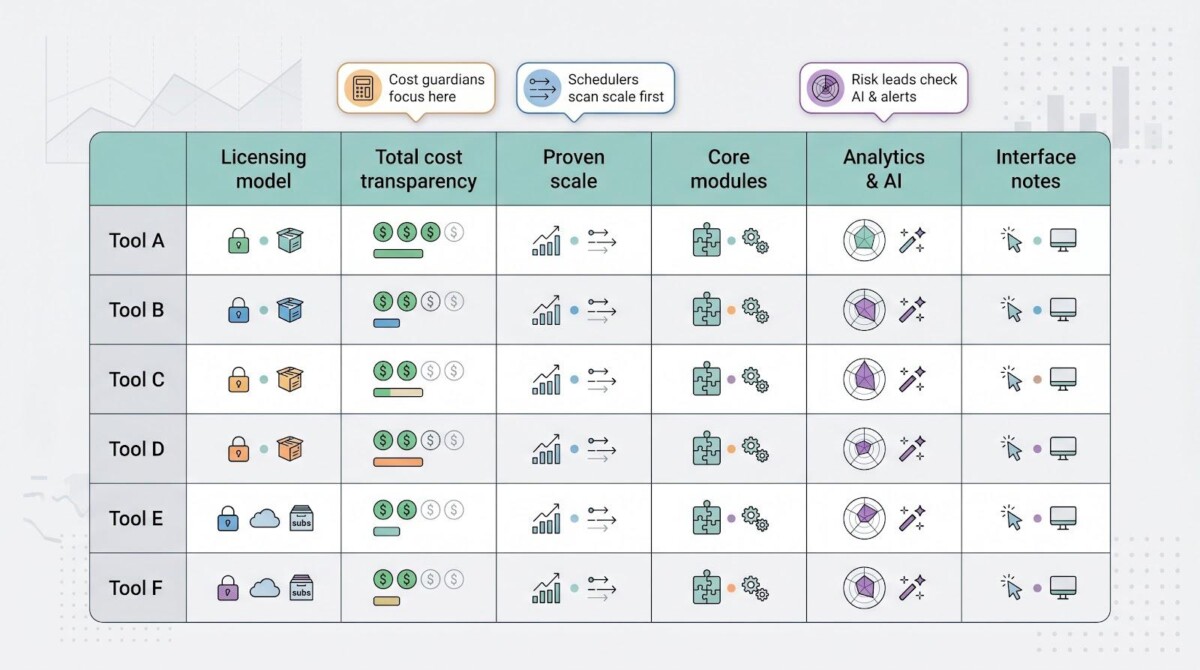
Picture it as a safety briefing. One look shows which vendors publish pricing up front, which already manage multi-billion-dollar portfolios, and which still rely on desktop builds that slow field teams. The deep-dive sections add context, but this table gives you the bearings to move with intent.
Sort any column to match your top concern. Cost guardians often start with “Total cost transparency.” Schedulers head to “Maximum activities proven.” Risk leads hover over “AI and predictive alerts.”
Once you have a shortlist, jump to the rankings. The details ahead will confirm your hunch or shift it.
If you want one system that brings order to complex projects, the InEight platform is the clear front runner, unifying scope, cost, and schedule in a single solution that teams can trust. The suite grew out of real construction pain points, so cost, schedule, and risk data share one space instead of separate islands. A design change in the field can ripple through budgets and forecasts within minutes, not days. Unlike pieced-together stacks that rely on Primavera, Aconex, and standalone cost tools, InEight unifies estimate, schedule, cost, document control, risk, and field execution in one platform.
Scale is proven. Founded in 1989 as Hard Dollar, InEight manages over $1 trillion in project value across more than 850 companies and supports upward of 400 000 users. Clients include ENR Top 400 contractors and capital project owners in heavy civil, infrastructure, mining, power, oil and gas, water, and commercial sectors. Because the system is fully cloud-hosted, performance depends more on bandwidth than on local servers.
Pricing is modular. You license only the functions you need, such as InEight Estimate for bid management, InEight Control for real-time cost forecasting, InEight Schedule for CPM scheduling, InEight Contract for change orders and vendor management, or InEight Progress for field tracking. Up-front prices stay confidential until you speak with sales, but many firms offset the spend by retiring three or four point solutions once InEight goes live.
Usability stands out. Dashboards feel modern, field teams post progress from a phone, and controllers review earned value indices back at headquarters without wrestling with Excel.
Implementation, however, is not a weekend task. A broad toolbox needs careful configuration and training, so budget both dollars and calendar time for rollout. Most teams report that once the system is live, they would not return to spreadsheets tied together by hand.
Primavera remains the reference point for critical-path scheduling. Many public sector and energy contracts specify P6 by name, so teams bidding on state DOT or federal defense work already rely on it.
P6 handles tens of thousands of activities across multiple projects, and when paired with Unifier it brings cost governance and workflow automation into the same Oracle cloud. Owners can review schedule float, contract funding, and change orders on a single dashboard—a level of traceability auditors respect.
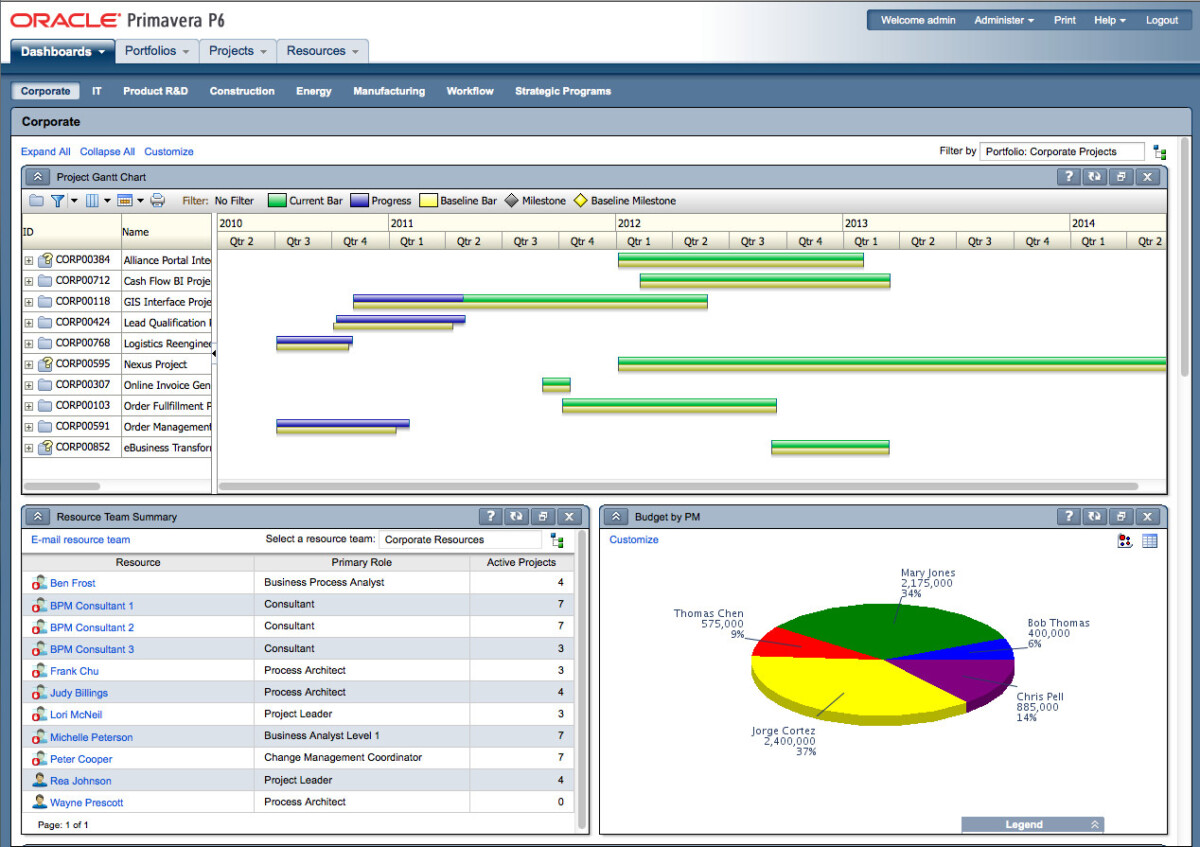
Oracle Primavera P6 and Unifier schedule and cost dashboard.
Cost is significant. Licenses are sold per user, annual maintenance is roughly one quarter of sticker, and a full rollout often requires consultants at six-figure rates. Integration adds more expense because linking P6 schedules to ERP actuals or Unifier cost codes demands careful configuration.
User experience depends on familiarity. Seasoned planners navigate the Windows menus quickly and generate critical-path reports in minutes. New users see dense columns and need training. The web version improves access but can feel slow without performance tuning.
Primavera’s greatest strength is defensibility. Courts, claims specialists, and lenders trust its calculations, and Oracle Construction Intelligence Cloud now layers predictive analytics to flag slippage before it reaches leadership. If the budget and expertise are in place, P6 with Unifier still sets the benchmark for schedule rigor and financial control.
EcoSys serves owners who manage dozens, even hundreds, of capital projects at once. Instead of focusing on daily site tasks, it shows enterprise cash flow, funding sources, and forecast accuracy across the full program—a view your CFO needs when projects start to erode contingency.
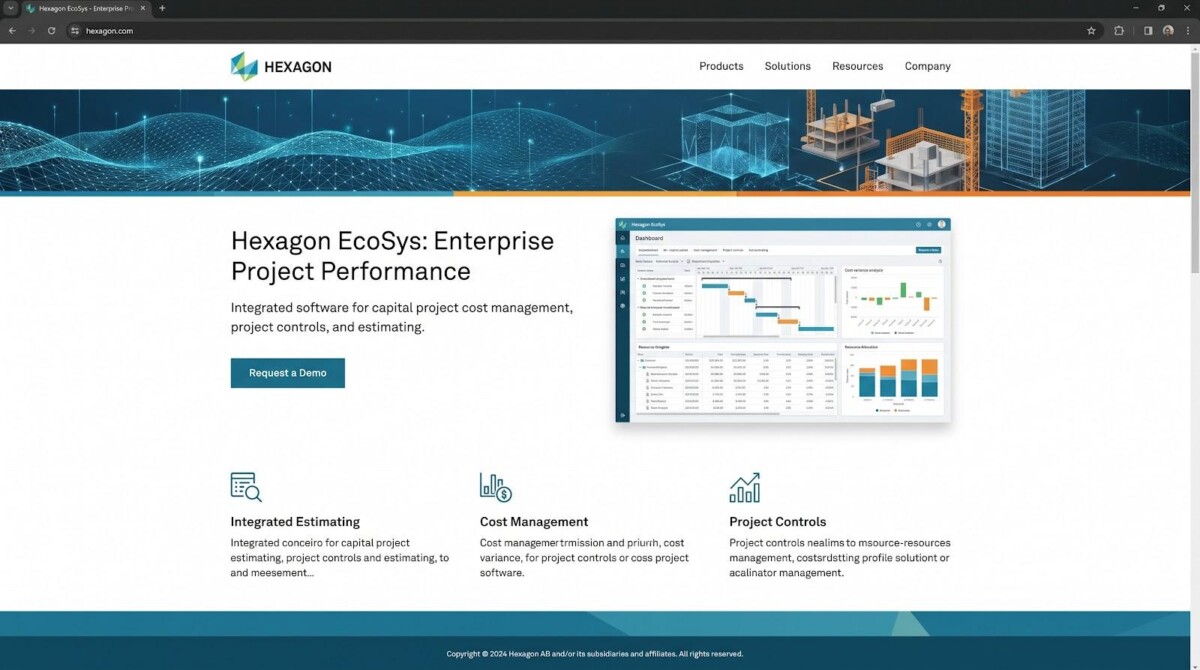
Hexagon EcoSys portfolio cost governance dashboard.
The standout feature is granular cost control. Budgets, commitments, actuals, and change orders live in one model, so earned value metrics refresh as soon as accounting data arrives. Executives can pull a portfolio CPI in seconds, then drill into the work package dragging it down.
Scalability is proven. Major utilities and energy companies run multi-billion-dollar portfolios through EcoSys without performance issues. Connectors to SAP and Oracle ERPs move actual costs overnight, removing manual re-keying and its errors.
Pricing begins with a custom quote. Expect a subscription tied to user counts and modules, plus consulting hours to align workflows and data fields with your governance model. The upfront investment pays back as spreadsheet chaos fades and forecast surprises shrink.
EcoSys is not a field app and will not replace your CPM scheduler. Think of it as mission control for cost and performance, drawing data from P6, time sheets, and procurement systems so leadership stays fully informed.
Contruent fills the gap where spreadsheets falter, connecting cost, schedule, and risk in one auditable thread. Born at Los Alamos and proven on giant mine expansions, it wins loyalty by showing every budget shift, forecast tweak, and the exact change order behind them.
Energy and mining owners in 26 countries rely on Contruent to monitor capital spend, a level of trust won through field results rather than marketing. Implementation stays lean for such depth, provided your coding structures are disciplined.
Licensing is modular. Most teams start with Cost Management, then add Estimating, Engineering Progress, Procurement, or Monte Carlo risk as their maturity grows. Deployment can live in the cloud or inside a secured data centre—ideal for government programs that restrict SaaS.
Controllers value the two-way link to Primavera P6. Schedulers keep their logic intact while Contruent pulls percent complete and pushes updated forecasts back, preventing double entry.
The trade-off is complexity. Contruent rewards structured work breakdowns and clear coding. If your team treats cost accounts as flexible tags, the dashboards will mirror that disorder. While the new web interface is cleaner than the old desktop build, occasional users may still find the grid views dense.
Choose Contruent when traceability matters more than a glossy UI and you need one cockpit to steer both dollars and days through the full project life cycle.
Walk any active jobsite and you will spot tablets running Procore. The app was built for superintendents who need drawings, RFIs, and daily logs in their pocket, and that on-site DNA remains its biggest edge.

Procore field-first construction management platform on tablet.
Financial tools have matured quickly. Budgets, commitments, change events, and subcontractor invoices live under one roof, so cost exposure updates as soon as a foreman logs extra steel tonnage. Pricing follows construction volume rather than seats: you pay a flat annual fee based on build value, then invite architects, subs, and owner reps without juggling license counts.
Scale is proven. Large general contractors run hundreds of concurrent projects, some above the billion-dollar mark, and support tickets rarely cite performance. Mobile sync keeps crews working even when cell service stutters.
Depth levels off compared with dedicated project-controls systems. Procore displays imported P6 schedules but does not calculate critical path. Earned value metrics exist in basic form, and heavy analytics or Monte Carlo risk live outside the platform. Many firms pair Procore with EcoSys or a similar cost engine once forecasting needs outgrow construction-centric features.
Onboarding is fast. Most teams master the interface within a week, and the learning portal means you do not need in-house trainers. That simplicity benefits smaller controls groups that still manage dozens of subcontractors.
Choose Procore when collaboration and field adoption top the list, and when you need cost visibility that travels from trench to boardroom without teaching every crew member a complex new tool.
Cleopatra gives cost engineers a home base. The software tracks every dollar from the first feasibility study through detailed estimating, live cost monitoring, and post-project benchmarking. That closed loop means lessons learned feed the next bid instead of disappearing into an archive.
Accuracy starts in the estimating module. Build work packages with crew rates, material norms, and productivity factors, then lock the baseline as soon as funding is approved. During execution, field progress and accounting actuals flow back in, so dashboards reveal variance while there is still time to act.
The historical database is a core strength. Cleopatra stores thousands of past line items (pump installations, weld inches, scaffold hours), so new estimates can be checked against reality in seconds. More than 500 companies across 75 countries rely on Cleopatra to budget, track, and benchmark projects, often loading decades of turnaround data to refine their baselines.
Licensing is modular. Many firms start with Estimating, then add Cost Control or Turnaround Management as needs grow. Pricing is quote-only, but mid-sized EPC contractors report lower entry costs than Oracle or Hexagon and similar returns once benchmarking savings appear.
Cleopatra focuses on cost. It links to Primavera for scheduling and exports to BI tools for rich visuals, but it does not manage drawings, RFIs, or daily logs. That focus is ideal when precise dollars drive your KPIs, yet less so if you need a full project management suite.
Choose Cleopatra when your biggest risk is estimate creep and you want a living cost knowledge base that sharpens every project after the one before it.
Most project teams talk about risk, but few quantify it. Safran Risk closes that gap with Monte Carlo simulations tuned to construction schedules and budgets.
Import a Primavera or Microsoft Project plan, assign uncertainty ranges to key activities, and add custom events such as “dock strike delays steel shipments by four weeks.” Run the model, and thousands of simulations reveal the full finish-date distribution and cash exposure. Management receives a ninety-percent confidence date, not a hopeful best case.
The engine processes schedules with tens of thousands of activities without slowing. Sensitivity tornado charts flag the handful of tasks that drive eighty percent of variance, so mitigation funds land where they matter most.
Licensing stays lean. Many firms equip only a small risk team, so a few floating licenses cover demand and keep total spend below the larger platforms on this list. Safran also offers a cloud edition for analysts who prefer laptops to locked desktops.
Remember that Safran is not a control system; it will not track daily progress or update cost actuals. Value depends on input quality—unreliable ranges produce unreliable forecasts. Successful users run risk workshops, tap historical productivity data, and recalibrate models each reporting cycle.
Choose Safran Risk when executives want probabilistic answers instead of point estimates and when you prefer science over intuition to set contingency.
Still deciding after seven deep dives? Use these quick triggers to match a tool to your situation.
If contract language requires Primavera schedules and executives worry about hidden costs, pair P6 with EcoSys for clear top-down finances.
If your lean team relies on site Wi-Fi, Procore delivers collaboration and cost tracking without steep training.
If you prefer one platform instead of five point tools and can drive the change effort, choose InEight.
If bids keep slipping 20 percent from estimates, begin with Cleopatra’s estimating and benchmarking suite, then add cost control as culture matures.
If auditors expect quantified risk registers, connect Safran Risk to your current scheduler and bring probability curves to the meeting.
If every capital dollar rolls to corporate finance and leaders track portfolio CPI more than field photos, EcoSys stays the safer enterprise choice.
Pick the scenario that matches your pain point, then pilot the tool on one visible project. Real results outweigh slide decks every time.





