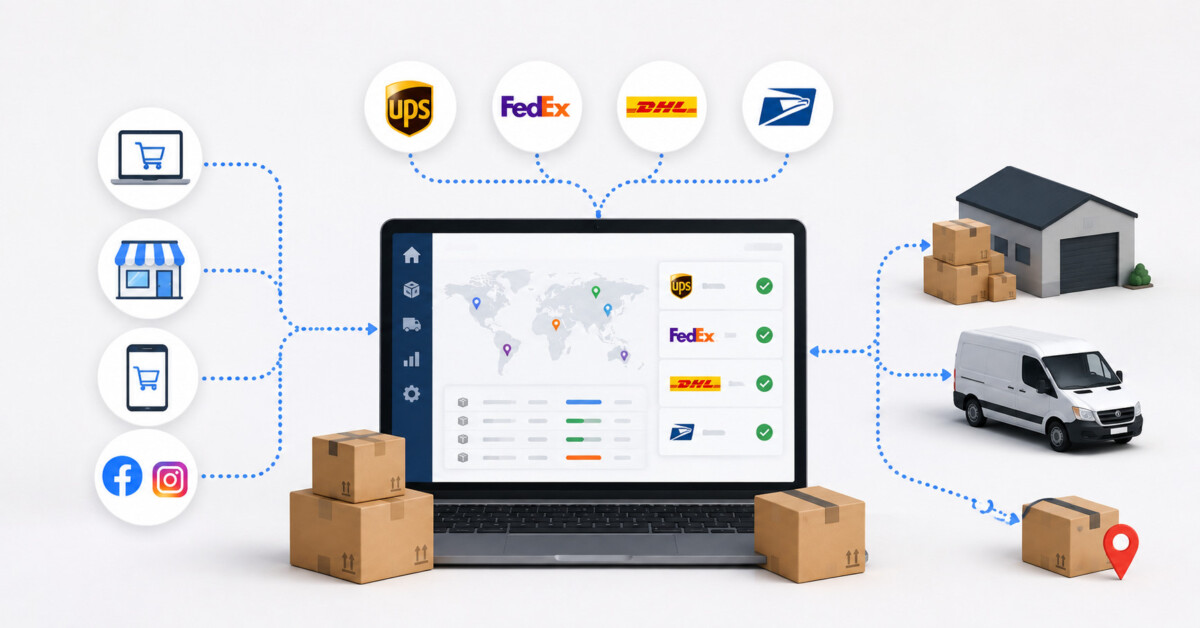
Multi-carrier shipping software supports omnichannel fulfillment by centralizing carrier selection, label creation, tracking, and shipping rules across every order source. It works best when inventory, order routing, and returns data are synchronized, so teams can choose the right fulfillment location and carrier without manual reconciliation.
Omnichannel fulfillment breaks when each channel has its own order, inventory, carrier, and returns process. The winning operational move is not adding more tools. It is making every tool act on the same trusted order data.
Shopping habits have changed dramatically over the past decade. Consumers no longer rely on a single website or physical store when making purchases. They browse social media, compare prices across marketplaces, order directly from brand websites, and expect the flexibility to buy online while picking up in a local store. For businesses, these changing expectations have transformed fulfillment into something much more complex than simply packing boxes and printing labels.
An omnichannel approach allows companies to connect every sales channel into one customer experience. Inventory, orders, returns, and shipping all need to work together without creating confusion behind the scenes. While this strategy offers tremendous opportunities for growth, it also introduces logistical challenges that can quickly overwhelm businesses relying on manual processes. Efficient shipping technology has become an important part of keeping operations organized as order volumes increase across multiple platforms.
Selling through several channels means every order may arrive with different requirements. A customer ordering through an online marketplace might expect a different delivery timeline than someone purchasing directly from a company website. Retail partners may have strict compliance rules, while in-store pickup orders require a completely different workflow than home deliveries.
Managing these differences manually becomes increasingly difficult as a business grows. Employees may find themselves logging into multiple carrier portals, comparing shipping costs by hand, updating tracking information separately, and trying to ensure inventory stays synchronized across every channel. Small inefficiencies begin to multiply, increasing the risk of shipping delays, incorrect labels, or unnecessary transportation costs.
The challenge isn’t simply shipping more packages. It’s shipping them consistently while maintaining visibility over every order regardless of where it originated.
One of the biggest advantages of centralized shipping technology is the ability to manage several transportation providers through a single interface. Instead of committing every shipment to one carrier, businesses can evaluate available services based on destination, delivery speed, package size, and pricing.
Using multi-carrier shipping software allows fulfillment teams to compare carrier options without constantly switching between different systems. This streamlines daily operations while helping businesses choose the shipping service that best matches each order’s requirements. A lightweight residential package may travel most efficiently with one carrier, while larger commercial shipments could be better suited for another.
Having flexibility also helps businesses respond when weather events, regional disruptions, or seasonal demand affect carrier performance. Rather than being locked into a single option, companies can adjust their shipping strategy without interrupting customer service.
Shipping efficiency depends heavily on accurate inventory management. Customers become frustrated when products appear available online but have already been sold through another channel. Likewise, warehouses struggle when inventory counts fail to reflect real-time demand.
Omnichannel fulfillment works best when inventory updates flow automatically between ecommerce platforms, marketplaces, warehouse systems, and shipping operations. This reduces the likelihood of overselling while giving fulfillment teams greater confidence that products are available before shipping labels are generated.
Real-time inventory visibility also supports smarter fulfillment decisions. If multiple warehouse locations hold the same product, businesses can often ship from the location closest to the customer. Shorter shipping distances frequently reduce transit times while lowering transportation expenses.
As businesses expand into additional sales channels, order volume often grows faster than fulfillment staff. Hiring additional employees may solve the problem temporarily, but it doesn’t necessarily improve efficiency.
Automation plays an important role in keeping fulfillment scalable. Shipping rules can automatically assign carriers based on package weight, destination, delivery commitments, or customer preferences. Labels can be generated in batches instead of individually, while tracking numbers are distributed automatically to sales platforms and customers.
These seemingly small improvements save valuable time throughout the day. Employees spend less time performing repetitive administrative tasks and more time focusing on exception handling, customer support, and quality control.
The result is a fulfillment process that continues to operate smoothly even during seasonal peaks or promotional events when order volumes spike dramatically.
Customers rarely think about fulfillment until something goes wrong. A delayed shipment, missing tracking number, or confusing delivery update can quickly overshadow an otherwise positive buying experience.
Reliable shipping communication builds confidence throughout the delivery journey. Automated tracking notifications help customers monitor their packages without contacting support, while accurate estimated delivery dates set realistic expectations before checkout.
Returns also become easier when shipping systems provide consistent workflows across every sales channel. Whether an item was purchased through a marketplace, company website, or retail partner, businesses can often process returns more efficiently when shipping information is centrally managed. A smoother return experience not only saves time internally but also encourages customers to purchase again in the future.
Omnichannel fulfillment is no longer reserved for large enterprise retailers. Even smaller businesses frequently sell through multiple ecommerce platforms, online marketplaces, wholesale partnerships, and physical storefronts. As these channels continue to expand, fulfillment processes must be able to grow without becoming increasingly complicated.
Technology that centralizes shipping decisions, automates repetitive tasks, and provides better visibility across operations gives businesses a stronger foundation for sustainable growth. Rather than constantly reacting to logistical challenges, teams can focus on improving customer satisfaction and expanding into new markets with greater confidence.
Successful omnichannel fulfillment depends on more than simply delivering packages from one location to another. It requires coordination across inventory, order management, carrier selection, and customer communication. Businesses that invest in efficient shipping workflows position themselves to meet rising customer expectations while keeping operations organized, flexible, and ready for whatever comes next.
Multi-carrier shipping software for omnichannel fulfillment is a platform that connects several carrier services to a shared order workflow, allowing businesses to rate shipments, create labels, send tracking, and apply shipping rules from one place. It supports omnichannel operations when it receives reliable order and inventory data from every sales channel and fulfillment location. The platform does not replace an OMS, WMS, ERP, or inventory system. Instead, it executes the carrier-selection and shipment-creation step after the business has determined where an order should be fulfilled.
A Shopify brand generally needs multi-carrier shipping software when one carrier, one shipping location, and manual label creation no longer meet its service or cost requirements. Common triggers include selling through marketplaces and wholesale channels, adding a 3PL or retail locations, negotiating direct carrier rates, shipping internationally, or spending too much time comparing services and updating tracking manually. A single-location brand with predictable domestic volume can often start with Shopify Shipping. Add a multi-carrier layer when real order data shows that carrier choice, automation, or cross-channel visibility is becoming an operational constraint.
Multi-carrier shipping reduces fulfillment costs by selecting an eligible service based on package details, destination, delivery commitment, and carrier rules instead of assigning every shipment to one default service. The savings do not come only from choosing lower rates. They also come from avoiding unnecessary premium services, using better-fitting carriers for specific zones or package types, reducing manual label work, and preventing costly delivery exceptions. Cost controls only work when product weights, package dimensions, service rules, and inventory locations are accurate. A low-cost label from the wrong fulfillment node is still an expensive operational decision.
Multi-carrier software can support ship-from-store and buy online, pick up in store workflows when it receives accurate inventory, location, and order-status data from the commerce and order-management systems. For ship-from-store, the system needs to know which store has sellable inventory, whether associates have capacity to fulfill the order, and which carrier service meets the customer promise. For BOPIS, shipping software may play a smaller role because the order is collected instead of shipped, but synchronized status updates remain essential. The customer should never see an item as pickup-ready until the store has actually confirmed it.
Track shipping cost per order, on-time delivery rate, delivery exception rate, label-creation time, tracking-sync failures, split-shipment rate, shipping-related support contacts, return cycle time, and fulfillment accuracy after implementing multi-carrier shipping. Review each metric by carrier, service, destination region, fulfillment location, SKU type, and sales channel. That segmentation shows whether a problem comes from carrier performance, packaging, order routing, inventory accuracy, or a customer promise that cannot be met. Review the data monthly, and conduct a deeper routing and carrier review before major seasonal peaks.