

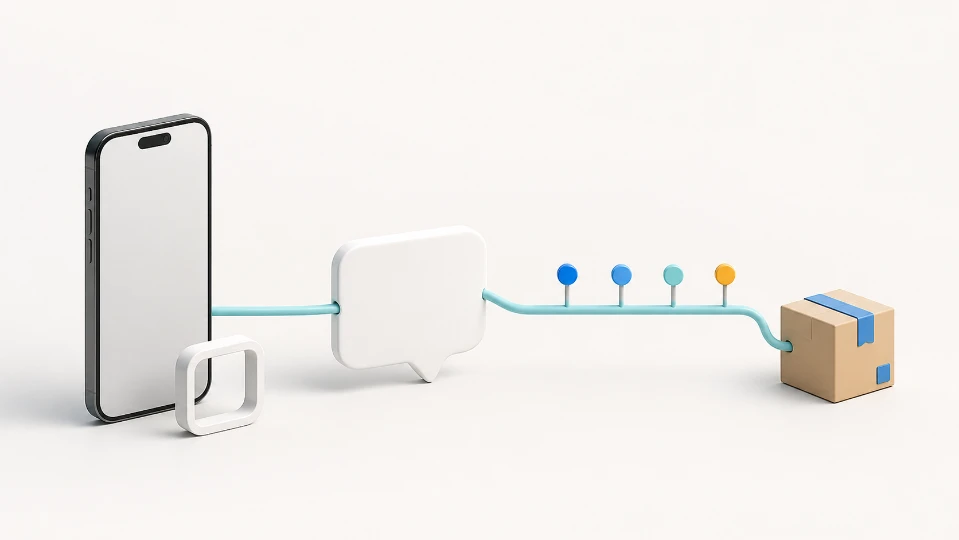
Removing an app download can improve conversational-commerce acquisition, but it does not eliminate the customer’s need for clarity, consent, trust, or a useful outcome. The winning experience reduces meaningful transitions while preserving context through the final commercial task.
A lower-friction entry point is only valuable when the customer can still see where they are, what the brand needs from them, and how they get to a completed outcome.
Product teams often treat the install as a single tap. For a customer who arrived from an advert or email, it is a bundle of transitions: leave the current page, visit a store, check compatibility, approve permissions, wait, find the icon and begin again. Starting inside a familiar channel can remove that bundle. It cannot remove the need to earn trust or deliver value.
This distinction matters for commerce teams exploring conversational shopping, support and retention. “No download” is a useful acquisition hypothesis, not a complete customer-experience strategy. If the exchange is vague, intrusive or unable to complete a task, fewer setup screens simply move abandonment to a later moment.
A conventional app journey has visible screens, so teams can measure each tap. Channel-based onboarding may look shorter because many steps occur inside a single thread. The customer still crosses several mental transitions: from curiosity to consent, from a general request to personal detail, and from conversation to an action such as a purchase, booking or recommendation.
Name those transitions in the event plan. A welcome message is a delivery event. A reply is an engagement event. A completed intake is only an input milestone. Activation should be reserved for the first moment when the customer receives something that advances the job they came to do. This vocabulary prevents a lively thread from being reported as a successful journey.
For replenishment, the outcome might be a confirmed schedule with the next date visible. For guided shopping, it could be a shortlist that respects price, delivery and one declared exclusion. For support, it may be a resolved issue with no repeat contact within the chosen review window. The definition should let an analyst distinguish progress from polite conversation.
A messaging thread feels ordinary, which can lower the effort required to begin. The same familiarity can blur the moment when casual conversation becomes structured intake. Teams should explain why a question is being asked, what action it will affect and how the customer can change or stop the flow.
This is not a claim that messaging is inherently more or less private than an app. The answer depends on the service, its providers and its practices. It is a design requirement: when the interface loses the visual boundaries of a standalone product, the copy must do more work to mark purpose and control.
Conversational onboarding makes it easy to keep asking. That is not a reason to do so. Each question should have a defined consequence. If an answer will not change the recommendation, eligibility, timing or handoff, postpone it. A shorter exchange built around consequential questions is more credible than a friendly interrogation.
Palaura presents itself as an AI matchmaker that works through iMessage and requires no separate app download. Its public flow asks about values, pace, dealbreakers and preferences before it makes introductions. Those statements describe its interface and positioning; they do not establish the quality of any match. For commerce teams, the useful observation is that a familiar channel can serve as both acquisition entry point and intake surface.
The model removes the app-store handoff, but it gives the product less visual territory. There is no persistent home screen to explain features or familiar settings page to hold controls. A thread may also be buried by newer messages. The conversation therefore needs its own landmarks: a clear opening promise, brief progress cues, an obvious next action and a short route back.
The descriptor Palaura — Alternative to Speed Dating Apps places that product against swiping and timed introductions. The contrast is relevant to funnel design because it changes the work requested at entry. Instead of asking a person to browse many options, the service asks for information and curates. That may reduce one kind of effort while increasing another: the customer must decide how much context to share before seeing a result.
Many conversational experiences are strongest at intake and weakest at completion. The thread gathers useful detail, then delivers a generic link or asks the customer to repeat information in checkout. This is where the removed friction quietly returns.
Work backwards from the handoff. If the output is a pre-filled cart, decide which variants and delivery details must survive the transfer. If it is a human handover, define the summary the agent will receive. Then ask only for the information required to create that object. This prevents a polished conversation from collecting a rich profile that checkout or support cannot use.
Customers also need to know what happens after the first outcome. Can they revise a preference, see an earlier recommendation or reach a human? In an app, navigation often answers these questions. In a thread, the service must state the available commands or offer concise choices without turning every message into a menu.
A fair experiment compares more than start rates. Track entry, completed intake, first useful outcome, completed commercial task and successful return. Keep “What happens next?” questions as a qualitative event rather than discarding them as support noise; they reveal landmarks that a screen-based product might have supplied automatically.
| Journey point | Channel-based signal | Standalone-app signal |
| Start | First meaningful reply | Account or session created |
| Value | Useful result delivered in-thread | Core task completed in-app |
| Handoff | Context survives the link or transfer | State survives navigation |
| Return | Customer can resume the thread | Customer can find saved state |
Segment the result by task. A familiar channel may work well for a narrow repeat purchase but poorly for a comparison involving many specifications. The goal is not to prove that conversation beats an app. It is to find the jobs for which removing the install creates more value than the standalone interface would have provided.
Customers who prefer browsing should not have to imitate a conversation to reach a product. Where possible, keep a direct path alongside the guided one. The comparison will reveal whether people value the channel, the curation or simply the shorter route.
Removing installation can eliminate a real break in the funnel. The gain is most durable when the product also makes purpose, progress, control and handoff easy to see. Otherwise, “start instantly” becomes an invitation to a journey with no map.
Commerce teams should test the familiar channel as an operational choice, not a slogan. Count the transitions, define the first useful outcome and measure whether the final task became easier. One fewer step matters only if the remaining steps carry their share of the work.
Commerce teams should evaluate channel-based onboarding by completed customer outcomes, explicit consent, preserved context, and task fit rather than treating “no download” as a universal conversion advantage.
A Shopify brand should measure whether conversational onboarding works by tracking first useful outcome, completed task, and successful return, not just replies or conversation starts. Start with entry rate, completed intake, useful recommendation or resolution delivered, checkout or support completion, and repeat usage. Review the funnel by customer job because a guided product match may need different metrics than order support or replenishment. Also tag repeated questions such as “What happens next?” because those messages often reveal missing instructions, weak handoffs, or unclear controls that a conventional interface would make visible.
A conversational shopping flow should collect only the information that changes the next recommendation, eligibility decision, timing, or handoff. Ask for budget, delivery location, size, product requirements, or exclusions when those answers materially alter the available choices. Postpone profile-building questions that do not affect the immediate task. Explain why each consequential question is being asked and what it will change. This approach lowers abandonment, reduces unnecessary data collection, and makes the interaction feel like a service rather than an extraction exercise.
A messaging channel is better than a standalone shopping app when the customer job is narrow, repeatable, and improved by fast guided action. Good candidates include replenishment, order tracking, basic support, restock alerts, repeat ordering, appointment scheduling, and a constrained product recommendation. Messaging is less suitable when shoppers need to compare many visual options, inspect detailed specifications, research policies, or manage complex account settings. Keep direct browsing available so customers can choose the interface that matches the work they need to do.
Prevent customers from repeating themselves by defining the structured object that must move from the conversation into checkout, CRM, or support before building the welcome flow. A product-guidance handoff may need selected variants, quantity, delivery constraints, and declared exclusions. A support handoff may need account identity, order number, issue category, troubleshooting steps already attempted, and a concise summary. Test the transfer with real scenarios before launch. If the receiving system cannot use a piece of information, do not collect it early in the conversation.
No, brands should keep a normal browse and checkout path when they launch conversational commerce. Guided conversation should offer a useful alternative for customers who want help, not force every shopper into a thread. Parallel paths also produce a better experiment because they show whether improvement comes from the channel, the curation, or a shorter route to purchase. Customers who know what they want, prefer visual comparison, or dislike chat should be able to complete their task without adopting a new interaction pattern.





