


NVIDIA Corporation has become a dominant force in accelerated computing, graphics processing units (GPUs), and AI technologies.
Founded in 1993 by Jensen Huang, Chris Malachowsky, and Curtis Priem, NVIDIA has evolved from a graphics chip maker into a full-stack computing company that powers everything from video games and autonomous vehicles to generative artificial intelligence (LLMs), almost achieving a monopoly in its field.
By the end of 2024, NVIDIA had reached a market capitalization exceeding $3.5 trillion — a roughly 200% increase over the year (following a 235% surge in 2023) — second only to Apple. Its price-to-earnings ratio of about 75x at the start of 2024 reflects strong market leadership and a promising growth trajectory. With over $20 billion in cash reserves and minimal debt, NVIDIA is well-positioned to make strategic investments in research, development, and production capacity.
NVIDIA commands an estimated 95% market share in AI accelerators, bolstered by significant entry barriers created by its proprietary CUDA software ecosystem. The company currently enjoys exceptionally high gross margins (over 90%) on its top-tier data center GPUs, underscoring its competitive edge and pricing power.
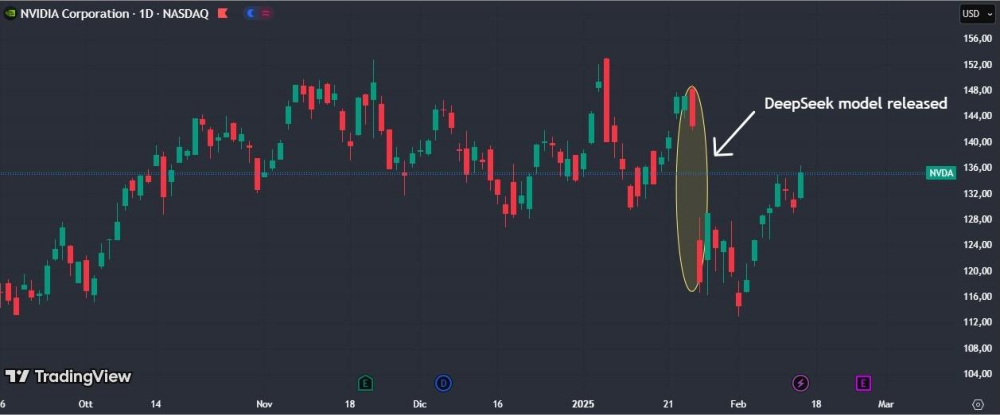
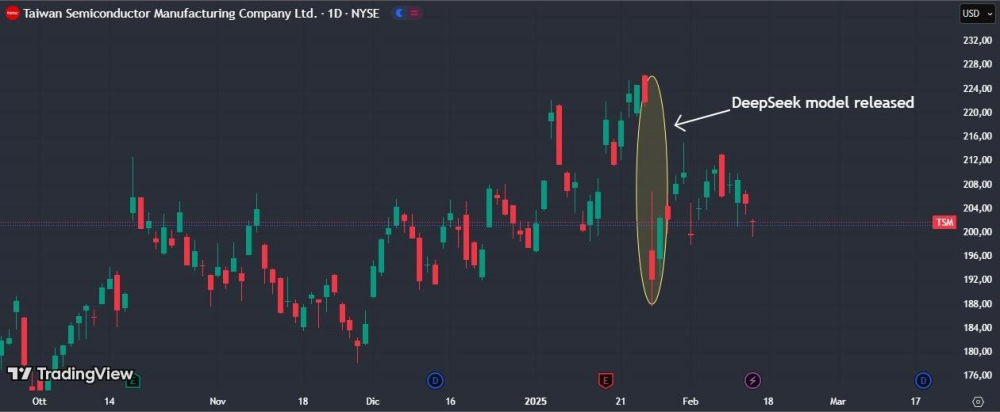
However, recent developments hint at potential challenges on the horizon. Following the release of DeepSeek’s new open-source model, NVIDIA suffered its largest single-session loss ever — nearly $600 billion in market capitalization. A few days later, Jeffrey Emanuel, a general analyst working with several hedge funds and an AI developer, published an intriguing article outlining potential threats that could undermine NVIDIA’s near-monopoly and, by extension, its esteemed Dow Jones index membership.
Let’s summarize these threats:
These converging threats pose a significant risk to NVIDIA’s future profitability. The market may not be adequately pricing in these risks, meaning the stock could be severely overvalued — even as AI’s transformative potential and relative margins continue to rise. It seems unlikely that a company like NVIDIA can maintain what appears to be a monopoly for much longer. In a free market, monopolistic conditions are rare and, historically, have never lasted long in such a competitive, impactful, and transformative sector as artificial intelligence. Only time will tell if NVIDIA will be an exception.





