Free every Thursday · 61,308 Readers
Fastlane Insider Newsletter: What's working for Shopify in the AI era?
Free every Thursday · 61,308 Readers
Fastlane Insider Newsletter: What's working for Shopify in the AI era?

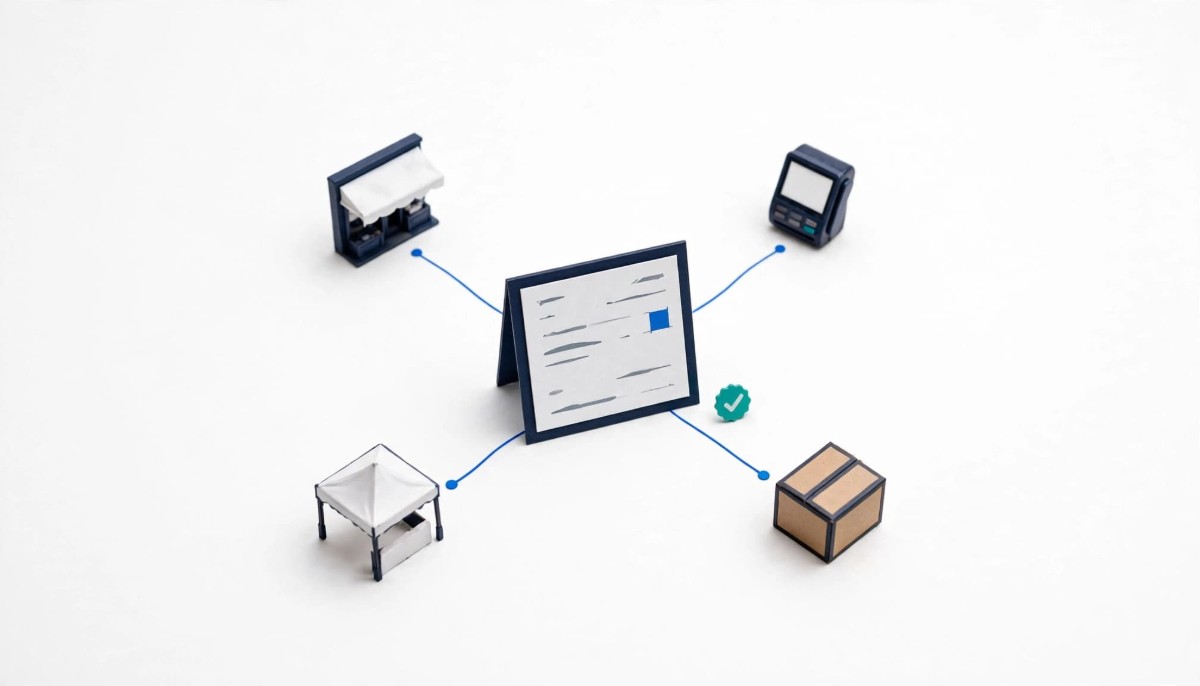
Multichannel means selling in more than one place; omnichannel means those places share one record of inventory, customers, and orders. Most Shopify stores under $2M should stay multichannel, connect inventory first, and add the rest only when gaps between channels start causing oversells, lost customers, or messy returns.
Adding a channel is a marketing decision. Connecting your channels is an operations decision. Most brands that struggle with omnichannel made the first decision three times before they made the second one once.
A brand selling on Shopify, Amazon, and at a weekend market sells the last unit of its best product at the market on Saturday morning. The Shopify store still shows two in stock. By Sunday night there are two online orders it cannot fill, two apology emails, and one customer who will not come back. Nobody on the team made a bad decision. The channels simply did not know about each other.
That gap is the whole difference between multichannel and omnichannel, and it is a much narrower problem than the word “omnichannel” suggests. Vendors use the term to sell order management systems, unified commerce suites, and headless rebuilds. Most merchants under $2M need none of those. They need their channels to agree on a small number of facts, starting with how many units are on the shelf.
This guide is for the merchant who already sells in more than one place, or is about to, and wants to know what to connect, in what order, and what to leave alone. If you are doing $10K months, the answer is short. If you are doing $1M months, the answer is longer, and I will get to it.
Multichannel retail means selling the same products in more than one place, such as your Shopify store, Amazon, a wholesale account, and a pop-up, with each channel run largely on its own. Omnichannel retail means those channels share the same underlying records, so a sale, a customer, or a return in one place is known everywhere else.
The cleanest way I have found to explain it is to stop thinking about channels and start thinking about records. Every store runs on three: inventory (how many units exist and where), customers (who bought what, through which channel), and orders (what was sold, where it ships from, and how it comes back). A multichannel business keeps a separate copy of some or all of those records per channel. An omnichannel business keeps one copy and lets every channel read and write to it.
Seen that way, omnichannel is not a strategy you adopt in one move. It is a set of three connections you make one at a time, and most brands only ever need the first one or two. A store selling on Shopify and eBay with one shared inventory count is partly omnichannel already. A retailer with ten stores and a mobile app that still cannot accept an online return at the till is not, no matter how many channels it runs.
The research behind the term holds up as far as it goes. A Harvard Business Review study of 46,000 shoppers at a single large US retailer, published in January 2017, found that customers who used more of the retailer’s channels spent more. Note the conditions: one large retailer with stores, an app, and a website, studied before most of today’s Shopify tooling existed. It shows that connected channels can be worth building. It does not show that a $400K brand should build them now.
Most Shopify stores under $2M in revenue should stay multichannel, because the cost of connecting customer and order records outruns the benefit until a meaningful share of customers actually cross between channels. A brand whose Amazon buyers never visit its website, and whose wholesale buyers are retailers rather than shoppers, has very little cross channel behavior to unify.
The pattern I saw most often during my years on Shopify’s merchant success team was the reverse: a brand that kept adding channels because each one looked like new revenue, then discovered that every channel also added a copy of its inventory to keep in sync, another dashboard to reconcile, and another set of customers it could not see. The fix was rarely more software. It was usually fewer channels, or one shared inventory count, or both.
That matters because adding a channel feels free and connecting one does not. Listing on a marketplace takes an afternoon. Going beyond Shopify’s native tools to build a single customer view across a marketplace, a retail store, and a website can take months and a five figure budget. Merchants at the $500K to $2M stage almost always get hurt by premature complexity rather than by missing features, and omnichannel tooling is one of the most expensive ways to add complexity early.
Peter van der Westhuizen, strategic partnerships and alliances lead for North America at Linnworks, a multichannel operations platform, made the point that every channel is its own job on episode 359 of the eCommerce Fastlane podcast: “It’s not just a matter of, you know, I’m gonna just list my products on every channel with the same strategy and it’s all gonna sell well.” He was making the case for getting the right strategy and partner support in place for each new channel, emerging ones like TikTok Shop included. My read on the same point is narrower: if every channel needs its own pricing, content, and attention, then each one you add should earn that cost before you also pay to connect it.
So the default for most readers is this: stay multichannel, keep each channel’s marketing separate, and connect only the records that are already causing pain. The next section is how to tell which ones those are.
Disconnected channels start costing you when your support inbox fills with tickets that exist only because one channel did not know what another one did. Count those tickets for the last thirty days, sort them by record, and you have a ranked list of what to connect first.
Each of the three records leaves a specific trace. Inventory gaps show up as oversells, cancelled orders, and “you charged me for something you do not have” emails, usually clustered around a pop-up, a marketplace spike, or a wholesale shipment that drained stock without updating the website. Customer gaps show up as a loyal buyer who is treated like a stranger: no points for an in-store purchase, a welcome discount sent to someone who has bought from you four times, or a support agent who cannot see an order placed through a different channel. Order gaps show up in returns: a shopper who bought online and wants to return in store, or a marketplace order your team cannot find when the customer calls.
The test is deliberately crude. You are not measuring lifetime value or attribution. You are counting how often a customer notices that your channels do not talk to each other, because that is the cost that compounds. A handful of oversell tickets a month at a market stall is an annoyance. Twenty a month during a marketplace promotion is a ratings problem, and on marketplaces that enforce cancellation limits it becomes an account health problem too.
If the count is near zero, you are a healthy multichannel business and should spend your time on the channels themselves. If one record dominates, connect that record and stop there. If all three show up, you have outgrown native tools, and that is when it makes sense to read about where Shopify’s native order routing runs out and what the order management systems built for multichannel teams actually add.
Action Figure Comics fixed its overselling by connecting one inventory count across its shop counter, its Shopify store, and its marketplaces, and it left every other record alone. The shop is a brick and mortar comic store that also sold online, on eBay, and on Amazon. Peter van der Westhuizen described the shop’s starting point on episode 359: “when something was sold in store they had to go manually remove that listing from Ebay and in a lot of times, you know, just wasn’t managed efficiently enough and it caused over selling and led to some really unhappy customers.”
Here is how I read that situation, in order. First, what was the shop’s actual problem? Not strategy. It sold one-off and low quantity items in several places, and each place kept its own count. Every in-store sale created a race against an eBay buyer. Second, which record was broken? Inventory only. There is nothing in the story about customer profiles or cross channel returns, and nothing that would justify a loyalty platform or an order management system. Third, what was the smallest fix? One inventory count that the point of sale, the online store, and the marketplace listings all read from, so a sale anywhere decrements stock everywhere.
That is what the shop did, using Linnworks to sync stock across its point of sale, Shopify store, and marketplaces. Van der Westhuizen said the shop’s eBay sales rose 60% in the first two weeks afterward. Treat that number as one vendor-reported result for one shop, not a benchmark: the gain likely came from staff finally being able to list freely without fear of overselling, which says more about how much the shop had been holding back than about what a sync tool does on its own.
The call I would make for any store shaped like this one: connect inventory, stop, and watch the inbox for a month. Do not touch customer or order records until the gap test says to. A shop selling unique items across a counter and a marketplace has an inventory problem that looks like an omnichannel problem, and paying for the second to solve the first is the most common way I see merchants overspend here. If you are choosing the tool, start with what an inventory management system does and which one fits your stage before anything with “omnichannel” in its name.
For a $2M brand selling direct, on Amazon, wholesale, and at pop-ups, I would connect inventory now, connect customer records only for the pop-ups, leave Amazon customers unconnected on purpose, and skip order management software entirely. That brand is a composite, built from patterns I have seen repeatedly rather than from one real company, and the revenue split below is illustrative.
Assume the brand sells apparel, does roughly 55% of revenue through its Shopify store, 30% on Amazon, 10% through two wholesale accounts, and 5% at quarterly pop-ups. It ships from one warehouse and uses Amazon for some of its own fulfillment. Its gap test shows a cluster of oversells after each pop-up, a few complaints from pop-up buyers who got no credit for their purchase online, and almost nothing about returns.
Inventory comes first because the oversells are real and cheap to fix. Running the pop-ups on Shopify POS, which updates inventory levels with each sale from the same admin as the online store, removes the post-event oversell spike without new software. For the Amazon listings, Shopify Marketplace Connect syncs inventory and orders with Amazon, eBay, Walmart, and Target Plus; as of October 2026 its listing shows the first 50 synced orders a month free, then a 1% fee per additional order, capped at $99 a month.
Customer records come second, and only for the pop-ups, because those buyers are the only ones crossing channels in a way the brand can see and reward. Shopify POS captures customer details at checkout into the same customer list as online orders, which is enough. Amazon customers stay unconnected deliberately: the brand does not get that data in a usable form anyway, and building workarounds to chase it would be effort spent against the platform’s rules rather than with them.
What I would remove: the plan to add a third wholesale account before the warehouse can show wholesale allocations separately from sellable stock, and any quote for an order management system. One warehouse and four channels do not need routing logic. The call changes the day this brand opens a permanent store and starts shipping online orders from it. At that point, order records matter, and choosing a point of sale built for a physical location becomes the first real omnichannel decision.
Marketplaces fit an omnichannel setup on the inventory and order side but rarely on the customer side, because the marketplace, not the brand, holds the relationship. That is not a flaw to engineer around. It is the trade you accept for the marketplace’s traffic, and it is why most brands treat a marketplace as a sales channel that shares stock rather than a customer channel that shares profiles.
Michael Sirpilla, CEO of Society Brands, which acquires and operates consumer brands, described how his company weighs that trade on episode 383 of the eCommerce Fastlane podcast. Amazon is a meaningful share of Society Brands’ revenue, but when it looks at a brand to acquire, his rule is direct: “Very much the rule today is we want to see at least half of a brand’s revenue on their direct consumer sites.” The logic is that direct sales are where the brand owns the customer data and the loyalty, so that is where the customer record has to live.
Read through the omnichannel lens, that gives a simple rule. Build the single customer view around channels where you own the customer: your Shopify store, your retail locations, your pop-ups, your email and SMS lists. Connect marketplaces through inventory and order sync so they never oversell and never lose an order. Measure them as a channel, not as part of the customer base. One caveat Sirpilla raised on the same episode: marketing you do off Amazon sends shoppers to search for your brand on Amazon, a halo his company counts on. That cross channel effect is real even though no customer record connects it, so judge your direct marketing partly by branded marketplace sales too.
If your marketplace share is above half, that changes the picture in a different way. The priority becomes building the direct channel up, not unifying records around a marketplace you do not control. The tooling question for marketplace-heavy sellers is mostly about listing and stock management, which is covered in detail in this guide to Shopify marketplace management tools and where the free one runs out.
The right amount of omnichannel depends on revenue stage more than on channel count: inventory at every stage, customer records once a real share of buyers cross channels, and order routing only once you fulfill from more than one location. The table below is the short version; the explanation follows.
If you are under $500K, your whole omnichannel program is one shared inventory count. Shopify’s own locations and POS handle that for a store plus pop-ups, and Marketplace Connect handles the major marketplaces. Spend the rest of your attention on making one or two channels work well.
Between $500K and $2M, add shared customer profiles where buyers actually cross over, which usually means a retail counter or pop-ups feeding the same customer list as the website and your email platform. This is also the stage to cut a channel that is not earning its keep, because each one you drop is one less copy of every record to maintain.
From $2M to $10M, fulfillment from more than one location usually arrives, and with it the case for order routing rules and returns accepted anywhere. This is the first stage where an order management system can pay for itself, and only if you have multiple stock locations. At $10M and above, store fulfillment and unified loyalty become standard, and the most common expensive mistake is rebuilding the storefront before the data underneath is connected, a pattern covered in why a headless commerce investment often fails to fix omnichannel problems.
One exception to waiting: if your stack already shares a record at no extra cost, as Shopify POS does with customer profiles, turn it on now. Customers who are not recognized rarely file a ticket; they quietly stop coming back. The gap test governs connections you would have to pay for, not ones you already own.
Whichever row you are in, the order does not change: inventory, then customers, then orders. Brands that skip ahead tend to end up with a connected customer view sitting on top of an inventory count nobody trusts.
Multichannel retail means selling in more than one place, while omnichannel retail means those places share the same records for inventory, customers, and orders. A multichannel brand might sell on its Shopify store, Amazon, and at pop-ups, with each channel tracking its own stock and its own buyers. An omnichannel brand connects those channels so a sale at a pop-up updates online stock, a returning customer is recognized in every channel, and an online order can be returned in a store. The practical way to think about it is that multichannel describes where you sell and omnichannel describes whether your channels know about each other. Most brands move from one to the other gradually, connecting inventory first and customer and order records later, rather than switching in one project.
If you only sell on Shopify and Amazon, you need shared inventory but usually not full omnichannel. The connection that matters is stock: both channels should read from one inventory count so an Amazon spike cannot oversell your website or the reverse. Shopify Marketplace Connect does this for Amazon, and as of October 2026 its listing shows the first 50 synced orders a month free, then 1% per additional order, capped at $99 a month. A shared customer view across the two is rarely worth chasing, because Amazon keeps the customer relationship and limits what you can use. Build your customer data around your own store and email list, and treat Amazon as a channel that shares stock and orders.
A Shopify store should move toward omnichannel when disconnected channels start showing up in customer complaints, not when it reaches a certain number of channels. Count thirty days of support tickets caused by one channel not knowing what another did: oversells after a pop-up or marketplace spike, loyal customers treated like strangers, or returns that cannot cross channels. If those tickets are rare, stay multichannel and invest in the channels themselves. If one type dominates, connect that record and stop. If all three appear regularly, usually once you fulfill from more than one location, it is time to look at order routing and an order management system. For most brands the first move is inventory, and it often happens well before $500K in revenue.
Most Shopify stores need only Shopify’s native tools for omnichannel retail until they fulfill from several locations. Shopify POS shares inventory and customer records with the online store from one admin, which covers retail counters and pop-ups. Shopify Marketplace Connect syncs stock and orders with Amazon, eBay, Walmart, and Target Plus. Brands selling across many more marketplaces often move to a multichannel operations platform such as Linnworks for listing and inventory control. A dedicated order management system becomes worth evaluating once there are multiple warehouses or stores shipping online orders, typically somewhere past $2M. Unified loyalty and store fulfillment platforms come last, after inventory and customer records are already reliable.
Omnichannel is worth it for a small ecommerce brand only in its simplest form, which is one inventory count shared across every place you sell. That piece is cheap, often built into Shopify, and prevents the oversells that cost small brands reviews and repeat customers. The heavier pieces, such as order management systems, ship from store, and unified loyalty, are built for brands with several stock locations and a large share of customers crossing between channels. A small brand buying those early takes on cost and complexity it cannot use yet. The better investment below $500K is usually making one or two channels work well, connecting inventory between them, and adding customer or order connections only when the support inbox shows they are needed.