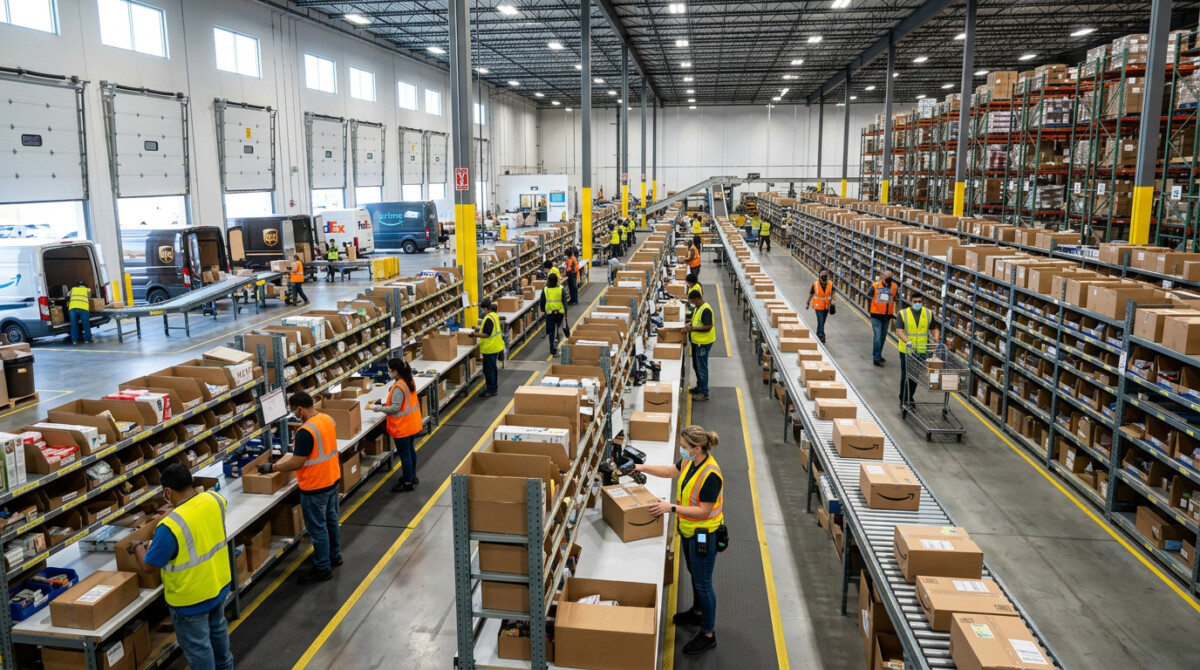
Warehouses that handle peak season without chaos build three things before Q4 hits: a layout mapped for two to four times normal order volume, an inventory accuracy system that catches errors before they ship, and an honest in-house versus 3PL decision made months in advance rather than mid-crisis.
Most warehouses do not fail during peak season because their systems are bad. They fail because systems built for a normal Tuesday get run at three times the volume with the same floor plan and the same headcount.
Warehouses break down during peak season because the same floor plan, pick paths, and staff count that handle a normal day get run at two to four times the volume, and small inefficiencies that cost seconds in June cost hours in November. Omnisend’s analysis of order data across 5,000 U.S. stores found that Black Friday average order value climbed to $215 in 2025, up from $164 the year before, with nearly 1 in 10 brands generating half or more of their annual orders inside the single week surrounding Black Friday, a pattern covered in more depth in Fastlane’s breakdown of Black Week 2025 order data. That kind of compression means a facility picking 200 orders a day in October can be picking 600 to 800 a day by the last week of November, using the same aisle widths and the same three person pack station.
Whether you’re running fulfillment out of a 2,000 square foot space or a leased 20,000 square foot facility, the failure pattern looks the same. Pick paths that were fine at low volume start crossing each other. Packing stations queue up because inbound flow was never timed against outbound flow. Staff who could handle ambiguity in October start making errors in November simply because there is no time to double check. None of this is a staffing problem or a technology problem on its own. It is a planning problem, and it shows up every year at the same predictable point in the calendar.
Map your warehouse layout at least 60 days before peak season begins by pulling last year’s order data, identifying your top 20% of SKUs by unit velocity, and physically relocating those items to the shortest possible path from storage to the pack station. This is standard ABC analysis applied to a warehouse floor rather than a spreadsheet, and it is the single highest leverage change most merchants can make before Q4. A brand doing $1.5M a year with 300 active SKUs typically finds that 40 to 60 of those SKUs account for 70% or more of peak season order volume, which means the layout decision is really about those 40 to 60 items, not the full catalog.
Fastlane’s warehousing fundamentals guide covers the broader layout and storage decisions in more depth, but the peak specific version of this work is temporary and reversible. Create a fast moving zone near packing for the peak window, move slow sellers to the back or a secondary space, and plan to reverse the layout once volume normalizes in January. Merchants using a WMS like Extensiv or SkuVault can often run this analysis directly from existing sales data rather than estimating from memory, which matters most for brands above $1M where guessing wrong costs real labor hours during the exact weeks labor is hardest to add.
The in-house versus 3PL decision should be made by August or September for a Q4 peak, not in the middle of the rush when a facility is already underwater. Merchants running fulfillment in-house at $500K to $2M in revenue are the group most likely to hit a genuine capacity wall during peak season, because the fixed costs of a warehouse (rent, equipment, a base staff) do not flex with a 3x volume spike the way a 3PL’s shared infrastructure does. Fastlane’s guide to 3PL best practices lays out the capex versus opex tradeoff in more detail, and the short version is that a 3PL absorbs the seasonal spike across many clients’ combined volume, which is exactly the flexibility a single in-house operation cannot replicate at low six or seven figure revenue.
That does not mean every merchant should switch. Brands with tight quality control needs, unusual packaging requirements, or a brand experience built around unboxing often have good reasons to stay in-house and simply plan harder for peak. But the decision needs real numbers behind it: current storage cost, current peak season overtime and temp labor cost, and an honest 3PL quote for comparison. Fastlane’s roundup of 3PL providers built for Shopify and DTC brands is a reasonable starting point for that comparison if the math points toward outsourcing. Merchants above $5M with dedicated operations staff typically have more room to make in-house work through better systems rather than a full switch.
Inventory accuracy during peak season depends on frequent small counts of high velocity sections rather than one large audit, because a full facility count that halts operations for a day is not realistic once order volume triples. Cycle counting the top 20% of SKUs weekly, or even every few days during the peak window, catches the discrepancies that actually cause stockouts and mis-picks before they compound. A single miscount on a fast moving SKU during a normal week is a minor annoyance. The same miscount during peak week can mean dozens of orders promising inventory that does not exist on the shelf.
Fastlane’s piece on why Shopify stores fail during peak seasons points to stockouts as one of the most common and most preventable failure points, and the fix is largely about detection speed rather than a bigger system. Barcode scanning at every touch point (receiving, put away, pick, pack) closes most of the gap that manual data entry creates, and tools like Inventory Planner or Cin7 can flag velocity mismatches automatically rather than waiting for a human to notice stock is running low. For merchants under $1M in revenue, even a disciplined manual cycle count schedule closes most of this gap without new software spend.
Staff for peak season by cross training your core team on multiple roles before volume increases, then layering in temporary help for the highest volume weeks rather than trying to run the entire season on overtime alone. A core team member who can move between receiving, picking, and packing gives a facility flexibility that a same size team of single skilled specialists cannot match when one station backs up. Fastlane’s guide to shipping during a seasonal rush covers the operational side of this in detail, and the staffing principle that holds across brand size is the same: decide staffing levels from last year’s actual peak week data, not from a guess, and build in a buffer above that number rather than scrambling to hire during the rush itself.
Brands at $500K to $2M often lean hardest on unpaid or underpaid overtime from a small core team during peak season, which produces short term output at the cost of burnout and elevated error rates by the third or fourth week of a sustained push. Bringing in temp labor for the two to four heaviest weeks, even at a wage premium, is frequently cheaper than the mistakes an exhausted core team makes during week three of an uninterrupted crunch.
Facility cleanliness and safety belong on the same checklist as picking speed and inventory accuracy because cluttered aisles and packaging waste slow down movement and raise injury risk at the exact moment a warehouse can least afford either one. Injury rates in e-commerce fulfillment centers run more than double those of non-fulfillment warehouses, according to data on e-commerce fulfillment center injury rates compiled from Department of Labor figures, and that gap widens further during peak weeks when floors are busier, boxes pile up faster, and fatigue sets in. A clear path to the pack station is not a nice to have during a volume spike. It is the difference between a facility that ships on time and one dealing with a workers’ comp claim in the middle of its busiest week.
Scheduled cleaning routines matter more during peak season, not less, even though they are often the first thing cut when everyone is focused on getting orders out the door. Some merchants keep this off their core team’s plate entirely by bringing in a dedicated service, similar to how a facility using a warehouse cleaning Seattle provider can keep floors and packaging waste clear without pulling picking and packing staff away from orders during the exact weeks when their time on the floor is worth the most. Whether that means an outside cleaning service or a rotating internal schedule, the point is the same: someone owns it, and it happens on a set cadence rather than whenever there is a spare moment.
Map your warehouse layout at least 60 days before peak season begins, using last year’s order data to identify your highest velocity SKUs. This gives enough time to physically relocate fast moving items closer to the pack station and test the new layout at moderate volume before the real spike hits. Waiting until the season is already underway means making layout changes while simultaneously trying to fulfill a surge in orders, which compounds risk rather than reducing it.
Switching to a 3PL makes sense when your fixed in-house costs and capacity ceiling can’t flex with a 3x seasonal volume spike, which is most common for merchants in the $500K to $2M range running fulfillment out of a single facility. Compare your current storage and peak season labor costs against real 3PL quotes rather than list prices, since the right answer depends on your specific margin structure and packaging requirements, not a blanket rule.
Count your highest velocity SKUs weekly, or every few days during the busiest stretch, rather than relying on a single full facility audit. Cycle counting the top 20% of SKUs by volume catches the discrepancies most likely to cause stockouts or mis-picks, without halting operations for a full count during the weeks a facility can least afford downtime.
Cross train your core team on multiple roles before volume increases, then add temporary staff for the two to four heaviest weeks rather than running the entire season on overtime from a small permanent crew. Base staffing decisions on last year’s actual peak week order data with a buffer built in, rather than estimating and hiring reactively once the rush has already started.
Cluttered aisles and packaging waste slow down picking speed and increase injury risk, both of which get worse during peak season when floors are busier and fatigue accumulates faster. Injury rates at e-commerce fulfillment centers already run more than double those of non-fulfillment warehouses, so a scheduled cleaning routine, whether handled internally or by an outside service, is a functional part of peak season readiness rather than a cosmetic concern.