

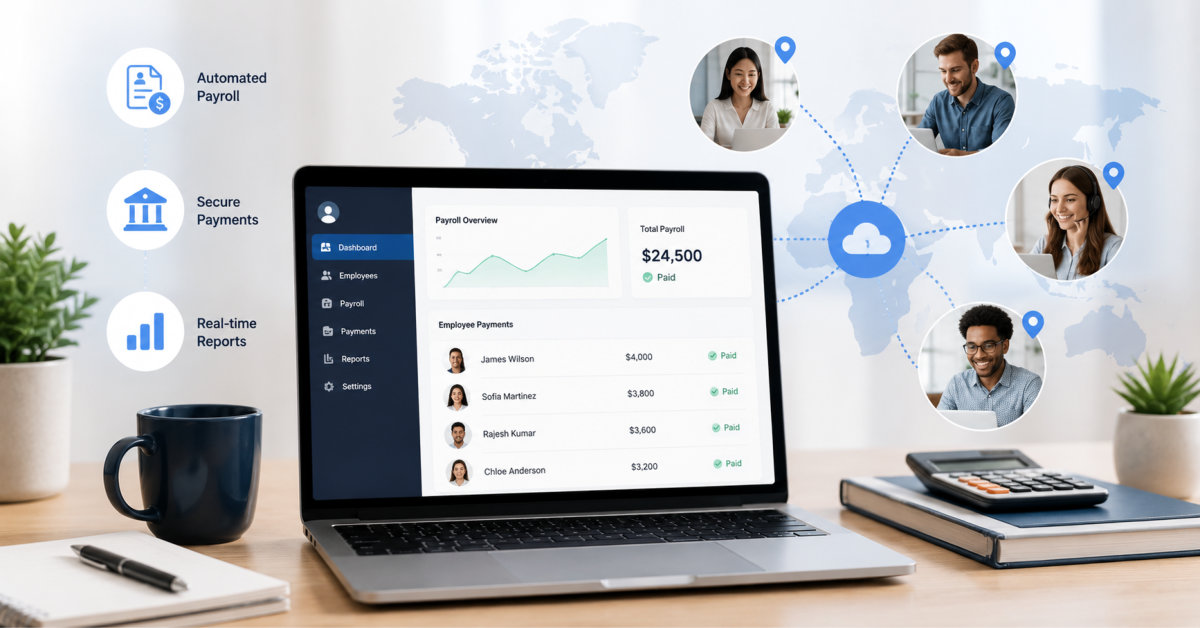
Payroll automation helps small businesses hire remote talent faster by centralizing onboarding, payroll setup, tax workflows, and employee records across jurisdictions. It reduces administrative friction, but it does not remove the need for human review of worker classification, state registration, employment eligibility, and local compliance requirements.
Remote hiring expands the talent pool, but every new jurisdiction adds a layer of payroll, tax, employment, and classification work that small teams cannot safely manage from memory alone.
Remote work has emerged as an excellent opportunity for small businesses to recruit remote talent to fill industry skill gaps more effectively. With emerging payroll use cases powered by tools like AI and machine learning (ML), the processes involved with onboarding new employees onto payrolls have become easier than ever before.
Small businesses have been a driving force in US hiring of late and have been responsible for 80.4% of all new hires domestically since February 2025. This already represents a significant increase over the 71.8% historical average and underlines the importance of SMBs as a critical component for job creation.
Despite a more active role in hiring, it can be extremely difficult for small businesses to compete in any meaningful way with their more resourceful corporate counterparts when it comes to onboarding the right people.
According to NFIB data, 31% of small business owners reported open positions that they were unable to fill. With 50% confirming that they were either hiring or trying to hire, it’s clear that there’s plenty of room for automation tools to help bridge the gap between identifying and onboarding the right candidates for roles.
The agility that small businesses are increasingly capable of showing when it comes to hiring has been a major asset, with remote working opportunities opening the door to talent that would otherwise be inaccessible due to costs, communications hurdles, and other geographical challenges.
Payroll automation has been a key tool in accelerating remote recruitment in the US, particularly among small businesses. The ability to remove geographical hiring barriers, ensure immediate compliance with fragmented state laws, and standardize onboarding workflows at scale has helped to transform access to skilled workers both domestically and beyond.
With this in mind, let’s take a closer look into the payroll automation revolution and how it’s helping to streamline remote talent acquisition for small businesses:
Hiring remote workers in the United States can cause small businesses to run into all kinds of compliance challenges throughout different local, state, and federal tax variations, making it particularly difficult for payroll teams to constantly manage their regulatory oversight.
But with the ability to autonomously conduct nexus tracking, ML tools can automatically detect when a remote hire creates a tax presence for the company in a brand-new state, which helps to ensure that all distributed payrolls remain accurate at all times.
Machine learning can also assist with withholding, with software capable of calculating precise local tax withholdings based on the precise residential address of employees.
The technology can also autonomously register and calculate State Unemployment Insurance (SUI) rates throughout different jurisdictions, which helps to ensure the accurate levels of pay for all team members without having to create sprawling payroll teams just to manage regional variations.
Small businesses can often require rapid onboarding to fill essential roles as a means of keeping core operations running smoothly. This calls for a frictionless recruitment process where payroll is set up and ready to go without any issue.
Delayed onboarding can also cause top remote candidates to fall out of the recruitment pipeline, leading to costly delays for companies.
Instead, automated portals can deliver instant verifications with integrations alongside federal systems to complete digital Form I-9 and W-4 verifications instantaneously.
Intelligent tools can also establish direct deposits, with candidates securely inputting their banking details pre-hire via self-service portals for accurate first-cycle payments. Some automated global payroll providers like Remote People have claimed that zero payments have been missed through the platform since 2018 in over 150 countries that the platform serves.
This level of automated efficiency means that employees can be onboarded at scale, helping to match your long- and short-term growth ambitions.
Artificial intelligence is also capable of generating document workflows through automated triggers that can help you to send, sign, and store jurisdiction-specific law disclosures without the need for HR intervention.
Another innovation that can certainly help the fortunes of small businesses is the smoothing out of the ‘try-before-you-buy’ model that focuses on taking on freelancers before offering full-time roles to high performers.
Once again, machine learning is capable of working in the background to analyze worker profiles to flag possible misclassification risks based on state laws like California’s AB5. This paves the way for the easy migration of a worker from a Form 1099 contractor to a W-2 employee in a matter of clicks.
The technology can also ensure that historical contractor payments sync directly into employee payroll profiles for easy data tracking over time.
Small businesses need to ensure that they have a holistic compliance overview at all times and the technology to ensure that all staff are paid promptly and accurately throughout their time with the company.
While this can be a challenge for remote employers having to juggle different state laws and jurisdictions, AI and payroll automation are helping to transform talent acquisition at scale, helping recruiters and payroll specialists to focus their attention away from these repetitive tasks and more towards complex challenges.
We’re set to see automation tools become more embedded in payroll management in the future, with the technology providing plenty of support to businesses with fewer resources to keep vigilant against payroll discrepancies. As a result, more companies can bridge their talent gaps accordingly and ensure they onboard the best talent, no matter where in the world they may be.
Payroll automation for remote employees uses software to collect employee details, calculate pay, manage payroll schedules, organize tax and onboarding tasks, and maintain employment records across the jurisdictions where employees work. It reduces manual data entry and makes it easier to run repeatable onboarding and payroll workflows. However, payroll automation does not remove an employer’s responsibility to confirm worker classification, register where required, follow employment-eligibility rules, review state or local obligations, and approve payroll accurately. The software is most valuable when it gives a small team a clear process for handling both routine tasks and exceptions.
Payroll automation can help a small business hire remote workers faster by reducing the administrative delay between an accepted offer and a completed payroll setup. A structured onboarding workflow can collect tax details, direct-deposit information, policy acknowledgments, employment documents, and required internal approvals without relying on disconnected email threads and spreadsheets. This helps new hires complete their information promptly and gives HR or finance visibility into missing tasks before the first pay run. The business must still verify employment eligibility, work location, classification, compensation, and applicable legal requirements, especially when hiring in a new state or country.
Payroll software does not automatically make a company compliant in every state because compliance depends on accurate setup, completed registrations, correct employee classifications, changing laws, and the facts of each employment relationship. Payroll platforms can assist by applying configured tax rules, tracking employee work locations, generating reminders, filing supported tax forms, and organizing records. However, a company may still need to register for payroll taxes, unemployment insurance, workers’ compensation, paid leave, or other obligations when it hires in a new state. Use qualified payroll, tax, HR, or legal guidance for unfamiliar jurisdictions and material workforce changes.
You can use payroll software to administer a contractor-to-employee transition, but the software does not determine whether the worker should legally be classified as an employee. Before converting the worker, review the actual relationship, including control over work, schedule, tools, ongoing responsibilities, and local classification rules. Then establish an effective employment date, issue the appropriate employment documentation, complete payroll and tax onboarding, confirm the employee’s work location, and determine benefits and policy requirements. Keep historical contractor payments separate from the new employee payroll record. If the prior relationship may have been misclassified, obtain professional advice before treating the change as routine onboarding.
Small businesses should look for remote payroll software that supports their current and planned work locations, employee and contractor types, onboarding workflow, payroll schedule, tax requirements, integrations, reporting, security controls, and escalation needs. The right system should make it easy to collect employee data securely, identify missing tasks, manage payroll approvals, handle changes in work location, and provide clear reporting for finance and operations. Before buying, calculate the full cost, including employee fees, contractor payments, filings, benefits, implementation, support, and global employment services. Test the workflow with realistic scenarios rather than choosing based only on an AI feature list or advertised starting price.
Global payroll generally helps a company pay workers through its own local entities, while an employer of record, often called an EOR, employs workers locally on the company’s behalf where the company does not have a legal entity. Global payroll is usually appropriate when you already operate and employ people in a country. An EOR can be useful when you want to hire internationally without first establishing a local entity, although the provider arrangement, local laws, role type, benefits, and termination requirements still matter. Independent contractors are a separate model and should only be used when the working relationship meets local contractor rules.




